
Закреплённый твит
Dr Time🌗⏳
11.3K posts


Dr Time🌗⏳
@drtime_
In Hibernation Mode. Waiting till the right time to see what wants to emerge next. // @eddieharran
Port Douglas, Australia Присоединился Eylül 2014
2.5K Подписки1.3K Подписчики
Dr Time🌗⏳ ретвитнул


Dr Time🌗⏳ ретвитнул

Is anyone finding their interest in consuming any "how-to" content dropping dramatically?
Whether YouTube videos or nonfiction books, passive consumption of static content now feels like a positively ancient way to learn anything, when compared to the instant interactivity of working with AI
English
Dr Time🌗⏳ ретвитнул
I think AI is going to massively widen the cognitive divide
Those who already know how to think clearly, logically, and critically have gained immense leverage to do so at unimaginable scales
For those who don't already have that cognitive capacity, it's going to be harder than ever to acquire it
The only way to learn to think better now, paradoxically, is to refuse to use AI tools so you can strengthen your natural intellect
But that essentially means opting out of humanity's most powerful invention and walking when jet engines are available
English
Dr Time🌗⏳ ретвитнул

Kevin Kelly (@kevin2kelly) has spent more time thinking about the future than almost anyone else.
From VR in the 1980s to the blockchain in the 2000s—and now generative AI—Kevin has spent a lifetime journeying to the frontiers of technology, only to return with rich stories about what’s next.
Today, as @WIRED’s senior maverick, his project for 2025 is to outline what the next century looks like in a world shaped by new technologies like AI and genetic engineering.
He’s a personal hero of mine—not to mention a fellow Annie Dillard fan—and it was a privilege to have him on AI & I. We get into:
- How you can predict the future. According to Kevin, the draw of new frontiers—from the first edition of Burning Man and remote corners of Asia, to the early days of the internet and AI—isn’t staying at the edge forever; it's returning with a story to tell.
- Why history is so important to help you understand the future. To stay grounded while exploring what’s new, Kevin balances the thrill of the future with the wisdom of the past. He pairs AI research with reading about history, and playing with an AI tool by retreating to his workshop to make something with his hands.
- From 1,000 true fans to an audience of one. Rather than creating for an audience, Kevin has been using LLMs to explore his own imagination. After realizing that da Vinci, Martin Luther, and Columbus were alive at the same time, he asked @ChatGPTapp to imagine them snowed in at a hotel together, and the prompt spiraled into an epic saga, co-written with AI. But he has no plans to publish it because the joy was in creating something just for himself.
- What the history of electricity can teach us about AI. Kevin draws a parallel between AI and the early days of electricity. We could produce electric sparks long before we understood the forces that created them, and now we’re building intelligent machines without really understanding what intelligence is.
- Why Kevin sees intelligence as a mosaic—not a monolith. Kevin believes intelligence isn’t a single force, but a compound of many cognitive elements. He draws from Marvin Minsky’s “society of mind”—the theory that the mind is made up of smaller agents working together—and sees echoes of this in the Mixture of Experts architecture used in some models today.
- Your competitive advantage is being yourself. Don’t aim to be the best—aim to be the only. Kevin realized that the stories no one else at Wired wanted to write were often the ones he was suited for, and trusting that instinct led to some of his best work.
This is a must-watch for anyone who wants to make sense of AI through the lens of history, learn how to spot the future before it arrives, or grew up reading Wired.
Watch below!
Timestamps:
1. 00:00:50 - Introduction
2. 00:01:10 - Why Dan and Kelly love Annie Dillard
3. 00:12:52 - Learn how to predict the future like Kelly
4. 00:16:10 - What the history of electricity can teach us about AI
5. 00:20:13 - How Kelly thinks about the nature of intelligence
6. 00:25:44 - Kelly's advice on discovering your competitive advantage
7. 00:29:33 - The story of how Kelly assembled a bench of star writers for Wired
8. 00:34:43 - How Kelly used ChatGPT to co-create a book
9. 00:39:12 - Using AI as a mirror for your mind
10. 00:43:43 - What Kelly learned from betting on VR in the 1980s
English
Dr Time🌗⏳ ретвитнул

Barack Obama says AI isn't just disrupting coders -- it’s disrupting meaning
“Already, AI can code better than 60–70% of programmers. A lot of that work is going to go away.”
When high-skill work is automated, it's not just the experts who need to adapt. Where does purpose come from in a world where machines can do what we do?
English
Dr Time🌗⏳ ретвитнул
The AI boom is not just probably bigger than the two previous ones I've seen (integrated circuits and the internet), but also seems to be spreading faster.
English
Dr Time🌗⏳ ретвитнул
The most underrated AI superpower isn't fancy prompting—it's writing down your workflow.
1. Record your process
2. Define what good looks like
3. Transform one-off AI experiments into systems that can be automated and shared with your team

English
Dr Time🌗⏳ ретвитнул

Dr Time🌗⏳ ретвитнул

immense harm is done by the belief that work must suck
from birth i was probably told 1,426 times you have to learn how to work hard. society shames people that don't have jobs.
I reject the notion that telling people to also consider work might be joyful is dangerous
English
Dr Time🌗⏳ ретвитнул

Dr Time🌗⏳ ретвитнул
Don't wait until you think you're an expert to share what you're learning about a skill or craft.
By the time you get really good, it's often hard to explain how you do what you do.
Expert advice is often unclear or overly abstract.
But there's a sweet spot when you're early in the learning curve where you've figured a few things out that might be helpful for people a few steps behind you.
And even though you won't feel like you're qualified to give anyone advice, you're actually at one of the most useful places to help other people who are trying to get started.
English
Dr Time🌗⏳ ретвитнул

this is what's keeping me up at night these days...
1. google has become unusable. once you get used to "deep research" (thanks grok, perplexity etc), google feels like bringing a typewriter to a macbook meeting.
2. MCP will do for ai agents what REST did for web services - this standard protocol means an ai agent built for healthcare can instantly talk to billing systems, patient records, and insurance databases without custom code, unlocking thousands of new startup opportunities. it's really exciting!
3. we're seeing the entire cost structure of building businesses collapse - you can now build profitable companies serving tiny, weird niches that were impossible to reach when you needed a full team. what used to need 1000 customers to break even now needs 10.
4. it's not too late to be a creator or build a media business. creators are evolving into the new holding companies, consolidating influence, revenue streams, and audiences in ways that mirror corporate giants. somehow it's still early
5. really big arbitrage opportunity to buy businesses without taste and add taste. "taste private equity" has a nice ring to it.
6. figuring out LLM seo. billions of dollars will flow to new players who figure out how to get "cited" by LLMs. finally.
7. most ai apps are designed for websites not mobile. ai-first consumer mobile is really interesting. we saw with cal ai and the looksmaxing apps, that this is just the beginning.
8. every product launch needs video now - i'm watching great features die on landing pages while quick screen recordings go viral and drive thousands of signups. the social feeds have spoken.
9. what used to require millions in vc funding now needs an api key, some prompts and a tweet. this fires me up!!
10. faster than ever to launch something of quality. faster than ever to pivot. knowing when to pivot is an art.
11. i dont understand anyone who sitting in business school right now. literally everything is being rewritten.
12. who is building the app store for ai agents? companies will browse and hire pre-trained, specialized agents like we download apps
13. the way to stop a big player to compete with you in this new world is to own distribution.
14. you can spend a lot of time thinking about politics or checking emails or on social in the name of research, but not really moving forward anywhere.
15. we're about to see software companies capture value that used to belong to agencies, consulting firms, and entire departments.
16. we're about to go from "there's an app for that" to "there's your app for that.
17. minimum viable audience is more important than minimum viable product
18. I don't know how long this window stays open, but we're in a moment where all the rules of building businesses are being rewritten. and for the people who are playing with this new tools, putting stuff out there, creating audiences/communities, you've got an unfair advantage.
i hope you get some sleep.
English
Dr Time🌗⏳ ретвитнул
Fine, I'll say the thing that no-one is saying...
There's a bunch of AI companies with $1-10M "ARR" raising big VC money on what I'll call "curiosity revenue" - not real sustainable ARR.
Basically, what's happening right now is a lot of people have high willingness to try AI products. They'll sign up for a free trial, maybe even convert to paid for a couple months out of curiosity. This creates a temporary revenue spike that looks like product-market fit but isn't.
They call it ARR, but it's more like "hey I'll try this product revenue".
Of course there are companies like Replit, Cursor or Bolt that are building real products solving actual workflow problems. These companies have genuine retention and expanding usage.
And hey, companies like Bolt had been building for like 6 years prior to adding any AI features. Replit has a similar story I think.
But many AI startups are riding a wave of novelty and FOMO, not solving real problems. They're showing investors nice growth curves that will flatten in 6-12 months when customers realize the product isn't actually improving their work.
A slick demo reel + stripe payment +novel feature might be good enough to try but may not be enough to be a true ARR type of customer.
And then we will see a bunch of zombie AI companies.
The people who will get hurt will be the employees who think their stock is worth millions but then the founders go and try to raise more money but try raising money when revenue is down 65%.
The real tell is retention. Are people still using the product 6 months in? Are they using it more over time? Or did they try it a few times, got the "wow" moment, and then slowly stopped?
By the way, even companies with true PMF are at risk.
The AI landscape shifts so rapidly that your PMF can be temporary. Example: we're seeing people switch from ChatGPT Pro at $200/month to Grok/Perplexity Deep Research for free with barely a second thought.
Unlike previous tech cycles (mobile, web), where advantages could last years, AI competitive moats are filling in weekly.
We're probably 18 months away before we start seeing a bunch of zombie companies.
The AI companies that survive will be the ones that focused on solving real problems, iterating as the market changes, building true community and not just demo-ing cool sizzle reel after sizzle reel.
Am I wrong?
English
Dr Time🌗⏳ ретвитнул

Dr Time🌗⏳ ретвитнул

The dope thing about having run 6 cohorts of Nervous System Mastery, is that the Masterclass Vault is literally overflowing with world-class workshops — exploring everything from public speaking + functional nutrition, to Alexander technique and ADHD...

English
Was their a mass exodus of twitter regulars?
A lot of my Australian power users friends on my @eddieharran account don't use it anymore and wondering if they same with time nerd twitter friends.
English
Hey Time Friends, do you still use Twitter regularly?
Stopped using it since it became X.
Not intentionally, just emerged in that way.
Not sure if I will get back on it yet - sad cause cultivated such a rich learning community but the cloud of Musk distorts my field for me.
English
Dr Time🌗⏳ ретвитнул
The argument against creating a massive, interlinked, totally comprehensive database of all your knowledge
(Instead, create a small, minimalistic, outcome-oriented one)

English
@p_millerd @jonnym1ller @kellycwilde I've been in creative dysregulation flop with Dr Time. Ahhh just that is nice to state.
English
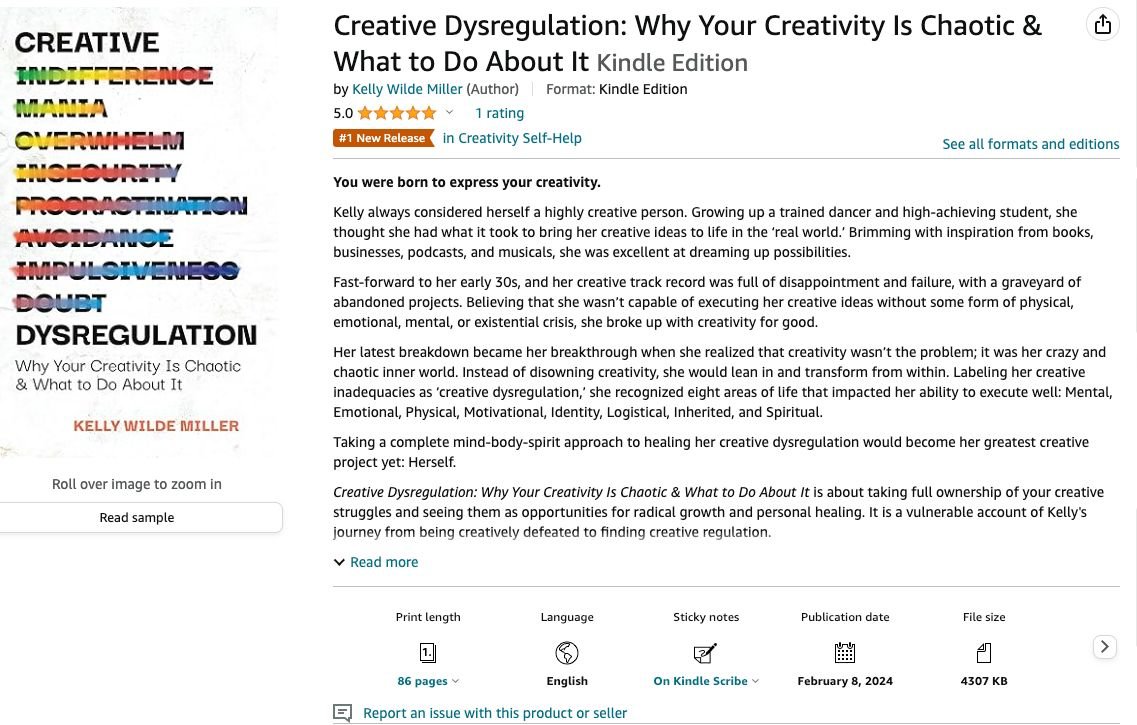
Ok I just bought 10 copies of @kellycwilde new book on creative dysregulation on kindle
who wants a copy? reply or DM and ill send you a free code
link here to read more: amazon.com/Creative-Dysre…
English