Fast Simon

1K posts

Fast Simon banner
Fast Simon

Fast Simon

@fastsimoninc

AI Search & Merchandising for Fast-Growing Online Brands. Increase merchants’ conversions and AOV while inspiring shoppers to buy.

California and Israel Присоединился Mart 2016
572 Подписки255 Подписчики
Закреплённый твит
Fast Simon
Fast Simon@fastsimoninc·
We build AI for online stores that actually sells stuff. Search that understands what people mean (not just what they type). Product displays that adapt to each shopper. Recommendations that don't feel creepy. Try it → fastsimon.com
English
0
0
0
276
Fast Simon
Fast Simon@fastsimoninc·
Merchandising isn’t about what you stock, it’s about what shoppers see. In ecommerce, products are discovered through search, filters, and recommendations. The challenge is making the right products surface at the right moment. AI merchandising blends data and intent to drive smarter product visibility, and ultimately, more conversions.
Fast Simon tweet media
English
0
0
0
2
Fast Simon
Fast Simon@fastsimoninc·
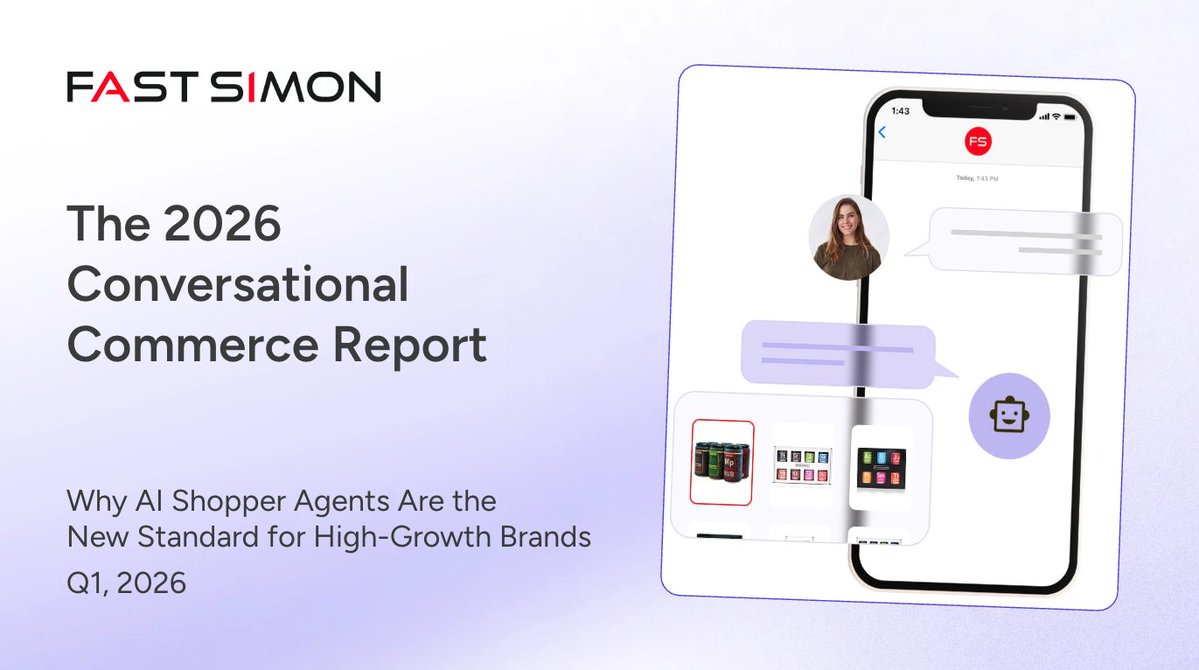
E-commerce search is entering a new era - and it relies on a dual-engine strategy. Our newly released Q1 2026 Conversational Commerce Report analyzed 48,000 real shopper conversations to show exactly how traditional search and AI agents complement each other on the digital sales floor.
Fast Simon tweet media
English
1
0
0
3
Fast Simon
Fast Simon@fastsimoninc·
Shoppers are no longer searching in keywords. They’re shopping in intent. Fast Simon’s latest conversational commerce analysis found that AI shopper agents are driving product discovery conversion rates of up to 22% across apparel and footwear brands. What’s happening inside these conversations? Read the full announcement: hubs.li/Q04j7VX40
English
1
0
0
6
Fast Simon
Fast Simon@fastsimoninc·
What does AI-powered personalization actually look like? For many brands, it’s still basic recommendations. Fast Simon goes further—optimizing the entire product discovery journey. By combining real-time behavior, historical data, and intent, it powers: Smarter site search that adapts to intent Real-time product recommendations Personalized collections and merchandising Scalable audience segmentation (no invasive data) AI-assisted merchandising controls The goal isn’t personalization for its own sake—it’s helping shoppers find what they want, faster. As eCommerce evolves, this isn’t a differentiator—it’s becoming the baseline. How advanced is your personalization today?
English
0
0
0
3
Fast Simon
Fast Simon@fastsimoninc·
In such a saturated market, strategies such as games, immersive experiences, and opt-ins, will ensure that your eCommerce personalization shines out above the rest. hubs.ly/Q04cSh_Y0
English
0
0
1
9
Fast Simon
Fast Simon@fastsimoninc·
A customer lands on your site and instantly finds what they need—no searching, no filtering. The experience simply adapts in real time. That’s hyper-personalization. It goes beyond past behavior, using real-time intent and context to shape every interaction. The shift: From reacting to what customers did → to responding to what they need right now. The impact: Fewer abandoned carts Higher conversions Stronger engagement It stops feeling like a website—and starts feeling one-to-one. That’s the advantage. How are you approaching hyper-personalization today?
English
0
0
0
4
Fast Simon
Fast Simon@fastsimoninc·
Hyper-personalization facilitates personalized recommendations with a deeper sense of understanding. As more customers expect this, hyper-personalization is set to take over the eCommerce world as time goes on. hubs.ly/Q04cSyVS0
English
0
0
0
3
Fast Simon
Fast Simon@fastsimoninc·
71% of shoppers expect personalization—but they also expect control over their data. That’s exactly why we built Audiences by Fast Simon. Today’s winning strategy isn’t about tracking people—it’s about understanding intent. With Audiences, you can: Segment shoppers based on real behavior (not guesswork) Personalize search, collections, and recommendations in real time Engage anonymous visitors without relying on invasive data Scale personalization using smart audience groups—not one-to-one tracking No cookies. No assumptions. Just relevant experiences built on trust. Because personalization isn’t about who your customers are— it’s about what they need right now. The future of eCommerce is trust-driven. Are you ready?
English
0
0
0
3
Fast Simon
Fast Simon@fastsimoninc·
71% of shoppers expect personalization—but they also want control over their data. That’s the tension: relevance vs. privacy. eCommerce is shifting from cookie-based tracking to consent-driven, real-time understanding. Trust is now the foundation. What leading brands do differently: Be transparent about data use Ask customers directly (surveys, preferences) Focus on behavior, not identity Personalize by segments, not individuals Key idea: personalization isn’t about who someone is—it’s about what they need right now. The future isn’t cookie-driven. It’s trust-driven. How is your team handling this shift?
English
0
0
0
9
Fast Simon
Fast Simon@fastsimoninc·
Personalization is a must on your eCommerce store. 71% of shoppers expect a personalized experience, as it improves the user experience. At the same time, it boosts conversions and AOV. As stricter data privacy laws come into play, the question is: how can we balance personalization and data privacy? hubs.li/Q04cSm6p0
English
0
0
0
7
Fast Simon
Fast Simon@fastsimoninc·
Personalization at scale is an incredibly powerful tool for making sure that all customers receive tailored experiences. We want to know how you are handling personalization for anonymous users in a privacy-first world. We rely on customer data We use real-time behavior We’re experimenting We don’t use personalization Vote below and share your approach in the comments.
English
0
0
0
8
Fast Simon
Fast Simon@fastsimoninc·
These days, eCommerce teams are frustrated. “We know personalization works,” they said. “We see the uplift in conversions, AOV, and loyalty… but only for customers we actually know.” And that’s the catch, isn’t it? Because the majority of shoppers aren’t logged in. They’re anonymous. First-time visitors. No history. No profile. No data trail. So for years, the assumption was: no data = no personalization. But that’s no longer true. Here is a simple question: “What if you stopped trying to identify the person… and started understanding the behavior?” That’s where things change. Instead of relying on personal data, look at real-time intent: – What is this user clicking on right now? – Are they browsing casually or searching with purpose? – Did they abandon a search or hover around a specific category? Within minutes, anonymous visitors start falling into audience patterns: • High-intent shoppers • Low-intent browsers • Search abandoners • Category explorers No names. No personal data. Just behavior. And suddenly, personalization is back on the table: at scale. Low-intent users saw trending products. Search abandoners were guided back with relevant alternatives. Curious browsers were nudged deeper into categories they clearly cared about. The result? A shopping experience that feels personal… without ever crossing privacy lines. Because here’s the shift happening right now: 👉 Personalization is no longer about who the customer is 👉 It’s about what they’re trying to do in the moment And in a world moving toward stricter privacy and a cookie-free future, that’s a massive advantage. The brands that win won’t be the ones with the most data. They’ll be the ones who use the right signals, creatively and responsibly. Curious to hear your take: How is your team approaching personalization for anonymous users today? Drop your thoughts below 👇
English
0
0
0
8
Fast Simon
Fast Simon@fastsimoninc·
The cookie-free future doesn’t need to be a problem, it just leaves room for a higher scope of creativity and ingenuity- something the eCommerce market knows a lot about. Both shoppers and merchants are expecting higher privacy standards and a secure customer experience, without losing any of the unique and incredible online personalization we’ve come to expect. Personalization for large audiences is the perfect example of this. hubs.li/Q04cSj4b0
English
0
0
0
6
Fast Simon
Fast Simon@fastsimoninc·
AI personalization is about creating shopping experiences tailored to each; helping merchants discover the right products, faster, and with less friction. From smarter recommendations to dynamic content to targeted offers, personalization is changing how brands connect with audiences. Why does this matter? Because today’s customers expect relevance. They don’t just want options, they want the right options. And businesses that deliver see stronger engagement, higher conversions, and deeper loyalty.
English
0
0
0
5
Fast Simon
Fast Simon@fastsimoninc·
Most ecommerce teams don’t lose sales because of bad products, they lose them because of bad product descriptions. I recently reviewed a store that had everything going for it: strong traffic, great design, and competitive pricing, yet conversions were flat. The issue was clear, generic, keyword-stuffed descriptions that described the product but didn’t sell it. In today’s crowded ecommerce space, product descriptions must do four things at once: Help customers find you (SEO) Communicate value Drive purchase decisions Reduce returns through accuracy This is where AI becomes a powerful advantage. It enables speed, scalability, consistency in brand voice, and data-driven optimization, but only when paired with the right strategy and inputs. The teams seeing real impact use a simple approach: define clear goals (SEO, conversions, or both), gather strong product insights (features, benefits, use-cases, USPs), choose the right AI tools, write detailed prompts, and refine outputs with a human touch. The fundamentals still matter: focus on benefits over features, keep language clear and persuasive, build trust, and always include a call to action. AI doesn’t replace storytelling; it scales it. When combined with human creativity, it turns product descriptions into high-performing assets that both rank and convert. Curious how your product descriptions are performing? Drop a comment below.
English
0
0
0
10
Fast Simon
Fast Simon@fastsimoninc·
In the overcrowded and competitive ecommerce landscape of today, product descriptions are not just descriptors; they are selling points. Ensuring that you have high quality, SEO-optimized product descriptions is key. hubs.li/Q04cSg-40
English
0
0
0
4
Fast Simon
Fast Simon@fastsimoninc·
"Search is becoming more visual, more instinctive and less dependent on traditional product language. Consumers may not know the technical term for a shoe shape or category. Increasingly, they know the symbol that gets them close enough. For footwear brands and retailers, the question is whether search can keep up. If a shopper types a sneaker emoji, the results still have to land on the right mix of product, price and style. As vibe shopping picks up, even a simple shoe icon is starting to carry more weight in how people browse." Read the full article on Womens Wear Daily: hubs.li/Q04d9B7_0
English
0
0
0
3
Fast Simon
Fast Simon@fastsimoninc·
Inventory issues tend to show up in two ways: 1. Running out of bestsellers when demand is high 2. Overstocking products that don’t move Both of these issues impact revenue and customer experience. Many teams have tried to manage this with manual forecasting in spreadsheets, but it’s time-consuming and often struggles to keep up with changing demand, trends, and external factors. What’s proving more effective is AI-driven forecasting. This means using historical data, real-time signals, and seasonality to predict demand, automate replenishment, and reduce costly mistakes, all while being monitored and refined by teams. As ecommerce becomes more dynamic, planning inventory this way is quickly becoming the standard. How are you currently approaching forecasting in your business?
English
0
0
0
8