Hardik
10.8K posts

Hardik
@hardikthecoder
Shipping in prediction market @RevalonLabs | Ex- DevRel @buildnexio , @starknet , @W3CG_Labs , @nillionnetwork | i cook dev community & eco
Присоединился Eylül 2021
730 Подписки673 Подписчики
Закреплённый твит
Hardik ретвитнул


last year i said the amount of cracked people flooding into prediction markets was insane and honestly this year makes last year look tame
the space did over $63B in volume but what's more interesting than the numbers is who's showing up:
it's not even gamblers, it's people who see prediction markets as the most interesting design space in crypto right now
and when you talk to them you realize they're not here for a cycle, they're here because the problem space is massive and mostly unsolved
> options on outcomes
> perps on narratives
> futarchy
> attention markets
> energy derivatives
most of these primitives haven't been cracked yet
English

@Ugbuericsam "we want to max extract from our community" lol
English
Hardik ретвитнул

Today, many are focused on adapting existing services to machine payments (@mpp).
In the future, I'm excited about MPP-native services.
Businesses without a human-facing website.
Just paid, MPP-enabled, API endpoints that "make something agents want".
English
Hardik ретвитнул

Vitalik Buterin explains why proof-of-stake is more secure than proof-of-work
“I think proof of stake is very secure because to attack the system, you need to have basically as much stake as the rest of the network. Right now, for example, we have 5 million ETH staking, which means you have to come up with 5 million ETH and then join the network.”
At the time of this writing, more than 37 million ETH are being staked, with 3 million ETH waiting to join via the validator queue. At today’s prices, that’s more than $80 billion of ETH someone would have to acquire to attack the network and revert finalized blocks, which is more than the cost of attacking even the Bitcoin network by some estimates.
The other defense mechanism that proof-of-stake has that proof-of-work doesn’t is slashing, which makes Ethereum antifragile. Vitalik explains:
“Recovering from attacks is much easier in proof-of-stake than proof-of-work. For many kinds of attacks you do against [the Ethereum] network, we have this concept of automatic slashing. In order to revert a finalized block, you basically have to have a big portion of your validators sign two conflicting messages. This is something where once these messages are on the network, you can go and prove ‘these people did it.’ So we have this feature in the protocol where you basically take all these people who provably misbehaved and you burn their coins.”
Vitalik also acknowledges the possibility of censoring attacks, where if 1/3rd of validators refuse to attest, the chain can’t finalize. But, as he explains, Ethereum has a contingency plan for this as well:
“Everyone who got censored would create a minority chain, and the community would have to do a soft fork. The would have to say, ‘this chain is clearly attacking us and this one is not attacking us, so we’re going to join this chain.’ Then what happens is, on that new chain, the attackers also lose a lot of coins. The difference between proof-of-stake and proof-of-work is that in a proof-of-stake system, you can identify specific participants — and this isn’t a human going in and saying ‘I don’t like you’. It’s all automated.”
One last benefit of proof-of-stake is that security scales with the value of the network. As Vitalik put it five years ago, it is really relative security, and not absolute security, that matters:
“The security needs of a thing have to be proportional to the size of that thing, because as a thing gets bigger, its enemies become bigger and more well-motivated. If BTC were 100x as big as it is today, the value from destroying it would be 100x higher, and the kinds of actors that would want to care about destroying it would be much bigger and scarier. This is also why countries of all sizes have roughly similarly sized militaries as a percentage of GDP. Hence, cost of attack divided by market cap really is the correct statistic to measure, and in the long run issuance-free PoW really does look not that good."
Source: @lexfridman (Jun 2021)
English
Hardik ретвитнул

0/ Today, the Ethereum Foundation finalized the terms of a 5,000 ETH sale at an average price of $2,042.96 via OTC.
For this sale, our OTC counterparty was @BitMNR.
English
Hardik ретвитнул
Hardik ретвитнул

This is the new EF Mandate.
For many of you, the contents should be no surprise, and a clarification along the lines that we have been going and thinking for the past few months. But the clarification is nevertheless worth making.
Ethereum is a unique object and has a unique role in the world. Its role is to be a sanctuary technology, to preserve technological self-sovereignty, to enable cooperation without coercion, domination or rugpulling, and to provide an escape hatch, to ensure that no single person, organization or ideology's victory in cyberspace can be total.
The Ethereum Foundation is a steward of Ethereum - the original steward, and today, the steward specifically dedicated to preserving and expanding the above aspects of Ethereum. This means a heavy emphasis on CROPS (censorship and capture resistance, open source, privacy, security), both at the protocol layer, and at the access layer, user-facing applications and tools that we create or contribute to.
There are things that we do in Ethereum because we believe that they are valuable for the underlying goals that we have for Ethereum. There are things that we do not do because from the perspective of our values we find them uninteresting (or worse, harmful). But there are also things that we do not do because while they are useful, they are not our role.
At the Ethereum protocol layer, we focus on decentralization, verifiability, inclusion guarantees, protocol liveness, security and privacy first and foremost. We also value capabilities (eg. L1 scale, account abstraction, perhaps some forms of in-protocol aggregation), particularly because improvements in these capabilities better enable users to properly benefit from Ethereum's CROPS properties and displace the need for higher-layer intermediaries that might weaken the extent to which Ethereum's properties carry over into the full stack.
We also believe that the Ethereum protocol must strive to pass the walkaway test. "We do X to specialize to serve the use cases of today, if more use cases appear later, we will continue to keep adding more EIPs for them later" is logic fit for many other blockchains whose names you hear often on this forum, but we do not believe it is logic fit for a decentralization-first blockchain like Ethereum.
At the application layer, we focus on making "the zero option" - user experience that goes hard on ensuring security and privacy, avoiding dependence on intermediaries, and respecting the user's agency - as high quality as possible. We see this as complementary to work in the Ethereum ecosystem that "goes broad", starting from the world that it exists, and brings it onchain and improves its properties over time. Such work has its natural home outside the EF. We intend to be supportive of such efforts. We believe that the two are complementary: tools that are developed within the EF can be adopted by anyone, including partially, and even partial adoption that improves people's security, privacy and agency is a good thing.
But the form of user experience that is more heavily insistent on CROPS properties is where we want the EF to develop its center of expertise. This does not mean shrinking from the hard questions. We believe in a vision of self-sovereignty that protects users, and does not leave users in the cold to face environments where they lose their life savings if they make a mistake, and click "yes" on a confirmation screen by accident two seconds after. But such protection must be designed based on a philosophical baseline of empowering the user, not empowering centralized organizations that claim to act in the user's name. This quadrant of design space - caring about users' (including non-experts') well-being and safety, and yet insistent on doing this in a way compatible with their agency and freedom, is underserved (not just in crypto, but in the world). We wish to use Ethereum as a platform to build out and showcase this quadrant, and ideally work with others to expand its reach over time.
This is also a new chapter in how we see our position in the world. We must see ourselves not just as the Ethereum community, but also as maintainers of the Ethereum tool within what you might call the CROPS community or the sanctuary tech community, or a dozen of other words that have for a long time been used by people with similar values to us but far outside Ethereum. This means open-mindedness to new conceptions of what things in the world are our natural allies.
Ethereum is not the world. Ethereum is a specific object in the world that is here to have specific properties. The Ethereum Foundation is a specific organization within Ethereum - one steward, not the sole one.
I encourage all to read the mandate in detail; it includes concrete examples of how we intend to deal with the challenges and nuances of these ideas. We are doubling down on Ethereum and are excited about its next chapter.
Ethereum Foundation@ethereumfndn
Today, the Foundation’s Board released the EF Mandate. This document, which was first intended for EF members, reaffirms the promise of Ethereum, and the role of EF within this ecosystem.
English
Hardik ретвитнул

@0xNairolf Yes right brother & i m consumer defi product in prediction market
English
Hardik ретвитнул

One thing that it is worth re-thinking is our perspective on when, and how, it makes sense to build "democratic things". This includes:
* DAOs and voting mechanisms in DAOs
* Quadratic and other funding gadgets
* ZKpassport voting use cases, incl freedomtool type stuff, incl attempts to deploy it for local governance, etc
* Voting systems inside social media
* Attempts at "let's build and push for a brighter and freer political system for my country"
Lately I am getting the feeling that there is less enthusiasm about these things than before. The "authoritarian wave" (a phenomenon that is often viewed as being about nation-state politics, but actually it stretches far beyond that, eg. see the phenomenon of companies lately becoming less "multi-stakeholder" and more founder-centric, and recent disillusionment with social media) is not just a matter of some malevolent strongmen smelling an opportunity to exert their will unopposed and seizing it. It's also a matter of genuine disillusionment with democratic things (of various types, not just nation-state, also corporate, nonprofit, social media).
Defense of democratic things lately has the vibe of actually being conservatism: it's about fighting to preserve an existing order, and ward off hostile attempts to push the order toward a different order (or chaos) that favors a few people's interests at the expense of others, and not about appreciating positive benefits of the existing order. But conservatism is progressivism driving at the speed limit, and so if that's all that there is, it will inevitably lose, it will just take longer.
There is an unfortunate irony to this, because it comes at the same time as we have much more powerful tools to build more effective democratic things: ZK, AI, much stronger cybersecurity, decades of research and experience. But to do so effectively we need to diagnose the present situation. I will break this down into a few parts.
## Stable era and chaotic era
In the 00s and 10s, it was common to dream about things like: creating a global UBI, moving a country wholesale to a better political system like ranked-choice voting or quadratic voting, building a large-scale DAO that could eventually provide billions of dollars to global public goods that current systems miss (eg. open source software).
Today, all of these dreams seem more unrealistic than ever. I see the main difference why as being that the 00s and 10s were a stable era, and the 20s are a chaotic era. In a stable era, more coordination is possible and imaginable, and so people naturally ask questions like "what would be a more perfect order?", and work towards it. In a chaotic era, the average intervention into the order is not a principled act of mechanism design, it's raw selfish power-grabbing, and so there is much less room to think about such questions. It's difficult to imagine eg. moving the United States to quadratic voting or ranked choice voting, when the country cannot even successfully ban gerrymandering.
What do chaotic era democratic things look like? At a large scale, they do not look like hard binding mechanisms for making decisions. Rather, they look like tools for consensus-finding. They look like tools for identifying possible shifts to the order that would satisfy large cross-cutting groups of people, and presenting those possible shifts to change-making actors (yes, including centralized actors, even selfish actors), to make it clear to them that those particular shifts would be easier for them to accomplish, because they would have a lot of support and legitimacy. Pol.is style ideas are good here, anonymous voting is good, also perhaps assurance contract-style ideas: votes or statements that are anonymous at first, but that flip into being public (and hence publicly commit everyone at the same time) once they reach a certain threshold of support.
This does not create a perfect order, but it gives highly distributed groups *a voice*. It gives actors with hard power something to listen to, and a credible claim that if they adjust their plans based on it, those plans are more likely to get widespread support and succeed.
The Iran war is a good example here. My biggest fear in the ongoing situation has been that while the IRGC is unambiguously awful and murderous, there is an obvious divergence between US/Israel interests, and interests of Iranian common people: while both would be satisfied by a beautiful peaceful democratic Iran, the former would also be satisfied by the perhaps easier target of Iran becoming a low-threat low-capability wasteland, whereas for the latter that would be ruinous. How can Iranian people have a collective voice that carries hard power - not just in some future order that they create, but now, literally this week, while the situation is chaos?
Some "sanctuary technology" is sanctuary money. Other times, it's sanctuary communication. But we need sanctuary tools for collective voice too.
English
Hardik ретвитнул

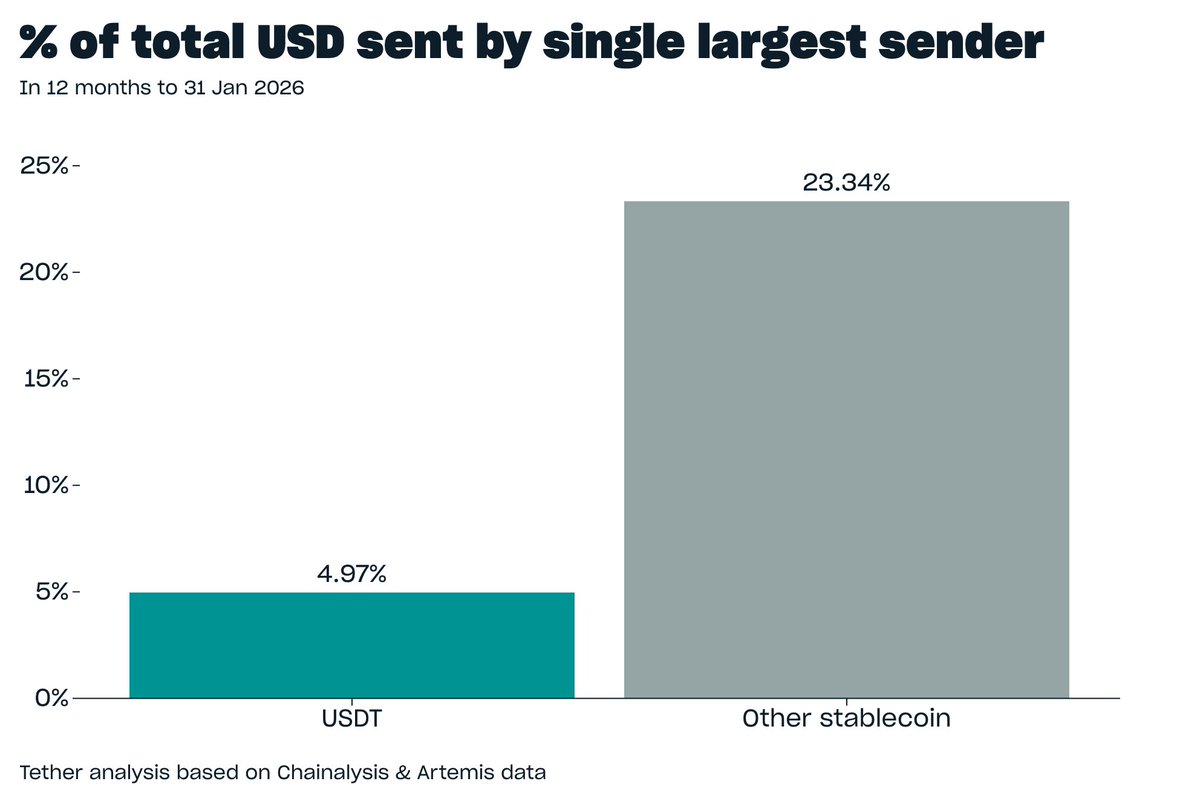
USDT is unique.
The largest sender is < 5% of total send volume, compared to others that have almost 25℅ of their stablecoin sent by one entity.
USDT is the digital dollar made for the people, the billions of individuals and hundreds of millions of families left behind by the traditional financial system because they're not wealthy enough.
Currently more than 550M users across emerging markets rely on Tether USDT.
Very proud of it ❤️

English
Hardik ретвитнул

unpopular opinion: polymarket is never doing an airdrop.
it makes no sense to me.
the cap table reads like a tradfi room:
ICE, founders fund, general catalyst, point72 (steve cohen) etc..
these guys did not put billions into a platform to dilute it with a governance token so degens can farm and dump.
polymarket is building a real financial institution not a points casino.
English
Hardik ретвитнул