Paul Clark

7.6K posts

Paul Clark banner
Paul Clark

Paul Clark

@sandtreader

Cornish software & creative geek, Green, shantyman, sailor, maker.

Cornwall Присоединился Ocak 2010
374 Подписки478 Подписчики
Paul Clark
Paul Clark@sandtreader·
@mattpocockuk Counterexample: My wife - a former educator, now gardener & vlogger - can often be heard shouting at ChatGPT "no, stop making things up, use reputable sources and reference them!".
English
0
0
0
20
Matt Pocock
Matt Pocock@mattpocockuk·
Every time an LLM says anything to me, I automatically assume it's BS unless it's read a source confirming it NONE of the non-devs I talk to have this instinct
English
152
29
794
39.3K
Paul Clark
Paul Clark@sandtreader·
@lthlnkso I'd want them to be very clear about whether they mean "odds" or "probability" and to be sure that's a / not a :
English
0
0
0
191
Quick Thoughts
Quick Thoughts@lthlnkso·
A morally neutral wizard offers you a bet. If you win, you get a quarter. If you lose, the person you love most dies. The odds of winning are 1/N and you get to pick N. Do you take the bet?
English
41
1
19
10.8K
Paul Clark
Paul Clark@sandtreader·
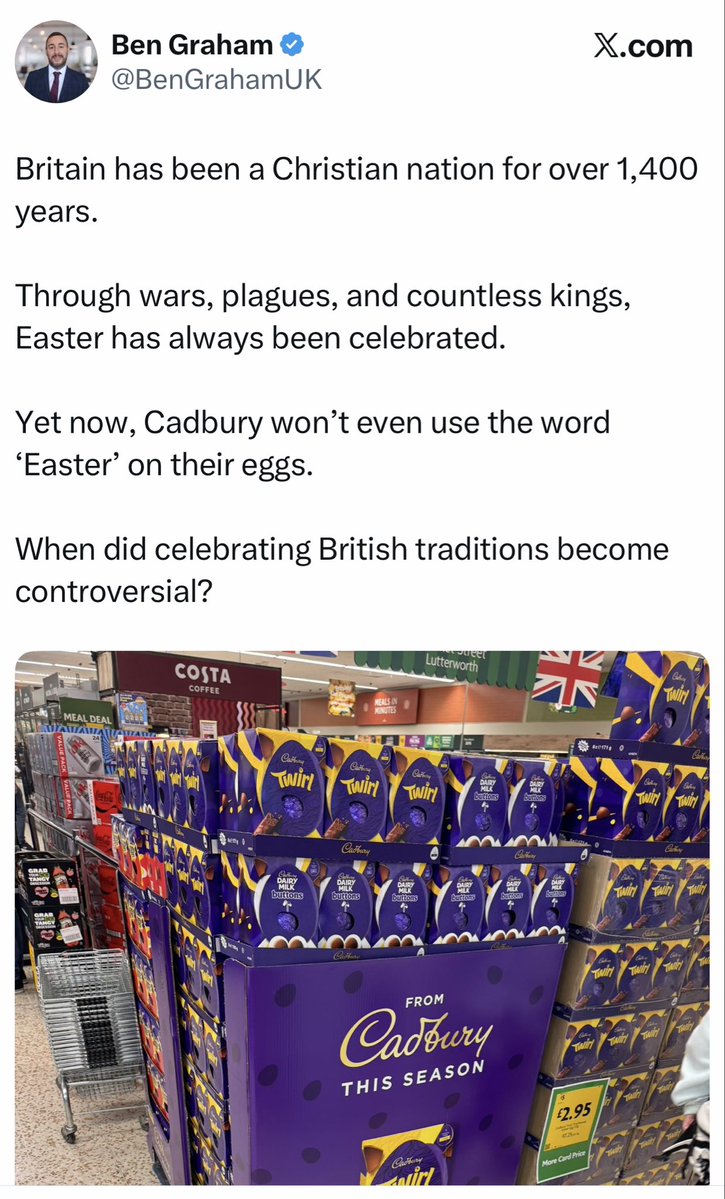
@GrahamSmith_ He's celebrating the British tradition of a bunch of gammons getting upset about Easter eggs. See also banning Christmas.
English
0
0
0
8
Paul Clark
Paul Clark@sandtreader·
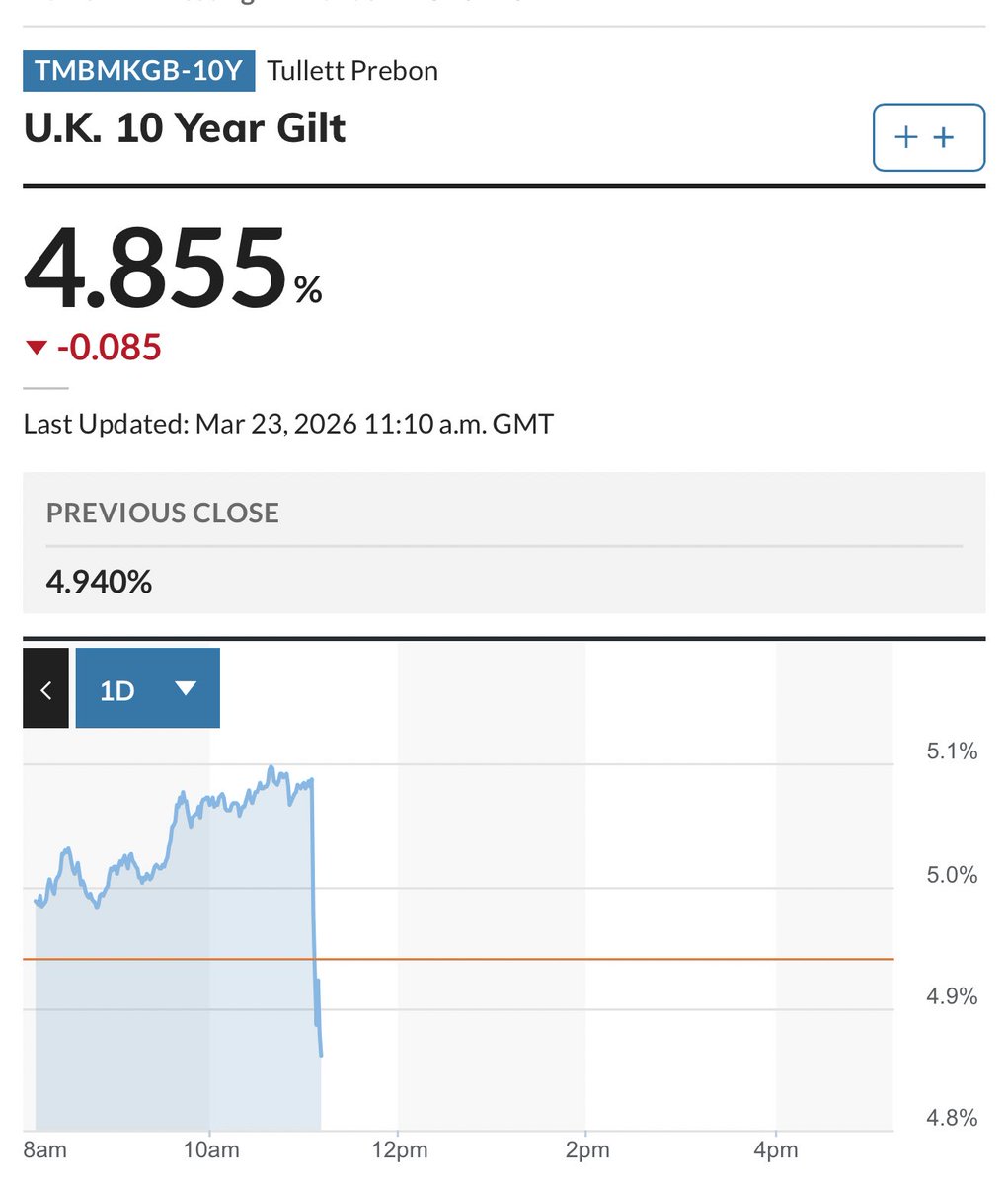
@faisalislam I'm amazed that anyone believes a word of what Trump spews forth, let alone drives pricing decisions off it.
English
0
0
2
641
Faisal Islam
Faisal Islam@faisalislam·
Gilt yields and other government bond yields actually falling off a cliff down about 25 basis points in about 10 mins… after Trump posts “very good and productive conversations” regarding “complete and total resolution” to hostilities in the Middle East….
Faisal Islam tweet media
English
41
61
211
76.4K
Paul Clark
Paul Clark@sandtreader·
@MartinSLewis I'm sure you're right that this is what will happen - just as it did after the Ukraine gas crisis. But this is crazy, surely, to deliberately cause a recession based on a short-term shock? (I'm aware that depending what happens in the next days "short term" might not age well)
English
0
0
1
894
Martin Lewis
Martin Lewis@MartinSLewis·
Why Mid East conflict pushes up mortgage rates in 6 simple steps... 1. Short supply means higher oil, gas & some other commodity prices 2. As well as direct impact on petrol, heating oil, energy bills, this increases transport, cold storage and other business costs, which they pass on to us. 3. So prices are likely to rise, and inflation is the measure of price rises. 4. Bank of England is targeted on keeping inflation low. As its rising, its main tool is the UK base rate of interest (higher rates make saving more attractive and borrowing less, taking money out of economy to reduce "demand" to try and ease inflation). 5. While UK base rate hasn't changed the markets think rate cuts are now less likely. 6. In v simple terms new Mortgage fixed rates are based on the City's long term view of interest rates. That's now higher than it was so mortgage fixed rates have gone up.
Davina Franks@FranksDavi94647

@MartinSLewis @mmhpi Super off topic - can you please explain to me like I’m 5 years old…. Why are mortgage rates going up because of the war? And inflation. I am really struggling to understand…..

English
44
34
192
167.3K
Paul Clark
Paul Clark@sandtreader·
@matthen2 I deliberately stop myself from multitasking - apart from trivial things - because I know (a) I'll lose context and get stressed and (b) I need the time to keep my thinking ahead of the agent.
Falmouth, England 🇬🇧 English
0
0
1
68
Paul Clark
Paul Clark@sandtreader·
@PeterStefanovi2 On News Agents they said Ofcom can't act unless there are complaints, and the audience is so self-selecting no-one complains. Which suggests an obvious solution for a wet winter evening, if you can stand it...
Penryn, England 🇬🇧 English
0
0
0
83
Peter Stefanovic
Peter Stefanovic@PeterStefanovi2·
BREAKING: Ed Davey says GB News is turning into the "Reform channel" just how Fox News became the "Trump channel" Starmer: "He's right to raise an important question of free speech and our media - it is a matter for Ofcom" #PMQs
English
112
305
1.6K
57.6K
Paul Clark
Paul Clark@sandtreader·
@PhiloGroves @sama Assembly, in 1975? It was hand-assembled binary hex, mate. Hex?? You had it lucky! We had to solder individual core grid wires. Solder?! We had to hold the wires together with our fingers. You could only program a single 10-bit opcode.
English
0
0
1
159
Philo Groves
Philo Groves@PhiloGroves·
@sama 2020 software developers are soon going to be as revered as 1975 assembly programmers
English
1
0
4
5.3K
Sam Altman
Sam Altman@sama·
I have so much gratitude to people who wrote extremely complex software character-by-character. It already feels difficult to remember how much effort it really took. Thank you for getting us to this point.
English
4.7K
2.2K
36.1K
5.6M
SE Hozaifa
SE Hozaifa@SeHozaifa·
Incredible perspective. As we move away from the 'character-by-character' era, do you think the core curriculum for Software Engineering needs to shift from 'how to code' to 'how to architect systems'? 🧐 If the syntax is solved, then high-level logic becomes the new competitive advantage. Thoughts? 📈🧠
English
4
0
3
29K
Paul Clark
Paul Clark@sandtreader·
@allenholub So what I ask it to do is the specification, but the first thing it has to do is write a failing test for that specification.
English
1
0
0
46
Paul Clark
Paul Clark@sandtreader·
@allenholub I have this in my global CLAUDE.md: "When fixing a bug or adding a new feature, try to add a relevant failing test first, then spawn sub-agent(s) to change code to make the test succeed, and retest. Do this iteratively for big changes."
English
1
0
4
404
Allen Holub. https://linkedIn.com/in/allenholub
I mentioned TDD in an earlier post, and it became clear from the responses that there's some confusion about what TDD is. TDD stands for test-driven _development_ (or design). The "test-driven" is an adjective modifying the word "development" (or "design"). That is, it's an iterative design-and-development strategy, not a testing strategy. The so-called "test" is an example of how you expect to use the code you're about to write. It's more of a specification than anything else, and it's a specification of only a small part of what the thing you're building will do. You kluge together exactly enough code to get that small "test" to pass, then you refactor the code until it's high quality, then you write a new "test" to expand the specification to include a bit more functionality, and repeat. The new test starts "red" because it specifies code that doesn't exist yet, so the test won't pass. You write the simplest possible thing you can to make the test pass ("green"). Then you add quality ("refactor"). The confusion stems from the fact that, as you work through the TDD loop, you might also add essential unit tests that check corner cases, failure modes, etc. That is, you're looking at the code, so you might as well toss in the unit tests while the code is fresh in your mind. Those unit tests are not really part of the TDD process, even though you write them while you're using TDD to drive the development. The fact that you're doing two things at once (design/development and unit testing) is the source of the confusion. Some people don't do both simultaneously—they'll add unit tests only after they've finished the entire chunk of code they're writing, but most of us do both at the same time. The LLM cannot really do TDD because the "test" is a specification. It's essentially the prompt, and an LLM cannot write its own prompt. The LLM *can* help write the unit tests, and it can help with the refactoring, but that initial specification/example part is the work of a human being. This is actually not a bad way to work with an LLM, in fact. Your prompt describes an executable specification, and then you use the LLM to realize it.
English
5
12
74
8.7K
Brian Taylor
Brian Taylor@BrianTaylor5580·
@Feargal_Sharkey The Green Party must renationalise water without rewarding water companies.
English
1
1
6
204
Feargal Sharkey
Feargal Sharkey@Feargal_Sharkey·
Thame Water offers to pay £25 million to environment charities and local community groups, but only if Ofwat allow TW to scrap their "outcome delivery incentives", over the next 5 years. In other words allow us to wilfully, deliberately, knowingly break the law for the next 5 years and we'll bug eNGOs a £25 million bribe, simply to shut them up. But would any of the eNGOs accept TW's blood money? I know at least one that would rip their arms off. londonstockexchange.com/news-article/A…
English
57
718
1.5K
92.8K
Paul Clark
Paul Clark@sandtreader·
@Feargal_Sharkey Retain and enforce the legislation, let it fail and bring it back into community ownership. Possibly compensate any UK mutual funds affected; the rest can take the lumps for decades of asset stripping.
English
0
0
2
120
Paul Clark
Paul Clark@sandtreader·
What's interesting here for me is that total dependency of our society on oil, fertiliser and plastics are the big 3 things that us Greens have been campaining to reduce for decades. Maybe as always it will take an emergency to trigger what should have been done strategically.
Shanaka Anslem Perera ⚡@shanaka86

The war just reached the grocery aisle. Not through wheat or rice or fertiliser. Through plastic. The Middle East is the world’s largest exporter of polyethylene. Approximately 84% of regional PE capacity depends on the Strait of Hormuz for export access. The Strait is running at 0.5 million barrels per day against a pre-war 19.5 million. The naphtha feedstock that Asian petrochemical plants require to crack ethylene and produce the polyethylene that wraps, bottles, trays, and films every packaged food item on every supermarket shelf on Earth is not arriving. The force majeures began on Day 4 and have not stopped. Indonesia’s Chandra Asri declared force majeure on 3 March citing feedstock disruption. South Korea’s Yeochun NCC followed on 4 March, cutting cracker rates to approximately 66%. Singapore’s PCS declared on 5 March. CNOOC-Shell Huizhou is planning shutdown of its 1.2 million tonne cracker in southern China. Four countries. Four declarations. Each one a petrochemical plant telling its customers that the molecules required to produce plastic packaging are no longer available in sufficient quantity because a waterway 8,000 kilometres away has been mined by a regime that says the war will last “as long as it takes.” US polyethylene spot prices surged 10 cents per pound in the first week. Indian PE prices jumped approximately 15,000 to 20,000 rupees per tonne. These are not energy prices. These are packaging input prices. Polyethylene, polypropylene, and PET resin account for the majority of disposable food packaging manufacturing costs. Every plastic bottle of water, every wrapped loaf of bread, every sealed tray of meat, every film-covered vegetable pack is now repricing through a channel that has nothing to do with agricultural commodity markets and everything to do with a naphtha tanker that cannot transit Hormuz. This is the third domino. The first was energy: oil from 19.5 million to 0.5 million barrels per day. The second was fertiliser: nitrogen feedstock dependent on the same natural gas the same strait carries. The third is packaging: the plastic that wraps the food that the fertiliser grew that the energy harvested. Each domino hits the same consumer from a different direction. Energy raises transport costs. Fertiliser raises farm costs. Packaging raises the cost of getting the food from the farm to the shelf. The consumer pays all three. The contrarians note US and Algerian producers can ramp, recycling offsets virgin resin, and Asian inventories buffer. They are correct individually and wrong on the timeline. Naphtha rerouting takes weeks. Cracker restarts after force majeure take longer. Inventories at current consumption cover days, not months. And the 1.2 million tonne Huizhou cracker, when it shuts, will remove more PE capacity from Asia than most countries consume in a year. The grocery inflation central banks are watching is not coming from food. It is coming from the wrapper. The Fed meeting on 18 March will assess an environment in which energy, fertiliser, and packaging inputs are all repricing through the same chokepoint. The plastic bottle costs more. The bread bag costs more. The meat tray costs more. None of it appears in the agricultural commodity indices that traditional models use to forecast food inflation. The molecules that wrap the food are stuck on the wrong side of a strait that is open to ten countries and closed to the rest. The grocery bill is repricing from the outside in. Full deep dive analysis - open.substack.com/pub/shanakaans…

English
0
0
0
41
Paul Clark
Paul Clark@sandtreader·
@shanaka86 What's interesting here for me is that total dependency of our society on oil, fertiliser and plastics are the big 3 things that us Greens have been campaining to reduce for decades. Maybe as always it will take an emergency to trigger what should have been done strategically.
English
0
0
1
90
Shanaka Anslem Perera ⚡
Shanaka Anslem Perera ⚡@shanaka86·
The war just reached the grocery aisle. Not through wheat or rice or fertiliser. Through plastic. The Middle East is the world’s largest exporter of polyethylene. Approximately 84% of regional PE capacity depends on the Strait of Hormuz for export access. The Strait is running at 0.5 million barrels per day against a pre-war 19.5 million. The naphtha feedstock that Asian petrochemical plants require to crack ethylene and produce the polyethylene that wraps, bottles, trays, and films every packaged food item on every supermarket shelf on Earth is not arriving. The force majeures began on Day 4 and have not stopped. Indonesia’s Chandra Asri declared force majeure on 3 March citing feedstock disruption. South Korea’s Yeochun NCC followed on 4 March, cutting cracker rates to approximately 66%. Singapore’s PCS declared on 5 March. CNOOC-Shell Huizhou is planning shutdown of its 1.2 million tonne cracker in southern China. Four countries. Four declarations. Each one a petrochemical plant telling its customers that the molecules required to produce plastic packaging are no longer available in sufficient quantity because a waterway 8,000 kilometres away has been mined by a regime that says the war will last “as long as it takes.” US polyethylene spot prices surged 10 cents per pound in the first week. Indian PE prices jumped approximately 15,000 to 20,000 rupees per tonne. These are not energy prices. These are packaging input prices. Polyethylene, polypropylene, and PET resin account for the majority of disposable food packaging manufacturing costs. Every plastic bottle of water, every wrapped loaf of bread, every sealed tray of meat, every film-covered vegetable pack is now repricing through a channel that has nothing to do with agricultural commodity markets and everything to do with a naphtha tanker that cannot transit Hormuz. This is the third domino. The first was energy: oil from 19.5 million to 0.5 million barrels per day. The second was fertiliser: nitrogen feedstock dependent on the same natural gas the same strait carries. The third is packaging: the plastic that wraps the food that the fertiliser grew that the energy harvested. Each domino hits the same consumer from a different direction. Energy raises transport costs. Fertiliser raises farm costs. Packaging raises the cost of getting the food from the farm to the shelf. The consumer pays all three. The contrarians note US and Algerian producers can ramp, recycling offsets virgin resin, and Asian inventories buffer. They are correct individually and wrong on the timeline. Naphtha rerouting takes weeks. Cracker restarts after force majeure take longer. Inventories at current consumption cover days, not months. And the 1.2 million tonne Huizhou cracker, when it shuts, will remove more PE capacity from Asia than most countries consume in a year. The grocery inflation central banks are watching is not coming from food. It is coming from the wrapper. The Fed meeting on 18 March will assess an environment in which energy, fertiliser, and packaging inputs are all repricing through the same chokepoint. The plastic bottle costs more. The bread bag costs more. The meat tray costs more. None of it appears in the agricultural commodity indices that traditional models use to forecast food inflation. The molecules that wrap the food are stuck on the wrong side of a strait that is open to ten countries and closed to the rest. The grocery bill is repricing from the outside in. Full deep dive analysis - open.substack.com/pub/shanakaans…
Shanaka Anslem Perera ⚡ tweet mediaShanaka Anslem Perera ⚡ tweet media
English
18
223
485
75K
Liam Byrne MP
Liam Byrne MP@liambyrnemp·
I have written to @CompaniesHouse CEO, Andy King, regarding “reports of a serious security vulnerability in your WebFiling system which, for an unknown duration, allowed unauthorised access to the private dashboards of any of the UK’s five million registered companies.” 🗓️The reply is due by Monday 23 March. 👀⬇️ committees.parliament.uk/publications/5…
English
12
11
47
3.7K
Paul Clark
Paul Clark@sandtreader·
@Keir_Starmer Agree with the sentiment, although I'd wish he'd make clearer what exactly the red lines are. But comms people, FFS, what's with the music?Detracts from the message and the last bit shades into comedy. Are you worried he's so boring people need to be entertained in the pauses?
English
0
0
0
7
Keir Starmer
Keir Starmer@Keir_Starmer·
I will always make decisions in the national interest. That’s why we did not join the offensive action against Iran.    Reform and the Tories would’ve rushed us into war without a plan to get us out.
English
8.3K
3.4K
22.2K
1.3M
Paul Clark
Paul Clark@sandtreader·
@DanNeidle @GarethM79 Because hackers only ever run single-threaded scripts from a single IP address 😜 Given it's been vulnerable for 5 months anyone could have scraped the entire database using distributed scripts with random delays and it would be almost impossible to rate limit.
English
1
0
1
47
Dan Neidle
Dan Neidle@DanNeidle·
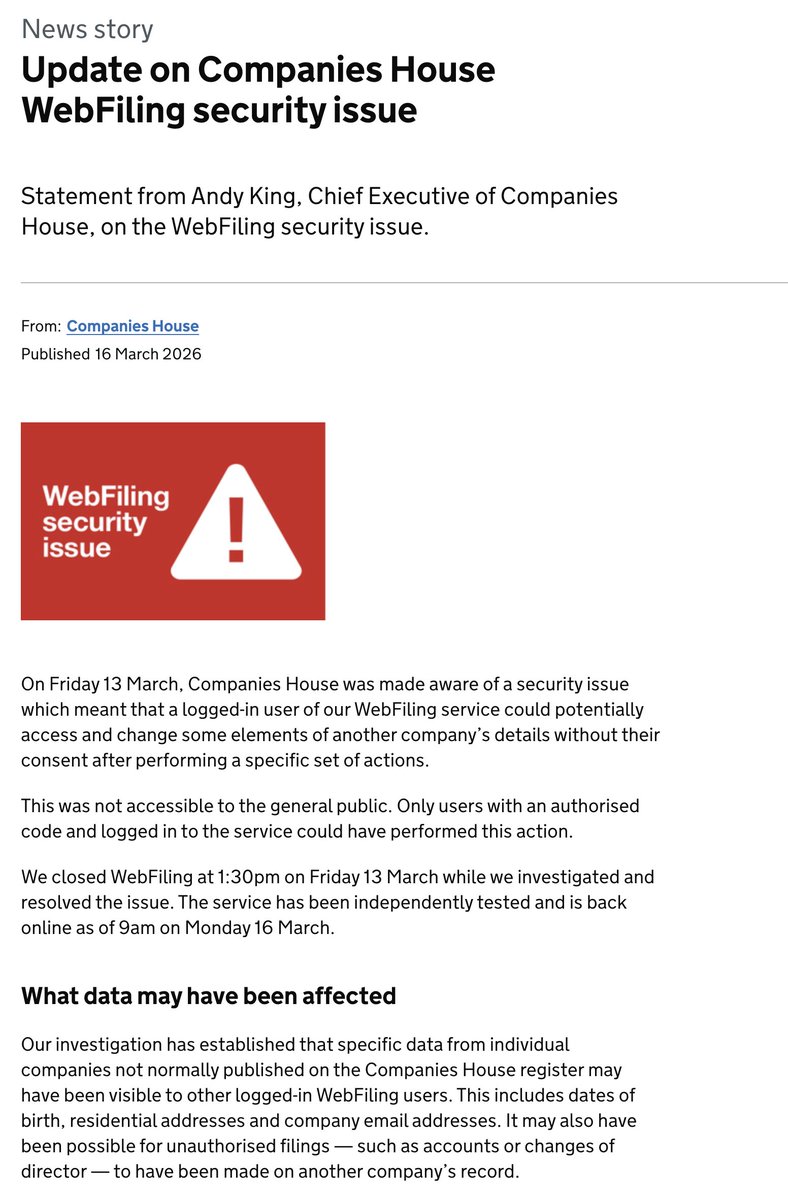
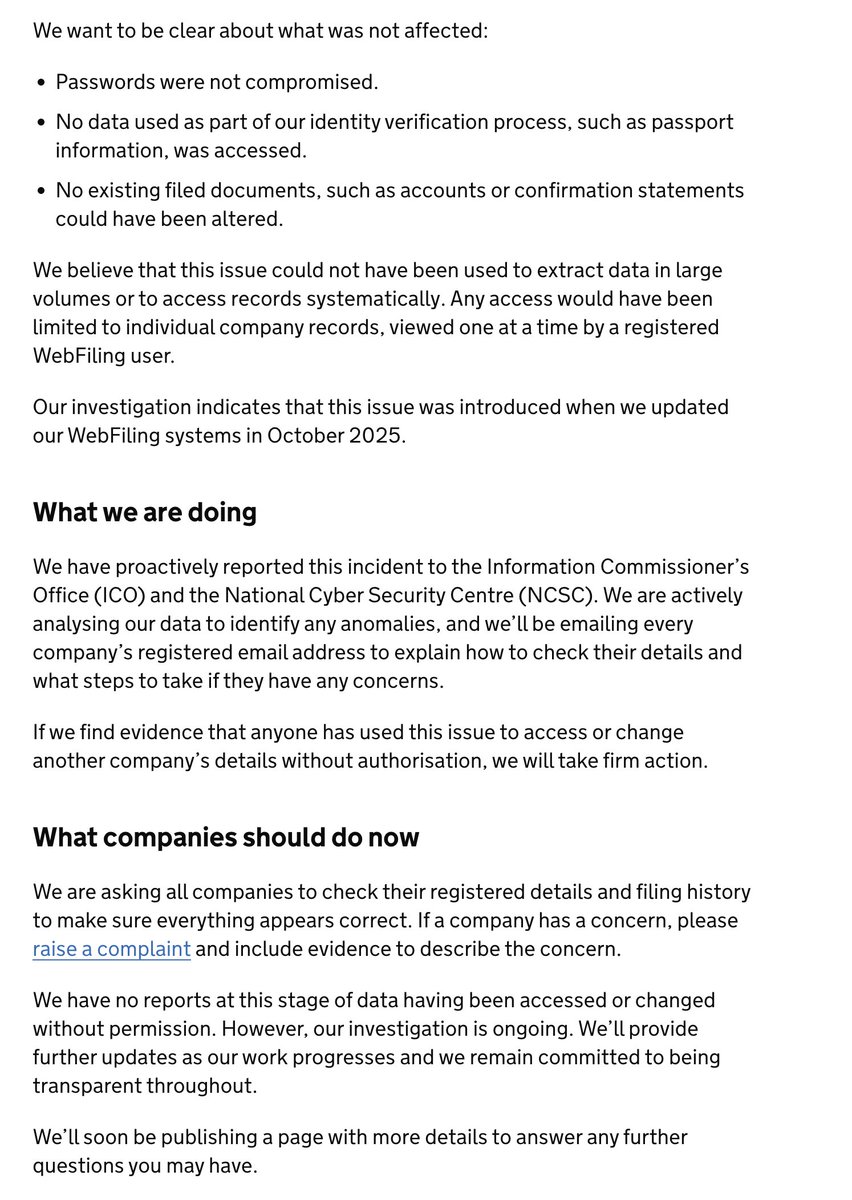
Companies House has put out a statement confirming that, for five months, every company in the UK was vulnerable to the simple exploit we identified on Friday. It enabled anyone in the world to view and change their company details.
Dan Neidle tweet mediaDan Neidle tweet mediaDan Neidle tweet media
English
185
1.3K
4.1K
394.8K