
Закреплённый твит
Ujjwal Chadha
8.9K posts

Ujjwal Chadha
@ujjwalscript
Engineering Lead. Ex Microsoft. 10+ years of building smart software that scales. I will help you build a great career in tech 🚀. DMs open 🙂
Присоединился Temmuz 2011
400 Подписки89.4K Подписчики

Stop wasting your time learning to be a "Prompt Engineer." It is a dead-end skill.
The entire tech industry is obsessing over how to perfectly word queries to Large Language Models.
We are treating it like a dark art, with people selling courses on "megaprompts" and optimal phrasing.
Here is the uncomfortable truth: Models are rapidly getting good enough to write their own prompts. The UI is already abstracting the raw prompt away.
If your only career moat is "knowing how to ask the chatbot nicely," you are going to be out of a job very soon.
The real 10x skill for 2026 isn't prompting. It is AI Orchestration and Agentic Workflows.
We don't need more people who know how to chat with AI. We need engineers who know how to integrate AI into complex system designs, manage state between agents, and handle the inevitable API failures.
English

If you want to be an AI Engineer in 2026, learn THIS:
1️⃣ Foundations: Python, Advanced Prompting, API Integration (OpenAI, Anthropic, Gemini).
2️⃣ The Brain (RAG): Embeddings, Vector DBs (Pinecone, Qdrant, Milvus), Advanced Chunking strategies.
3️⃣ Orchestration & Agents: LangChain, LlamaIndex, DSPy, Multi-agent frameworks (CrewAI, AutoGen).
4️⃣ Customization: PEFT, LoRA fine-tuning, DPO/RLHF.
5️⃣ LLMOps & Production: Evals (RAGAS), Observability (LangSmith), Guardrails, and cost-routing.
English

Unpopular Opinion: The 10% of developers still refusing to use AI aren’t dinosaurs. They are the ones keeping the internet from collapsing.
We keep pointing at the adoption metrics: "90% of devs use AI!", and treating the holdouts like they are stubborn luddites refusing to let go of Vim and Notepad.
But if you look at who actually makes up that remaining 10%, they aren't unemployed. They are:
- The Principal Engineers maintaining 20-year-old banking systems.
- The kernel hackers writing low-level device drivers.
- The embedded systems devs working with zero-margin memory constraints in C.
AI is phenomenal at writing your 50th React component or spitting out a standard Node.js backend. It has ingested millions of those repositories.
But AI is completely useless when you are debugging a race condition in a custom, undocumented database engine, or working in an air-gapped environment where a single hallucinated library could be a fatal security flaw.
The 90% of us using AI are building the wrappers and the top layer. The 10% holdouts are maintaining the foundational infrastructure that our AI tools actually run on.
So why are we trying to convince them to switch? We shouldn't be. We need them exactly where they are.
English

Unpopular Opinion: We aren't building the future 10x faster with AI. We are just generating legacy code 10x faster.
Everyone is currently bragging about developer velocity. "I built this entire backend in a weekend!" "AI wrote 80% of my codebase!"
But here is the reality check we are ignoring: Code is a liability, not an asset.
If an AI tool spits out 1,000 lines of functional boilerplate in five seconds, that is still 1,000 lines that a human being has to read, review, secure, and maintain when the dependencies inevitably break next year.
We are treating code generation like a pure productivity win, but we are optimizing for the wrong metric. The bottleneck in software engineering was never how fast we could type. The bottleneck has always been comprehension, architecture, and maintenance.
If we don't shift our focus from "generation speed" to "architectural sanity," the tech debt of the next five years is going to be an absolute, unmaintainable nightmare.
English

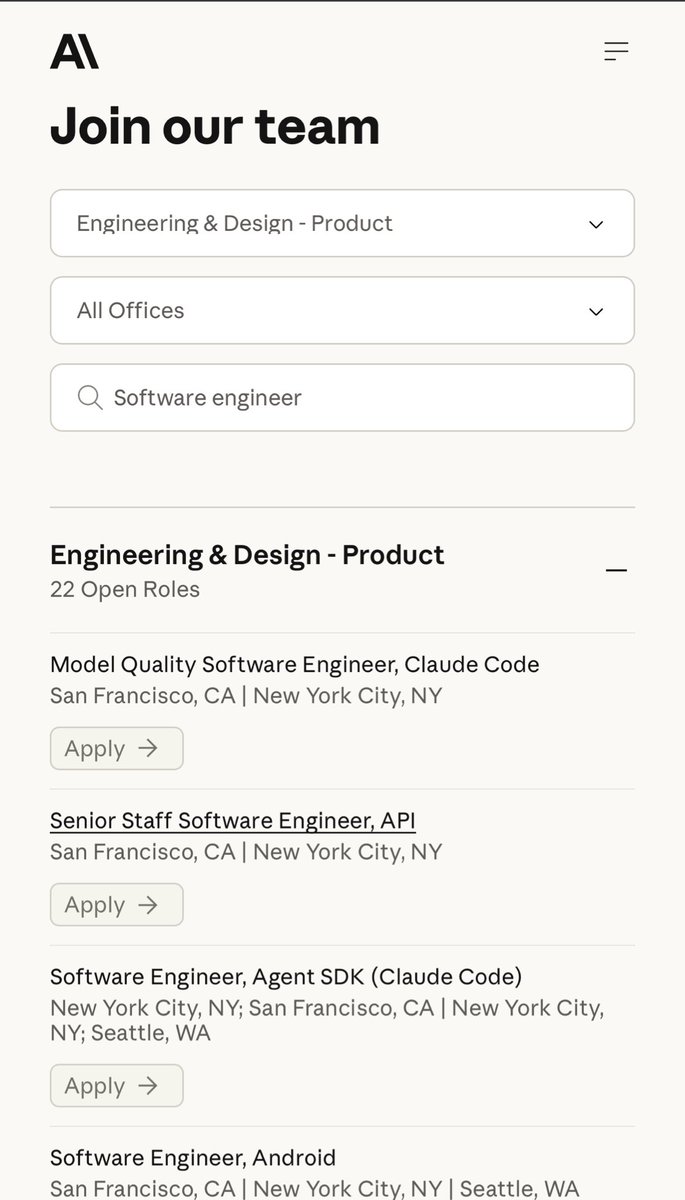
So Anthropic just opened 22 roles only for 6 months?

Kekius Maximus@Kekius_Sage
🚨 ANTHROPIC CEO SAYS AI WILL REPLACE MOST SOFTWARE ENGINEERS WITHIN 6–12 MONTHS
English

You are in a Modern Tech Interview.
You have full access to Claude Code.
The interviewer hands you a slow, synchronous Python script that fetches data from 100 different API endpoints. It currently takes 5 minutes to run.
The challenge: "Refactor this to be concurrent (where possible), implement exponential backoff for rate limits (429 errors), and write unit tests for the error handling. You have 40 minutes."
How do you start?
English

The “AI Engineer” job is changing quickly. Here is what a Modern AI Engineer should know:
1. Orchestrating the "Crew"
The future is Multi-Agent Systems (MAS). Why have one LLM do everything when you can have a team?
Frameworks: CrewAI for role-based orchestration or Microsoft’s AutoGen for conversational agents.
2. Master the "Brain" of the Operation: LangGraph
Linear chains are for toys. Complex business logic is a graph.
3. Stop Basic RAG, Start Agentic Retrieval
Forget simple "top-k" vector searches. That was 2024.
- The Tech: Advanced Embeddings (multimodal) + Vector Databases (Milvus, Pinecone, or Weaviate).
4. The "Action" Layer: Agentic Tool Use
An AI that can’t touch the real world is just a sophisticated poet.
- Skills: Use MCP (Model Context Protocol) to give agents deep access to local data and secure environments.
English

Most In-Demand Tech Roles (2026 Hiring Demand):
- AI/ML Engineers: 91% (Driven by LLM integration and local model deployment)
- Cybersecurity Engineers — 88% (Rising demand due to AI-driven threats and regulatory compliance)
- Data Scientists & Analysts — 84% (Essential for fueling proprietary AI training sets)
- Full-Stack Developers — 82% (Shifted focus toward building AI-agentic interfaces)
- Cloud Architects — 79% (Scaling infrastructure for compute-heavy AI workloads)
- DevOps / MLOps Engineers — 76% (Critical for automating the AI lifecycle)
- AI Ethics & Governance Leads — 72% (New high-growth role focused on compliance and safety)
- Prompt Engineers / AI Interaction Specialists — 68% (Evolving from a "fad" into a specialized UI/UX discipline)
- Mobile App Developers — 65% (Emphasis on "On-Device" AI processing)
English

HOT TAKE: Demand for developers with surge with AI.
Historically, when cost of a resource drops, demand for it explodes. As AI makes software cheaper, companies won't build the same amount with fewer devs.
They will build 100x more software, have custom features with same/more number of devs.
English