
Закреплённый твит
willo2
216 posts


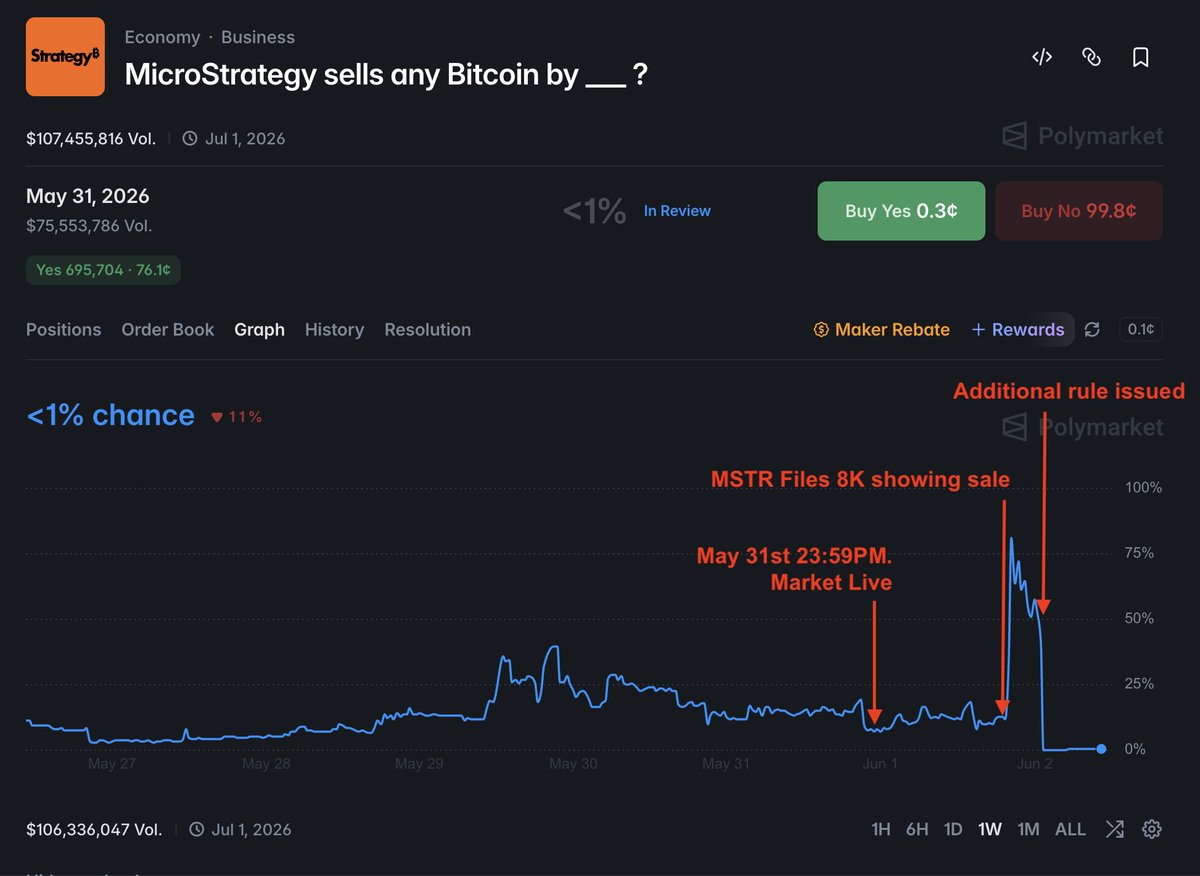


If Polymarket can’t get this correct there is 0 reason to ever use them as a 4th grader could figure out the proper resolution here. Clarifications can’t add new rules.
15 billion dollar company btw
willo2@willo2_Poly
I was just scammed for $500K by Polymarket. I am "willo2", the top holder of YES on "MicroStrategy sells Bitcoin by May 31st". Here's what happened:
English
Guys, thank you for all the support.
It's been a long day, I was hoping that people would understand my perspective but I didn't expect the level of solidarity that I would find from CT.
I'm going to keep fighting for all YES holders.
We will win against Polymarket. 🐦
English
@bryantheden Exactly, the receipts don't lie
Strategy sold - it's as clear as day. Absolutely shameless behaviour from Polymarket
English

The "will strategy sell btc by may 31" polymarket market just resolved NO
and strategy literally filed an 8-K with the SEC confirming they sold 32 BTC between May 26–31
i don't know how to make this more clear
my answer: YES, they sold and i'll explain exactly why
32 BTC sold, avg price $77,135, total ~$2.5M in proceeds, purpose: fund preferred stock distributions
this isn't speculation, this isn't on-chain noise this is Strategy's own SEC filing, Form 8-K, filed June 1, 2026
the receipts don't lie
the market rules literally say: "This market will resolve to Yes if MicroStrategy sells ANY of its Bitcoin by 11:59 PM ET on the date specified"
ANY 32 BTC sold before the deadline but polymarket resolved NO anyway
here's what happened behind the scenes:
on-chain data showed ~411 BTC move from Strategy wallets → Coinbase Prime Deposit, market odds jumped from 3% → 40% in hours, then the same BTC moved back out, polymarket saw the chaos and proposed "No"
people disputed it twice then polymarket added an after-the-fact "clarification" saying on-chain moves don't count unless confirmed by official disclosure
so the official disclosure came
Strategy's 8-K to the SEC, black and white: "BTC Sold: 32 | Aggregate Sale Price: $2.5M | Average Sale Price: $77,135 | Period: May 26–31, 2026"
that is the definition of selling BTC by May 31
polymarket's response? still NO
one trader lost $500k on YES
this is the playbook now add after the fact rule clarifications mid-dispute, ignore the primary resolution source (MSTR official disclosure + SEC filing), protect the majority position (NO was 99¢, YES was 0.7¢)
if you can rewrite the rules whenever it's convenient, what's the point of rules at all
polymarket's credibility just took a direct hit not from a gray-area market, not from a vague rule, but from a market where the answer is literally inside a government filing
the 8-K exists to comply with SEC disclosure requirements the most regulated, audited, publicly verifiable document in finance
and polymarket chose to ignore it this isn't about $500k
it's about whether prediction markets can be trusted when the answer is inconvenient
if YES resolves correctly → polymarket is a truth machine
if NO holds → it's just another venue where house rules bend toward whoever has more liquidity on the other side
we're about to find out which one it is

English


Polymarket, what are you doing with the MicroStrategy BTC sale market?
The market closed on May 31 (Sunday) at 11:59 PM ET.
MicroStrategy sold 32 BTC between May 26-31 (clear in the filing).
SEC 8-K was published on June 1 (Monday) — everyone knows filings don’t happen on Sunday.
Yet Polymarket added a clarification on June 1 (after the market closed):
“Confirmation achieved outside of the market’s time frame does not qualify.”
You changed the rules after trading ended and after
the filing came out.
@Polymarket
willo2@willo2_Poly
I was just scammed for $500K by Polymarket. I am "willo2", the top holder of YES on "MicroStrategy sells Bitcoin by May 31st". Here's what happened:
English
@TheFlowHorse Thank you Mr Flow Horse the support means a lot.
Polymarket have to do right by my fellow YES holders, I won't let them get away with this
English

If this was me, I would lawyer up and be hanging out right outside Polymarket’s upper east side location.
willo2@willo2_Poly
I was just scammed for $500K by Polymarket. I am "willo2", the top holder of YES on "MicroStrategy sells Bitcoin by May 31st". Here's what happened:
English

> read the news that Saylor sold 32 BTC between May 26 - May 31
> slam the orderbook for $500K on Polymarket that Strategy indeed sold bitcoin before May 31
> lose $500K because you should have known that confirmation achieved outside of the market's time frame does not qualify

English

@willo2_Poly The argument for no is that you have to ignore the rules of the market entirely and go based on another set of rules not stated
English
The rules were very explicit. So explicit in fact that I have trouble understanding how people are arguing NO
The market was "Did Microstrategy Sell". Not Did Microstrategy Announce.
They sold.
DeFiyst@DeFiyst
@Polymarket needs to ensure the MicroStrategy UMA dispute goes in the right direction. If people can't trust a resolution in favour of black and white text in a form 8-k filed to SEC's EDGAR, you risk serious erosion of your >$20bn brand enterprise value.
English

@ProfessorCornel @Polymarket Polymarket added this "Confirmation achieved outside of the market's time frame does not qualify."
It's insane because clearly the market was open while the 8K was issued.
There was no reason to think the 8K would be disqualified, but Polymarket decided not to recognise it.
English

@willo2_Poly @Polymarket whats the change? i mean what do u mean actually?
English
SEC Form 8-K filed on June 1
so technically @Polymarket is right

Cornel@ProfessorCornel
The recent MicroStrategy market has raised a lot of debate on Crypto X. The market asked: → Would MicroStrategy sell any Bitcoin before the end of May 2026? Later, SEC filings and on-chain data showed that around 32 BTC had been sold, so many traders expected the market to resolve YES. Instead @Polymarket resolved it as NO. The reason is simple: Prediction markets don't just care about what happened. They care about whether the event qualifies under the market's resolution rules. Polymarket had already established precedent in similar markets that information confirmed after the market timeframe would not count the same way for resolution. Many people disagree with the outcome, but changing the rules after the deadline would've created an even bigger problem. If markets could be changed days or weeks later whenever new information appears, traders would never know when a market is truly settled. The willo2 situation is also an important lesson. After the news became public, he reportedly kept buying large amounts of YES shares while the market was still trading around 70-80%. That price alone was a warning that there was uncertainty around the resolution. If something looks like free money, it usually isn't! Greed can make people ignore risk, especially when they believe the outcome is obvious. In the end, the biggest issue wasn't the NO resolution itself. But the lesson is clear: → Prediction markets run on rules, not headlines. → Precedent matters. → And greed can be far more expensive than being wrong. The lesson isn’t that Polymarket stole $500k . The lesson is that greed can make people treat uncertainty like certainty like @willo2_Poly
English

so ugh is polymarket going to respond here?
sickening stuff
willo2@willo2_Poly
I was just scammed for $500K by Polymarket. I am "willo2", the top holder of YES on "MicroStrategy sells Bitcoin by May 31st". Here's what happened:
English
@KllN349312 @mhorsman013 @CamillusLellis Here's a Hypothetical Question.
If you were an evil bucketshop who purposefully scams its users, and you wanted to make the maximum amount of money off this -
Precisely what would you do differently to what Polymarket did here?
Most likely? You would do exactly what they did.
English

I read it as market opened with certain rules. The market stayed open even though the deadline had passed. Microstrategy then filed the 8-k filing confirming that they had sold BTC before the deadline. Then Polymarket „clarified“ that confirmation outside of the timeframe doesn’t count and the market resolved to „No“.
If confirmation outside the timeframe doesn’t count why would they wait until after that filing to resolve the market to „No“ in the first place? To me it looks like it if they were perfectly fine with letting confirmation outside the timeframe count but „clarified“ the rules when the criteria was actually met to their surprise.
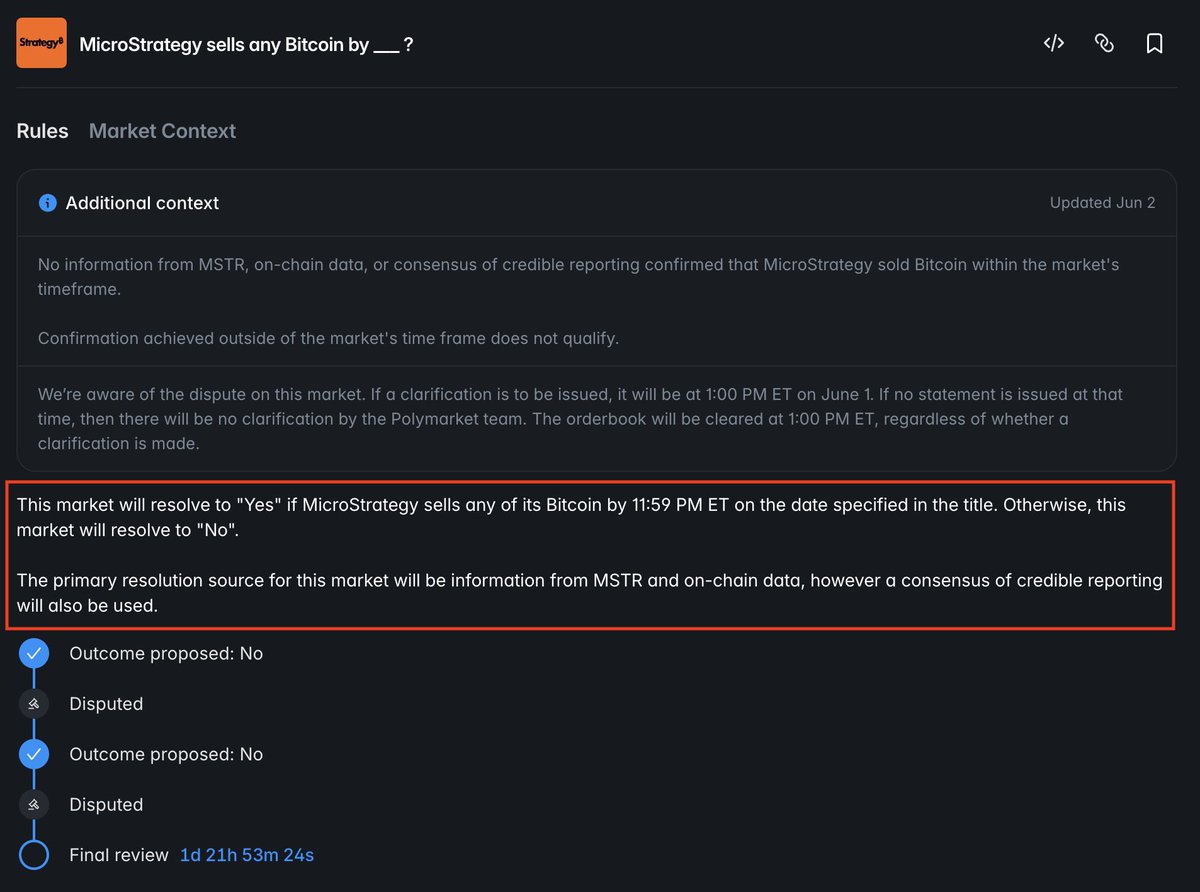
willo2@willo2_Poly
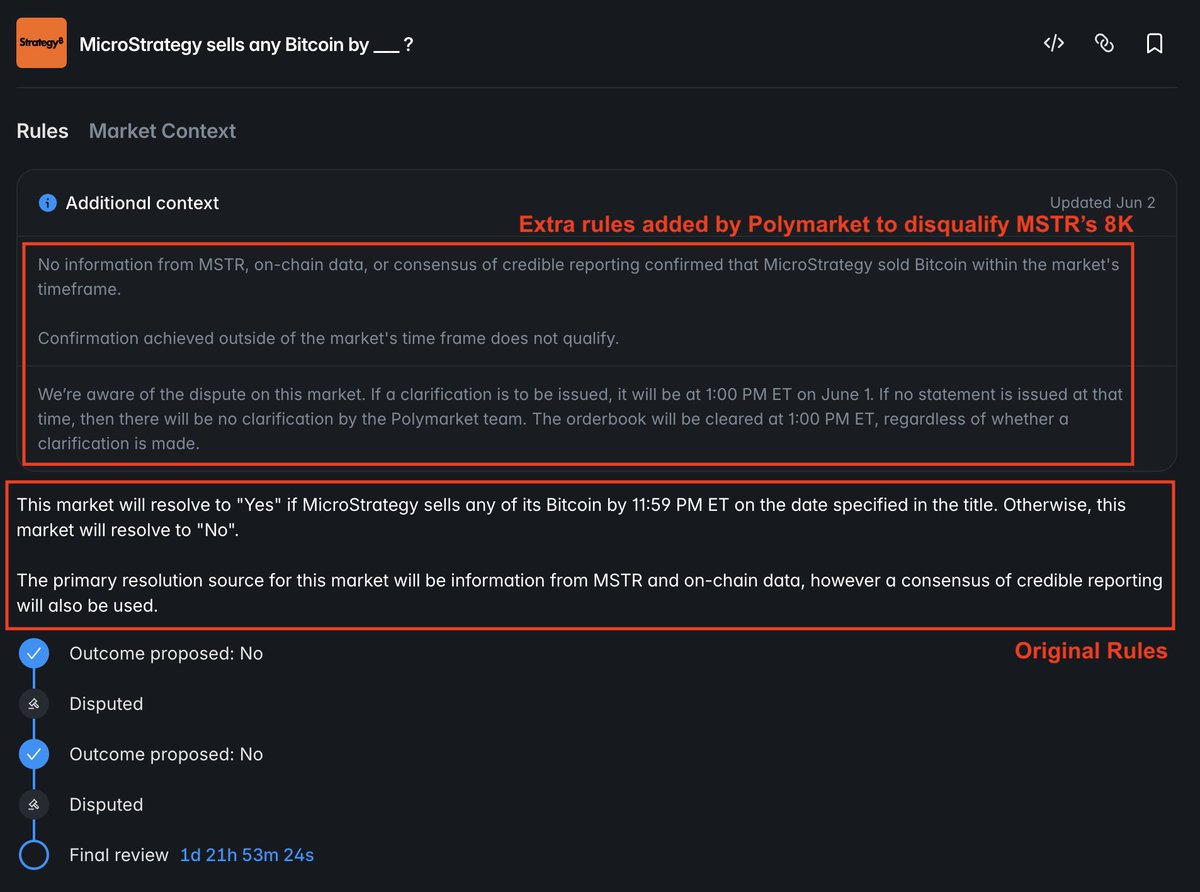
Later, Polymarket added clarification. "No information from MSTR, on-chain data, or consensus of credible reporting confirmed that MicroStrategy sold Bitcoin within the market's timeframe. Confirmation achieved outside of the market's time frame does not qualify."
English
@meustermint How about you read the rules of the market
The idea that 'previously we did this so going forward we will deny reality' is a special type of group hallucination that can only be dreamed up by the severely mentally ill
English

All those unfamiliar with resolutions should read this thread by Car
Car@CarOnPolymarket
MicroStrategy sold Bitcoin, but Polymarket resolved NO. Here's why:
English

Polymarket shills constantly claim this market was "ambiguous".
It was apparently so "ambiguous" that they couldn't tell whether MSTR sold Bitcoin in May or not.
FACT CHECK: The original rules were crystal clear. All evidence submitted while the market is live should be valid.
The Greek Trader@TheGreekTrader
When the rules are ambiguous, Polymarket can clarify them. This is how the platform works, there have probably been 100+ clarifications just this year. The ambiguous part here was, whether or not, information outside of the market's timeframe will count. They don't just randomly change the rules, they only do it when things are ambiguous enough that the market can't be resolved properly. If you don't agree with this, I guess you shouldn't use the platform and you clearly already knew this is how it works. Also, you ignored all my other arguments and just picked this one. And for the record, if you read my post, I already said this was Polymarket's mistake for not clarifying the market earlier or not having better rules in the first place. But it was also your mistake for being greedy & going all in when it was obvious that there was ambiguity and something going on.
English
@llamaonthebrink @CarOnPolymarket Exactly. Polymarket purposefully didn't include any mention of this in the rules. There was no mention that they reserved the right to disqualify the final week of May (for no reason)
The end result of this is that their users get scammed.
English

@CarOnPolymarket There is zero reason to keep this “unspoken rule” a secret
This wasn’t an old market, it was new. They could have easily included the clause in the rules.
On top of that, the earliest that MSTR could have reported sales for the last week of May was yesterday.
Which they did.
English

@0xDinoCrypto Doing God's work. Let's Go!
It's time to hold these scumbags to account.
English

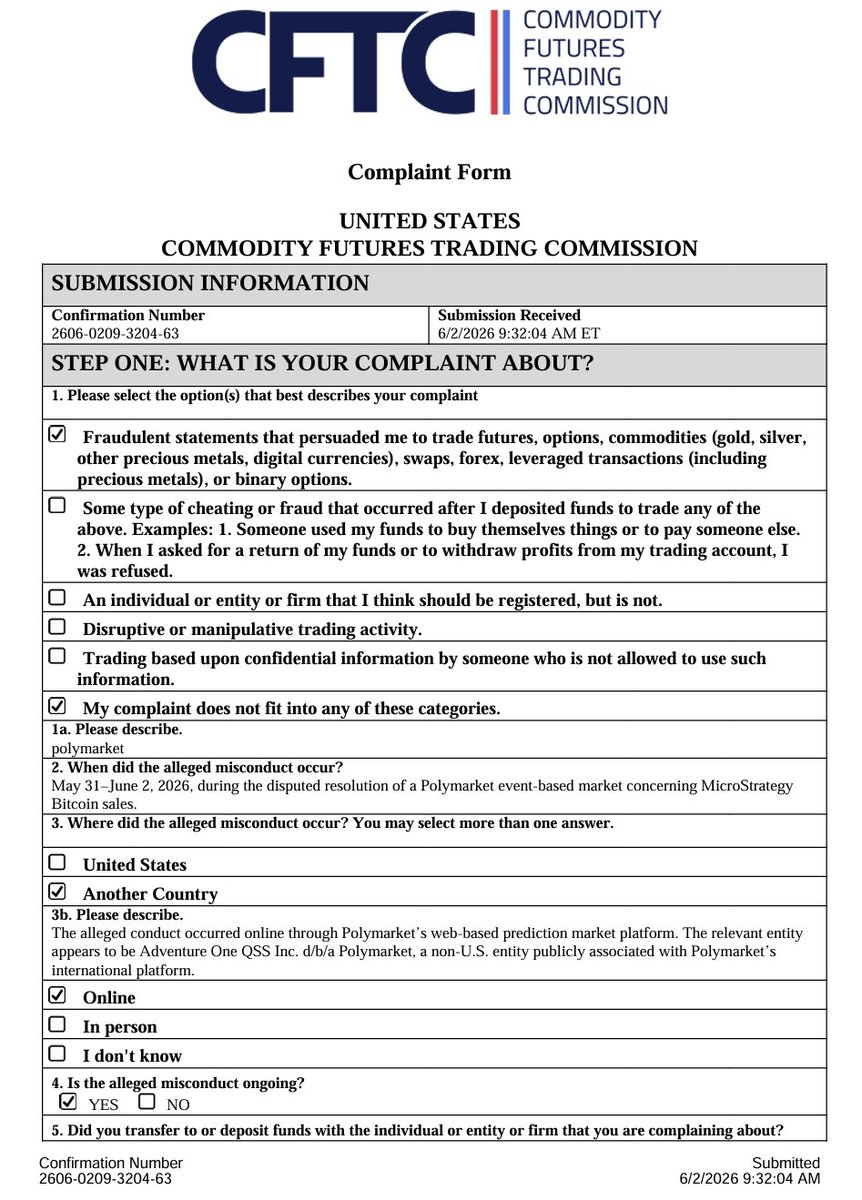
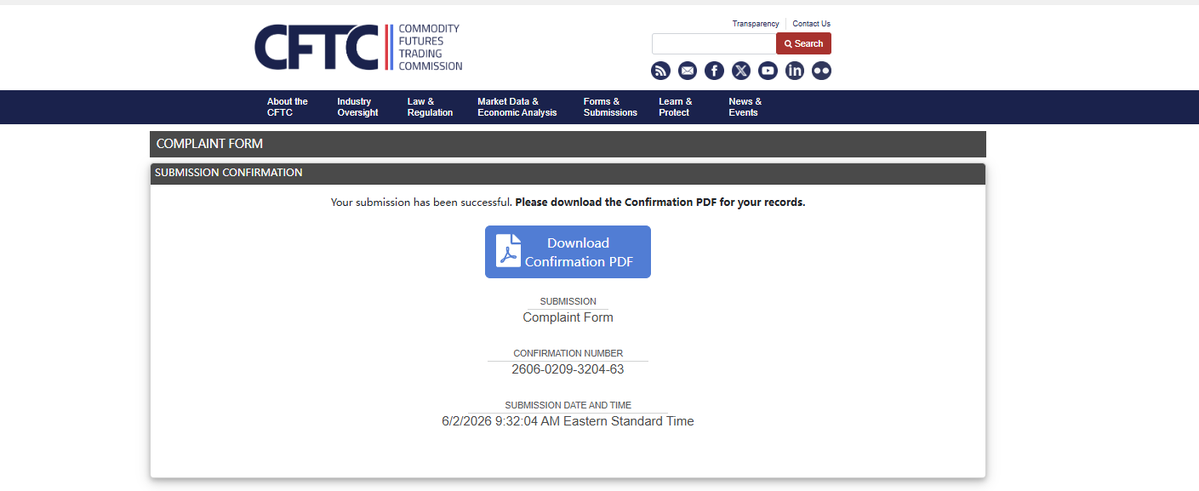
I have officially submitted a complaint form to the CFTC regarding the disputed Polymarket market:
“MicroStrategy sells any Bitcoin by May 31, 2026?”
The rule said “sells,” not “discloses.” The dispute now deserves regulatory attention, proper documentation, and a fair review.
I will continue preserving evidence and pursuing every lawful path available.

English
@ithinkthisisgod @fr1ko_eth The rules were Microstrategy sold Bitcoin in May.
They did.
English

@fr1ko_eth @willo2_Poly u r fucking dumb for not knowing how rules work
English
Hey Polymarket actually according to you this did not happen
Polymarket Money@PolymarketMoney
$MSTR sold 32 Bitcoin for ~$2.5M last week.
English
@BTCBeliever21 @Polymarket I'm very glad you took profit brother.
It's absolutely insane that they are trying to resolve it as NO, when it was clear how much hard work you had put into predicting this outcome.
If you hadn't sold, your entire position and work would have been rugged to zero. That's crazy
English

This research and article made me $146,185.27 in profit.
It also made me rank #1131 out of 1.7 Million traders.
One single trade placed me as a top 0.07% trader on @Polymarket for all categories and in all time.
I published my thesis on May 24 when YES traded at 11¢. A few days later I was buying up shares as low as 2¢.
I ended up holding 200,000 shares at 7.5¢ each and became the #1 holder on May 31, 23:59.
Nobody believed they would sell. I argued the thesis endlessly with 100's of comments on Polymarket and X.
8 hours later Strategy's 8-K confirmed they sold 32 BTC. YES shares jumped to ~85¢ on the conclusive evidence.
My average exit was ~75¢, cashing out over $146,000, before Polymarket decided the change the market rules.
The only condition was that they sold. Suddenly they sided with NO whales and say it wasn't confirmed on time. This was nowhere to be found in the rules.
I'm not giving up yet. My dispute is still ongoing. Polymarket simply can't resolve it to NO in good faith.
Did I get lucky? Maybe. But I also worked 100 hours last week on researching, writing and defending the thesis.
I've had 6 figure profit trades before in crypto. Always on the back of hundreds of hours of research and work.
Work hard. Have faith. Believe in something.
And never, ever give up on your dreams.

₿itcoin ₿eliever@BTCBeliever21
English
@buythedipagain @laurashin Exactly. The industry needs to change otherwise this will just keep happening
English

@willo2_Poly @laurashin this is prediction gambling.
a multi billion dollar casino with rules that can change and you have no option to legally fight it.
time to burn those casinos down to the ground.
English