Mark Zandi

2.3K posts

Mark Zandi banner
Mark Zandi

Mark Zandi

@Markzandi

Chief Economist @economics_ma. Host of Inside Economics podcast https://t.co/ONmSCQ65Ib. Co-founder of https://t.co/ZAo6ME72qu. Views expressed here are my own.

เข้าร่วม Mart 2010
151 กำลังติดตาม48.6K ผู้ติดตาม
Mark Zandi
Mark Zandi@Markzandi·
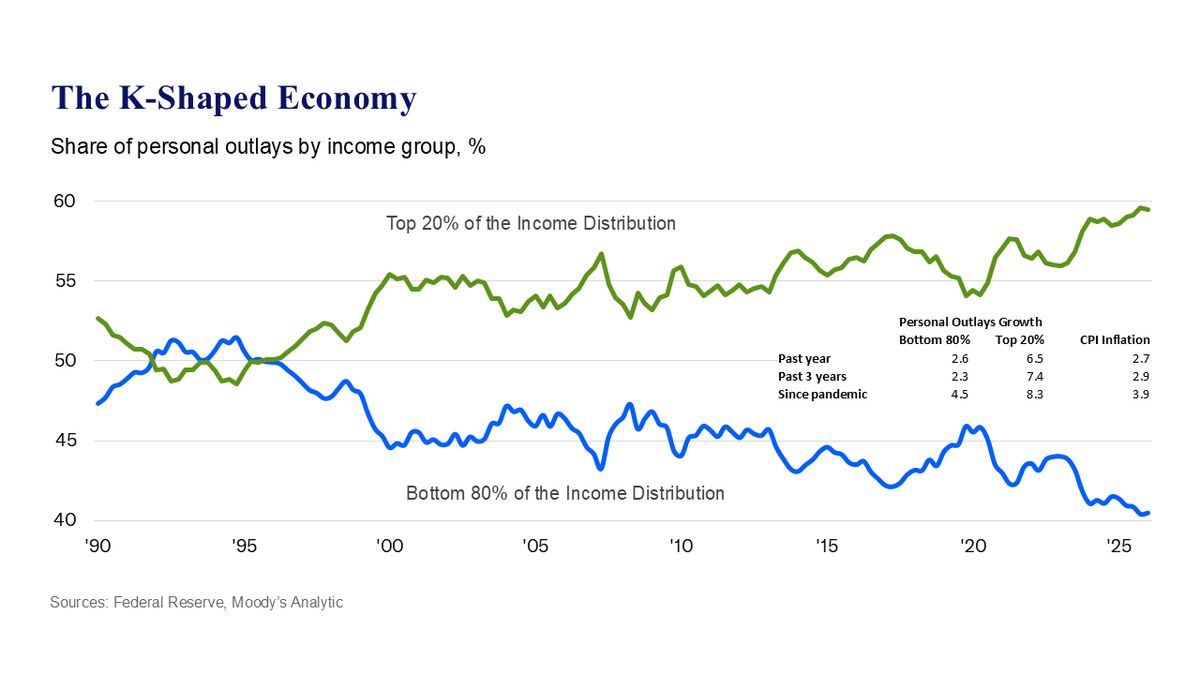
The K-shaped economy remains firmly intact. That’s according to our updated estimate of personal outlays by income group for 2026q1, based on the Fed’s Financial Accounts and Survey of Consumer Finance. Americans in the top 20% of the income distribution (those who earn over $175k annually) account for an astounding nearly 60% of outlays. The top 20% is driving spending and the economy. Their outlays increased by 6.5% over the past year and by 7.4% per annum over the past 3 years, well above CPI inflation of 2.7% and 2.9%, respectively. But outlays by those in the bottom 80% fell short of inflation. No wonder most Americans are upset with their financial situations and the broader economy. ICYMI, our estimates have come under some criticism. Fair enough. While we use a methodology devised by Fed researchers long ago, even with the modest adjustments we have made, these estimates may overstate the case. But they make an overwhelming case that the economy is K-shaped and becoming increasingly so. Our methodology is an open book: economy.com/getfile?q=8D6D…
Mark Zandi tweet media
English
1
10
39
4.6K
Mark Zandi รีทวีตแล้ว
Prof G Markets
Prof G Markets@ProfGMarkets·
Ed Elson and @Markzandi on the new Fed chair, Kevin Warsh as Federal Reserve holds rates steady but signals possible hike before year’s end: "The president, who has been aggressively calling for rates to be cut, this is what he was complaining about with Chair Powell for the longest time. There was a lot of debate over whether Kevin Warsh would kind of obey those demands. He has decided to be hawkish here, defying the president."
English
2
2
15
3.7K
Mark Zandi
Mark Zandi@Markzandi·
What do subways have to do with stocks? More than you'd think. Last week on #InsideEconomics, we were joined by James Lebenthal, Chief Market Strategist at Cerity Partners — and author of the fantastic new book How to Ride the Subway: Getting Around on Wall Street and in Life. Trust me, you'll never look at a MetroCard the same way again. Jim joins us on the morning of the #SpaceX IPO — talk about timing — to break down the equity market's extraordinary run, whether AI stocks are getting ahead of themselves, and the age-old debate: pick your own stocks or just buy the index? Check out Jim's book here: amazon.com/How-Ride-Subwa… Listen to the episode: podcasts.apple.com/us/podcast/sto…
Mark Zandi tweet media
English
3
3
16
1.9K
Mark Zandi
Mark Zandi@Markzandi·
New research out this week on how the Basel re-proposal will impact the mortgage market, co-authored with Jim Parrott and Laurie Goodman at the @urbaninstitute. Bottom line: moderately positive as drafted. The proposal gives banks a real incentive to hold more low-LTV loans, and the change in the mortgage-servicing right threshold quietly opens the door for nonbanks to pursue bank charters. But the rule leaves meaningful gains on the table. Three targeted fixes — clarifying the residential exposure definition, expanding the securitization definition, and recognizing PMI — could roughly double the benefit to borrowers. Worth a read if you're thinking about where bank vs. independent mortgage banks (IMBs) market share goes from here, what it means for Fannie and Freddie, or who wins and loses on borrower pricing. economy.com/getfile?q=FBDD…
Mark Zandi tweet media
English
0
4
16
3.6K
Mark Zandi
Mark Zandi@Markzandi·
If Warsh doesn’t buck his colleagues on holding rate unchanged and eliminating the easing bias, it would help assuage fears over #Fed independence. Those worries have already receded with former chair Jay Powell’s decision to stay on. And if the Supreme Court rules that the President can’t fire Fed officials at will, as expected, it’s (mostly) a reason to exhale.
English
0
1
13
2.3K
Mark Zandi
Mark Zandi@Markzandi·
This, despite the new Fed chair’s own seeming bias to ease rates. He has called out trimmed mean inflation, which is rising more slowly than the Fed’s current preferred measure, the PCE deflator. He has also argued that AI will lower inflation. Neither argument is convincing, as trimmed mean is also above target, and, at least so far, AI is juicing inflation.
English
1
1
12
2.7K
Mark Zandi
Mark Zandi@Markzandi·
The Fed meets this week, and while it will be the first with Kevin Warsh as chair, it is tough to see any significant changes to monetary policy. The Fed is stuck between surging inflation, which argues for rate hikes, and a soft job market, which argues for cuts, thus no change. One likely tweak will be to remove the easing bias in the last meeting’s statement.
Mark Zandi tweet media
English
9
13
50
6K
Mark Zandi
Mark Zandi@Markzandi·
It’s tough to ignore the seeming tension that on the same day (last Friday) that SpaceX went public, the U.S. government slapped export controls on Anthropic’s Mythos and Fable LLMs. The SpaceX IPO is the largest in history, by 3x, and embodies the runaway optimism over AI’s prospects. However, the government’s move on Anthropic, forcing the company to pull the leading-edge LLMs from use, highlights a massive threat to that optimism, and by extension, the stock market and economy. It is hard to imagine that the USG won’t quickly come to terms with Anthropic on the use of these LLMs, but it is equally hard to imagine there won’t be lots more government restrictions on AI’s use coming soon. Optimism over AI is warranted, but the cautious kind seems wisest.
English
4
5
56
8K
Mark Zandi รีทวีตแล้ว
Prof G Markets
Prof G Markets@ProfGMarkets·
@Markzandi on inflations 4.2% May print, from today's episode: "It goes to the tariffs. There's still some tariff pass-through. It goes to the restrictive immigration policy, which is having an impact on different industries and, uh, causing sticky service price inflation. And also AI. AI is juicing up demand, the data center infrastructure buildout, consumer spending because of the wealth effects ...You can see it in electricity prices, you can see it in chip prices..."
English
1
2
13
3.1K
Mark Zandi
Mark Zandi@Markzandi·
It is rare for the two employment surveys to tell such different stories about the job market. Perhaps it shouldn’t be too surprising, given the extraordinary measurement and response rate problems both surveys are struggling with. These dueling stories will thus only get reconciled with more data. But my bet is the job market isn’t as upbeat as the payroll survey suggests or as downbeat as the household survey suggests, which, when you add it up, means it still isn’t that great.
English
1
1
23
2.4K
Mark Zandi
Mark Zandi@Markzandi·
Positive, but weak job growth is also consistent with other related data. Real GDP growth is stuck near 2% at best, and given that productivity growth is about the same and hours worked are unchanged, there is little, if any, room for job growth. Then there are the historically low hiring and separation rates. There is no indication that the no-hire, no-fire dynamic that has been weighing heavily on the job market for some time has changed.
English
1
4
38
4.1K
Mark Zandi
Mark Zandi@Markzandi·
Just how strong is the job market? Judging by the payroll employment survey, it’s pretty strong. Payroll employment is up by 409,000 since January. But judging by the household employment survey, it’s pretty weak. Household employment, adjusted to be conceptually on the same basis as payroll employment, is down by 382,000 since January. The reality is likely some weighted average of the two survey results, suggesting job growth is above water, but not by much.
English
9
16
81
9.3K
Mark Zandi
Mark Zandi@Markzandi·
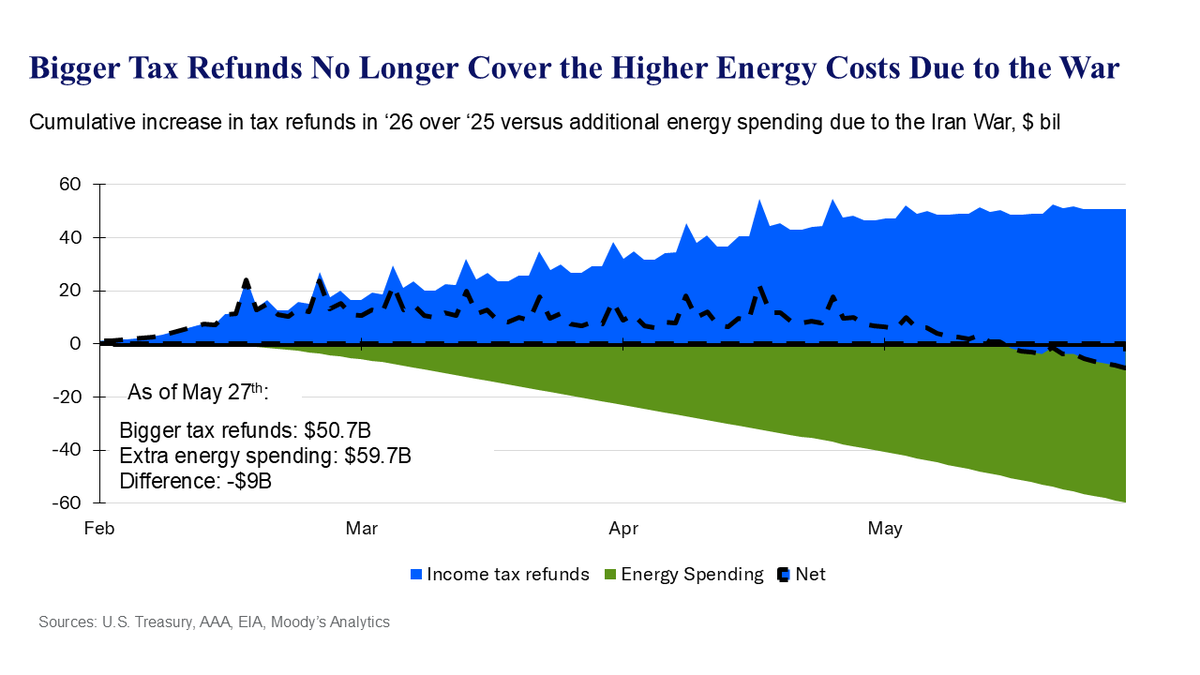
$100 billion. That’s our estimate of the cost of the Iran War to American households. That’s nearly $750 per household. This includes the additional U.S. military costs and the higher energy and other prices resulting from the war. This is a big economic blow, but deficit-financed tax cuts have cushioned it. Until now. As of May 16th, the bigger tax refunds Americans have received this year no longer cover the higher costs of gasoline, diesel, and jet fuel caused by the war. The financial pressure is thus mounting quickly, particularly on already hard-pressed middle and lower-income households. With the saving rate about as low as it ever goes, unless the war ends soon and energy prices come down, they will have little choice but to rein in their spending, weighing further on the already sagging economy.
Mark Zandi tweet media
English
64
369
706
96.8K
Mark Zandi
Mark Zandi@Markzandi·
The economy isn’t just soft, it’s struggling. That's the clear message in the flood of economic data released today. Ordered from least to most worrisome: First-quarter real GDP was revised down to just 1.6% and this includes the bounce back from the government shutdown at the end of last year. Then there is the durable goods report, which showed a decline in core capital goods in April. The decline comes after some strong readings, but it's still not great. New home sales were also weaker than expected, as higher mortgage rates overwhelmed homebuilders’ incentives. Then there was the decline in real disposable income and another sharp decline in the personal saving rate, which has only been briefly lower in the housing bubble twenty years ago. Consumers are running out of financial resources to maintain their spending, which stalled out last month. And then, of course, there is the surge in inflation, which is closing in on 4%, double the Federal Reserve’s target. And of all of this, with the benefit of massive deficit-financed tax cuts, which are now fading fast. The Iran war needs to end, and the Strait of Hormuz needs to be reopened soon, or recession will become more likely than not.
English
25
112
367
28.2K
Mark Zandi
Mark Zandi@Markzandi·
This week’s economic data will tell a familiar story: resilience, but growing strain beneath the surface. The good: durable goods orders should be strong, underscoring that business investment remains the economy’s brightest spot. Much of this is tied to AI-related spending and incentives from the corporate tax provisions in the OBBBA. The okay: GDP, income, and consumer spending data will likely show the economy continuing to grow at roughly a 2% pace. That’s enough to keep the expansion going, but below the economy’s potential growth rate. The consequence is a labor market that is slowly softening, with unemployment edging higher and participation drifting lower. The bad: housing. New home sales are expected to remain weak as higher mortgage rates following the war and deeply strained affordability continue to weigh on demand. Homebuilders are leaning heavily on incentives, including mortgage rate buydowns, to keep buyers engaged. The ugly: inflation. The PCE deflator will likely show inflation running close to 4%, with core inflation still well above 3% — far from the Fed’s target and uncomfortably high. Put it all together, and the economy is still growing. But it is tenuous growth, increasingly dependent on a narrow set of strengths while more sectors weaken around the edges.
English
7
17
65
6.3K