Stephen Jackson รีทวีตแล้ว
Stephen Jackson
5.8K posts

Stephen Jackson
@jackson684
Interested in multimodal brain imaging and brain stimulation and the pathophysiology of Tourette syndrome. Tweeting in personal capacity
University of Nottingham เข้าร่วม Mart 2011
358 กำลังติดตาม513 ผู้ติดตาม
Stephen Jackson รีทวีตแล้ว

Will be the first Prime Minister that the UK has had since 1979 that isn't controlled by Rupert Murdoch.
Which apparently makes many people very angry.
BladeoftheSun@BladeoftheS
Zack Polanski. Your next Prime Minister.

English
Stephen Jackson รีทวีตแล้ว

In January BBC News provided 37 minutes of live coverage of a Reform press conference (12 minutes and then 25 minutes).
@ZackPolanski has done a press conference for the Greens this morning, & never mind any live coverage, I haven't even see it mentioned!
Saul Staniforth@SaulStaniforth
BBC News have just played 12 minutes of uninterrupted coverage of Nadhim Zahawi at a Reform press conference.
English
Stephen Jackson รีทวีตแล้ว

Here we have Reform Richard Tice.
He believes in reimposing the cruel two-child benefit cap.
Willingly innocent children back into abject poverty.
Happy for said children to starve.
Whilst he avoids paying a staggering £600,000 in Tax.
Tice = morally bankrupt.
#bbclaurak

English
Stephen Jackson รีทวีตแล้ว

In 1348, the Black Death reached England.
By 1350, somewhere between a third and a half of the English population was dead.
What happened next was, from the perspective of the English nobility, a disaster that had nothing to do with plague.
Labour was suddenly catastrophically scarce. Peasants who had survived the decimation found themselves in possession of something they had never previously held: leverage. Lords needed workers to bring in harvests, to tend livestock, to maintain estates. Workers could demand pay. They could demand conditions. They could, in the chaos that followed, demand food.
And what they demanded, when they had the power to demand it, was meat.
The historical record here is specific and striking. Post-plague wage contracts from the 1350s and 1360s frequently include food provisions as part of the payment, and the food provisions include meat. Fresh meat. Multiple times per week. Not the feast-day and harvest-time access that had previously defined peasant protein consumption. Regular, weekly, contractual meat.
Within a generation of gaining access to adequate animal protein, the skeletal record shows measurable change. Average height among the labouring classes increases. Bone density improves. The markers of chronic nutritional deficiency that define pre-plague peasant remains begin to appear less frequently.
A well-fed labouring class is a productive labouring class, which is good. It is also, however, a physically capable labouring class, which is rather more complicated.
The English nobility was alarmed.
In 1349, Parliament passed the Statute of Labourers, attempting to freeze wages at pre-plague levels and prevent workers from demanding "excessive" compensation. The Statute was widely ignored because the economic reality overwhelmed the legal intention. Labour remained scarce. Workers remained able to negotiate.
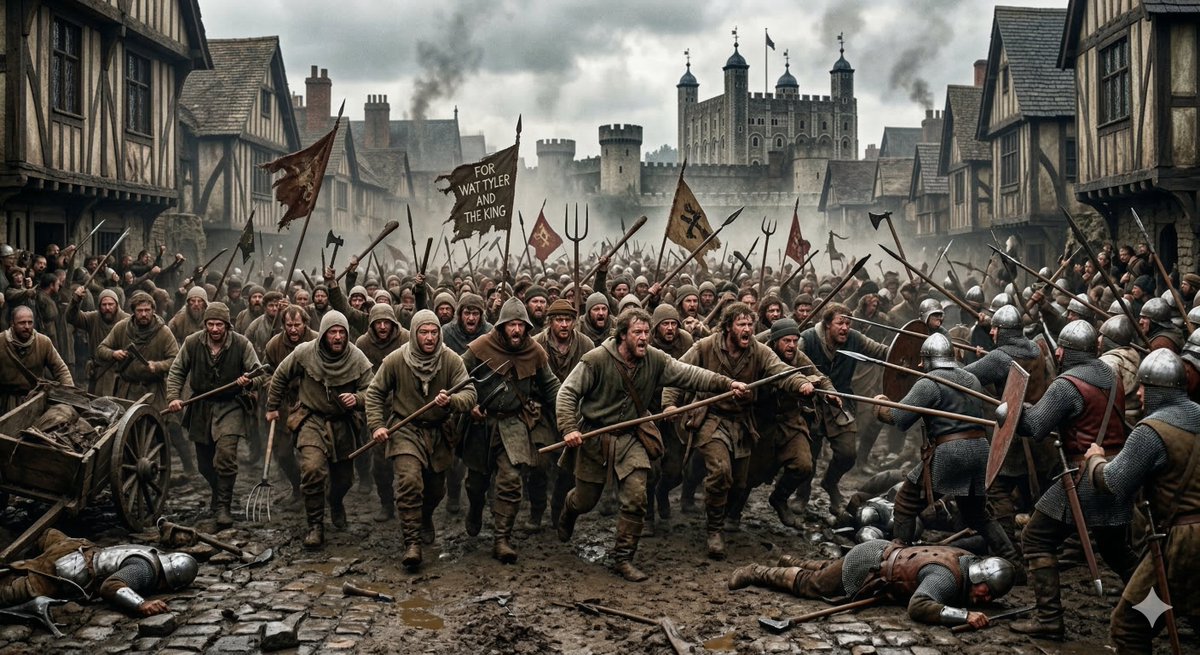
The Peasants' Revolt of 1381 brought a well-fed army of common people to the gates of London. They burned the Savoy Palace. They beheaded the Archbishop of Canterbury and the Lord High Treasurer. They presented a list of demands to Richard II that included the abolition of serfdom and free access to the land.
Richard, who was fourteen years old, rode out to meet them at Smithfield. His advisors had the rebel leader Wat Tyler killed during the negotiations. The revolt was suppressed.
The lesson the ruling class drew was not that they should keep feeding people adequately.
The lesson they drew was that they should never again allow the conditions that had produced an adequately fed peasantry.
The Forest Laws tightened. Sumptuary legislation was introduced: laws dictating what foods the lower orders were permitted to consume, framed in the language of moral propriety. Religious fasting requirements were enforced more rigorously.
The experiment in meat equity lasted approximately thirty years.
The nobility shut it down as quickly as they were able.
The Peasants' Revolt is taught as a failed rebellion.
It might more accurately be taught as proof of what happens when you feed people properly.

English
Stephen Jackson รีทวีตแล้ว