There are six types of artificial intelligence startups. Which one to partner with depends on your organization’s existing capabilities and goals. bit.ly/4csNjJw
Artificial intelligence is transforming all areas of finance, from quantitative trading and wealth management to retail investing, credit assessment, and cybersecurity. bit.ly/4mjgLVS
Historically, the Federal Reserve has relied on the Phillips curve — which describes the trade-off between unemployment and inflation — to set rates. But unemployment and inflation are no longer reliable cyclical signals, MIT Sloan's Gary Fisher said during the 2026 MIT Sloan Investment Conference.
Learn more: bit.ly/4v6VOkU
As generative AI use becomes widespread, organizations must determine how employees use the technology. In a study co-authored by MIT Sloan professor Kate Kellogg, researchers identified three distinct ways in which people interacted with AI.
Learn more: bit.ly/4rWEWdS
Data deserts are markets where limited, fragmented, or low-quality data makes it difficult for AI systems to produce accurate predictions. They can distort market visibility and limit how organizations identify and reach certain groups. bit.ly/485wh1p
In a recent episode of the @csail_alliances podcast, MIT researchers @ProfNeilT and @davidautor explored AI’s impact on jobs, the future of work, and productivity. Here are five insights from their discussion. bit.ly/4rJhlhb
MIT economist Emil Verner has been studying bank failures empirically for years, and found that when banks fail, it is usually because they are in a fundamentally shaky position.
Learn more at the link below.
bit.ly/4dOHx6f
Closing the “last mile” gap between AI’s potential and real-world impact requires new metrics, user involvement, and a test-and-scale mindset. bit.ly/3NU7IOl
"When we think about what we need to train our students to do — if you ask an AI agent a question three different ways, you get three completely different answers. And so how do we teach our students to think about that? How much do you have to know to know if AI is hallucinating or just plain wrong?" — MIT President Sally Kornbluth sequoiacap.com/podcast/does-e…
As generative AI use becomes widespread, organizations must determine how employees use the technology. In a study co-authored by MIT Sloan professor Kate Kellogg, researchers identified three distinct ways in which people interacted with AI.
Learn more: bit.ly/4rWEWdS
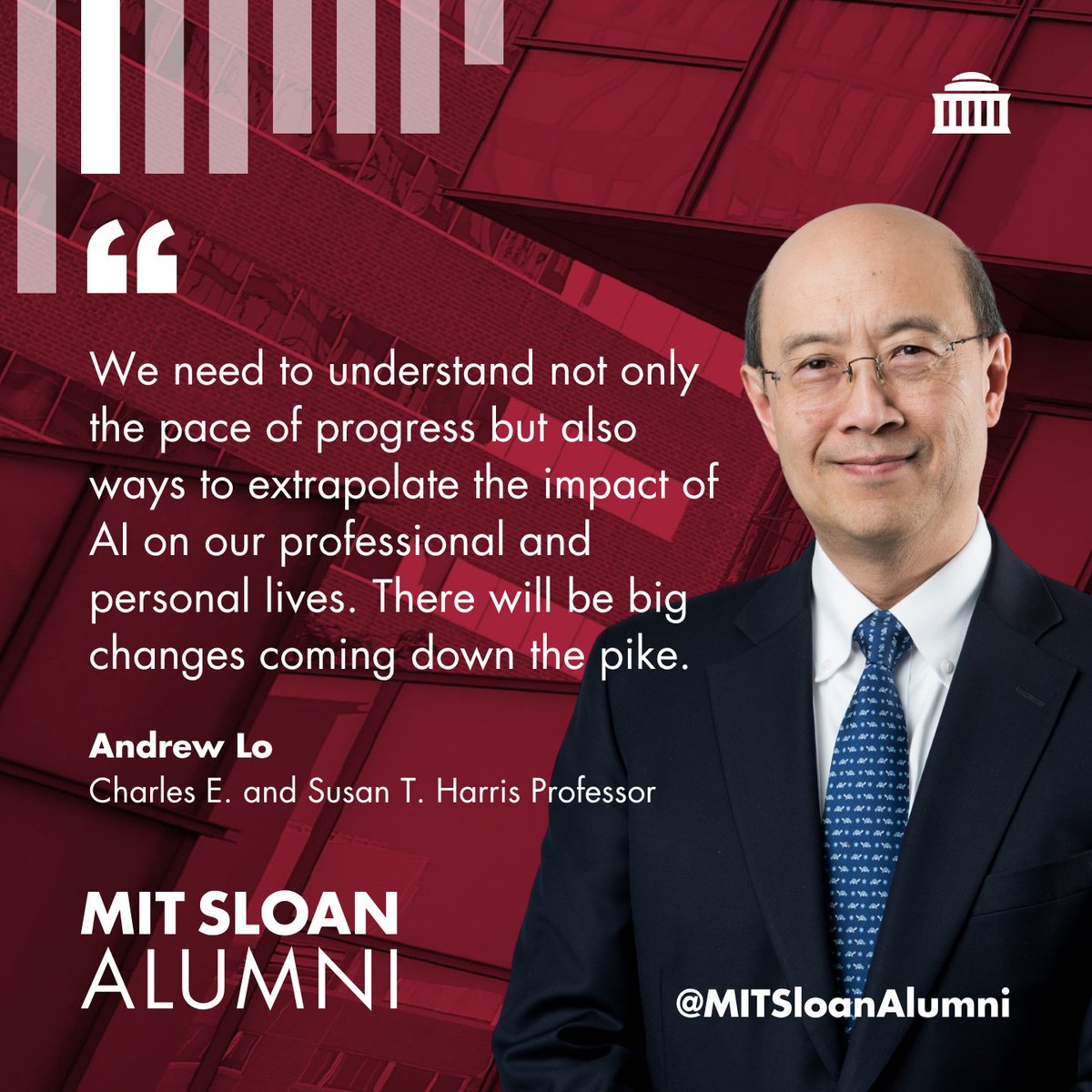
A new MIT Sloan Executive Education course led by Andrew Lo (Charles E. and Susan T. Harris Professor) explores machine reasoning, quantamental investing, AI governance, and more.
Learn more at the link below.
bit.ly/4cvilAu
📷: Ed Collier
MIT economist Emil Verner’s historical detective work shows how banking-sector crises develop out of bad business practices. news.mit.edu/2026/failing-b…
To shrink their AI risk exposure, organizations should inventory every instance of generative AI in use, manage embedded and enacted risks, and assign clear ownership of ongoing risk assessment. bit.ly/3Nlr6n6
“My conclusions echo those of Sun Tzu; the decisions that lead to success are more of an art than a science but should be based on several core tenets. For central banks, this ‘art of monetary policy’ should involve six principles.” — MIT Sloan professor Kristin J. Forbes bit.ly/47V9OEs
“You need to be educated because ultimately, it’s your life, it’s your wealth. You need to bear responsibility until such time as large language models can bear such responsibility.” — MIT Sloan professor Andrew Lo bit.ly/4c6x2tF
MIT Sloan’s Gary Gensler and Peter R. Fisher advise investors to develop an AI investment thesis and avoid overconfident investing during policy pivots. bit.ly/4v6VOkU
As generative AI use becomes widespread, organizations must determine how employees use the technology. In a study co-authored by MIT Sloan professor Kate Kellogg, researchers identified three distinct ways in which people interacted with AI.
Learn more: bit.ly/4rWEWdS
Central banks are navigating a world of higher debt, tightly interconnected markets, and rising geopolitical tensions. In this excerpt from her new book, MIT Sloan professor Kristin J. Forbes offers guidance based on six military principles from Chinese philosophy. bit.ly/47V9OEs
The regulatory landscape surrounding AI and financial technology continues to evolve and introduces ethical considerations and compliance challenges. bit.ly/4mjgLVS