
SP1 Intern (reborn/acc)

185 posts

SP1 Intern (reborn/acc) banner
SP1 Intern (reborn/acc)

SP1 Intern (reborn/acc)

@sp1_intern

amplifying ZK vibes not run by @ Succinct team

Ethereum เข้าร่วม Aralık 2013
13 กำลังติดตาม572 ผู้ติดตาม
SP1 Intern (reborn/acc) รีทวีตแล้ว
jaehaerys 🪽
jaehaerys 🪽@0xJaehaerys·
HyperEVM pulled 2B in TVL But people did not pay enough attention to this @Lighter_xyz does not want the sequencer limited to perps. The plan is to make it a shared resource for other protocols such as lending, AMMs and NFT apps • Perps keep running on custom ZK circuits, optimized for matching, risk checks and liquidations • External apps can run through a zkVM like Succinct’s SP1. They do not need microsecond latency but they can still use the same sequencer • All events go through the same ordering • This creates atomic composability: a perp liquidation can in the same block trigger a borrow in lending and a hedge on an AMM • No bridges, no wrapped assets, no extra committees Builders can connect their own protocols and use the same engine while keeping capital anchored to Ethereum More detailed analysis coming soon
jaehaerys 🪽 tweet media
jaehaerys 🪽@0xJaehaerys

x.com/i/article/1961…

English
11
17
126
8.6K
SP1 Intern (reborn/acc) รีทวีตแล้ว
jaehaerys 🪽
jaehaerys 🪽@0xJaehaerys·
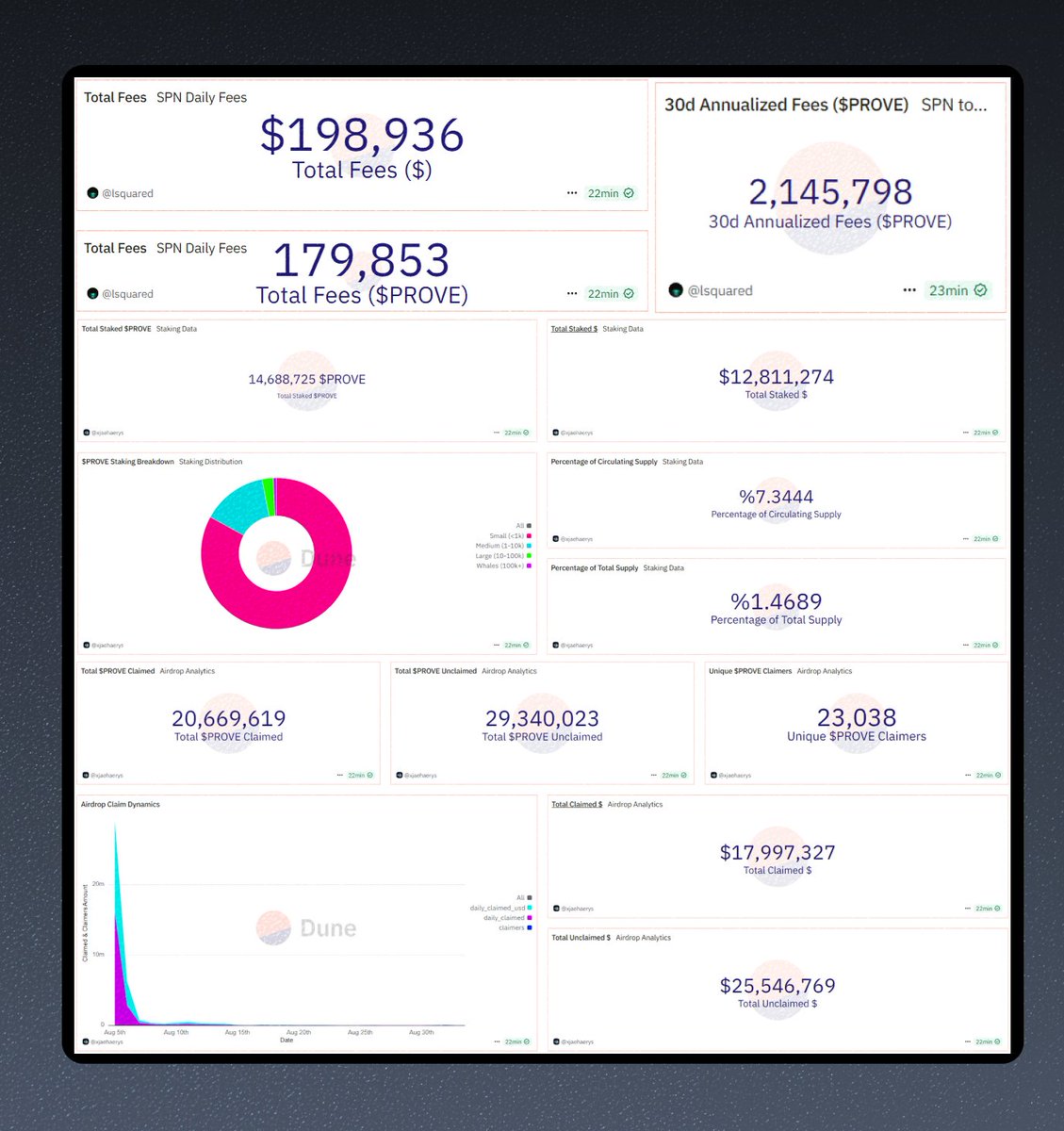
Succinct launched Prover Network on August 5. After a month the marketplace is already running with real usage, fees and staking. • 184,586 proofs generated • 636 trillion PGUs of work • $198,936 in fees (~179,853 PROVE) • run rate ➝ about 2.1M PROVE annualized Who’s using it: @katana ➝ 17.7k proofs / 39.5k PROVE Celestia ➝ 19.5k proofs / 4.2k PROVE Across ➝ 1.1k proofs 23 programs active so far, with more customers about to join Who’s proving: - ZAN ➝ 322.6 tPGUs, 77.5k PROVE earned - A41 ➝ 105.5 tPGUs, 27.2k PROVE - Mintair ➝ 82 tPGUs, 27k PROVE - @cysic_xyz ➝ 70.7 tPGUs, 16.1k PROVE - InfStones ➝ 45.6 tPGUs, 12.4k PROVE - Succinct prover ➝ 12k jobs, 10.7k PROVE Airdrop and staking: • 50M PROVE allocated for airdrop • 20.7M claimed (~18M USD) by 23k wallets • 14.7M PROVE staked (~12.8M USD), 7.3% of circulating supply • Cysic leads ➝ 6.2M PROVE staked (42% of total) across 2.3k wallets • Stakers not only earn PROVE rewards but also start to get partner incentives like @hibachi_xyz points and Cysic has rolled out a dedicated staking airdrop for those who stake directly with their prover Notes: Cysic is currently upgrading its proving nodes (Aug 31 → Sep 10). The upgrade should add more compute capacity and stability to their SPN operations.
jaehaerys 🪽 tweet media
English
16
12
120
5.4K
SP1 Intern (reborn/acc) รีทวีตแล้ว
jaehaerys 🪽
jaehaerys 🪽@0xJaehaerys·
“One interesting thing about @HyperliquidX is, I sort of think it's almost a bug, not a feature that you have to use this like a separate protocol and HyperUnit to bridge spot assets.” — @tarunchitra What is the practical difference between the ZK approach and models based on MPC/multisigs? Capital efficiency and true composability, enabled by the architecture pioneered by @Lighter_xyz using @SuccinctLabs' infrastructure. ZK allows assets to remain productive even while serving as collateral. @vnovakovski from @Lighter_xyz explains: "imagine kind of where any asset that's kind of in the Ethereum ecosystem can be kind of natively used as collateral for Lighter. So you can kind of keep those assets and trade. And then, you know, the liquidation, if you get liquidated, then only then are those assets touched.” This vision extends beyond Ethereum. Murat from Lighter describes how ZK can unite different blockchains: "...for other chains, you can deposit some like SOL token to Solana, a contract in Solana, and there can be a ZK proof of it, which then can be used to, again, securely mint that SOL token on Lighter..." Furthermore, an L2 like Lighter can become a factory for new, composable L1 assets: "You can natively tokenise this public pool, and it can be on Ethereum. So you can have like a native 3x ETH token on Ethereum, which can be, I don't know, used to lend to Aave or something.” These innovations may be implemented in the future. Capital Efficiency & Composability
jaehaerys 🪽@0xJaehaerys

x.com/i/article/1961…

English
14
12
90
7.4K
SP1 Intern (reborn/acc) รีทวีตแล้ว
jaehaerys 🪽
jaehaerys 🪽@0xJaehaerys·
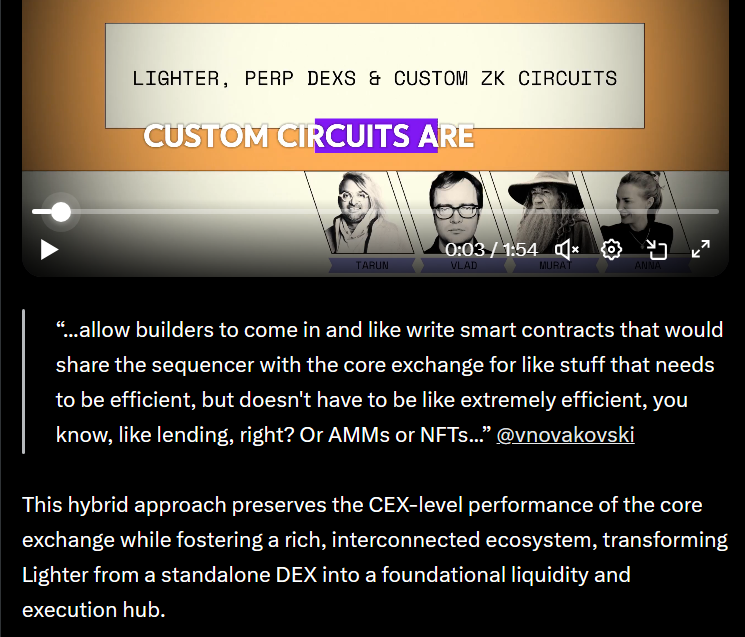
“…allow builders to come in and like write smart contracts that would share the sequencer with the core exchange — for stuff that needs to be efficient, but doesn’t have to be extremely efficient, you know, like lending, right? Or AMMs or NFTs…” — @vnovakovski How do you build a lightning-fast L2 without turning it into an isolated, walled garden? The main trade-off in DeFi is between the speed of specialized systems and the flexibility of universal ones. Vladimir Novakovski describes their hybrid Shared Sequencer model, which leverages infrastructure from teams like @SuccinctLabs to combine the best of both worlds This is the forward-looking piece: how @Lighter_xyz + Succinct can expand beyond perps into a shared execution surface. “for custom circuit perps dexes like Lighter (no VM on the L2) this is extremely cheap! That’s why I singled them out over general purpose / full VM proofs.” This allows an ecosystem to be built around a high-frequency trading engine, enabling atomic composability without sacrificing speed. Lighter is transformed from a simple DEX into a foundational liquidity and execution hub
jaehaerys 🪽@0xJaehaerys

x.com/i/article/1961…

English
0
2
11
987
SP1 Intern (reborn/acc) รีทวีตแล้ว
jaehaerys 🪽
jaehaerys 🪽@0xJaehaerys·
“Like why does HyperUnit need to exist, why can’t I just bridge any spot asset over, why do I need to have this separate protocol that does verification and still relies on the multisig effectively?” — @tarunchitra Here’s the origin of composable collateralization. Tarun contrasts HyperUnit — a committee of MPC guardians minting uBTC/uETH — with what’s possible if you plug @SuccinctLabs's ZK proving layer into @Lighter_xyz. "...capital efficiency that I think you actually can't get without ZK. It's a fundamental improvement.” With Succinct + Lighter, collateral stays locked on Ethereum L1, and ZK proofs from Succinct’s Prover Network let Lighter credit margin on L2.
jaehaerys 🪽@0xJaehaerys

x.com/i/article/1961…

English
7
14
113
8.6K
SP1 Intern (reborn/acc) รีทวีตแล้ว
jaehaerys 🪽
jaehaerys 🪽@0xJaehaerys·
Bridgeless Composability Most L2s still run on bridges: you lock assets on Ethereum, get a wrapped version on L2, and trade with that. It fragments liquidity and keeps adding security risk. Bridgeless collateralization (future path with @Lighter_xyz + @SuccinctLabs): instead of moving coins, you move ZK proofs. Assets never leave Ethereum; their value is projected to an L2 for trading. If a position is liquidated, Ethereum itself executes the collateral transfer from the L1 escrow. “With ZK you can lock assets on mainnet and use them on L2 as collateral — not just bridged, but actually used in a way that doesn’t require the user to think that much.” — Tarun Chitra How it could work (concept): - Lock ETH/stETH/Morpho shares in an L1 escrow. - Succinct’s Prover Network produces a ZK proof of the lock/value. - Lighter (perps DEX) credits margin on L2 based on that proof. - If liquidation happens, the L1 escrow moves collateral after verifying a proof-of-liquidation. Why this matters: - Capital efficiency: stETH and vaults keep earning on L1 while backing perps on L2. - Unified liquidity: no wrapped IOUs, no fragmentation. - Composability: L2 strategies can be tokenized back to L1 and reused in Aave/Maker. - Trust-minimized: security = Ethereum + cryptography, not operators. Important: not live today. It could be built with Lighter’s custom ZK circuits (cheap/fast perps proofs) + Succinct’s SP1 zkVM and decentralized Prover Network (general proofs like vault valuation and liquidation checks). Alternatives: even advanced designs like HyperUnit (MPC guardians minting uBTC/uETH) still rely on a committee of trust. Bridgeless removes that layer: custody stays on Ethereum; correctness is enforced by ZK proofs.
jaehaerys 🪽 tweet media
jaehaerys 🪽@0xJaehaerys

x.com/i/article/1961…

English
15
17
113
7.1K
SP1 Intern (reborn/acc) รีทวีตแล้ว
jaehaerys 🪽
jaehaerys 🪽@0xJaehaerys·
Arbitrum embraces ZK Succinct has signed exclusive partnership with Tandem (@offchain’ venture arm) to bring ZK proving to Arbitrum chains. @pumatheuma: “Every rollup will become a ZK rollup. We gave OP Stack that option with OP Succinct; now Arbitrum’s massive ecosystem gets it too.” What changes for users - Finality: withdrawals and settlements go from 7 days to minutes. - Capital efficiency: funds are no longer locked during week-long challenge periods. - User experience: bridges become smoother, safer, and significantly faster. - Security: execution is enforced by ZK proofs at L1, reducing dependence on sequencer honesty. @sgoldfed: “Using ZK proofs brings the network closer to something like Stage 2 decentralization — security enforced at L1, not just by trusting the sequencer.” What changes for the ecosystem - Flexibility: more than 40 Arbitrum chains, including projects like Robinhood and Converge, will be able to choose ZK proving. - Modular design: Succinct provers integrate without requiring a rewrite of the stack. - Governance: Arbitrum One itself is DAO-governed and will not flip overnight, but the stack now supports ZK from the ground up. - Hybrid paths: optimistic and ZK approaches can coexist, giving teams cost and latency trade-offs. What it means for Succinct - SP1 zkVM is already used by 35+ projects including Across, Avail, Celestia, Mantle, Polygon. - Succinct Prover Network, secured and powered by the PROVE token, expands beyond OP Stack chains to cover Arbitrum. - The addressable market effectively doubles. Monetizing even a fraction of Arbitrum’s L2 value could mean hundreds of millions in revenue distributed to provers, stakers, and partners. The ZK era is upon us
English
30
32
297
17.8K
SP1 Intern (reborn/acc) รีทวีตแล้ว
jaehaerys 🪽
jaehaerys 🪽@0xJaehaerys·
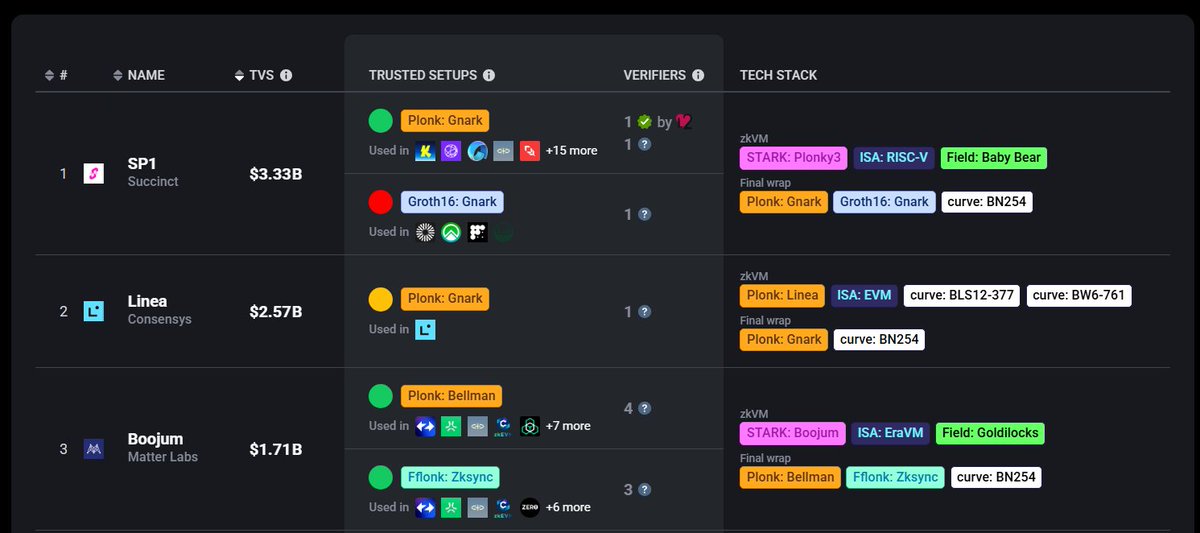
Goodbye EVM, Hello RISC-V Ethereum is about to change its engine. ________________________ For Dummies: If you’re an ordinary Ethereum user, here’s the key point: your wallet address will not change. - Your 0x... address stays the same. - Your ETH, tokens, and NFTs remain exactly where they are. - Your MetaMask or any other wallet will keep working. What does change is everything under the hood: - Transactions become cheaper (up to 100× lower fees). - Ethereum becomes faster (thousands of transactions per second). - Rollup withdrawals become quicker (hours instead of a week). - Security becomes stronger (fewer risks of protocol-level bugs). _____________________________ For ten years, Ethereum has been powered by the EVM — the Ethereum Virtual Machine. It was revolutionary, enabling smart contracts, DeFi, and NFTs. But in a future built on zero-knowledge proofs (ZK-proofs), the EVM has become the bottleneck. What’s wrong with the EVM? - Slow in ZK: zkEVMs don’t prove the EVM directly; they prove an interpreter of the EVM that itself compiles to RISC-V. This adds an extra layer and results in a 50–800× slowdown. - Overcomplicated: precompiles (hardcoded cryptographic functions) bloat the protocol and have caused near-consensus failures. Vitalik has called them “horrible.” - Outdated design: a 256-bit stack-based machine, chosen a decade ago, is inefficient for most real-world and ZK operations compared to modern 32/64-bit register machines. In short: the EVM was brilliant for its time, but it carries heavy technical debt that becomes unsustainable in a ZK-native world. RISC-V RISC-V is not a product, but an open standard for processors — a universal alphabet of instructions: simple, modular, and free. It already powers real chips and is the default backend for most zkVMs (9 out of 10). Adopting RISC-V gives Ethereum: - Massive speedups: direct proving without an interpreter layer. - Cheaper fees: ~100× lower proving costs, making transactions far cheaper. - Better developer experience: smart contracts in Rust, Go, C++, even Python, thanks to LLVM. - Stronger security: backed by a precise, machine-readable spec (SAIL), unlike the ambiguous Yellow Paper. - Hardware acceleration: paths for ASICs and FPGAs already being tested (Succinct SP1, Nervos, Cartesi). Migration Path @VitalikButerin outlines a gradual 3-step plan: - Precompile replacement — new cryptographic functions implemented as RISC-V programs, replacing fragile EVM precompiles. - Dual VM era — contracts can be deployed as either EVM or RISC-V, with full interoperability via system calls. - Rosetta strategy — the EVM itself becomes a contract running inside the RISC-V VM, ensuring backward compatibility while simplifying the core protocol. What does this mean for the ecosystem? - Optimistic rollups: break. Their fraud proofs rely on re-executing EVM on L1. Without the EVM, they must rebuild from scratch or change models. - ZK rollups: win big. Already standardized on RISC-V, they can integrate seamlessly with L1. Polygon, zkSync, Scroll, StarkNet all benefit (though StarkNet continues with Cairo). - Developers: no longer limited to Solidity and Vyper. They can reuse mainstream tooling, compilers, debuggers, and libraries. Users: transactions become cheaper, rollups finalize faster (hours not days), and Ethereum scales to ~10,000 TPS (Gigagas L1). Ethereum is evolving from a smart contract VM into a verifiable trust layer for the entire internet. As Vitalik puts it: “The finish line includes… ZK-snarking everything.” By adopting RISC-V, Ethereum aligns with the ZK-proving ecosystem, eliminates long-standing inefficiencies, and unlocks a new era where developers can bring the full power of mainstream software to the blockchain — and users benefit from faster, cheaper, and safer applications.
jaehaerys 🪽@0xJaehaerys

x.com/i/article/1960…

English
61
147
708
73.3K
SP1 Intern (reborn/acc) รีทวีตแล้ว
jaehaerys 🪽
jaehaerys 🪽@0xJaehaerys·
"What we're aiming for here is to be the internet of value." — @drakefjustin, Ethereum Foundation This defines the technical endgame for Ethereum, and it requires a massive leap in scale. The roadmap is built on concrete, staggering numbers: - The L1 Goal: 10,000 transactions per second (TPS). - The Ultimate L2 Vision: 10 million TPS across all L2s combined , powered by real-time zkVMs (Like SP1 by @SuccinctLabs). This level of throughput enables high-value transactions for every single person, from minting critical assets to settling entire chains. L1 alone is not enough for the ~100 daily transactions per person required for true global adoption; this scale will be achieved through L2s , secured by the blob scaling roadmap. The endgame is Ethereum. Watch the full clip below to understand why
English
4
15
76
4.5K
SP1 Intern (reborn/acc) รีทวีตแล้ว
jaehaerys 🪽
jaehaerys 🪽@0xJaehaerys·
"Virtual machines don't have to be complex." — @VitalikButerin For most people, the buzz around Vitalik's "Long-term L1 execution layer proposal: replace the EVM with RISC-V" sounded like black magic. But what if it's actually much simpler, and it affects everyone? The current EVM is essentially a computational ASIC, built for a narrow task back in 2014. It's inflexible and extremely inefficient for the world of ZK technology. Trying to prove its execution is like running a modern OS on a calculator. It requires a cumbersome emulation layer that, as research from teams like Succinct confirms, creates a 100-1000x performance bottleneck. In his talks, Vitalik visually proves why this needs to change by showing two code snippets: - ON THE LEFT: The code for the entire new system (RISC-V). It's so simple that it fits on a single screen. - ON THE RIGHT: The code for just one single old part in Ethereum, which is monstrously complex and convoluted. Vitalik's proposal is to stop trying to teach ZK systems to "speak EVM." Instead, he suggests making a universal and simple standard—RISC-V—the base language of Ethereum itself, on which high-performance zkVMs will run. His conclusion is simple and clear for everyone: "Even if all we do is replace our old, complex... it would be a very significant SIMPLIFICATION of the protocol." It's about removing a fundamental bottleneck that has held back ZK-native apps. This shift creates the necessary groundwork for the high-performance zkVMs being pioneered by teams like @SuccinctLabs, finally allowing their full potential to be realized directly on Ethereum.
English
9
11
151
13.7K
SP1 Intern (reborn/acc) รีทวีตแล้ว
jaehaerys 🪽
jaehaerys 🪽@0xJaehaerys·
"The finish line includes... ZK-snarking everything." — @VitalikButerin The ZK endgame is inevitable, and the thesis is simple: Ethereum is being rebuilt from the ground up on Zero-Knowledge proofs. This represents the protocol's technical finish line— re-architecture of the L1 to achieve its ultimate form, powered by high-performance zkVMs from core development teams like Succinct. This fundamental transformation means: - Trustless Verification: All block validation will be handled instantly by ZK-SNARKs. - A New Engine: The EVM itself will be replaced with a ZK-native architecture like RISC-V. - Radical Efficiency: Every node becomes "ultra-light," slashing hardware requirements to the point where anyone can run one. This unlocks the holy grail of blockchain design: massive L1 scale combined with default privacy for everything from simple payments to the most sophisticated DeFi protocols.
English
15
27
219
10.6K
SP1 Intern (reborn/acc) รีทวีตแล้ว
jaehaerys 🪽
jaehaerys 🪽@0xJaehaerys·
AI slop is making it hard to know what's real. ZK can fix this. imagine a ZK camera, or any zk-powered tool, that cryptographically signs your work at the source. a true proof of origin.
English
14
7
76
3.4K
SP1 Intern (reborn/acc) รีทวีตแล้ว
jaehaerys 🪽
jaehaerys 🪽@0xJaehaerys·
"Every transaction in crypto is gonna be ZK proven" — @pumatheuma, co-founder of Succinct The ZK endgame is an observable reality, and the thesis is simple: Ethereum's entire L1 roadmap is reorienting around ZK for scale, creating massive, built-in demand. The technology to meet this demand is already here. Breakthroughs like real-time proving have crushed previous latency barriers, slashing proof times from minutes to under 12 seconds. With only a few percent of transactions currently using ZK, the stage is set for a protocol-level expansion.
English
30
24
176
10.8K
SP1 Intern (reborn/acc) รีทวีตแล้ว
jaehaerys 🪽
jaehaerys 🪽@0xJaehaerys·
"I've always viewed what we're doing with ZK... as kind of Ethereum's Manhattan Project." — @TrustlessState Rather than chase short-term throughput, Ethereum’s long-term commitment to ZK for scaling without compromise is now delivering a key strategic advantage.
English
5
7
57
3.2K
SP1 Intern (reborn/acc) รีทวีตแล้ว
jaehaerys 🪽
jaehaerys 🪽@0xJaehaerys·
"SP1 is kind of like, in a sense, a foundation model for cryptography." — @pumatheuma @SuccinctLabs's SP1 represents the ChatGPT moment for verifiable computation. It marks the transition from a complex technology accessible only to expert cryptographers to a general-purpose platform that any developer can use. This democratization is set to unlock a new wave of innovation, similar to how foundation models redefined the AI landscape.
English
6
10
110
6.9K
SP1 Intern (reborn/acc) รีทวีตแล้ว
jaehaerys 🪽
jaehaerys 🪽@0xJaehaerys·
"If you multiply out the numbers—4,000 TPS, one-tenth of a cent per transaction... that ends up being like a hundred million dollars of proving demand." — @pumatheuma For anyone who believes ZK is just technology without a real revenue model, consider this: based on conservative estimates from Ethereum's own roadmap, the annual market for proving is already a nine-figs opportunity.
jaehaerys 🪽@0xJaehaerys

x.com/i/article/1955…

English
8
19
127
9.3K