Institute for the Study of War

54.4K posts

Institute for the Study of War banner
Institute for the Study of War

Institute for the Study of War

@TheStudyofWar

ISW is a policy research organization focused on U.S. national security. Email: [email protected]. https://t.co/FO1PVyOnYB

Washington D.C. เข้าร่วม Eylül 2009
3.3K กำลังติดตาม1.1M ผู้ติดตาม
ทวีตที่ปักหมุด
Institute for the Study of War
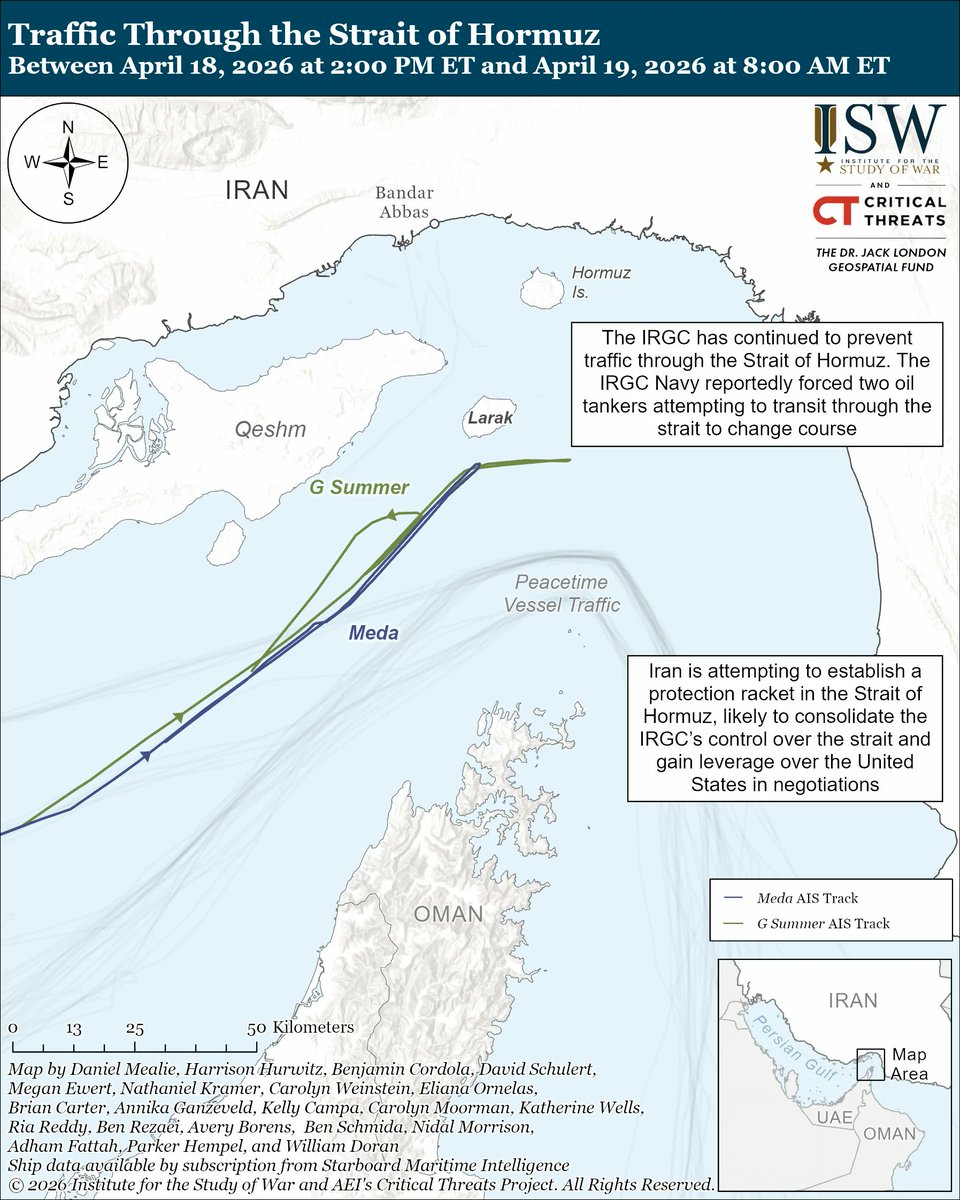
NEW: Any US settlement or resolution of the conflict that enables Iran to control traffic through the Strait of Hormuz would represent a major US defeat and set a precedent with critical implications for global trade, given the strait’s role as a critical energy chokepoint. Any US acceptance of Iran’s ability to regulate transit would undermine the principle of freedom of navigation through the Strait of Hormuz and enable Iran to condition access to the strait on compliance with its demands, thereby enabling Tehran to exert persistent pressure on the global economy and the United States and its allies. Iran is attempting to establish a protection racket in the Strait of Hormuz by granting priority transit to vessels that pay fees and comply with Islamic Revolutionary Guards Corps (IRGC) protocols as part of its effort to try to consolidate control over the strait. Iran has also continued to prevent non-Iranian-linked vessels from transiting the strait. US forces seized an Iranian-flagged container ship for the first time during the war. Commercially available shipping data indicates that the US Navy also forced at least three Iranian or Iranian-linked ships to change course toward Iranian ports on April 19. US Vice President JD Vance, US Special Envoy to the Middle East Steve Witkoff, and Jared Kushner are expected to travel to Islamabad, Pakistan, to engage in negotiations with Iran on April 21. ISW-CTP has not observed any Iranian sources confirming Iran’s participation in the negotiations as of 6:00 PM ET on April 19, however. Incomplete reporting about the damage that the US-Israeli combined force inflicted on Iran’s ballistic missile and drone programs precludes the development of a quantitative assessment about the threat that Iranian missiles and drones still pose. A statement released by Iranian-backed Iraqi militia Kataib Hezbollah on April 18 appears to confirm that IRGC Quds Force Commander Brigadier General Esmail Ghaani discussed preparations for renewed conflict with the United States and Israel during his meetings with Iraqi militia leaders in Baghdad on April 18. Ghaani may have specifically discussed enhancing coordination between Iraqi militias and other Axis of Resistance groups against the United States, Israel, and the Gulf states in the event of renewed conflict.
Institute for the Study of War tweet mediaInstitute for the Study of War tweet mediaInstitute for the Study of War tweet media
Institute for the Study of War@TheStudyofWar

NEW: The Iranian political officials who will reportedly negotiate with the United States in Islamabad, Pakistan, on April 21 neither have the authority to independently determine Iran’s negotiating positions nor are driving decision-making in Tehran. Other Key Takeaways: US Special Envoy to the Middle East Steve Witkoff and Jared Kushner will attend the talks. Iran’s negotiating delegation is expected to include Foreign Minister Abbas Araghchi and Parliament Speaker Mohammad Bagher Ghalibaf. The upcoming talks appear focused on extending the ceasefire, which is set to expire on April 22. Iranian sources familiar with the negotiations stated that Iran expects that the ceasefire will be extended and that additional talks will occur if the negotiations on April 21 go well. The Iranian negotiating team does not have the authority to independently determine Iran’s negotiating positions, however. IRGC Commander Major General Ahmad Vahidi and other senior members of the IRGC have consolidated control and wielded significant influence over the negotiations process thus far. Iran is attempting to establish a protection racket in the Strait of Hormuz, likely to consolidate the IRGC’s control over the strait and gain leverage over the United States in negotiations. Iran has reportedly decided to give vessels that pay a “security” fee and adhere to Iranian protocols priority to transit through the strait. The IRGC has continued to prevent traffic through the Strait of Hormuz. The IRGC Navy reportedly forced two oil tankers attempting to transit through the strait to change course. Many vessels that intended to transit through the strait have turned around.

English
13
98
280
172.7K
Institute for the Study of War
MORE: Incomplete reporting about the damage that the US-Israeli combined force inflicted on Iran’s ballistic missile and drone programs precludes the development of a quantitative assessment about the threat that Iranian missiles and drones still pose. Multiple US officials told the New York Times on April 19 that Iran retains around 40 percent of its attack drones, around 60 percent of its missile launchers, and around 70 percent of its missile stockpile. The officials stated that the 60 percent of missile launchers includes around 100 launchers that Iran has dug out from underground facilities since the ceasefire went into effect. ISW-CTP previously assessed that Iran is exploiting the ceasefire to reorganize and regenerate its ballistic missile forces on a tactical level, including by clearing debris from tunnel entrances to retrieve missile launchers from underground missile bases. The recent assessments about Iran’s remaining offensive capacities do not specify whether the launchers that Iran has dug out from underground facilities are intact or operational. Shockwaves from combined force strikes may have damaged launchers stored in underground facilities without directly hitting them. The recent assessments also do not specify what kinds of launchers Iran has retrieved. Iran possesses different kinds of launchers for ballistic missiles with different ranges. These gaps preclude the development of a quantitative assessment of the current status of Iran’s missile program.
Institute for the Study of War tweet media
Institute for the Study of War@TheStudyofWar

NEW: Any US settlement or resolution of the conflict that enables Iran to control traffic through the Strait of Hormuz would represent a major US defeat and set a precedent with critical implications for global trade, given the strait’s role as a critical energy chokepoint. Any US acceptance of Iran’s ability to regulate transit would undermine the principle of freedom of navigation through the Strait of Hormuz and enable Iran to condition access to the strait on compliance with its demands, thereby enabling Tehran to exert persistent pressure on the global economy and the United States and its allies. Iran is attempting to establish a protection racket in the Strait of Hormuz by granting priority transit to vessels that pay fees and comply with Islamic Revolutionary Guards Corps (IRGC) protocols as part of its effort to try to consolidate control over the strait. Iran has also continued to prevent non-Iranian-linked vessels from transiting the strait. US forces seized an Iranian-flagged container ship for the first time during the war. Commercially available shipping data indicates that the US Navy also forced at least three Iranian or Iranian-linked ships to change course toward Iranian ports on April 19. US Vice President JD Vance, US Special Envoy to the Middle East Steve Witkoff, and Jared Kushner are expected to travel to Islamabad, Pakistan, to engage in negotiations with Iran on April 21. ISW-CTP has not observed any Iranian sources confirming Iran’s participation in the negotiations as of 6:00 PM ET on April 19, however. Incomplete reporting about the damage that the US-Israeli combined force inflicted on Iran’s ballistic missile and drone programs precludes the development of a quantitative assessment about the threat that Iranian missiles and drones still pose. A statement released by Iranian-backed Iraqi militia Kataib Hezbollah on April 18 appears to confirm that IRGC Quds Force Commander Brigadier General Esmail Ghaani discussed preparations for renewed conflict with the United States and Israel during his meetings with Iraqi militia leaders in Baghdad on April 18. Ghaani may have specifically discussed enhancing coordination between Iraqi militias and other Axis of Resistance groups against the United States, Israel, and the Gulf states in the event of renewed conflict.

English
3
28
99
30.5K
Institute for the Study of War
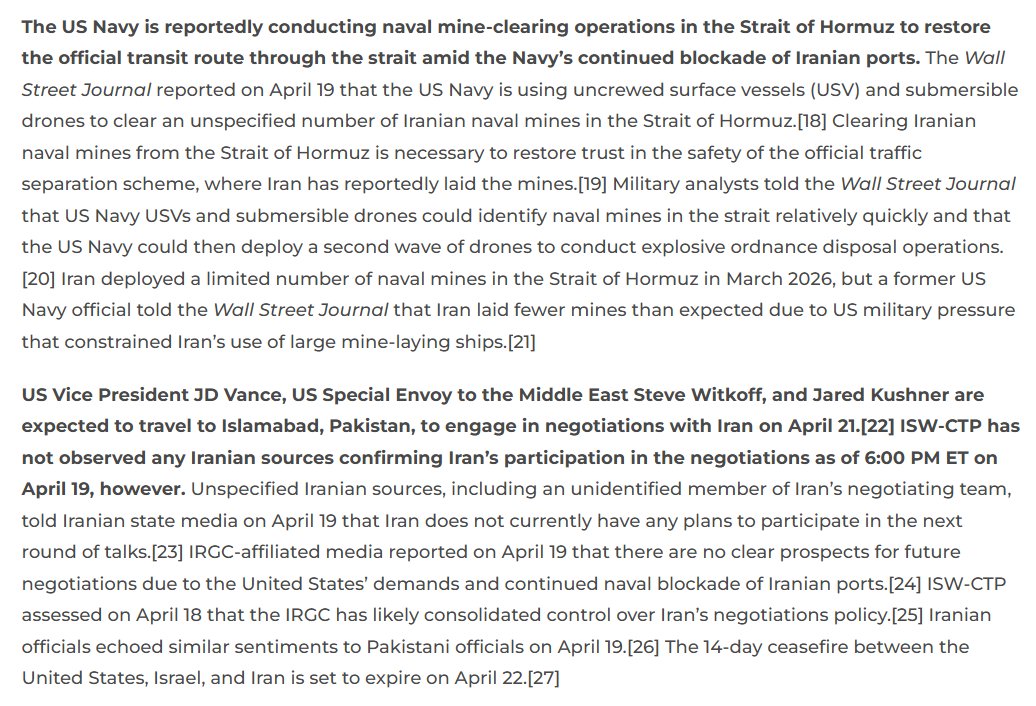
MORE: The US Navy is reportedly conducting naval mine-clearing operations in the Strait of Hormuz to restore the official transit route through the strait amid the Navy’s continued blockade of Iranian ports US Vice President JD Vance, US Special Envoy to the Middle East Steve Witkoff, and Jared Kushner are expected to travel to Islamabad, Pakistan, to engage in negotiations with Iran on April 21.[22] ISW-CTP has not observed any Iranian sources confirming Iran’s participation in the negotiations as of 6:00 PM ET on April 19, however. ISW-CTP assessed on April 18 that the IRGC has likely consolidated control over Iran’s negotiations policy.
Institute for the Study of War tweet media
Institute for the Study of War@TheStudyofWar

NEW: Any US settlement or resolution of the conflict that enables Iran to control traffic through the Strait of Hormuz would represent a major US defeat and set a precedent with critical implications for global trade, given the strait’s role as a critical energy chokepoint. Any US acceptance of Iran’s ability to regulate transit would undermine the principle of freedom of navigation through the Strait of Hormuz and enable Iran to condition access to the strait on compliance with its demands, thereby enabling Tehran to exert persistent pressure on the global economy and the United States and its allies. Iran is attempting to establish a protection racket in the Strait of Hormuz by granting priority transit to vessels that pay fees and comply with Islamic Revolutionary Guards Corps (IRGC) protocols as part of its effort to try to consolidate control over the strait. Iran has also continued to prevent non-Iranian-linked vessels from transiting the strait. US forces seized an Iranian-flagged container ship for the first time during the war. Commercially available shipping data indicates that the US Navy also forced at least three Iranian or Iranian-linked ships to change course toward Iranian ports on April 19. US Vice President JD Vance, US Special Envoy to the Middle East Steve Witkoff, and Jared Kushner are expected to travel to Islamabad, Pakistan, to engage in negotiations with Iran on April 21. ISW-CTP has not observed any Iranian sources confirming Iran’s participation in the negotiations as of 6:00 PM ET on April 19, however. Incomplete reporting about the damage that the US-Israeli combined force inflicted on Iran’s ballistic missile and drone programs precludes the development of a quantitative assessment about the threat that Iranian missiles and drones still pose. A statement released by Iranian-backed Iraqi militia Kataib Hezbollah on April 18 appears to confirm that IRGC Quds Force Commander Brigadier General Esmail Ghaani discussed preparations for renewed conflict with the United States and Israel during his meetings with Iraqi militia leaders in Baghdad on April 18. Ghaani may have specifically discussed enhancing coordination between Iraqi militias and other Axis of Resistance groups against the United States, Israel, and the Gulf states in the event of renewed conflict.

English
12
67
236
45K
Institute for the Study of War
3/ At least four Iranian or Iranian-linked ships appear to be attempting to pass the US Navy’s blockade line. US officials have stated that the United States will interdict vessels beyond the blockade line. The vessels include the Iranian-flagged Artman container ship, the Liberian-flagged Basel, the Marshall Islands-flagged CECI, and the Vietnam-flagged NV Aquamarine. Both the Basel and CECI originated from Iranian ports, while the NV Aquamarine is under US sanctions and is blacklisted by United Against Nuclear Iran. US Chairman of the Joint Chiefs of Staff Dan Caine and Defense Secretary Pete Hegseth said on March 16 that US forces will interdict any ship that crosses the blockade line, which runs diagonally across the Gulf of Oman from Ras al Hadd, Oman, to the Iran-Pakistan border.
Institute for the Study of War tweet media
English
2
21
73
20.9K
Institute for the Study of War
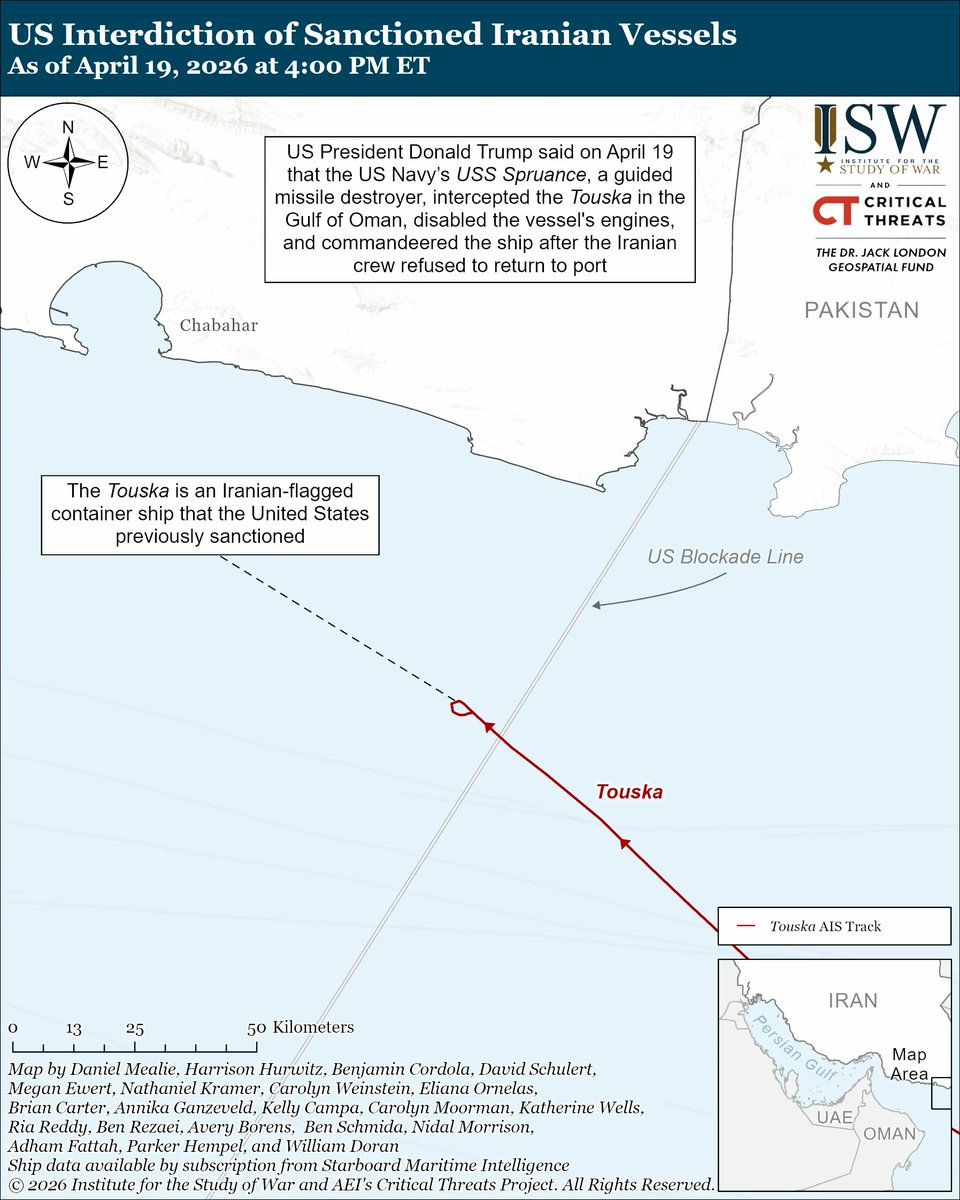
2/ US forces seized an Iranian-flagged container ship for the first time during the war. US President Donald Trump announced on April 19 that the US Navy’s USS Spruance, a guided missile destroyer, intercepted the Touska in the Gulf of Oman, disabled the vessel’s engines, and commandeered the ship after the Iranian crew refused to return to port. US forces seized the Touska after it attempted to pass the US blockade line. The United States previously sanctioned the Touska, which is owned by the Islamic Republic of Iran Shipping Lines. Commercially available shipping data indicates that the US Navy also forced at least three Iranian or Iranian-linked ships to change course toward Iranian ports on April 19. The vessels include the US-sanctioned Guinea-flagged Raine tanker, the Iranian-flagged Shamim container ship, and the Hong Kong-flagged Flora tanker, which was previously Iranian-flagged.
Institute for the Study of War tweet media
English
3
16
65
21.5K
Institute for the Study of War
MORE 🧵(1/3): A senior Iranian official told CNN on April 18 that vessels that pay “security fees” and comply with the IRGC’s protocols will receive priority transit through the Strait of Hormuz, while those that refuse to pay will face delayed passage. Iran has reportedly charged vessels around $2 million USD to transit the strait. Extracting fees from commercial vessels enables Iran to earn income amid the United States’ efforts to impose economic pressure on Iran through its blockade of Iranian ports. The IRGC has also continued to prevent non-Iranian-linked vessels from transiting the strait. Bloomberg reported on April 18 that at least five liquefied natural gas (LNG) tankers reversed course after Iran warned the vessels’ captains that it had closed the Strait of Hormuz. No LNG tankers have exited the Strait of Hormuz since the war began in February. Iranian media separately reported on April 19 that the IRGC forced the Botswana-flagged Meda and the Angola-flagged G Summer to change course after the vessels attempted to cross the Strait of Hormuz. Commercially available shipping data indicates that the G Summer later transited the Strait of Hormuz via the Iranian-approved route on April 19.
Institute for the Study of War tweet media
Institute for the Study of War@TheStudyofWar

NEW: Any US settlement or resolution of the conflict that enables Iran to control traffic through the Strait of Hormuz would represent a major US defeat and set a precedent with critical implications for global trade, given the strait’s role as a critical energy chokepoint. Any US acceptance of Iran’s ability to regulate transit would undermine the principle of freedom of navigation through the Strait of Hormuz and enable Iran to condition access to the strait on compliance with its demands, thereby enabling Tehran to exert persistent pressure on the global economy and the United States and its allies. Iran is attempting to establish a protection racket in the Strait of Hormuz by granting priority transit to vessels that pay fees and comply with Islamic Revolutionary Guards Corps (IRGC) protocols as part of its effort to try to consolidate control over the strait. Iran has also continued to prevent non-Iranian-linked vessels from transiting the strait. US forces seized an Iranian-flagged container ship for the first time during the war. Commercially available shipping data indicates that the US Navy also forced at least three Iranian or Iranian-linked ships to change course toward Iranian ports on April 19. US Vice President JD Vance, US Special Envoy to the Middle East Steve Witkoff, and Jared Kushner are expected to travel to Islamabad, Pakistan, to engage in negotiations with Iran on April 21. ISW-CTP has not observed any Iranian sources confirming Iran’s participation in the negotiations as of 6:00 PM ET on April 19, however. Incomplete reporting about the damage that the US-Israeli combined force inflicted on Iran’s ballistic missile and drone programs precludes the development of a quantitative assessment about the threat that Iranian missiles and drones still pose. A statement released by Iranian-backed Iraqi militia Kataib Hezbollah on April 18 appears to confirm that IRGC Quds Force Commander Brigadier General Esmail Ghaani discussed preparations for renewed conflict with the United States and Israel during his meetings with Iraqi militia leaders in Baghdad on April 18. Ghaani may have specifically discussed enhancing coordination between Iraqi militias and other Axis of Resistance groups against the United States, Israel, and the Gulf states in the event of renewed conflict.

English
4
60
170
45.2K
Institute for the Study of War
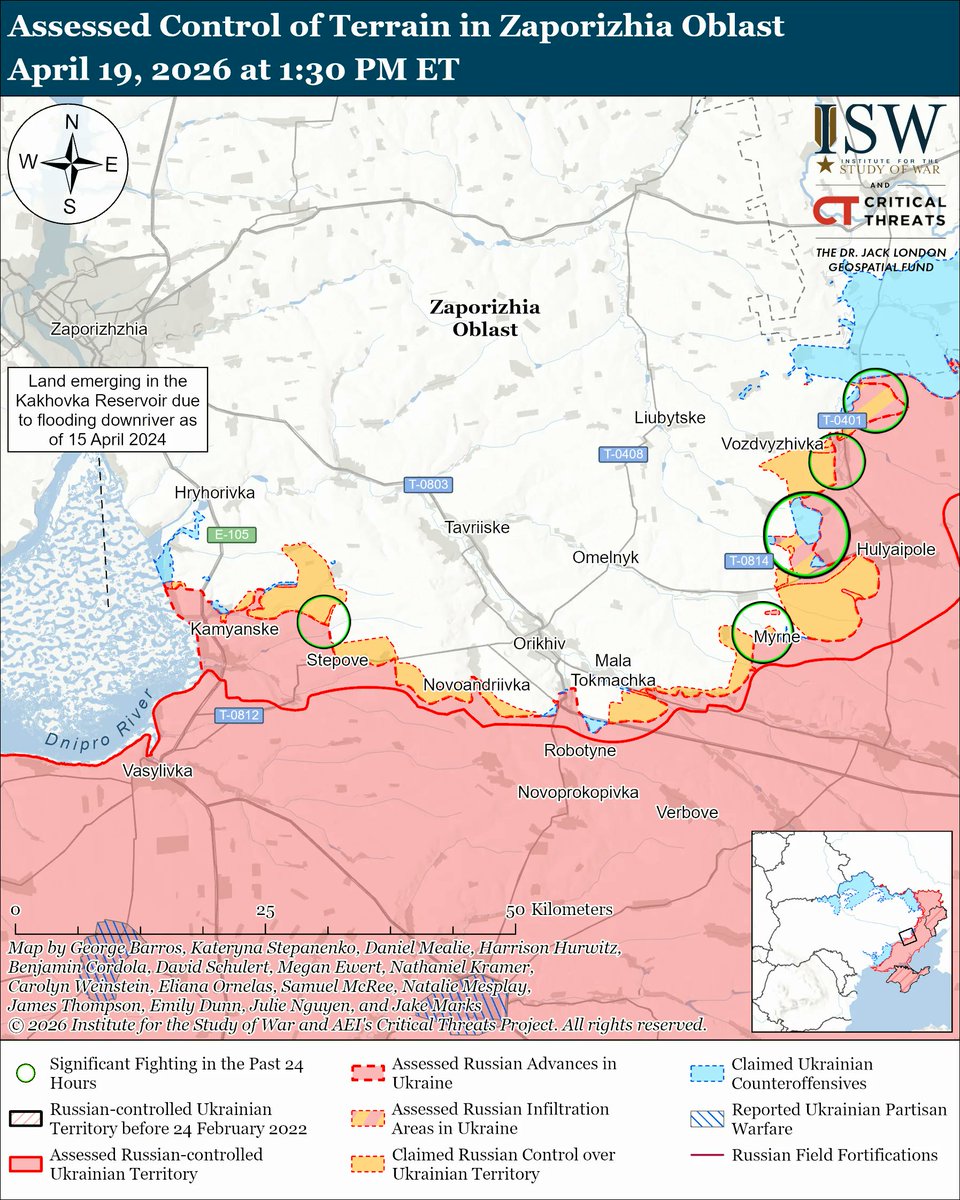
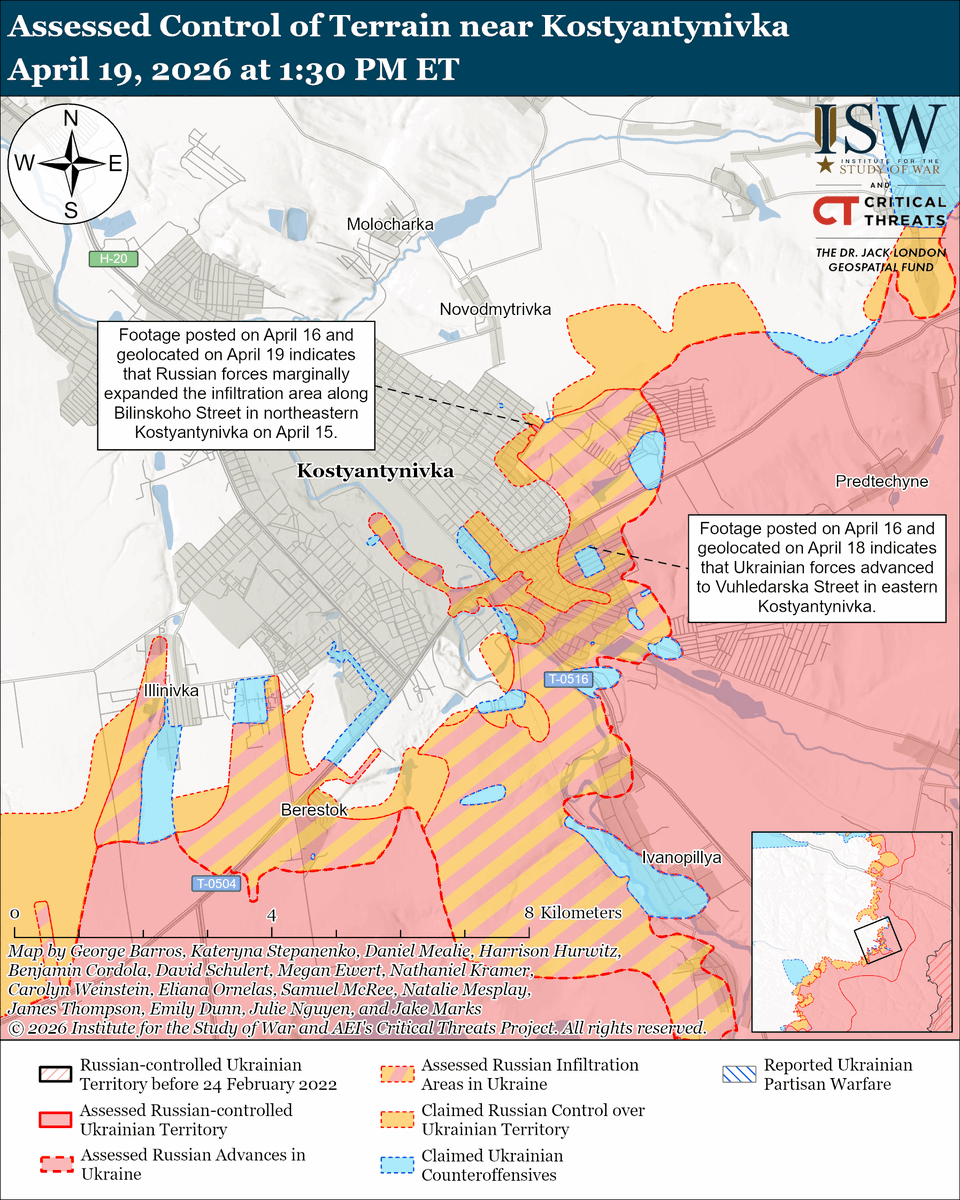
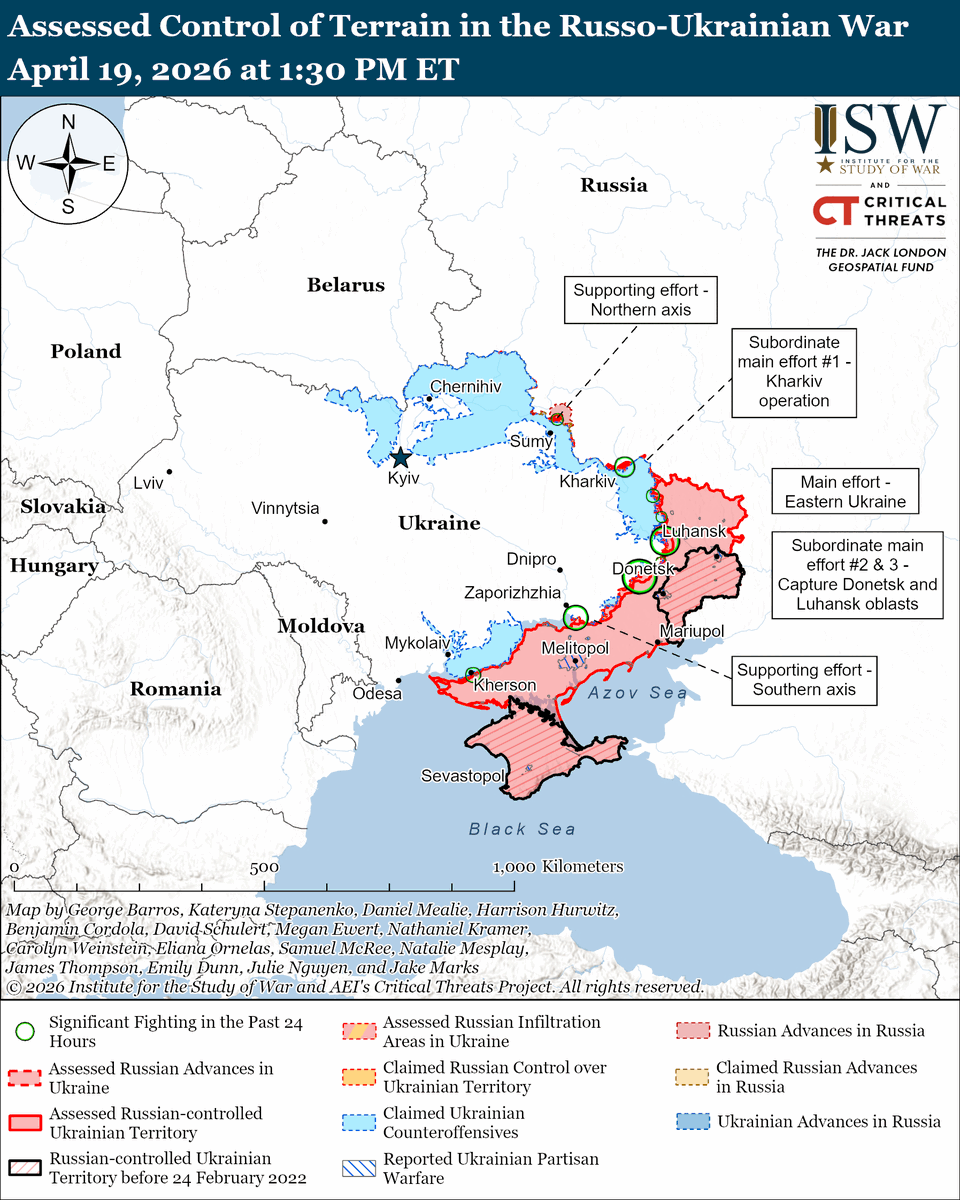
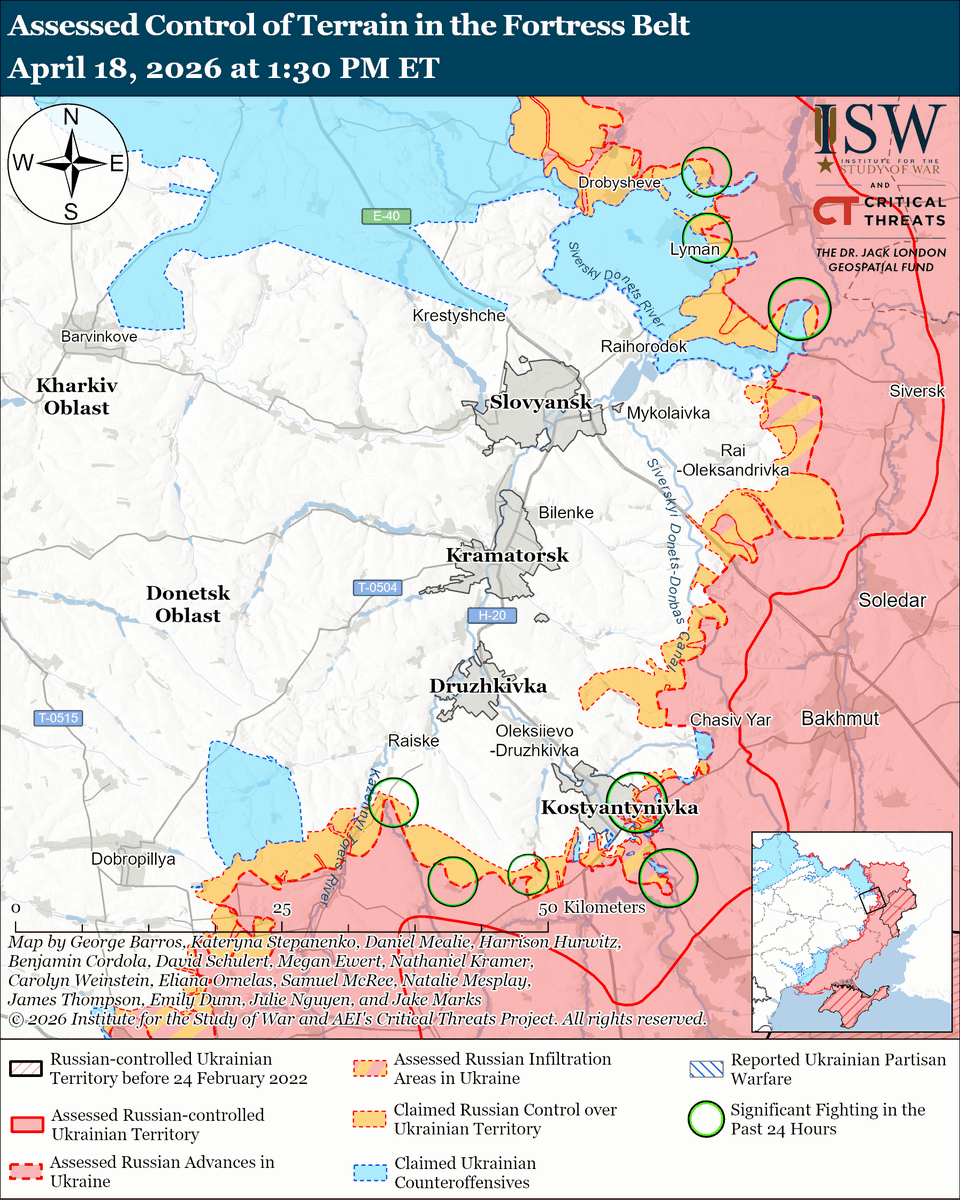
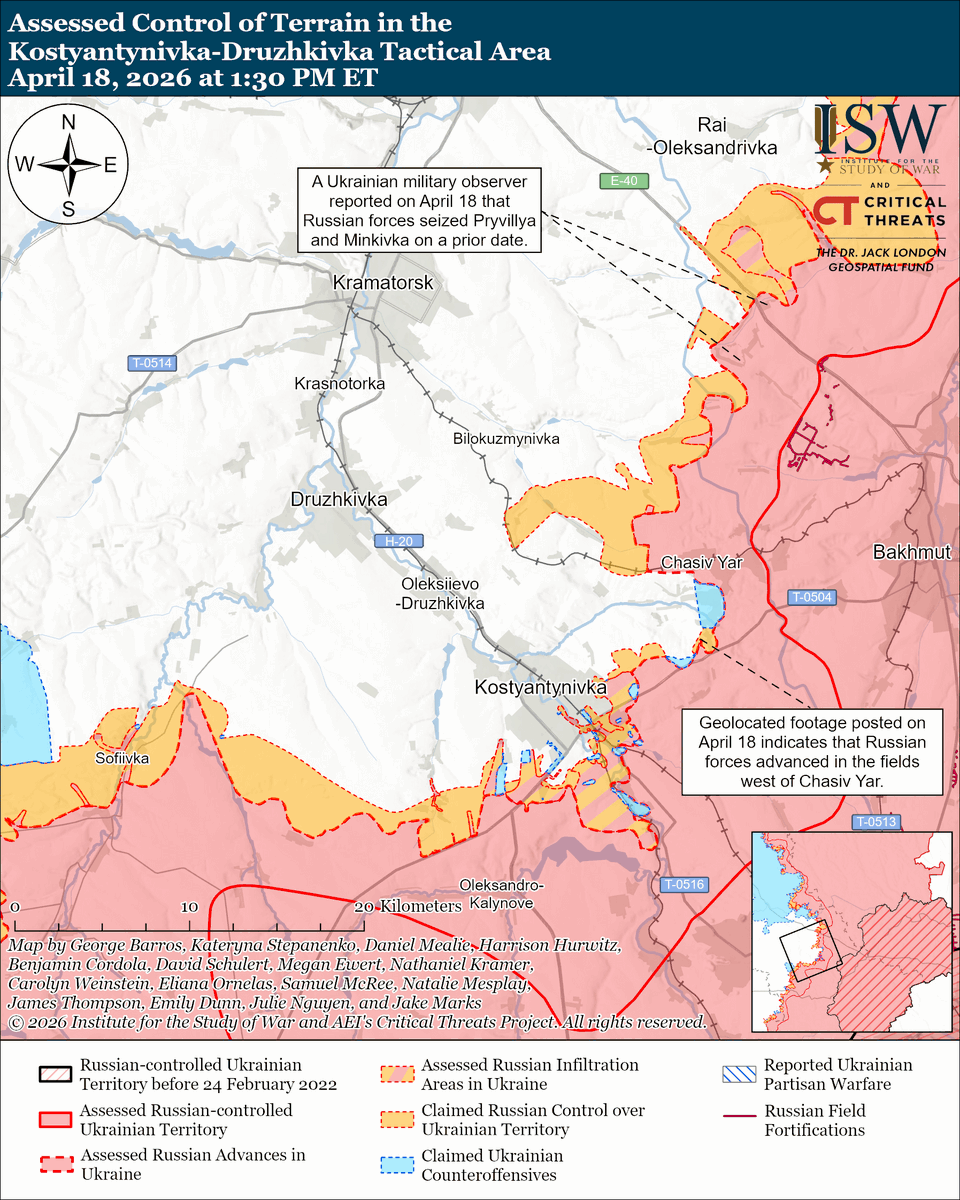
MORE: Geolocated footage published on April 18 and 19 indicates that Russian forces conducted two roughly platoon-sized mechanized assaults east of Chasiv Yar (northeast of Kostyantynivka) on April 18 and 19, a motorized assault of multiple Ural transport trucks and at least six motorcycles east of Svyatopetrivka (northwest of Hulyaipole) on April 18, and a roughly platoon-sized mechanized assault near Kucherov, Kursk Oblast (southeast of Glushkovo) on April 19. ISW has observed no evidence that these assaults have resulted in tactically-significant gains, and three of the four assaults do not appear to have made it beyond the currently assessed line of contact. These Russian mechanized and motorized assaults may have been reconnaissance-in-force missions that aimed to probe, identify, or test Ukrainian positions and defenses ahead of future ground assaults. Russian forces may also have conducted relatively independent opportunistic assaults aimed at exploiting perceived or actual tactical advantages near Chasiv Yar, Svyatopetrivka, and Kucherov. Russian forces may intend to conduct mechanized and motorized assaults across the theater to fix Ukrainian forces in areas that are not Russia’s current priority effort: advancing on Ukraine’s Fortress Belt in Donetsk Oblast, particularly its northern tip of Slovyansk. However, Russian forces would need to dedicate more expansive forces and materiel over a greater period to achieve an operationally significant fixing effect. Russian forces are conducting these assaults as Ukrainian forces have managed to restrain Russian advances in several areas of the frontline, including the priority Russian effort in the Slovyansk direction and other Russian efforts against Vovchansk, Kharkiv Oblast, advancing northwest from Pokrovsk, Donetsk Oblast and west from Hulyaipole toward Orikhiv, Zaporizhia Oblast, and outflanking Orikhiv along the western bank of the Kakhovka Reservoir. Russian forces have sought to maintain the illusion of advancing across several axes simultaneously during their spring-summer 2026 offensive as part of a longstanding cognitive warfare campaign aimed at convincing Ukraine and the West that Ukraine’s defensive lines face imminent collapse. The Russian offensive remains underwhelming so far, however. Russian forces are allocating forces in such a way that siphon resources from the main effort, and the April 18-19 mechanized and motorized assaults largely do not support the Slovyansk effort. Only the assault northwest of Hulyaipole was in an area that Russian forces have reportedly reinforced with strategic reserves, and Russian forces continue to struggle to achieve their goals for the spring-summer offensive.
Institute for the Study of War tweet mediaInstitute for the Study of War tweet mediaInstitute for the Study of War tweet mediaInstitute for the Study of War tweet media
Institute for the Study of War@TheStudyofWar

NEW: Russian forces conducted four platoon-sized or smaller mechanized and motorized assaults across the theater in the last 48 hours, but these assaults are unlikely to bolster the ongoing Russian spring-summer 2026 offensive. Additional Key Takeawys: The Ukrainian Unmanned Systems Forces (USF) employed an unmanned surface vessel (USV)-launched interceptor drone to intercept a Russian Shahed long-range strike drone for the first time and are creating USF naval drone battalions. A Russian defense industrial enterprise director criticized how the Russian government’s adopted economic policies have overcooled the Russian economy to the detriment of Russia’s import substitution efforts. Ukrainian forces recently advanced in the Kostyantynivka direction. Russian forces recently advanced in Kursk Oblast. Russian forces launched 236 drones against Ukraine. Ukrainian forces struck the Atlant Aero drone development and production plant in Taganrog, Rostov Oblast. (1/2)

English
1
60
192
37.3K
Institute for the Study of War
NEW: Any US settlement or resolution of the conflict that enables Iran to control traffic through the Strait of Hormuz would represent a major US defeat and set a precedent with critical implications for global trade, given the strait’s role as a critical energy chokepoint. Any US acceptance of Iran’s ability to regulate transit would undermine the principle of freedom of navigation through the Strait of Hormuz and enable Iran to condition access to the strait on compliance with its demands, thereby enabling Tehran to exert persistent pressure on the global economy and the United States and its allies. Iran is attempting to establish a protection racket in the Strait of Hormuz by granting priority transit to vessels that pay fees and comply with Islamic Revolutionary Guards Corps (IRGC) protocols as part of its effort to try to consolidate control over the strait. Iran has also continued to prevent non-Iranian-linked vessels from transiting the strait. US forces seized an Iranian-flagged container ship for the first time during the war. Commercially available shipping data indicates that the US Navy also forced at least three Iranian or Iranian-linked ships to change course toward Iranian ports on April 19. US Vice President JD Vance, US Special Envoy to the Middle East Steve Witkoff, and Jared Kushner are expected to travel to Islamabad, Pakistan, to engage in negotiations with Iran on April 21. ISW-CTP has not observed any Iranian sources confirming Iran’s participation in the negotiations as of 6:00 PM ET on April 19, however. Incomplete reporting about the damage that the US-Israeli combined force inflicted on Iran’s ballistic missile and drone programs precludes the development of a quantitative assessment about the threat that Iranian missiles and drones still pose. A statement released by Iranian-backed Iraqi militia Kataib Hezbollah on April 18 appears to confirm that IRGC Quds Force Commander Brigadier General Esmail Ghaani discussed preparations for renewed conflict with the United States and Israel during his meetings with Iraqi militia leaders in Baghdad on April 18. Ghaani may have specifically discussed enhancing coordination between Iraqi militias and other Axis of Resistance groups against the United States, Israel, and the Gulf states in the event of renewed conflict.
Institute for the Study of War tweet mediaInstitute for the Study of War tweet mediaInstitute for the Study of War tweet media
Institute for the Study of War@TheStudyofWar

NEW: The Iranian political officials who will reportedly negotiate with the United States in Islamabad, Pakistan, on April 21 neither have the authority to independently determine Iran’s negotiating positions nor are driving decision-making in Tehran. Other Key Takeaways: US Special Envoy to the Middle East Steve Witkoff and Jared Kushner will attend the talks. Iran’s negotiating delegation is expected to include Foreign Minister Abbas Araghchi and Parliament Speaker Mohammad Bagher Ghalibaf. The upcoming talks appear focused on extending the ceasefire, which is set to expire on April 22. Iranian sources familiar with the negotiations stated that Iran expects that the ceasefire will be extended and that additional talks will occur if the negotiations on April 21 go well. The Iranian negotiating team does not have the authority to independently determine Iran’s negotiating positions, however. IRGC Commander Major General Ahmad Vahidi and other senior members of the IRGC have consolidated control and wielded significant influence over the negotiations process thus far. Iran is attempting to establish a protection racket in the Strait of Hormuz, likely to consolidate the IRGC’s control over the strait and gain leverage over the United States in negotiations. Iran has reportedly decided to give vessels that pay a “security” fee and adhere to Iranian protocols priority to transit through the strait. The IRGC has continued to prevent traffic through the Strait of Hormuz. The IRGC Navy reportedly forced two oil tankers attempting to transit through the strait to change course. Many vessels that intended to transit through the strait have turned around.

English
13
98
280
172.7K
Institute for the Study of War
NEW: Russian forces conducted four platoon-sized or smaller mechanized and motorized assaults across the theater in the last 48 hours, but these assaults are unlikely to bolster the ongoing Russian spring-summer 2026 offensive. Additional Key Takeawys: The Ukrainian Unmanned Systems Forces (USF) employed an unmanned surface vessel (USV)-launched interceptor drone to intercept a Russian Shahed long-range strike drone for the first time and are creating USF naval drone battalions. A Russian defense industrial enterprise director criticized how the Russian government’s adopted economic policies have overcooled the Russian economy to the detriment of Russia’s import substitution efforts. Ukrainian forces recently advanced in the Kostyantynivka direction. Russian forces recently advanced in Kursk Oblast. Russian forces launched 236 drones against Ukraine. Ukrainian forces struck the Atlant Aero drone development and production plant in Taganrog, Rostov Oblast. (1/2)
Institute for the Study of War tweet mediaInstitute for the Study of War tweet media
English
5
58
263
66.8K
Institute for the Study of War
NEW: The Iranian political officials who will reportedly negotiate with the United States in Islamabad, Pakistan, on April 21 neither have the authority to independently determine Iran’s negotiating positions nor are driving decision-making in Tehran. Other Key Takeaways: US Special Envoy to the Middle East Steve Witkoff and Jared Kushner will attend the talks. Iran’s negotiating delegation is expected to include Foreign Minister Abbas Araghchi and Parliament Speaker Mohammad Bagher Ghalibaf. The upcoming talks appear focused on extending the ceasefire, which is set to expire on April 22. Iranian sources familiar with the negotiations stated that Iran expects that the ceasefire will be extended and that additional talks will occur if the negotiations on April 21 go well. The Iranian negotiating team does not have the authority to independently determine Iran’s negotiating positions, however. IRGC Commander Major General Ahmad Vahidi and other senior members of the IRGC have consolidated control and wielded significant influence over the negotiations process thus far. Iran is attempting to establish a protection racket in the Strait of Hormuz, likely to consolidate the IRGC’s control over the strait and gain leverage over the United States in negotiations. Iran has reportedly decided to give vessels that pay a “security” fee and adhere to Iranian protocols priority to transit through the strait. The IRGC has continued to prevent traffic through the Strait of Hormuz. The IRGC Navy reportedly forced two oil tankers attempting to transit through the strait to change course. Many vessels that intended to transit through the strait have turned around.
Institute for the Study of War tweet media
English
20
88
236
115.4K
Institute for the Study of War
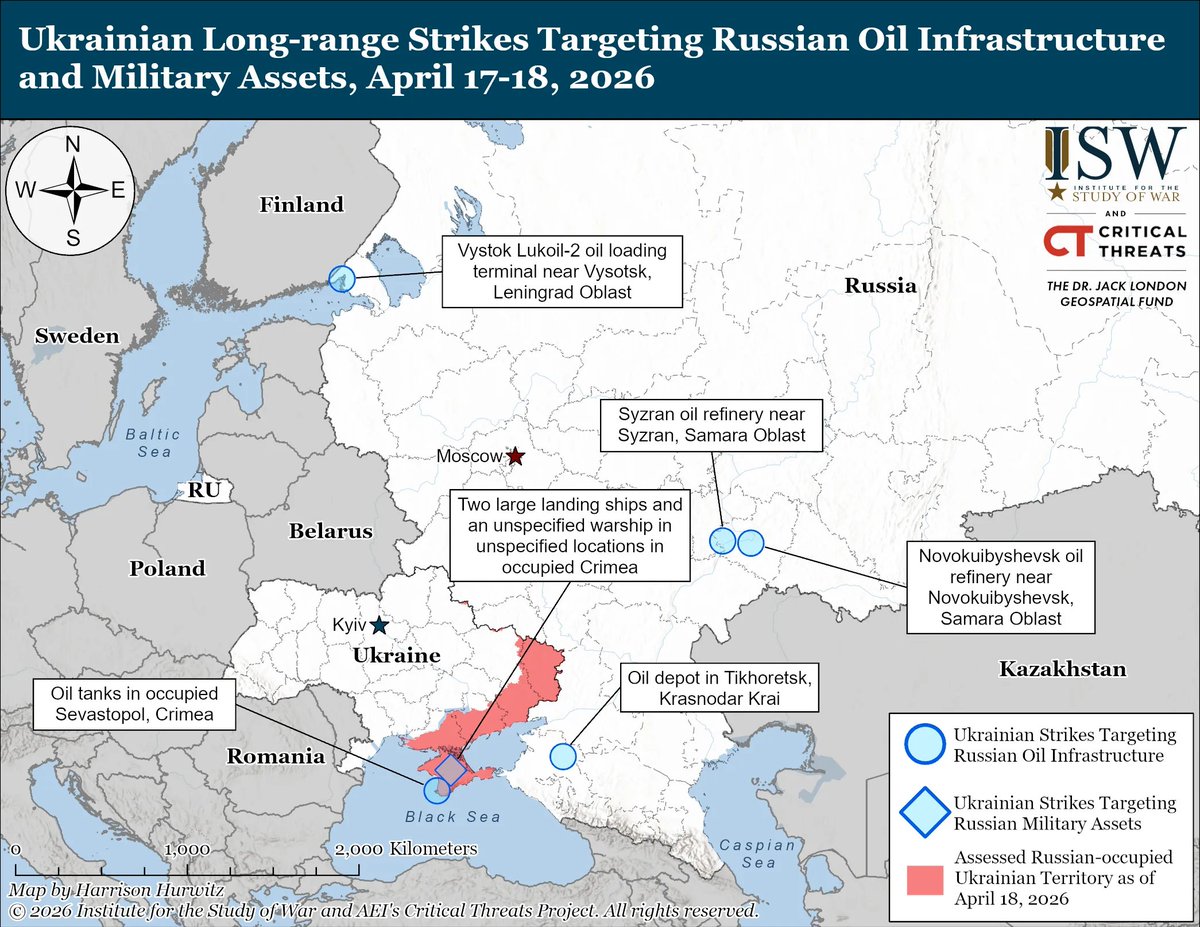
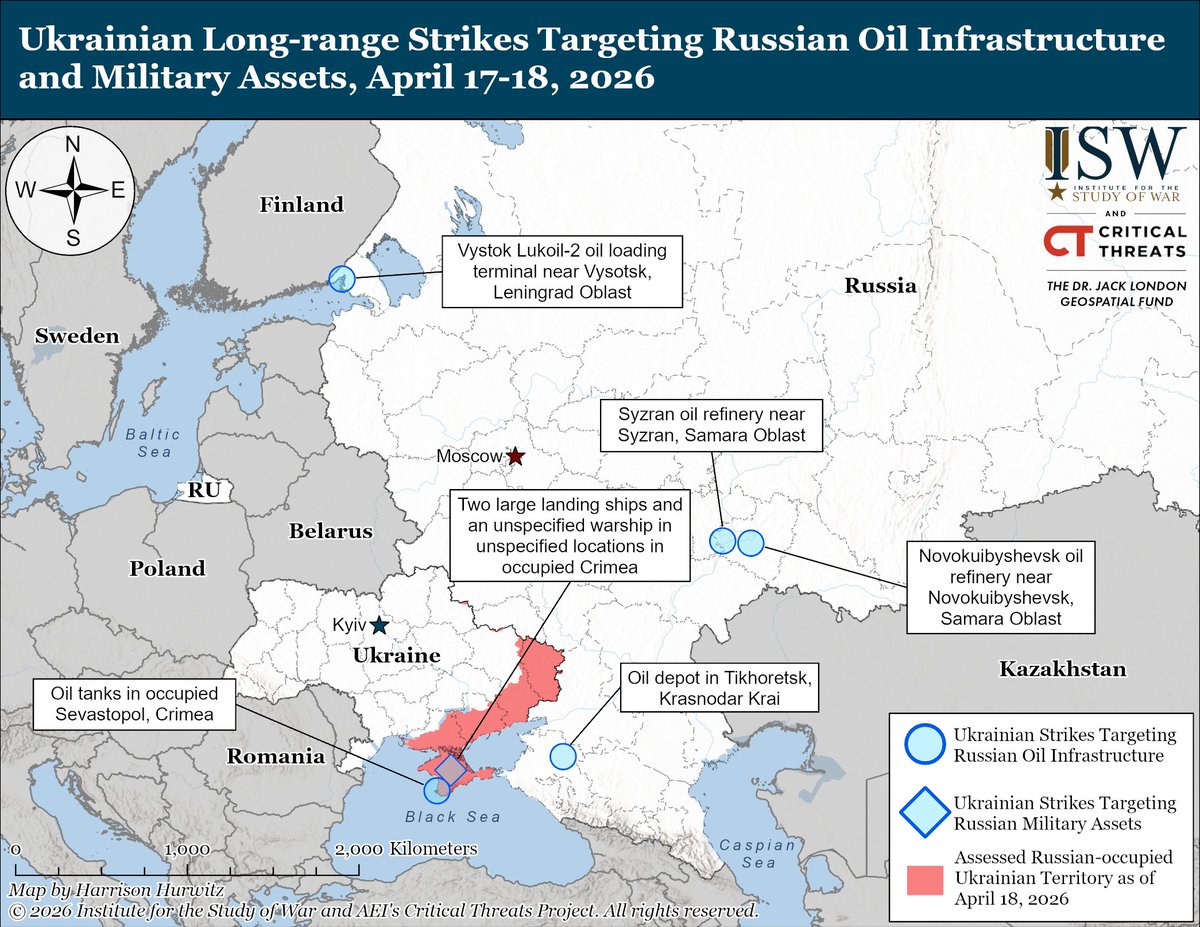
Ukrainian Long-Range Strike Campaign: The Ukrainian General Staff reported on April 18 that Ukrainian forces struck the Novokuibyshevsk and Syrzan oil refineries in Samara Oblast, an oil terminal at the Vysotsk Lukoil-2 Distribution Transshipment Complex in Leningrad Oblast, and the Tikhoretsk oil pumping station in Krasnodar Krai on the night of April 17 to 18, causing fires at the facilities. Geolocated footage published on April 18 shows fires at the Novokuibyshevsk and Syrzan oil refineries, and a Ukrainian open-source intelligence (OSINT) source assessed that the strike on Novokuibyshevsk may have damaged up to three tanks. Regional Russian officials acknowledged that Ukrainian drone strikes caused fires at the port in Vysotsk, Leningrad Oblast, and at an oil depot near Tikhoretsk, Krasnodar Krai. Ukraine’s Security Service (SBU) reported on April 18 that Ukrainian forces also struck military and energy targets in occupied Crimea including the Yamal and Azov Ropucha-class project 775 large landing ships (both of the Black Sea Fleet [BSF]), an unidentified third warship, the antenna block of a Delfin communication system, and an MMys-M1 radar station in unspecified areas of occupied Crimea, and fuel tanks at the Yugtorsan oil depot near occupied Sevastopol. The SBU reported that Ukrainian strikes may also have damaged a Russian Grachonok-class project 21980 patrol boat. Geolocated footage published on April 18 shows a fire at the Sevastopol oil depot, and Sevastopol occupation governor Mikhail Razvozhaev acknowledged that the strike caused a fire at a fuel storage tank.
Institute for the Study of War tweet media
Institute for the Study of War@TheStudyofWar

NEW: Ukraine’s long-range strike campaign continues to exploit overstretched Russian air defenses to damage oil infrastructure and military assets in Russia and occupied Crimea. Other Key Takeaways: Russian milbloggers criticized Russian air defense failures on the heels of the successful Ukrainian strike campaign against Russian oil and defense industrial infrastructure. Russia appears to be leveraging Russian SIM cards with international roaming data capability in Ukrainian border areas to support its long-range strike campaign against Ukraine. The United States extended on April 17 the waiver allowing Russia to sell its existing seaborne oil until May 16. Russian forces advanced in the Kostyantynivka-Druzhkivka tactical area. Russian forces launched 219 long-range drones against Ukraine.

English
2
62
252
36.5K
Institute for the Study of War
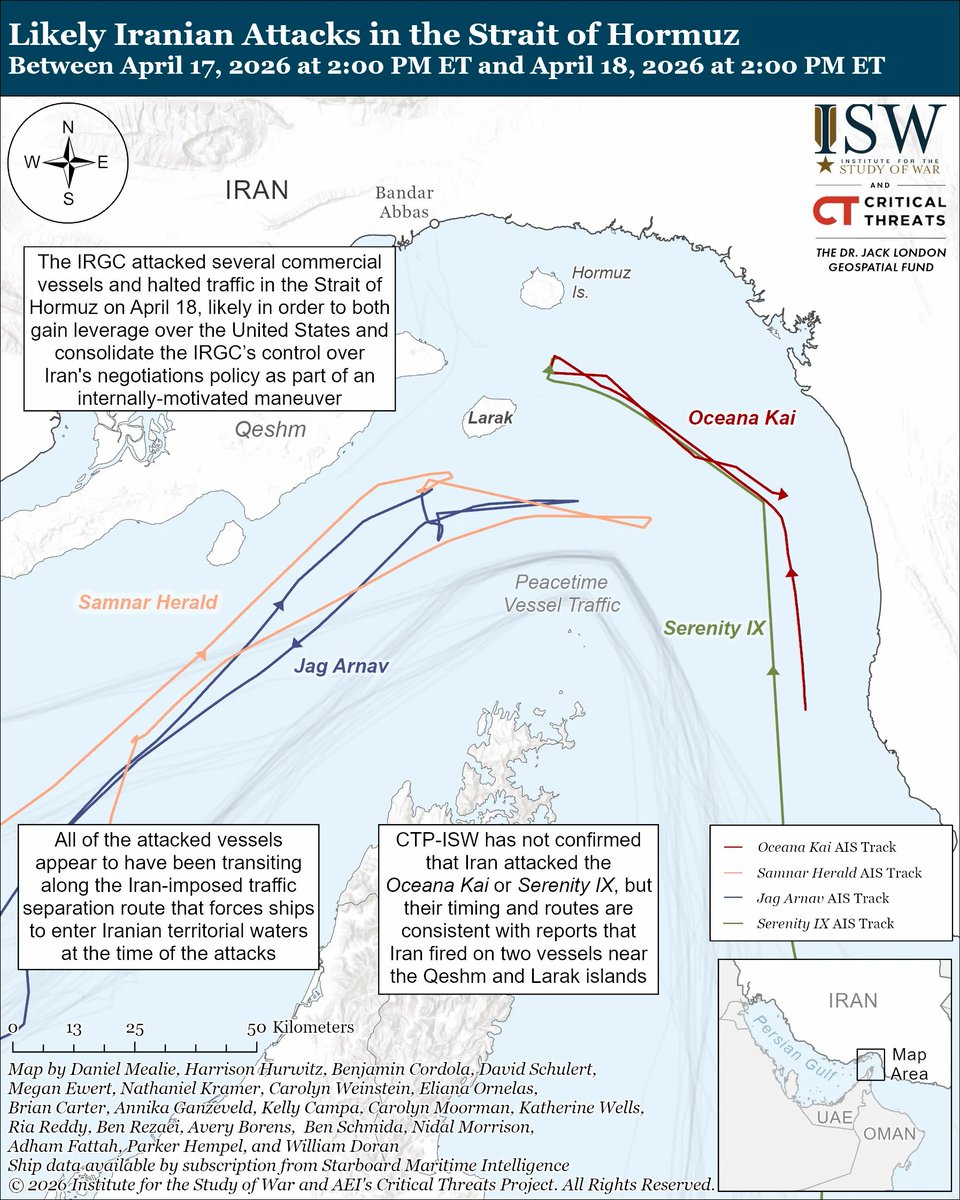
The IRGC Navy attacked several commercial vessels and halted traffic in the Strait of Hormuz on April 18, likely in order to both gain leverage over the United States and consolidate the IRGC’s control over Iran’s negotiations policy as part of an internally-motivated maneuver. The IRGC appears to have intervened and reasserted Iranian “control” over the Strait of Hormuz after Araghchi announced on April 17 that the strait was open to commercial shipping. At least nine vessels exited the strait through Omani territorial waters and outside of Iran’s imposed traffic separation scheme on April 17 and early on April 18 following Araghchi’s announcement. The IRGC, however, harshly criticized Araghchi’s statement and outlined specific conditions for vessels to transit the strait that amount to Iran retaining control over maritime traffic through the strait. The IRGC Navy later announced that “no vessel of any kind” should approach the strait, or it will be targeted. The IRGC likely aims to secure leverage over the United States by halting traffic and driving up shipping and oil prices to impose economic pressure on the United States. The IRGC’s actions are also likely intended as an internal demonstration of power, designed to exhibit the IRGC’s control within the regime, particularly over Iran’s negotiation policy. The IRGC Navy likely used fast attack craft to attack and intimidate at least four vessels in order to deter vessels from transiting the strait on April 18. All of the attacked vessels appear to have been transiting along the Iran-imposed traffic separation route that forces ships through Iranian territorial waters at the time of the attacks. IRGC Navy “gunboats” fired on a likely Indian-flagged tanker east of Larak Island, and “unknown projectiles” struck a likely Iranian-flagged container ship in the same area. Reuters also reported that two vessels reported being struck by gunfire between Qeshm and Larak islands. All four vessels turned around. The IRGC also broadcast radio messages to vessels in the strait, warning them that the strait is “closed.” Numerous vessels traveling toward the strait turned around after the Iranian attacks, according to maritime tracking data. The US Navy’s blockade of Iranian ports remained in place as of April 18. US CENTCOM said that it forced two ships to turn around and return to Iran between April 17 and 18. The US Navy has forced 23 ships to turn back since the United States began the blockade. Commercially available maritime tracking data shows that Iranian-flagged tankers and cargo ships continued to transit inside the strait on March 18 after the IRGC attacks, but no Iranian vessels have attempted to approach or test the blockade line as of this writing.
Institute for the Study of War tweet media
Institute for the Study of War@TheStudyofWar

MORE: The IRGC is responsible for coordinating and conducting military actions, but has historically not directly interfered in Iranian diplomacy and negotiations to the extent it currently does. The IRGC’s consolidation of control over Iranian decision-making indicates that the Iranian political officials currently negotiating with the United States do not have the authority to independently determine Iran’s negotiating positions. CTP-ISW recently assessed that the United States is negotiating with a divided committee of hardliners and pragmatists that lacks a cohesive, unified position. The IRGC appears to have sidelined more pragmatic figures with whom the United States has negotiated. Araghchi and Ghalibaf’s negotiating team reportedly did not have full authority to finalize a deal with the United States in Islamabad, for example.

English
10
125
345
59.1K
Institute for the Study of War
MORE: The IRGC is responsible for coordinating and conducting military actions, but has historically not directly interfered in Iranian diplomacy and negotiations to the extent it currently does. The IRGC’s consolidation of control over Iranian decision-making indicates that the Iranian political officials currently negotiating with the United States do not have the authority to independently determine Iran’s negotiating positions. CTP-ISW recently assessed that the United States is negotiating with a divided committee of hardliners and pragmatists that lacks a cohesive, unified position. The IRGC appears to have sidelined more pragmatic figures with whom the United States has negotiated. Araghchi and Ghalibaf’s negotiating team reportedly did not have full authority to finalize a deal with the United States in Islamabad, for example.
Institute for the Study of War tweet media
Institute for the Study of War@TheStudyofWar

NEW: Islamic Revolutionary Guards Corps (IRGC) Commander Major General Ahmad Vahidi and members of his inner circle have likely secured at least temporary control over not only Iran’s military response in this conflict but also Iran’s negotiating position and approach within the past 48 hours. The IRGC Navy attacked several commercial vessels on April 18 and declared that no vessel of “any type or nationality” is permitted passage through the strait, a reversal of Iranian Foreign Affairs Minister Abbas Araghchi’s announcement on April 17 that the strait was “completely open” to commercial traffic. IRGC-affiliated media also announced on April 18 that Iran has not agreed to participate in another round of negotiations with the United States due to “excessive” US demands. Other Key Takeaways: Vahidi and individuals close to him may have effectively controlled the negotiations process throughout the war, which is traditionally a role reserved for political leaders. Vahidi likely intended to impose IRGC oversight over the recent US-Iran talks in Islamabad. The IRGC continued to play an outsized role in Iran’s negotiations after the Islamabad talks. The IRGC’s consolidation of control over Iranian decision-making indicates that the Iranian political officials currently negotiating with the United States do not have the authority to independently determine Iran’s negotiating positions. The IRGC appears to have sidelined more pragmatic figures with whom the United States has negotiated. The IRGC attacked several commercial vessels and halted traffic in the Strait of Hormuz on April 18, likely in order to both gain leverage over the United States and consolidate the IRGC’s control over Iran’s negotiations policy as part of an internally-motivated maneuver. The IRGC likely aims to secure leverage over the United States by halting traffic and driving up shipping and oil prices to impose economic pressure on the United States. The IRGC’s actions are also likely intended to be an internal demonstration of power designed to exhibit the IRGC’s control within the regime, and in particular, its control over Iran’s negotiations policy. The US Navy’s blockade of Iranian ports remains in place as of April 18. US CENTCOM said that it forced two ships to turn around and return to Iran between April 17 and 18. The US Navy has forced 23 ships to turn back since the United States began the blockade. No Iranian vessels have attempted to approach or test the blockade line as of this writing.

English
37
247
702
220.2K
Institute for the Study of War รีทวีตแล้ว
Institute for the Study of War
NEW: Ukraine’s long-range strike campaign continues to exploit overstretched Russian air defenses to damage oil infrastructure and military assets in Russia and occupied Crimea. Other Key Takeaways: Russian milbloggers criticized Russian air defense failures on the heels of the successful Ukrainian strike campaign against Russian oil and defense industrial infrastructure. Russia appears to be leveraging Russian SIM cards with international roaming data capability in Ukrainian border areas to support its long-range strike campaign against Ukraine. The United States extended on April 17 the waiver allowing Russia to sell its existing seaborne oil until May 16. Russian forces advanced in the Kostyantynivka-Druzhkivka tactical area. Russian forces launched 219 long-range drones against Ukraine.
Institute for the Study of War tweet mediaInstitute for the Study of War tweet mediaInstitute for the Study of War tweet mediaInstitute for the Study of War tweet media
English
5
186
767
141.9K
Institute for the Study of War รีทวีตแล้ว
Institute for the Study of War
NEW: Islamic Revolutionary Guards Corps (IRGC) Commander Major General Ahmad Vahidi and members of his inner circle have likely secured at least temporary control over not only Iran’s military response in this conflict but also Iran’s negotiating position and approach within the past 48 hours. The IRGC Navy attacked several commercial vessels on April 18 and declared that no vessel of “any type or nationality” is permitted passage through the strait, a reversal of Iranian Foreign Affairs Minister Abbas Araghchi’s announcement on April 17 that the strait was “completely open” to commercial traffic. IRGC-affiliated media also announced on April 18 that Iran has not agreed to participate in another round of negotiations with the United States due to “excessive” US demands. Other Key Takeaways: Vahidi and individuals close to him may have effectively controlled the negotiations process throughout the war, which is traditionally a role reserved for political leaders. Vahidi likely intended to impose IRGC oversight over the recent US-Iran talks in Islamabad. The IRGC continued to play an outsized role in Iran’s negotiations after the Islamabad talks. The IRGC’s consolidation of control over Iranian decision-making indicates that the Iranian political officials currently negotiating with the United States do not have the authority to independently determine Iran’s negotiating positions. The IRGC appears to have sidelined more pragmatic figures with whom the United States has negotiated. The IRGC attacked several commercial vessels and halted traffic in the Strait of Hormuz on April 18, likely in order to both gain leverage over the United States and consolidate the IRGC’s control over Iran’s negotiations policy as part of an internally-motivated maneuver. The IRGC likely aims to secure leverage over the United States by halting traffic and driving up shipping and oil prices to impose economic pressure on the United States. The IRGC’s actions are also likely intended to be an internal demonstration of power designed to exhibit the IRGC’s control within the regime, and in particular, its control over Iran’s negotiations policy. The US Navy’s blockade of Iranian ports remains in place as of April 18. US CENTCOM said that it forced two ships to turn around and return to Iran between April 17 and 18. The US Navy has forced 23 ships to turn back since the United States began the blockade. No Iranian vessels have attempted to approach or test the blockade line as of this writing.
Institute for the Study of War tweet media
English
109
673
1.8K
500.8K