Anotherdev

276 posts

Anotherdev banner
Anotherdev

Anotherdev

@0xAnotherdev

Physics student at @UdeA and full-stack engineer. Cryptography advocate. Web3 developer at @KolektivoLabs

Medellín, Colombia Sumali Ağustos 2021
309 Sinusundan131 Mga Tagasunod
Anotherdev nag-retweet
Terrible Maps
Terrible Maps@TerribleMaps·
Believe it or not, Germany’s 5 largest cities lie perfectly on a 4th-degree polynomial
Terrible Maps tweet media
English
383
1.1K
30.4K
5M
Fede’s intern 🥊
Fede’s intern 🥊@fede_intern·
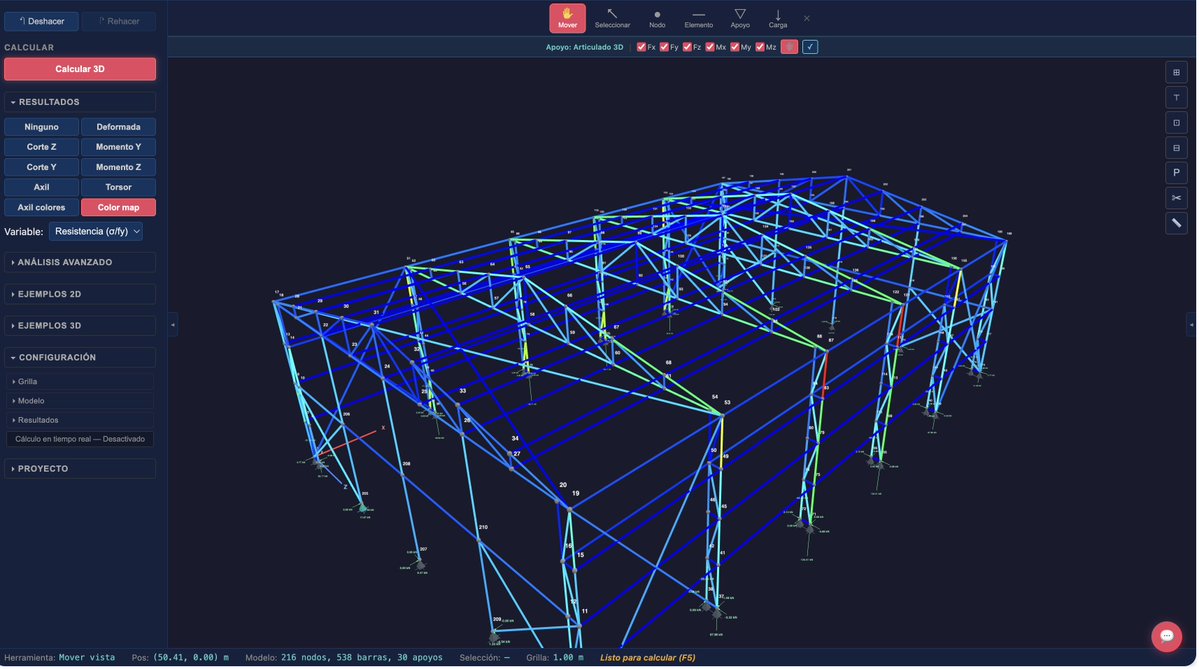
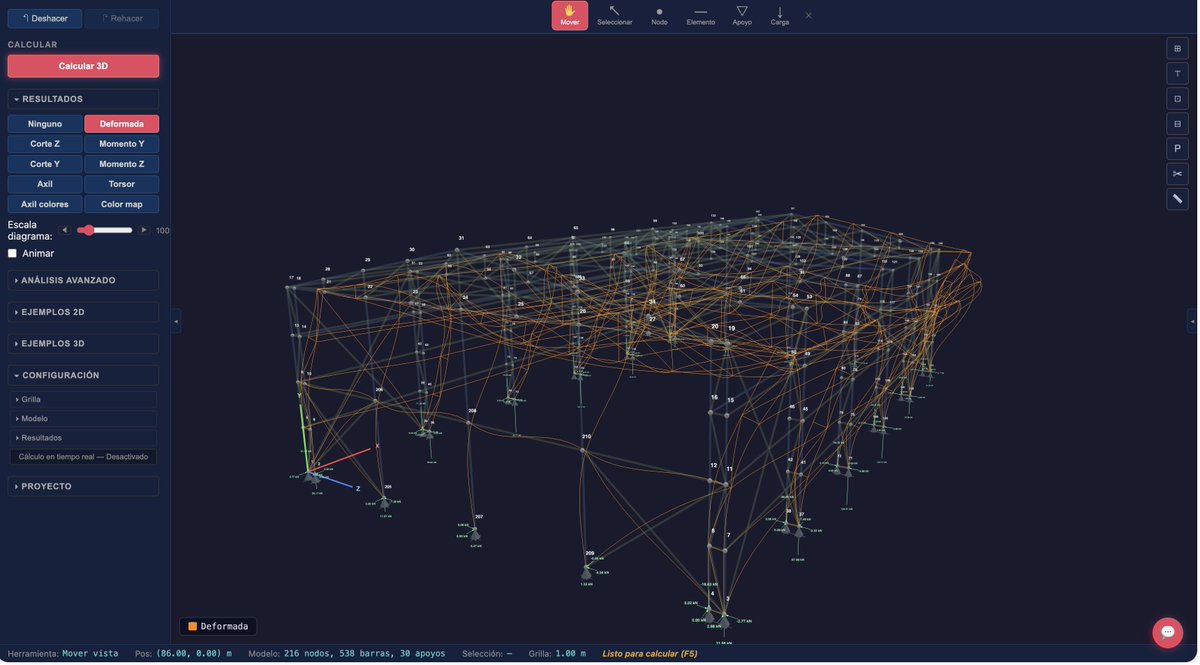
Lambda @class_lambda brings together engineers from every discipline, chemical, structural, civil, mechanical, industrial, with computer scientists, mathematicians, physicists, and experienced software engineers. We're using that depth, plus LLMs, to ship free alternatives to the tools that have charged $5k to $50k/seat to the engineering profession for decades. Pull request by pull request.
Fede’s intern 🥊 tweet mediaFede’s intern 🥊 tweet media
English
11
6
92
6.3K
Anotherdev nag-retweet
vitalik.eth
vitalik.eth@VitalikButerin·
There have recently been some discussions on the ongoing role of L2s in the Ethereum ecosystem, especially in the face of two facts: * L2s' progress to stage 2 (and, secondarily, on interop) has been far slower and more difficult than originally expected * L1 itself is scaling, fees are very low, and gaslimits are projected to increase greatly in 2026 Both of these facts, for their own separate reasons, mean that the original vision of L2s and their role in Ethereum no longer makes sense, and we need a new path. First, let us recap the original vision. Ethereum needs to scale. The definition of "Ethereum scaling" is the existence of large quantities of block space that is backed by the full faith and credit of Ethereum - that is, block space where, if you do things (including with ETH) inside that block space, your activities are guaranteed to be valid, uncensored, unreverted, untouched, as long as Ethereum itself functions. If you create a 10000 TPS EVM where its connection to L1 is mediated by a multisig bridge, then you are not scaling Ethereum. This vision no longer makes sense. L1 does not need L2s to be "branded shards", because L1 is itself scaling. And L2s are not able or willing to satisfy the properties that a true "branded shard" would require. I've even seen at least one explicitly saying that they may never want to go beyond stage 1, not just for technical reasons around ZK-EVM safety, but also because their customers' regulatory needs require them to have ultimate control. This may be doing the right thing for your customers. But it should be obvious that if you are doing this, then you are not "scaling Ethereum" in the sense meant by the rollup-centric roadmap. But that's fine! it's fine because Ethereum itself is now scaling directly on L1, with large planned increases to its gas limit this year and the years ahead. We should stop thinking about L2s as literally being "branded shards" of Ethereum, with the social status and responsibilities that this entails. Instead, we can think of L2s as being a full spectrum, which includes both chains backed by the full faith and credit of Ethereum with various unique properties (eg. not just EVM), as well as a whole array of options at different levels of connection to Ethereum, that each person (or bot) is free to care about or not care about depending on their needs. What would I do today if I were an L2? * Identify a value add other than "scaling". Examples: (i) non-EVM specialized features/VMs around privacy, (ii) efficiency specialized around a particular application, (iii) truly extreme levels of scaling that even a greatly expanded L1 will not do, (iv) a totally different design for non-financial applications, eg. social, identity, AI, (v) ultra-low-latency and other sequencing properties, (vi) maybe built-in oracles or decentralized dispute resolution or other "non-computationally-verifiable" features * Be stage 1 at the minimum (otherwise you really are just a separate L1 with a bridge, and you should just call yourself that) if you're doing things with ETH or other ethereum-issued assets * Support maximum interoperability with Ethereum, though this will differ for each one (eg. what if you're not EVM, or even not financial?) From Ethereum's side, over the past few months I've become more convinced of the value of the native rollup precompile, particuarly once we have enshrined ZK-EVM proofs that we need anyway to scale L1. This is a precompile that verifies a ZK-EVM proof, and it's "part of Ethereum", so (i) it auto-upgrades along with Ethereum, and (ii) if the precompile has a bug, Ethereum will hard-fork to fix the bug. The native rollup precompile would make full, security-council-free, EVM verification accessible. We should spend much more time working out how to design it in such a way that if your L2 is "EVM plus other stuff", then the native rollup precompile would verify the EVM, and you only have to bring your own prover for the "other stuff" (eg. Stylus). This might involve a canonical way of exposing a lookup table between contract call inputs and outputs, and letting you provide your own values to the lookup table (that you would prove separately). This would make it easy to have safe, strong, trustless interoperability with Ethereum. It also enables synchronous composability (see: ethresear.ch/t/combining-pr… and ethresear.ch/t/synchronous-… ). And from there, it's each L2's choice exactly what they want to build. Don't just "extend L1", figure out something new to add. This of course means that some will add things that are trust-dependent, or backdoored, or otherwise insecure; this is unavoidable in a permissionless ecosystem where developers have freedom. Our job should make to make it clear to users what guarantees they have, and to build up the strongest Ethereum that we can.
English
2.6K
1.7K
10K
6.3M
Anotherdev nag-retweet
Fede’s intern 🥊
Fede’s intern 🥊@fede_intern·
Humanity is completely unprepared for what's coming. I've been talking with partners, employees, and countless people over the last few weeks. I'm amazed by most people's inability to adapt or even grasp second order effects of what's coming. They don't even want to think about the consequences. Some of the smartest people I've met in my life are trying to avoid accepting the reality: it's very likely we will have tools that are able to do almost everything better than a human in a very short timeline. It's very likely that even those of us who can generally adapt quickly won't be able to overcome this tsunami. We will experience one of the biggest deflationary shocks in history. Only robotics combined with AI could be bigger than this. I find it almost absurd to watch so many YouTube channels and X accounts showing you how to create your own simple app or SaaS. If anybody can build things fast, what do you think will happen? Is there demand for thousands of applications of every kind? During the last 20 years some of the smartest people alive battled for attention of people by building software and the limitation was execution costs, speed and distribution. Right, but I'm forgeting that people say it's not the time of implementation anymore. In theory, we're now in the time of ideas. So what happens when someone has a good idea and anyone can copy it in days? If implementation becomes worthless, what remains? Perhaps taste, distribution, or maybe in some cases deep domain expertise. But even those moats are eroding fast. What makes this different from past disruptions is the pace. Previous technological shifts gave people decades to adapt. This one might give them months. We built this. And yet it feels like it's happening to us, not by us. The strange position of being both the creator and the displaced. This is going to be very sad and fun at the same time. Happy to be alive during this time.
English
197
149
1.7K
175.6K
Ariiellus.eth
Ariiellus.eth@Ariiellus·
Hey guys, I just quit my job and decided to go full time yapper any advice?
English
3
0
11
492
Anotherdev
Anotherdev@0xAnotherdev·
@krichard121212 Crazy, stock market is way more complex than a Lorenz attractor.
English
0
0
5
1.2K
Richárd
Richárd@krichard121212·
Least delusional quant on tiktok
English
49
87
2.2K
138.4K
Shaak 💙🧡
Shaak 💙🧡@cryptosinomx·
Necesito un ejemplo de un verdadero proyecto Zk "Verificar información sin tener que revisarla" Eso me suena a un par de mappings en cualquier sc Solidity Devs, Zk protocol ambassadors, alguien que fune o respalde esta premisa
Español
3
0
1
88
Anotherdev nag-retweet
All day Astronomy
All day Astronomy@forallcurious·
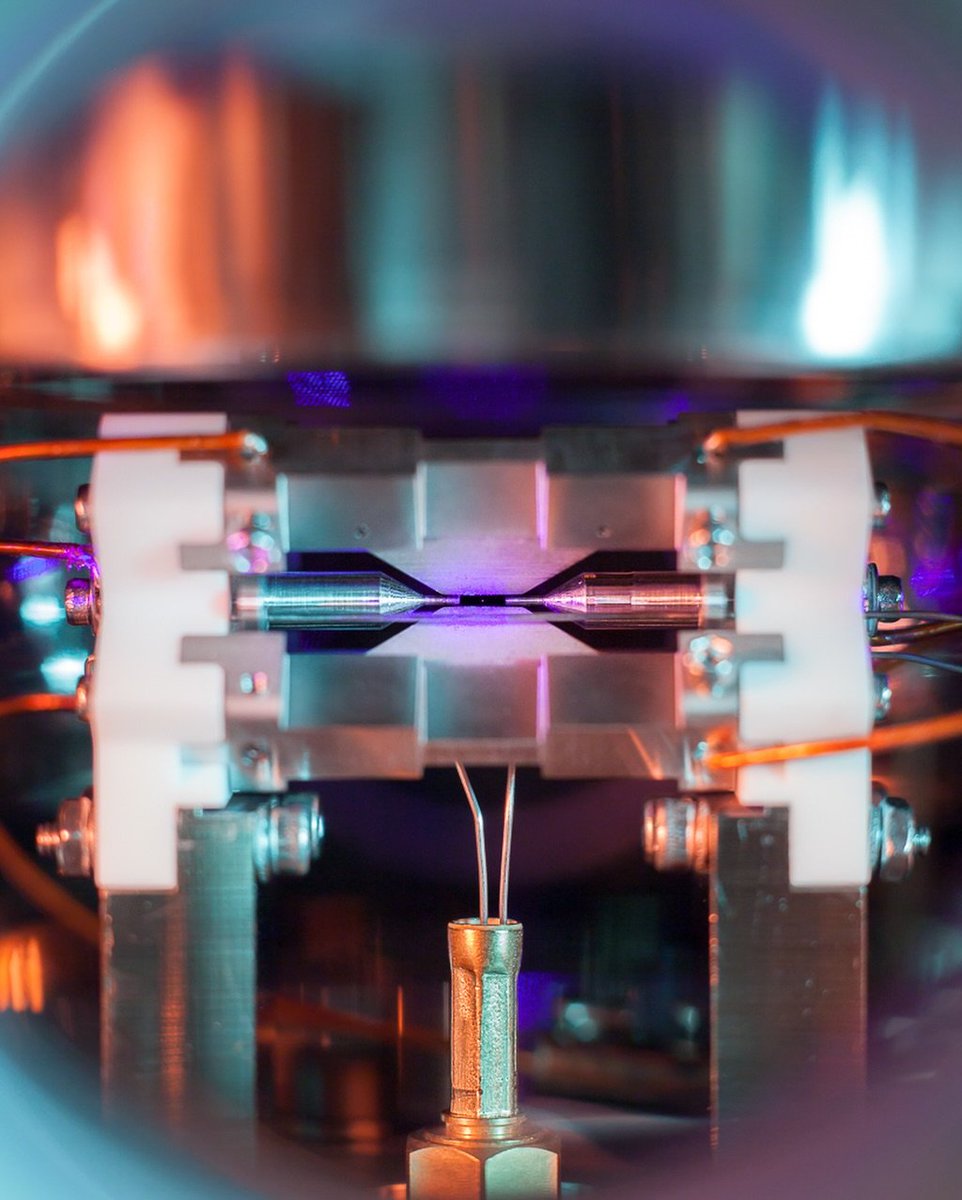
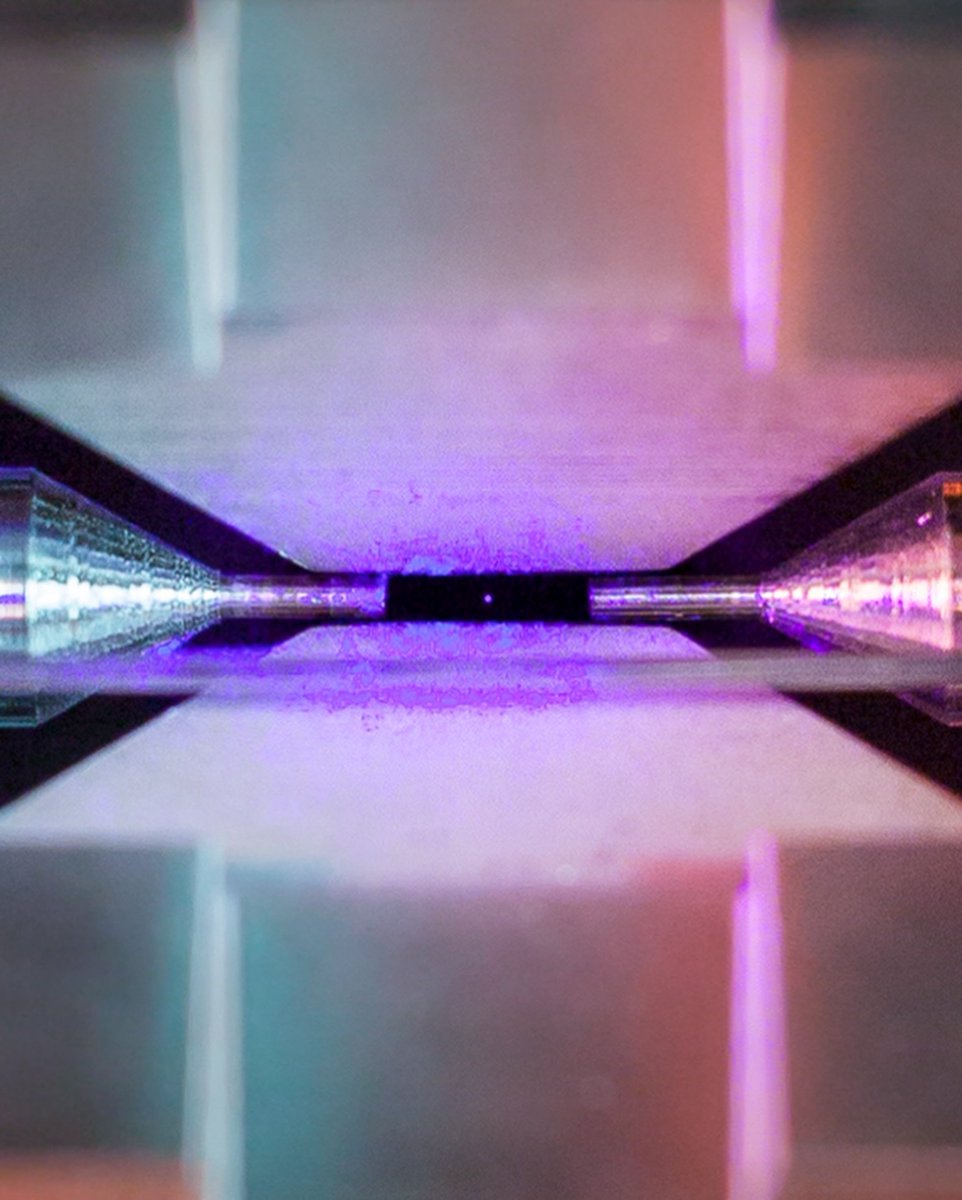
🚨: Behold! You're looking at a photo of a single atom.
All day Astronomy tweet mediaAll day Astronomy tweet media
English
383
2.4K
50.8K
1.4M
Ariiellus.eth
Ariiellus.eth@Ariiellus·
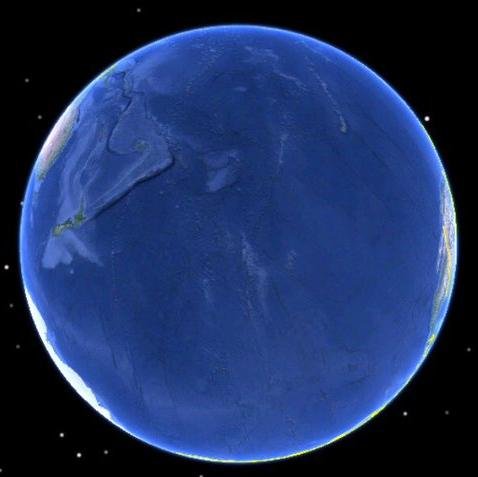
three body problem in live action
Black Hole@konstructivizm

GW Orionis remains one of the most iconic examples of a warped and torn protoplanetary disk in a multi-star system. The core findings from the 2020 Science paper—disk tearing driven by the gravitational torques from the misaligned triple stars—have held up well, but recent theoretical work (up to late 2025) has refined the debate.Key updates as of early 2026:High-resolution hydrodynamic simulations (Young 2025, published in MNRAS) show that disk tearing can indeed occur under realistic protoplanetary disk conditions for GW Ori's parameters. These models replicate the "wavelike" warp propagation expected in thicker, low-viscosity disks (h/r ≈ 0.04–0.05) and confirm tearing without needing unrealistically thin disks. They also rule out retrograde disk rotation relative to the stars and suggest a slightly thicker disk better matches the observed structure. The alternative hypothesis—an unseen giant planet (or planets) carving the large gap and contributing to the misalignment—remains viable but unproven. Some 2024–2025 studies argue that stellar torques alone may be marginal or insufficient in certain parameter regimes, potentially requiring a circumtriple planet to fully explain the break. However, no direct detection of such a planet has been reported yet. No major new observational campaigns (e.g., deeper ALMA or JWST follow-ups specifically resolving planets) appear in recent literature, so the disk structure is still best described by the original ALMA + SPHERE/VLT data: three distinct dust rings, with the inner one sharply misaligned (~40° tilt) and containing ~30 Earth masses of dust—plenty for forming planets on highly inclined orbits around all three stars. This system continues to serve as a benchmark for understanding extreme disk dynamics in multiple-star environments, where ~50% of stars form. The ongoing tension between pure stellar-torque tearing and planet-assisted models highlights how challenging it is to disentangle these effects observationally.What draws you to GW Orionis specifically—the possibility of circumtriple planets, the tearing physics, or its implications for exoplanet demographics in binaries/triples?

English
1
0
2
154
Anotherdev
Anotherdev@0xAnotherdev·
Life hits different when you understand the difference between the abstraction and the actual implementation of the abstraction. Category theory seems so powerful.
English
0
0
0
25
Anotherdev nag-retweet
Edward Frenkel
Edward Frenkel@edfrenkel·
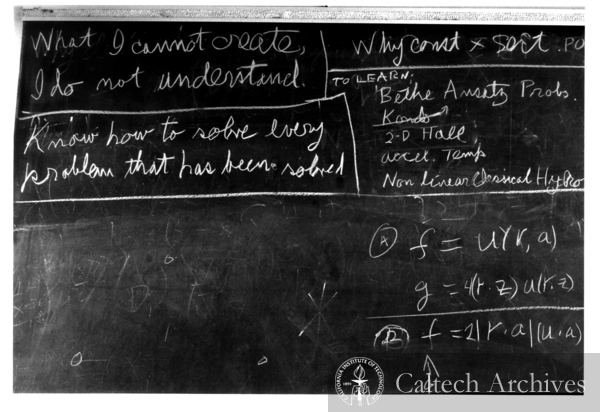
When Richard Feynman died in 1988, his last blackboard bore a curious note to himself: “To learn: Bethe Ansatz.” The Bethe Ansatz, introduced by Hans Bethe in 1931, is a method for finding the spectra of Hamiltonians in quantum integrable systems such as the Heisenberg magnet. For decades it helped produce astonishing results and conjectures, though no one quite knew why it worked. I will revisit this enduring mystery today at @London_Inst (see the link below). In collaboration with Boris Feigin & Nicolai Reshetikhin, I had reinterpreted the Bethe Ansatz through the lens of the geometric Langlands correspondence in 1994, expressing its spectra in terms of mathematical objects known as opers. This framework led us to powerful generalizations involving q-characters of quantum affine algebras and q-opers, bridging quantum physics and modern geometry. I will explore these ideas and reflect on why the Bethe Ansatz—an old key to new symmetries—still stood at the top of Feynman’s list.
Edward Frenkel tweet media
English
22
101
655
50.6K
Anotherdev nag-retweet
Physics In History
Physics In History@PhysInHistory·
Maryna Viazovska, a mathematician from Kyiv, was awarded the Fields Medal in 2022—one of the most prestigious honors in mathematics—for solving the problem of sphere packing in eight-dimensional space. Notably, before her breakthrough, the problem had only been solved in three dimensions, and that solution spanned 300 pages. Viazovska’s proof, in contrast, was just 23 pages long and stood out for its remarkable elegance. She also holds the distinction of being only the second woman ever to receive the Fields Medal.
Physics In History tweet media
English
79
966
7.4K
265K
Anotherdev nag-retweet
the Rich
the Rich@Duderichy·
EVERYTHING IS JUST A SIMPLE HARMONIC OSCILLATOR
English
143
882
11K
367.3K
Arturo
Arturo@0xVato·
ZK != a Privacy mis niños! 🤠 a la orden pal desorden
Español
2
0
18
865
Anotherdev
Anotherdev@0xAnotherdev·
@garosan1 Dios mio, los libros están carísimos, y no me gusta leer en pdf :(
Español
1
0
2
22
Garosan
Garosan@garosan1·
Los libros físicos ya son objetos de colección para nostálgicos 🥹 no descarto que en 20 años tener una biblioteca sea socialmente visto como tener una colección de funkos ahorita.
Garosan tweet media
Español
2
0
3
112
Anotherdev nag-retweet
Jarrod Watts
Jarrod Watts@jarrodwatts·
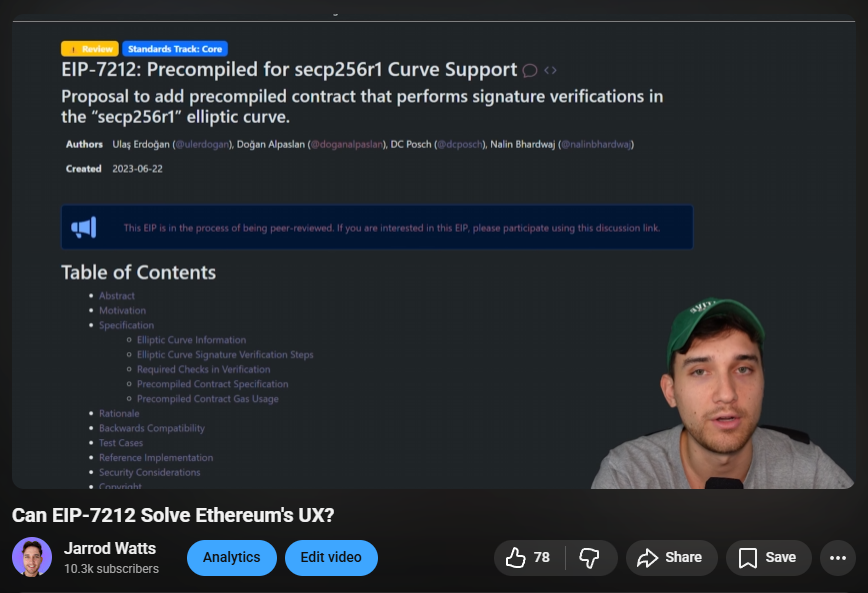
If you're interested in a nerdy deep dive, I made a video covering this a few years back (when it had a different eip name) youtube.com/watch?v=HVlHfu…
YouTube video
YouTube
Jarrod Watts tweet media
English
3
2
16
1.9K