Adamant

21 posts

Adamant banner
Adamant

Adamant

@AdamantProtocol

https://t.co/s4yA1M14gw A Layer 1 protocol for users who require properties no existing programmable chain delivers in combination.

Sumali Mayıs 2026
38 Sinusundan128 Mga Tagasunod
Adamant
Adamant@AdamantProtocol·
Good question. ADM doesn’t have a hard supply cap. The 100M figure is the genesis pool only a fixed quantity distributed during the launch phase via two paths (70% burn-to-mint, 30% validator block rewards). Once the pool is fully claimed (or 5 years pass, whichever first), the launch phase ends. After that, post-launch issuance kicks in on a fixed, hard-coded schedule: — 4% per year, Years 1–5 — 3% per year, Years 6–10 — 2% per year, Years 11–20 — 1% per year, perpetual thereafter This issuance pays validators for ongoing consensus work and a small slice for witnesses. Counterbalancing the issuance is fee burn. Transaction fees (EIP-1559-style base fees) are burned on most fee dimensions, removing ADM from circulation. Under heavy network usage, burn exceeds issuance and supply contracts. Under light usage, supply expands slowly. So the supply behaviour is: — Launch phase: 100M ADM enters circulation via burn-to-mint and validator rewards. — Post-launch: continuous slow issuance offset by fee burn. Net direction depends on usage. — No upper bound. No “maxed out” state. No issuance cliff. The schedule is fixed at genesis and cannot be modified except by socially-coordinated hard fork same model as Bitcoin’s monetary policy.
English
0
0
0
3
Adamant
Adamant@AdamantProtocol·
The chain has its own token called ADM. There are 100 million of them at the start. Nobody not the people who built it, not investors, not anyone gets any for free. Here's how you get them: Burn external value. You can take Bitcoin, Ethereum, or stablecoins (USDT, USDC) and provably destroy them. The Adamant chain sees you destroyed them, and gives you ADM in exchange. The rate is fixed: 20 ADM for every dollar's worth of crypto you burn. (Adamant does not hold any of the burned value you send it to a null address that no one can access) So $50 worth of Bitcoin gets you 1,000 ADM exactly enough to register as a Node Runner. $5 worth gets you 100 ADM exactly enough to register as a Node Watcher. Earn it by validating. If you're a Node Runner, you earn ADM as the chain runs. The chain rewards you for doing the work. That's it. There are only two ways to get ADM at the start. Both are open to anyone in the world. adamantprotocol.com/genesis
English
2
0
5
67
Adamant
Adamant@AdamantProtocol·
Adamant Protocol Development Status The v0.1 specification is complete. After an extensive design phase incorporating five integrated proposals low-coordination launch, two-regime mempool encryption, permissionless prover market, hybrid post-quantum signatures, and the four-tier participation model every protocol parameter is now concrete. No placeholders remain. Specified and finalised: Cryptographic foundation: Ed25519 + ML-DSA hybrid signatures, ML-KEM-768 post-quantum key agreement, Halo 2 zero-knowledge proofs, Wesolowski VDF time-lock encryption, BLS12-381 aggregation. Consensus: DAG-BFT (Mysticeti-shaped), constitutional floor of 7 validators, soft ceiling of 75, first-come-first-served selection with persistent membership. Economics: 100M ADM genesis pool, 70/30 burn-to-validator split, 20 ADM per USD-equivalent burn rate, 1,000 ADM Node Runner stake floor, 100 ADM Node Watcher stake floor, scheduled five-year parameter re-evaluation. Throughput floor: 50,000 TPS at design-target validator count on residential-fibre hardware. Remaining work, in sequence: Reference implementation in Rust. Pre-Phase-1 currently the protocol is fully specified but no production code exists. Estimated 18–36 months across cryptographic primitives, object model, privacy layer, consensus, recursive proofs, and genesis tooling. Empirical validation of the 50,000 TPS floor on representative residential-fibre topology. The figure is provisional until measured. If empirics fall short, the floor is revised not the hardware tier raised. External audits of cryptographic implementations, consensus correctness, and economic mechanisms. Public testnet with stepwise feature activation, followed by an extended stability period. Genesis activation autonomous, occurring the moment seven independent validators are simultaneously registered, stake-eligible, and online. No coordination event. No recruited cohort. No foundation. Repository: github.com/adamant-protoc…
English
1
0
3
40
Adamant
Adamant@AdamantProtocol·
Most blockchains pick their Node Runners using either "whoever has the most money" or "whoever has the fastest computer." Both of those mean rich people and big companies always win. Small home operators get pushed out over time. Adamant does it differently. First come, first served. You register, you wait in line if all the slots are full, and when a slot opens up, you're in. Once you're in, you keep your slot as long as you stay online. Forever, if you want. This is the most important design choice in the whole chain. It means a normal person who registered early and keeps their computer running can never be pushed out by a billionaire who shows up later. Your slot is yours as long as you keep showing up. Imagine a club with 75 chairs. Most clubs let the richest people buy the chairs whenever they want, kicking poorer members out. Adamant's club says: if you got here first and you keep coming to meetings, the chair is yours. The rich newcomer can wait in line like everyone else.
English
0
0
3
46
Adamant
Adamant@AdamantProtocol·
imagine the internet had its own kind of money, and instead of a bank or a company controlling it, the rules were written down once and never changed. That's a blockchain. Bitcoin was the first one. Ethereum added the ability to run programs (like apps) on top of it. There are hundreds of others now. Adamant is a new one being built. Here's what makes it different. Most blockchains have a problem nobody talks about. When people say a blockchain is "decentralised," they mean lots of different computers around the world are running it, so no single person or company controls it. That's the idea, anyway. But in practice, most modern blockchains require really expensive computers to run. We're talking $300 a month minimum, sometimes thousands. So the only people running them are big companies with money to spend on data centres. The "lots of different computers" turns out to be "a few hundred big company servers." That's not really decentralisation. It's just a different kind of centralisation, where instead of one bank, you have a handful of tech companies running the show. Adamant is built so that a normal person, with a normal computer at home, on normal home internet, can actually be part of running it. Not just watching from the sidelines. Actually doing the work and getting paid for it. What can you actually do on Adamant? The same kinds of things you can do on other blockchains. Send money to people. Build apps. Trade tokens. Make digital art. Borrow and lend. All the usual stuff. But three things work differently: Privacy is automatic. When you send money on Bitcoin or Ethereum, anyone in the world can look up your address and see your entire history every payment you ever made, every dollar you ever held. Forever. On Adamant, your transactions are private by default. Nobody can see them unless you specifically choose to show them. It's like the difference between sending a postcard (anyone can read it) and sending a sealed letter (only the recipient can read it). It's fast. Most blockchains take 10 seconds to several minutes to confirm a transaction. Adamant takes about half a second. Roughly the same speed as tapping your card at a shop. It works on a phone. Your smartphone can verify that the entire blockchain is correct every transaction, every block, all of it in under a quarter of a second. That sounds impossible but it's done with clever maths. The point is: you don't need a powerful computer to trust the chain. Your phone is enough.
English
0
0
1
35
Adamant
Adamant@AdamantProtocol·
Most chains called "decentralised" actually run on datacenter hardware. Solana needs industrial-grade machines. Sui requires VPS-class validators. Home participation is a footnote. Adamant flips this. A residential fibre connection and a £2,000 desktop is enough to be a validator. What you get on top of that: Privacy by default. Every transaction shielded. Post-quantum cryptography. Survives future quantum computers. Sub-second finality. Encrypted mempool. No front-running. Phone-verifiable. Any smartphone verifies the whole chain in under 200ms. No foundation, no premine, no admin keys, no governance capture. 50,000 TPS minimum. That's double Visa's global peak. On home hardware. With privacy. Four ways to participate: Node Runners (validators)1,000 ADM stake. Up to 75 active. Node Watchers (witnesses) 100 ADM stake. Phone-class. Provers permissionless GPU market. Service nodes permissionless infrastructure. The selection mechanism that matters: First-come-first-served, persistent membership. You register, you take a slot when one opens, you keep it as long as you stay online. A small Node Runner who registered early can't be displaced by wealthier latecomers or faster hardware. Commitment beats capital. Genesis: 100M ADM total. Nobody starts with any. Burn BTC, ETH, USDT, or USDC at 20 ADM per USD-equivalent to acquire it. The chain self-activates when 7 validators come online. No tokens for sale. No round being raised. No private allocation. github.com/adamant-protoc…
English
1
0
2
56
Adamant
Adamant@AdamantProtocol·
We wanted to lower the barrier to entry for people who want to run nodes, be witnesses, and participate in chain security without needing datacenter hardware or a 200-person coordination event. Five proposals locked. Whitepaper amendments being drafted now. — TPS: 200k → 50k. Drops validator hardware from VPS to residential fiber. Still 30x Visa. Subject to empirical validation. — Active set: dynamic, floor=7, ceiling 60-80. No coordinated cohort. Chain runs at whatever N currently is. — Activation: 7 validators online → block 1. No countdown. No human switch. Protocol activates itself. — Prover market. Validators do consensus + decryption. GPUs do proofs in a permissionless market. Validator fallback at degraded cadence keeps phone-verifiability structural. — Time-lock encryption at low N, threshold at N≥15. Compatible with low-coordination launch. Trade-off: 10-30s latency during early period. Mitigated by anchor rotation + equivocation slashing. — Halt-on-disagreement at low N. Safety preserved. Liveness weak early. Honest cost. — Witness tier. Phones and laptops do attestation, data availability sampling, fraud detection. Massive participation expansion beyond validators. — Hybrid signatures: Ed25519 + ML-DSA + ML-KEM. Fast for ordinary tx, post-quantum for identity, ML-KEM for stealth addresses (caught a primitive misidentification during deliberation). — On-chain security tier disclosure. Wallets read current N and adjust. Chain doesn't pretend to be strong when it isn't. Constitutional posture: honest disclosure of every trade-off. No marketing complexity hiding the costs. Seven core properties remain. Launch is now honest about being a trajectory. Whitepaper amendments push to GitHub soon.
English
1
1
10
906
Adamant
Adamant@AdamantProtocol·
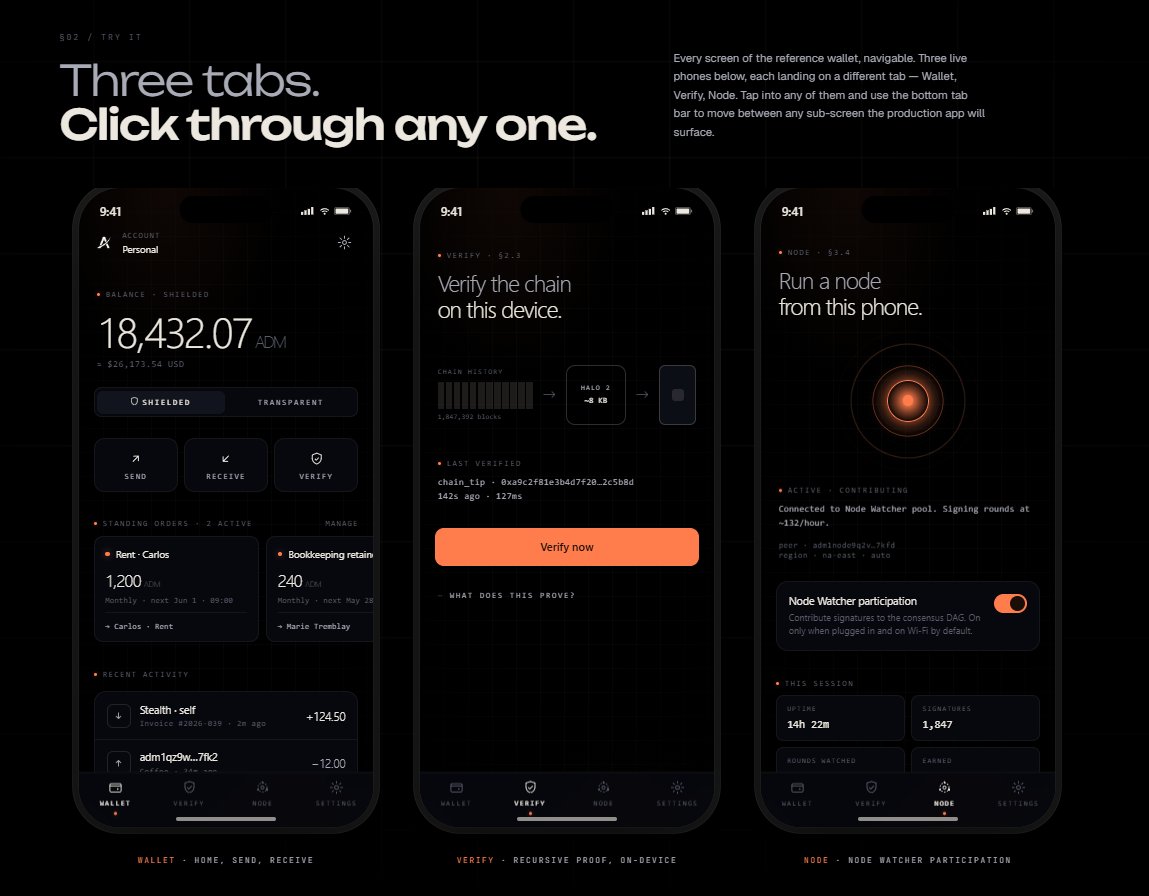
The reference wallet is up. The first and only application the team will ship. Open source, self-custodial, every protocol property exercised in one app. Three tabs. Click through any of them. Try it: adamantprotocol.com/wallet Watch the repo: github.com/adamant-protoc…
Adamant tweet media
English
3
0
7
218
Adamant
Adamant@AdamantProtocol·
Building the verifier passes that catch malformed bytecode before it executes on Adamant. This week's work: bounds checking (every index points somewhere valid), duplication detection (no duplicate handles or signatures), signature well-formedness (type tokens are structurally sound). 11 passes wired. Layer by layer. github.com/adamant-protoc…
English
8
0
16
338
Adamant
Adamant@AdamantProtocol·
Adamant has two classes of participants. Both permissionless. Both first-class. → Node Runners secure the chain → Node Watchers verify the chain Same protocol. Different roles. Anyone can be either. adamantprotocol.com/genesis
Adamant tweet media
English
13
0
21
375
Adamant
Adamant@AdamantProtocol·
After launch, perpetual issuance fixed at genesis: Yr 1–5: 4% / yr Yr 6–10: 3% Yr 11–20: 2% Yr 21+: 1%, forever Every newly-issued ADM flows to validators and their delegators. None to a foundation, none to a treasury. Base fees burned, balancing issuance. Full spec: github.com/adamant-protoc…
English
15
0
19
849
Adamant
Adamant@AdamantProtocol·
Phase 5 update: porting the Move bytecode verifier to an Adamant-native implementation rather than vendoring Sui's directly. Independence at the consensus boundary, with cross-validation parity tests against upstream as the audit anchor. Six passes complete, 956 tests passing. github.com/adamant-protoc…
English
21
0
32
575