Cleaners Union

282 posts

Cleaners Union banner
Cleaners Union

Cleaners Union

@CleanersUnion

The Cleaners' Union is an organisation that allows Cleaners all over the UK to unionise. Representing all Cleaners in any part of the industry.
[email protected] Sumali Eylül 2021
97 Sinusundan165 Mga Tagasunod
Naka-pin na Tweet
Cleaners Union
Cleaners Union@CleanersUnion·
The Cleaners Union is a new trade union representing Cleaners in all industries all over the UK! Follow us for more updates on our ongoing activities and share this to spread the word! #getorganised
English
5
5
9
0
Cleaners Union nag-retweet
Dr Paul CHIY, FCIArb
Dr Paul CHIY, FCIArb@DrPaulCHIY·
A Turning Point for the Care Workforce: The Government’s New Settlement Vision By Paul Chiy, LLB, LLM, PhD, FCIArb, FCIlex — Barrister I. Introduction: A New Legal Era for International Care Workers The Home Office’s Command Paper A Fairer Pathway to Settlement marks the beginning of a fundamental reconfiguration in the legal landscape governing migrant workers in the United Kingdom. Among all sectors, it is the care industry—and particularly International Care Workers—who will experience the most profound consequences. The shift from an automatic settlement framework to an earned, conditional and significantly prolonged model represents a legal change with ramifications extending far beyond immigration control. It touches the core duties of local authorities, the operational stability of care providers, the rights of children and families, and the continuing relevance of long-standing public law and human rights principles. As these changes move from proposal to policy, they create not only operational challenges but legal tensions that deserve close scrutiny. II. Understanding the Context A. The Surge in International Recruitment In the period between 2022 and 2024, the UK turned decisively toward international recruitment to address the critical shortages in adult social care. Thousands of workers entered the country under the Health and Care Visa route in reliance on the clear promise written into the Immigration Rules: that after five years of lawful residence, they could apply for settlement. That assurance was both a legal incentive and a moral anchor, offering stability to workers uprooting their lives to meet urgent national needs. B. The Legal Framework Under Which Workers Arrived The Immigration Rules formed a binding framework that governed entry and residence. It was within this framework that workers made life-changing decisions—accepting employment, relocating families, incurring debt to finance migration, and integrating into communities. The legal basis of their actions was not aspirational but specific, published, and relied upon. C. The Government’s Shift Toward “Earned Settlement” The new settlement model aims to replace predictability with conditionality. Instead of a five-year route, care workers will now face a baseline qualifying period of ten years, and in the case of lower-skilled roles, an extended period of fifteen years. The government expressly intends that these new rules apply even to those already on their route to settlement, creating a retrospective element that sits uneasily with established public law principles. III. The Transformation of Settlement Rules A. From a Five-Year Route to a Fifteen-Year Pathway The most significant legal shift is the extension of the qualifying period from five years to fifteen for those in roles below RQF Level 6. For International Care Workers, this means that the pathway to stability, previously expected within a reasonable timeframe, is now tripled. Settlement, once a near-automatic endpoint of compliance and continuous residence, becomes a distant milestone that few may be able to reach. B. Retrospective Application and Legitimate Expectation There is a serious legal question as to whether the government can alter a route so drastically for individuals who entered the country on the basis of a clear, unambiguous, published representation. Public law recognises a doctrine of legitimate expectation, and although immigration control ultimately lies with Parliament, any change which disrupts the reasonable reliance of thousands invites challenge. The absence of transitional protections intensifies these concerns. C. Potential Grounds for Judicial Challenge Judicial review may arise on the grounds of unfairness, irrationality, procedural impropriety, or breach of Article 8 ECHR. Migrants may argue that the change undermines their rights and expectations, particularly where substantial parts of their lives have already been lived in the UK under the assumption of a five-year settlement route. Courts have historically taken issue with abrupt changes affecting those mid-journey, especially where reliance is clear. IV. Prolonged Insecurity and Its Legal Consequences A. Article 8 ECHR Implications Settlement is a key stabilising factor in the Article 8 analysis. A fifteen-year wait prolongs insecurity, which may undermine the private and family life rights of long-term residents. Where children have been raised in the UK, the proportionality assessment required under Article 8 becomes particularly sensitive. Courts have repeatedly recognised that prolonged immigration precarity can itself be a factor in determining whether removal or restrictions are disproportionate. B. The Impact on Family Life and Long-Term Integration Families who have established deep roots in the UK will face a new reality in which legal permanence remains perpetually out of reach. This affects decisions around housing, education, care arrangements, and community engagement. It also undermines one of the core aims of immigration law: encouraging lawful integration. C. The Risk of Prolonged Precarity A workforce kept in limbo for over a decade is at risk of exploitation, anxiety, and instability. Prolonged precarity is not merely a sociological issue; it is a legal strain on the integrity of the immigration system, which depends upon clarity and predictability. V. Dependants and Family Members Under the New Rules A. Moving from Derivative to Independent Settlement Rights Under the existing structure, dependants typically settled at the same time as the primary worker. The new model would dismantle this derivative right, requiring partners and adult children to meet the settlement criteria independently. This marks a radical shift, fundamentally altering the architecture of family migration in the UK. B. Children Turning 18: The Risk of Legal Limbo Children who enter the UK at a young age and turn eighteen before their parents qualify may find themselves without a clear route forward. They may no longer be treated as dependants and may be required to enter new, unrelated immigration categories. This has profound consequences for identity, community ties, and continuity of residence. C. The Section 55 Duty and Best Interests of the Child The statutory duty to safeguard and promote the welfare of children remains active and binding. Any system that produces outcomes inconsistent with the best interests of children risks legal challenge. The government will need to justify why a prolonged and independent settlement requirement for dependants is compatible with this statutory obligation. VI. Financial Thresholds and Equality Considerations A. Earnings Requirements and Their Practical Impact Care workers typically earn modest salaries. The proposed system, which rewards higher-earning individuals with accelerated settlement, creates a structural imbalance that disproportionately affects those in essential but low-paid roles. Intermittent periods of illness, maternity leave, or employer non-compliance may break the earnings continuity required, placing workers at risk of further delay. B. Indirect Discrimination Risks Under the Equality Act 2010 Because the care workforce is disproportionately female and disproportionately drawn from specific ethnic groups, the earnings-linked settlement model may produce discriminatory outcomes. Although immigration law is partially shielded from discrimination claims, public authorities must still exercise duties under the Equality Act, especially in relation to indirect discrimination and the Public Sector Equality Duty. C. Gendered and Racialised Consequences Women, particularly women of colour, dominate the care workforce. Any rule that disproportionately disadvantages this cohort carries equality implications that cannot be ignored. The shift to an earned model raises concerns that lower wages—rooted in longstanding structural inequalities in the care sector—are being used as a basis to prolong immigration insecurity. VII. Public Funds, Penalties and Lawful Entitlements A. The Five- and Ten-Year Penalty Proposals The proposal to extend the settlement qualifying period for those who have accessed public funds is particularly troubling. The distinction between short-term and long-term claims carries heavy consequences: an additional five or ten years of instability based on circumstances that may have been entirely lawful. B. Conflict with Statutory Welfare Duties Local authorities are legally obliged to provide welfare support under numerous statutory schemes. Penalising migrants who have received support pursuant to these obligations risks creating a legal contradiction, in which compliance with one statutory framework results in detriment under another. This tension is ripe for challenge. C. Proportionality, Rationality, and Human Rights Penalising vulnerable families for claiming lawful support may be open to challenge as disproportionate and irrational. A system that punishes those most in need sits uneasily with human rights jurisprudence and the government’s own duties to safeguard welfare. VIII. Abolition of Long Residence and the Emerging Legal Gap A. Impact on Young People Raised in the UK The proposed abolition of the ten-year long residence route creates uncertainty for young people who have grown up in the UK. Their integration, education and social identity may be at odds with their immigration status. This gap places them at risk of exclusion from stability despite being, in every meaningful sense, part of UK society. B. Risks of Creating Future Immigration Injustices History demonstrates that abrupt changes in immigration systems can create future injustices. The long residence route has long served as a safeguard against such outcomes. Removing it without a clear alternative exposes the system to a repeat of past failures, albeit in a different form. IX. Employer and Sector-Level Legal Pressures A. Duties Under the Care Act 2014 and CQC Regulations Care providers have statutory duties requiring workforce stability. The new settlement model undermines that stability by making long-term retention difficult. Providers may find themselves legally exposed if staff shortages impede their ability to meet regulated standards. B. Workforce Instability and Legal Non-Compliance Risks Recruitment costs rise, retention falls, and workforce planning becomes legally precarious. When a statutory duty exists but the workforce to deliver it does not, providers may face investigations, enforcement action, or judicial scrutiny. C. Local Authority Exposure to Judicial Review Local authorities carry non-delegable obligations under the Care Act. If they are unable to meet eligible needs because recruitment and retention collapse, they remain legally accountable. This increases their exposure to judicial review and Ombudsman findings. X. Exploitation and Immigration Dependency A. How Long Routes Increase Vulnerability A fifteen-year immigration route inherently increases dependency on employers. Workers may be reluctant to report unlawful practices for fear of jeopardising their future settlement. B. The Risk of Modern Slavery, Coercion, and Employment Law Breaches Long-term dependency amplifies risks of exploitation. The care sector already faces scrutiny over wage deductions and coercive recruitment practices. A longer route increases vulnerability and may create the conditions for modern slavery. C. The Tension Between Immigration Control and Worker Protection Immigration policy must balance control with protection. A model that effectively ties workers to employers for extended periods risks prioritising control at the expense of safety and dignity. XI. The Wider Systemic Impact on Social Care and the NHS A. Recruitment Challenges and Legal Duties Remaining Unchanged Social care’s statutory duties remain constant, but its workforce may shrink. This mismatch exposes providers and authorities to legal risk. B. Bed Blocking, Discharge Delays, and Public Law Implications The NHS cannot discharge patients safely without a functioning care sector. Shortages driven by immigration instability will inevitably escalate discharge delays, triggering further legal and financial pressures. C. Strain on Local Authorities and Public Bodies Local authorities already face extreme financial pressure. Increased reliance on international recruitment was a response to these pressures. Restricting the attractiveness of the UK as a destination undermines that solution and compounds legal strain. XII. The Policy Choice Before the UK A. Whether Care Is to Be a Profession of Stability or Transience The settlement reforms pose a fundamental question: will the UK build a stable, professional care workforce or rely indefinitely on temporary, insecure labour? B. The Legal and Ethical Questions at the Heart of Reform Law and morality converge in immigration policy. A system that invites essential workers to the UK and then prolongs their insecurity challenges principles of fairness, reliance, and proportionality. C. What the Future of the Care System Will Reveal About the Nation How a society treats those who care for its most vulnerable members says much about its values. These reforms test not only the legal coherence of immigration policy but the ethical identity of the nation. XIII. Conclusion: The Legal Consequences of Reforming Settlement Mid-Journey International Care Workers arrived in good faith, relying on a clear and published settlement pathway. Rewriting that pathway mid-journey raises serious legal, human, and ethical concerns. The settlement reforms reverberate across public law, equality law, human rights, employment regulation, and the statutory framework of social care. As the consultation unfolds, it is essential that stakeholders—legal practitioners, care providers, public authorities, and affected workers—scrutinise these proposals to ensure that any reform upholds the rule of law, respects legitimate expectations, and acknowledges the indispensable role that migrant workers play in sustaining the fabric of the UK’s care system.
English
0
8
7
195
Cleaners Union nag-retweet
Dr Paul CHIY, FCIArb
Dr Paul CHIY, FCIArb@DrPaulCHIY·
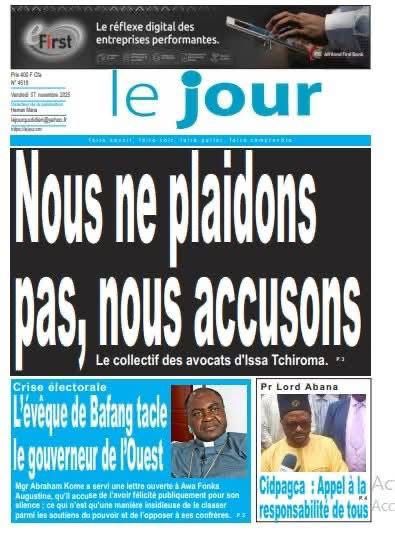
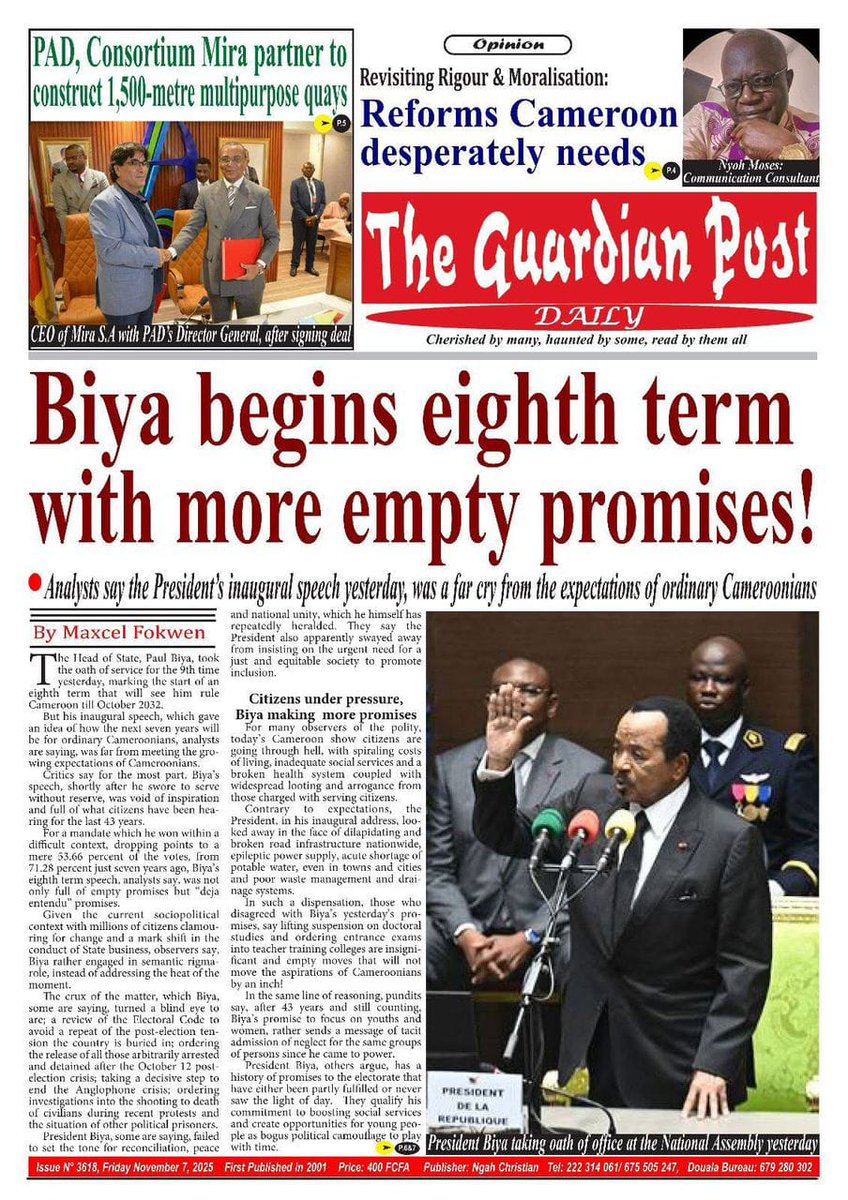
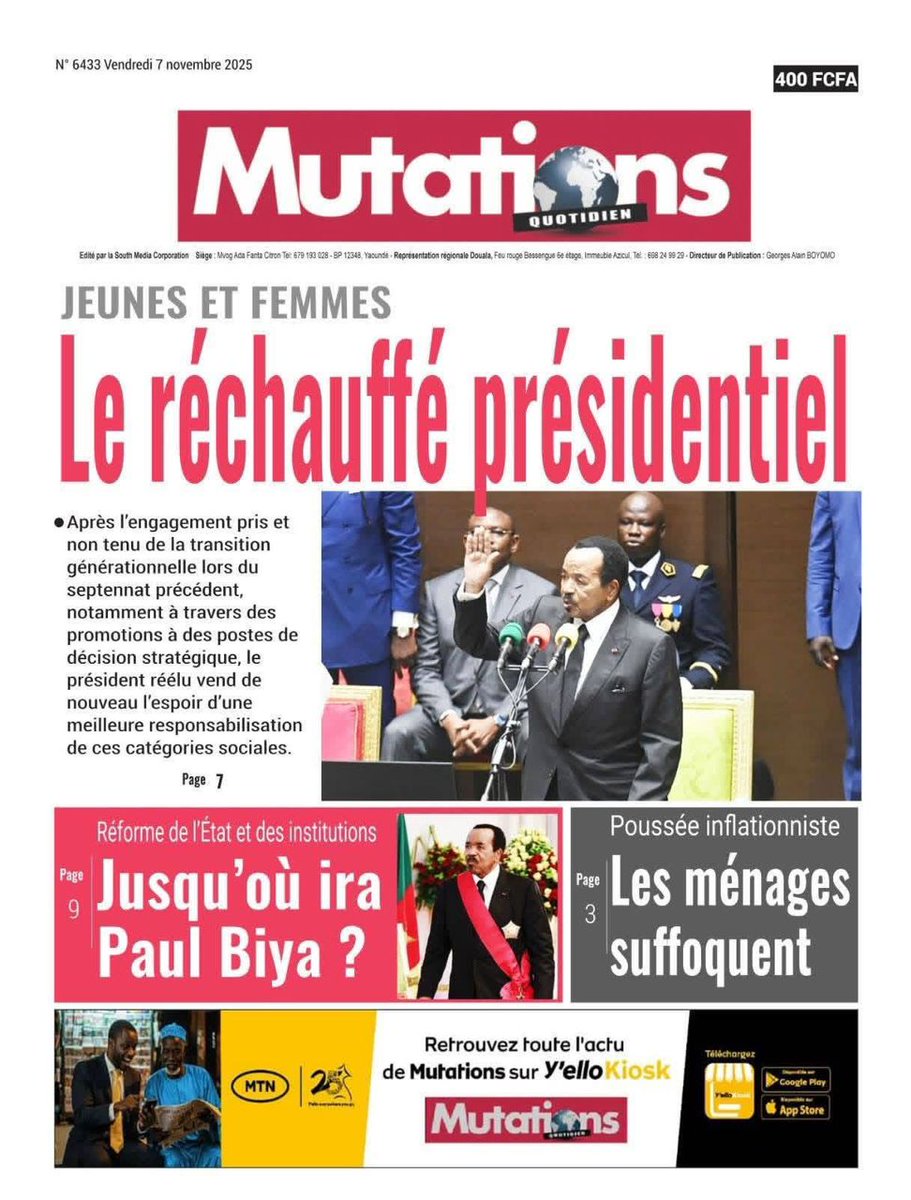
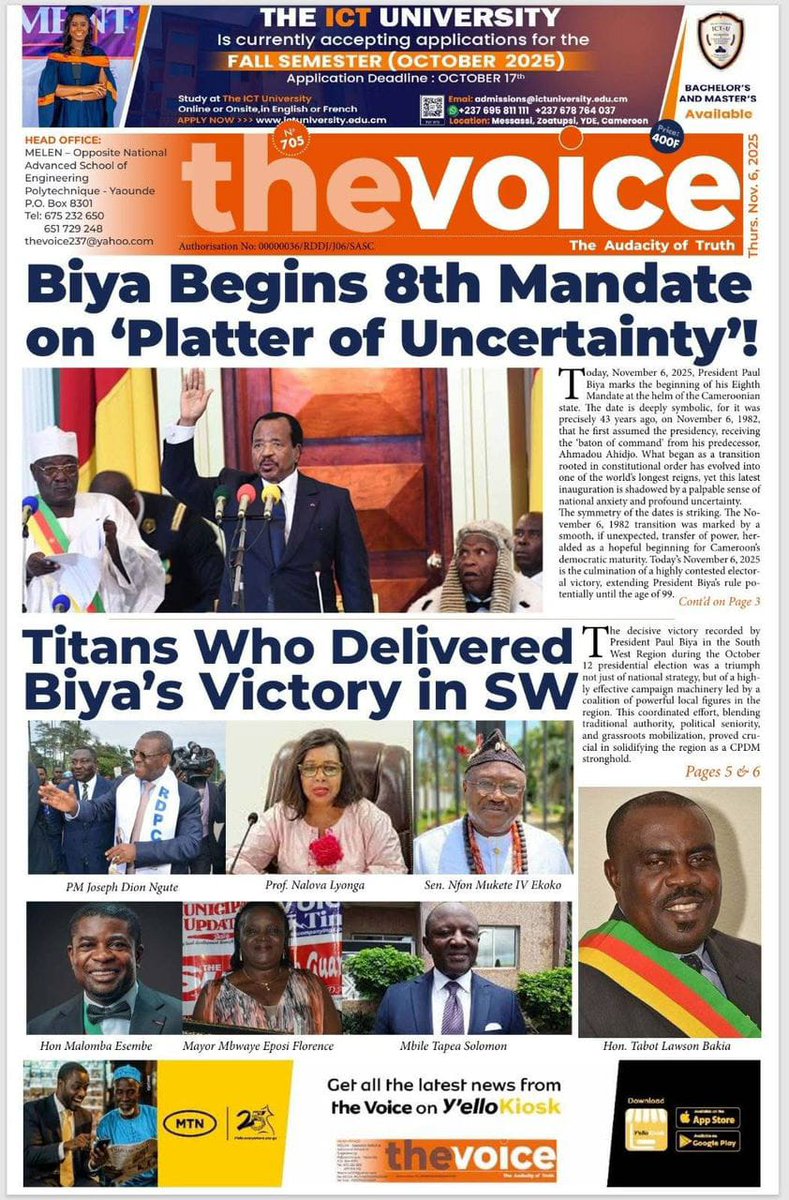
HE President Biya’s Oath, the People’s Silence — and the Birth of Project C By Paul Chiy, LLB, LLM, PhD| November 7, 2025 President Paul Biya has taken the oath of office for an unprecedented eighth term, sealing more than four decades of rule over Cameroon. In Yaoundé, the state orchestration of pomp and ceremony masked a deeper unease — a quiet, collective exhaustion. Across the nation, the mood was not triumph but numbness. While the official narrative painted the day as one of unity and continuity, the independent press told another story — one of disillusion, frustration, and a people caught between fear and fatigue. A Ceremony Without Conviction “Biya Begins 8th Mandate on a Platter of Uncertainty,” wrote The Voice, echoing what many felt but could not say aloud. The Guardian Post described the inauguration as “another chorus of empty promises,” highlighting how even within government circles, the ritual of renewal had lost its meaning. At 92, Biya stood once again before the assembled elite — distant, unyielding, almost spectral. Le Messager called it “sept ans de coma profond,” a “seven-year coma” into which the nation now willingly re-enters. What was once hailed as stability now feels like paralysis. Defiance from the Margins Away from the capital’s stagecraft, the Union Démocratique du Cameroun (UDC) led by Tomaino Ndam Njoya marked the day with a symbolic boycott. Their gathering in Foumban was not a protest in the traditional sense — it was a statement of dignity. “We will not applaud our own silencing,” a participant told Le Messager. Meanwhile, Émergence reported growing interest from U.S. lawmakers, several of whom have expressed concern over the electoral process and called for a review of relations with Cameroon. In the face of repression, the global gaze is beginning to turn — faintly, cautiously — toward Yaoundé. The Birth of Project C From the diaspora came a new voice: Project C. In a strongly worded communiqué signed by Eric Chinje and Arrey Obenson, the movement rejected Biya’s legitimacy and appealed directly to the international community to withhold recognition of his mandate. Their declaration, “L’appel du Projet C à la communauté internationale,” went further — demanding a referendum-led transition and a rebirth of civic power. “After decades of counterfeit democracy,” it read, “the will of the Cameroonian people has been stolen too often. It is time to reclaim it.” The message was not one of violence but of moral resistance — a call for unity, courage, and reawakening among Cameroonians at home and abroad. The Two Cameroons In the newspapers of November 6, two nations were on display. One celebrated Paul Biya, the eternal president — serene, invincible, untouchable. The other mourned a country trapped in time, where elections change nothing and silence has become the only safe language. Between these two realities lies Project C — a flicker of hope, born from exile but rooted in defiance. It is not yet a revolution, but it may be the first word of one. A Closing Reflection History may one day remember this day not for the oath itself, but for the silence that surrounded it — and for those who dared to break that silence from afar. In the stillness of November 2025, a whisper began to grow: Cameroon deserves more than endurance. It deserves renewal.
Dr Paul CHIY, FCIArb tweet mediaDr Paul CHIY, FCIArb tweet mediaDr Paul CHIY, FCIArb tweet mediaDr Paul CHIY, FCIArb tweet media
English
3
12
15
176
Cleaners Union nag-retweet
Dr Paul CHIY, FCIArb
Dr Paul CHIY, FCIArb@DrPaulCHIY·
Le Serment de Biya, le Silence du Peuple — et la Naissance du Projet C Par Paul Chiy, LLB, LLM, PhD | 7 novembre 2025 Le président Paul Biya a prêté serment pour un huitième mandat, prolongeant ainsi plus de quarante-trois ans de règne sur le Cameroun. À Yaoundé, la mise en scène de la cérémonie officielle masquait mal un malaise profond : une lassitude collective, une résignation silencieuse. Alors que le discours officiel célébrait l’unité et la continuité, la presse indépendante décrivait une autre réalité : la désillusion, la frustration et un peuple pris entre la peur et la fatigue. Une cérémonie sans conviction « Biya entame son 8ᵉ mandat sur un plateau d’incertitude », titrait The Voice, reprenant ce que beaucoup pensaient tout bas. The Guardian Post évoquait quant à lui « un nouveau chapelet de promesses creuses », soulignant à quel point, même dans les cercles du pouvoir, le rituel de la reconduction a perdu tout sens. À 92 ans, Biya s’est présenté une fois encore devant l’élite rassemblée — distant, inflexible, presque spectral. Le Messager a résumé l’impression générale : « Sept ans de coma profond », écrivant que la nation s’apprêtait à replonger dans une inertie prolongée. Ce qui autrefois incarnait la stabilité est désormais perçu comme une paralysie nationale. La défiance des marges Loin du faste de la capitale, l’Union Démocratique du Cameroun (UDC) de Tomaino Ndam Njoya a choisi la voie du boycott symbolique. Leur rassemblement à Foumban n’était pas une manifestation ordinaire : c’était un acte de dignité politique. « Nous refusons d’applaudir notre propre silence », confia un participant à Le Messager. Dans le même temps, Émergence rapportait un regain d’intérêt de la part de parlementaires américains, inquiets du processus électoral et appelant à une réévaluation des relations entre Washington et Yaoundé. Face à la répression, le regard du monde commence doucement à se tourner vers le Cameroun. La naissance du Projet C Depuis la diaspora s’est élevée une voix nouvelle : le Projet C. Dans un communiqué vigoureux signé par Éric Chinje et Arrey Obenson, le mouvement a rejeté la légitimité du nouveau mandat de Biya et a lancé un appel à la communauté internationale pour refuser de reconnaître cette investiture. Le texte, intitulé « L’appel du Projet C à la communauté internationale », réclame une transition pacifique fondée sur un référendum populaire et une renaissance du pouvoir citoyen. « Après des décennies d’une démocratie factice, écrivait le communiqué, la volonté du peuple camerounais a trop souvent été confisquée. Il est temps de la reprendre. » Le message n’était pas un cri de guerre, mais un appel moral à la résistance civique : un message d’unité, de courage et d’espérance adressé aux Camerounais du pays et de la diaspora. Les deux Camerouns Dans la presse du 6 novembre, deux pays semblaient coexister. L’un célébrait Paul Biya, président éternel — serein, inébranlable, intouchable. L’autre pleurait un pays figé dans le temps, où les élections ne changent rien et où le silence est devenu la seule langue sûre. Entre ces deux réalités, le Projet C surgit comme une étincelle d’espoir, née de l’exil mais enracinée dans la défiance. Ce n’est pas encore une révolution, mais peut-être le premier mot d’une ère nouvelle. Réflexion finale L’histoire retiendra peut-être cette journée non pas pour le serment lui-même, mais pour le silence qui l’a entouré — et pour ceux qui ont osé le rompre depuis l’étranger. Dans le calme de novembre 2025, un murmure a commencé à s’élever : Le Cameroun mérite plus que l’endurance. Il mérite le renouveau.
Dr Paul CHIY, FCIArb tweet mediaDr Paul CHIY, FCIArb tweet mediaDr Paul CHIY, FCIArb tweet mediaDr Paul CHIY, FCIArb tweet media
Français
0
11
11
88
Cleaners Union nag-retweet
Dr Paul CHIY, FCIArb
Dr Paul CHIY, FCIArb@DrPaulCHIY·
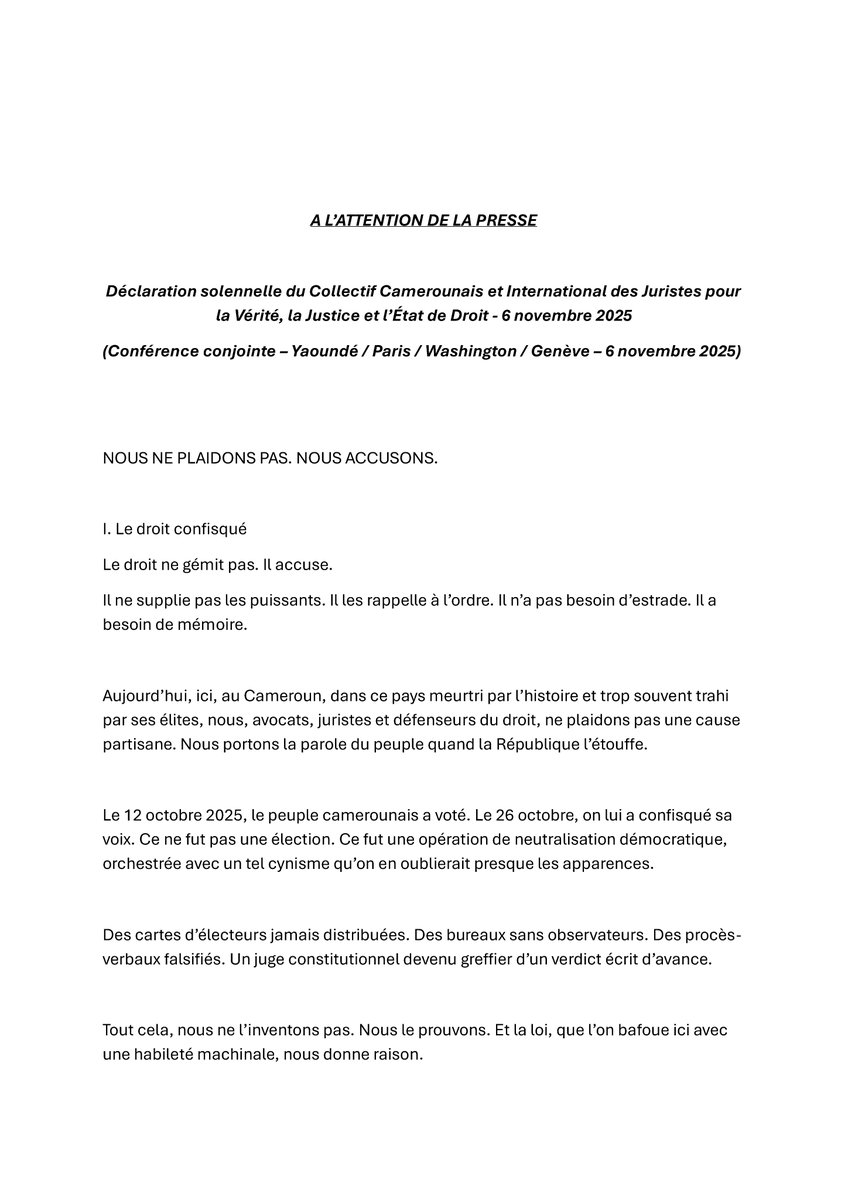
When Law Becomes the Last Refuge: A Legal Profession Standing Against the Darkness A Narrative Legal Analysis of Post-Election Violations in Cameroon and the Courage of Its Jurists I. A Nation Confronted With a Constitutional Breach The disputed presidential election of 12 October 2025 has drawn Cameroon into a profound constitutional crisis, the contours of which are now unmistakably delineated by independent sources. The front-page investigations of The Voice, the detailed findings of Human Rights Watch, and the solemn declaration issued by the Collectif Camerounais et International des Juristes pour la Vérité, la Justice et l’État de Droit converge with striking coherence. Together they paint a picture not of isolated irregularities but of a systemic unravelling of legality. The declaration of the jurists opens with a line that resonates with the authority of an indictment: “Nous ne plaidons pas. Nous accusons.” This is not the rhetoric of political actors. It is the solemn pronouncement of legal professionals compelled to speak in the face of overwhelming evidence. Their words bear the deliberative cadence of legal reasoning, yet behind them lies an unmistakable moral gravity. They speak not for a faction but for the very idea of law itself. II. Electoral Rights Violated: When Procedure Becomes a Weapon The lawyers’ narrative reveals an electoral process transformed into an instrument of disenfranchisement. Voter cards left undistributed, polling stations devoid of observers, falsified procès-verbaux, and a Constitutional Council reduced to endorsing a predetermined result amount not merely to administrative dysfunction but to a targeted subversion of democratic rights. The right to vote, protected under Article 25 of the International Covenant on Civil and Political Rights, is not a symbolic gesture. It is the juridical foundation upon which the legitimacy of political authority rests. To frustrate this right through calculated procedural manipulation is to weaponise electoral law against the very citizens it is designed to protect. The jurists’ insistence on recording these breaches converts their declaration into a legal artefact—one destined to shape the contours of future accountability. III. Non-Derogable Rights Under Assault The violations did not end with the ballot. The Human Rights Watch report documents a violent post-election crackdown in which dozens were killed and thousands detained. Such actions strike not merely at public order but at the non-derogable core of human rights law. The right to life, enshrined in Article 6 of the ICCPR, permits no exception. The prohibition against arbitrary arrest in Article 9 admits no justification in political expediency. The African Charter reinforces these protections under Articles 4, 6, and 7. The jurists’ declaration recognises that these violations do not exist in a vacuum. They occupy the gravest register of international legal scrutiny. By expressly invoking these provisions, the lawyers anchor their denunciation within a legal framework that binds all states without reservation. What occurred in Cameroon is thus rendered not merely politically reprehensible but legally indefensible. IV. The Lawyers Who Refused Silence: A Profession’s Moral Reckoning It is in this context that the conduct of Cameroon’s legal community acquires profound significance. In moments when institutional independence is suppressed, it is often the legal profession—standing at the frontier between power and right—that becomes the final custodian of constitutional principle. Under the leadership of Maître Nguefack Augustin, Cameroonian lawyers chose to inhabit precisely this role. Their declaration is not a call to rebellion. It is a call to legality. They urge independent inquiry, diplomatic vigilance, and an inclusive process of mediation—all firmly grounded in the rule of law. Their decision to speak, in a climate where speech carries personal peril, reflects a fidelity to their professional oath that transcends personal interest. It is a demonstration that the rule of law survives not through institutions alone but through the principled courage of individuals who refuse to surrender its ideals. V. The Honour of Law: A Call to Accountability The jurists frame the crisis not as a political impasse but as a breach of the honour of law itself. A government that denies its people cannot reclaim legitimacy through ceremony, decree, or force. An oath sworn in defiance of democratic will becomes, in their words, a false testimony. Such an oath does not shield power from responsibility; it binds it more tightly to the eventual demands of justice. In their closing passages, the jurists remind Cameroon that repression has a long memory. Today’s victims become tomorrow’s witnesses. Today’s silences become tomorrow’s evidence. Today’s contested oath becomes tomorrow’s stigma. This is not the language of prophecy but the accumulated wisdom of comparative constitutional experience across continents and decades. Where legality is suppressed, justice eventually reasserts itself—whether through domestic courts, regional tribunals, or the judgment of history itself. VI. Toward Justice: The Legacy of Maître Nguefack Augustin and His Colleagues In a moment when the machinery of state power appeared determined to extinguish dissent, the courage of Maître Nguefack Augustin and his fellow jurists stands out as a rare illumination. Their defence of the rule of law does not merely respond to violations; it preserves the nation’s legal memory at the very moment when memory itself is under threat. Their work ensures that Cameroon’s crisis cannot be rewritten by those who benefit from silence. Instead, it is secured within a disciplined legal narrative that will outlive political regimes and form the basis of eventual accountability. Their stance affirms that law is more than a compilation of rules. It is a living ethic sustained by those who are prepared to defend it when it is most at risk. Through their collective courage, these jurists have positioned themselves as guardians of Cameroon’s constitutional future. They have demonstrated that even in the darkest moments, law endures wherever justice is upheld with truth, conviction, and unyielding resolve. r
Dr Paul CHIY, FCIArb tweet mediaDr Paul CHIY, FCIArb tweet mediaDr Paul CHIY, FCIArb tweet media
English
2
11
11
138
Cleaners Union nag-retweet
Dr Paul CHIY, FCIArb
Dr Paul CHIY, FCIArb@DrPaulCHIY·
Quand le droit devient le dernier refuge : une profession juridique face aux ténèbres Analyse juridique narrative des violations post-électorales au Cameroun et du courage de ses juristes I. Une nation confrontée à une rupture constitutionnelle L’élection présidentielle contestée du 12 octobre 2025 a plongé le Cameroun dans une crise constitutionnelle d’une gravité exceptionnelle, dont les contours apparaissent désormais avec une clarté incontestable. Les investigations de The Voice, les constats minutieux de Human Rights Watch et la déclaration solennelle du Collectif Camerounais et International des Juristes pour la Vérité, la Justice et l’État de Droit se répondent, se complètent et convergent vers une même réalité : celle d’un effondrement méthodique de l’État de droit. La déclaration des juristes s’ouvre sur une phrase qui résonne comme le premier paragraphe d’un acte d’accusation : « Nous ne plaidons pas. Nous accusons. » Ces mots ne relèvent ni de la rhétorique partisane ni de l’emphase oratoire. Ils expriment l’obligation professionnelle de juristes confrontés à des faits d’une gravité telle que le silence deviendrait une complicité. Ils portent le rythme réfléchi du raisonnement juridique, mais aussi la gravité d’un devoir éthique assumé. II. Le droit électoral violé : lorsque la procédure devient une arme Le récit des avocats révèle un processus électoral détourné de son objet et instrumentalisé à des fins d’exclusion. Des cartes d’électeurs non distribuées, des bureaux dépourvus d’observateurs, des procès-verbaux falsifiés, et un Conseil constitutionnel réduit au rôle d’enregistreur d’un verdict écrit d’avance : autant d’atteintes qui dépassent le cadre de simples irrégularités. Elles touchent au cœur du droit de suffrage consacré par l’article 25 du Pacte international relatif aux droits civils et politiques. Le vote n’est pas une formalité. Il est la source juridique de la légitimité politique. En entravant ce droit par des procédés calculés, la procédure électorale cesse d’être la garante neutre de la démocratie pour devenir l’outil même de sa négation. En consignant rigoureusement ces violations, les juristes n’expriment pas une opinion : ils établissent un dossier juridique appelé à devenir une référence probatoire dans tout futur processus de reddition des comptes. III. Les droits non dérogeables attaqués Les atteintes ne se limitent pas au scrutin. Le rapport de Human Rights Watch décrit une répression post-électorale d’une extrême violence, entraînant la mort de nombreuses personnes et l’arrestation de milliers d’autres. Ces actes, par leur nature même, se situent au sommet de la hiérarchie des violations reconnues par le droit international. Le droit à la vie, garanti par l’article 6 du PIDCP, ne supporte aucune exception, pas plus que l’interdiction des arrestations arbitraires prévue par l’article 9. Ces droits trouvent un écho supplémentaire dans les articles 4, 6 et 7 de la Charte africaine des droits de l’homme et des peuples. En invoquant explicitement ces normes, les juristes camerounais placent le débat dans l’espace du droit impératif. Ce qui s’est produit n’est pas seulement contraire à la morale ou aux principes politiques : c’est juridiquement inadmissible, et susceptible de poursuites devant les juridictions nationales, régionales ou internationales. IV. Les avocats qui ont refusé le silence : un moment de vérité professionnelle Dans un contexte où l’indépendance judiciaire semble affaiblie, le rôle de la profession juridique prend une dimension historique. Les avocats deviennent souvent les derniers gardiens de la mémoire constitutionnelle lorsque les institutions hésitent ou fléchissent. Sous la direction de Maître Nguefack Augustin, les avocats camerounais ont assumé cette responsabilité avec une dignité qui force le respect. Leur déclaration ne constitue pas un appel à la confrontation. Elle est un appel au droit. Ils réclament une enquête indépendante, une vigilance diplomatique et un mécanisme de médiation inclusive, tous enracinés dans les principes fondamentaux de l’État de droit. Leur prise de parole, dans un climat où chaque mot peut exposer à la menace, manifeste une fidélité rare au serment professionnel. Ils rappellent ainsi que le droit ne survit pas seulement par les institutions qui l’incarnent, mais par les femmes et les hommes qui le défendent lorsque tout semble s’effondrer. V. L’honneur du droit : une exigence de responsabilité Les juristes replacent la crise dans un cadre qui dépasse l’urgence politique : celui de l’honneur du droit. Un pouvoir qui nie la voix du peuple ne peut restaurer sa légitimité par le rituel ou la contrainte. Un serment prêté dans le déni démocratique devient, selon leurs mots, un faux témoignage. Et un tel faux témoignage engage non seulement la responsabilité morale mais aussi la responsabilité juridique des acteurs qui s’en accommodent. La déclaration rappelle que la répression crée sa propre archive. Les morts deviennent des preuves. Les arrestations, des traces. Les silences, des indices de complicité. L’histoire des transitions constitutionnelles à travers le monde montre que lorsque les normes sont violées à ce point, la justice finit toujours par réclamer son dû. Le temps judiciaire n’est pas celui du pouvoir politique, mais il est inéluctable. VI. Vers la justice : l’héritage de Maître Nguefack Augustin et de ses collègues Dans une période où la force brute semblait vouloir imposer le silence, le courage de Maître Nguefack Augustin et des juristes qui l’ont accompagné constitue l’un des rares motifs d’espérance. Leur engagement ne se limite pas à dénoncer les violations : il préserve la mémoire juridique de la nation au moment même où cette mémoire est menacée d’effacement. Grâce à eux, les faits ne pourront être réécrits. Ils demeureront inscrits dans une structure narrative et juridique qui survivra à toute tentative de manipulation future. Ces juristes démontrent que le droit n’est pas un simple corpus de règles abstraites. Il est un principe vivant, soutenu par des personnes qui acceptent d’en être les gardiens lorsque le contexte devient hostile. Par leur parole et leur détermination, ils se sont placés au premier rang des défenseurs de l’avenir constitutionnel du Cameroun. Ils ont montré que, même dans les moments les plus sombres, le droit subsiste là où des femmes et des hommes ont le courage de le maintenir debout. Par Paul Chiy, LLB, LLM, PhD, FCIArb, FCILex Barrister / Avocat
Dr Paul CHIY, FCIArb tweet mediaDr Paul CHIY, FCIArb tweet media
Français
3
11
11
80
Cleaners Union nag-retweet
Dr Paul CHIY, FCIArb
Dr Paul CHIY, FCIArb@DrPaulCHIY·
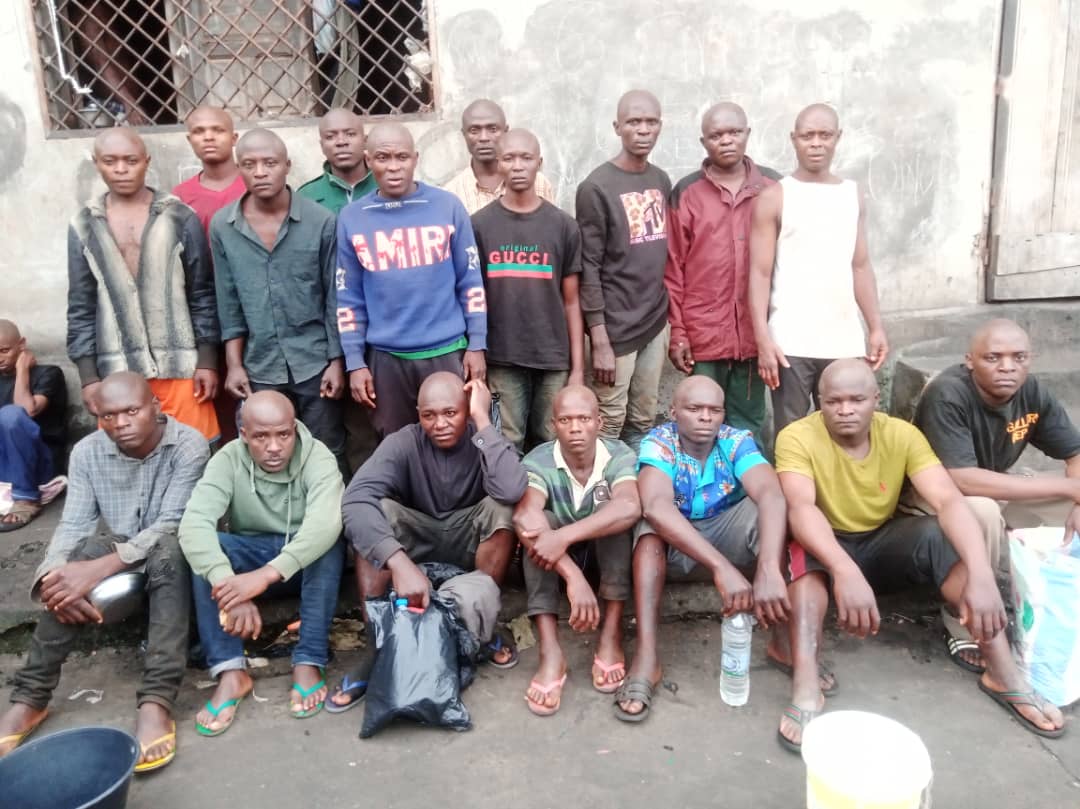
Sortir de l’illégalité : les libérations de détenus comme révélateur d’une crise du droit Analyse juridique narrative autour de la libération de détenus post-électoraux au Cameroun I. Une photographie comme acte juridique involontaire Cette image de détenus récemment libérés, réunis contre un mur délabré, ne représente pas seulement un moment humain. Elle constitue, malgré elle, un document juridique. Car chaque visage marqué, chaque posture crispée, chaque silence visible dans le cadre renvoie à l’ombre d’une privation de liberté dont les contours interrogent la légalité. Le droit n’apparaît pas toujours dans les tribunaux ou les textes officiels. Il apparaît parfois dans l’expression même de ceux qui en ont été privés. Cette photographie est l’une de ces apparitions. II. La détention arbitraire : une violation systémique des garanties procédurales L’arrestation et la détention de ces hommes — selon les récits concordants de défenseurs, d’observateurs et de juristes — semblent s’être déroulées en marge des garanties fondamentales prévues tant par la Constitution camerounaise que par les instruments internationaux ratifiés par l’État. Le droit à la liberté, protégé par l’article 9 du Pacte international relatif aux droits civils et politiques (PIDCP), impose que nul ne soit privé de liberté sans procédure régulière, sans information sur les motifs de l’arrestation, et sans contrôle judiciaire effectif. Or, l’état physique et moral de ces hommes, ainsi que leur libération groupée et non motivée, suggèrent une privation de liberté dénuée de base légale claire, caractéristique de la détention arbitraire. Dans un tel contexte, leur libération n’est pas une faveur. Elle est l’aveu implicite qu’une irrégularité initiale a entaché la procédure. III. L’atteinte au droit à la dignité comme conséquence directe de l’arbitraire Le droit à la dignité humaine, consacré par l’article 5 de la Charte africaine des droits de l’homme et des peuples, impose une obligation absolue : toute personne détenue doit être traitée avec humanité et respect. La fatigue inscrite dans les traits de ces hommes, l’absence de vêtements appropriés, la précarité matérielle visible dans la scène, participent d’un constat lourd : la détention ne s’est pas limitée à une privation de liberté ; elle semble avoir porté atteinte à l’intégrité morale et physique des intéressés. Ainsi, cette image devient une trace juridiquement significative d’un traitement potentiellement contraire aux standards régionaux et internationaux. IV. La libération collective : un indicateur de non-conformité institutionnelle Le fait que plusieurs individus soient libérés ensemble, sans que des décisions judiciaires individuelles soient documentées ou publiées, interroge directement le respect du principe de l’individualisation des mesures privatives de liberté. En droit, chaque détention doit être justifiée par un acte précis, motivé, susceptible de recours. En pratique, lorsque des dizaines de personnes sont arrêtées dans un même mouvement puis libérées de manière tout aussi collective, cela révèle un usage institutionnel du pouvoir coercitif qui contourne les procédures prévues par le Code de procédure pénale. Le droit ne reconnaît pas la détention de masse — elle est presque toujours le signe d’un détournement de procédure. V. La responsabilité de l’État face à l’effondrement de la légalité La libération de ces hommes entraîne une conséquence juridique majeure : l’État demeure responsable, non seulement des conditions dans lesquelles ils ont été privés de liberté, mais aussi des conséquences physiques, psychologiques et matérielles de cette privation. L’obligation de l’État ne s’arrête pas à la porte de la cellule. Elle inclut le devoir de réparation, le devoir d’enquête sur les violations alléguées et le devoir de sanctionner les agents qui auraient agi en dehors du cadre légal. Le Cameroun, en tant qu’État partie au PIDCP et à la Charte africaine, ne peut invoquer des circonstances internes pour se soustraire à ces obligations. VI. Un pays face à l’exigence d’un rétablissement juridique L’image de ces hommes récemment libérés ne doit pas être lue comme la conclusion d’un épisode, mais comme le début d’une exigence. Le droit exige que des faits de cette nature fassent l’objet d’une enquête indépendante, que des registres de détention soient vérifiés, que des magistrats indifférents soient interrogés, que des institutions silencieuses retrouvent leur voix. Aucun État ne peut durablement demander loyauté à ses citoyens lorsqu’il ne leur offre pas la garantie minimale que leur liberté ne dépendra jamais d’un contexte politique. La restauration de la légalité ne passe ni par le déni ni par la justification, mais par la reconnaissance, l’enquête, la réparation et la réforme. VII. La photographie comme futur élément de preuve Enfin, dans l’histoire des violations des droits humains, certaines images deviennent des pièces. Celle-ci pourrait un jour figurer dans un dossier, à côté de registres de détention lacunaires, de témoignages concordants et de rapports juridiques. Elle pourrait contribuer à établir qu’à un moment précis, dans un contexte politique donné, des citoyens ordinaires ont été privés de leur liberté en violation des garanties légales. Le droit a cette particularité : il peut transformer un simple cliché en une preuve, un visage en un témoignage, un silence en une interpellation. Ainsi, ces hommes, par leur seule présence dans ce cadre, rappellent à la nation que l’État de droit est fragile. Et qu’il appartient à chacun de veiller à ce qu’il ne devienne jamais irréparabl
Dr Paul CHIY, FCIArb tweet mediaDr Paul CHIY, FCIArb tweet media
Français
2
11
11
108
Cleaners Union nag-retweet
Dr Paul CHIY, FCIArb
Dr Paul CHIY, FCIArb@DrPaulCHIY·
I. A Photograph That Speaks The men in this image do not need to speak for the law to understand what has happened. Their posture, their exhaustion, their disorientation constitute the unvarnished residue of a detention that bears none of the hallmarks of legality. A lawful arrest leaves a paper trail. An unlawful arrest leaves human evidence. This photograph is that evidence — stark, immediate, and impossible to explain away. II. The Presumption of Arbitrariness Is Written Across Their Faces International law is clear: when individuals are deprived of liberty without prompt judicial oversight, without individualised charges, and without access to counsel, the detention is presumed arbitrary. Nothing in this image contradicts that presumption. Everything in it reinforces the conclusion that these men were held outside the judicial system, in breach of Article 9 of the ICCPR and the constitutional guarantees Cameroon owes its citizens. Their release does not cure the violation. It confirms it. III. The Violation of Dignity Is Evident in Their Condition The right to dignity is not symbolic. It is a binding, non-derogable obligation under the African Charter. Yet the visible strain on these men — their physical decline, the absence of basic care, the shock that still clings to their expressions — reveals a period of confinement inconsistent with any accepted standard of humane treatment. Dignity once violated cannot be retroactively restored. It must be acknowledged, investigated, and redressed. IV. Their Collective Release Is Itself Proof of Systemic Illegality The law treats liberty as individual. The State treated these men as a group. They were arrested together, processed together, and released together — without individual decisions, reasons, or judicial findings. This alone is sufficient to establish that their detention was not the product of lawful criminal procedure, but of administrative or political expediency. Collective detention is not a legal category. It is a symptom of abuse. V. The State’s Liability Survives Their Freedom Their release does not extinguish the legal consequences of what occurred. Under international law, the State is now confronted with a non-negotiable set of obligations: investigate, disclose, compensate, prosecute. A State that detains unlawfully must account for the breach. A State that harms must remedy. A State that remains silent deepens its liability. VI. This Image Is Already an Exhibit in the Court of History — and May Become One in Law Though taken in an ordinary setting, this photograph has the qualities of a legal artefact. It documents the physical aftermath of unlawful custody. It captures a moment when the gap between the law on paper and the law in practice became incontrovertible. If Cameroon chooses accountability, this image will serve as a starting point for truth. If it chooses denial, it will stand as a permanent indictment.
Dr Paul CHIY, FCIArb tweet media
English
2
11
12
136
Cleaners Union nag-retweet
Dr Paul CHIY, FCIArb
Dr Paul CHIY, FCIArb@DrPaulCHIY·
Congratulations to De Jure Chambers on achieving the SQM. A superb accomplishment, and well-deserved recognition of Nicole Papantoniou’s outstanding leadership. — Cornerstone Publications
English
0
7
7
40
Cleaners Union nag-retweet
Dr Paul CHIY, FCIArb
Dr Paul CHIY, FCIArb@DrPaulCHIY·
A Contemporary Reflection on Syvil Lloyd Morris’s 2024 Analysis of the QLR Scheme By Paul Chiy, LLB, LLM, PhD, FCIlex, FCIArb Introduction This narrative is respectfully addressed to Mr Syvil Lloyd Morris, Director of Family Law at Bastian Lloyd Morris, in recognition of the significant contribution he made to the early critical examination of the Qualified Legal Representative (QLR) scheme. His two-part article, published in Family Law Week in January 2024—accessible at familylawweek.co.uk/articles/abusi… and familylawweek.co.uk/articles/abusi…—was written at a time when the scheme was still newly implemented and little tested in practice. Yet his assessment, produced when the QLR role had been operating for less than two years, now stands out as a remarkably prescient and analytically rich commentary on its conceptual and structural challenges. Situating the QLR Scheme Within the Modern Understanding of Domestic Abuse In revisiting Mr Lloyd Morris’s analysis today, one is struck first by the way he placed the QLR scheme squarely within the broader contemporary understanding of domestic abuse. His narrative traced the evolution from a narrow view focused primarily on physical violence towards a more complete recognition of coercive and controlling behaviour, as reflected in the Domestic Abuse Act 2021, PD12J and the “Harm Report”. He recognised that domestic abuse is frequently hidden, sustained and complex, and that victims often encounter patterns of control that do not cease simply because proceedings have begun. It was within this legal and social context that he framed his assessment of the QLR scheme, emphasising that any evaluation of its effectiveness must account for the continuing risk of harm that can occur through the litigation process itself. Litigation Abuse and the Court as a Continuation of Coercive Control A particularly notable aspect of Mr Lloyd Morris’s work was his early articulation of litigation abuse—an increasingly acknowledged phenomenon whereby the alleged perpetrator uses the family justice process as a further mechanism of intimidation or manipulation. His narrative described how repeated applications, procedural manoeuvring, or the crafting of accusatory narratives could become tools of continued coercion. He recognised that preventing direct cross-examination was an important safeguard, yet he emphasised that the underlying dynamics of abuse could persist in more subtle but equally damaging forms. In doing so, he drew attention to the risk that abusive narratives might simply find new expression in the questions a QLR is required by statute to put. The Conceptual Tension at the Heart of the QLR Role One of the central themes in Mr Lloyd Morris’s analysis was his exploration of the inherent conceptual tension in the statutory construction of the QLR role. He highlighted the difficulties created by imposing a duty on QLRs to be “responsible only to the court”, while simultaneously requiring them to “speak to” a prohibited party for the purpose of identifying “the essence” of their case, without taking instructions, offering legal advice or forming a lawyer–client relationship. He articulated, with considerable clarity, the practical challenge of drawing distinctions between these categories in real cases, noting that the scheme places QLRs in a procedural position that resembles a kind of “no-man’s land”. His analysis revealed how these statutory constraints can create genuine risks for both the vulnerable witness and the QLR, and how they may lead to expectations or misunderstandings that the statutory scheme does not adequately resolve. The Problem of Presenting “The Essence” of an Abusive Case Mr Lloyd Morris also captured the difficulty inherent in the statutory duty to present “the essence” of a prohibited party’s case. He recognised that in many domestic abuse cases the central narrative advanced by the alleged perpetrator may be rooted in the same coercive dynamics that characterise the abusive relationship itself. His narrative made clear that, even when framed carefully, such narratives can retraumatise a vulnerable witness and may inadvertently transplant abusive dynamics into the courtroom. His observation that the scheme risks “transferring gaslighting from the home into the witness box” has since been echoed widely and remains a central concern for practitioners and policymakers. Structural Weaknesses and the Early Funding Regime In addition to conceptual concerns, Mr Lloyd Morris addressed the practical limitations of the scheme as originally implemented, particularly its funding and remuneration structure. He highlighted how the lack of travel reimbursement, inadequate compensation for essential preparatory work and payment structures dependent upon cross-examination created perverse incentives and impeded the scheme’s protective function. His analysis was among the first to note that the fee regime could deter QLR participation in certain cases or regions, leading to uneven national coverage and undermining the intended availability of specialist assistance. Ethical Complexity and Professional Tension Mr Lloyd Morris’s work also emphasised the ethical complexity generated by the hybrid nature of the QLR role. While early guidance suggested that QLRs were unlikely to face significant ethical difficulty, he argued convincingly that the statutory limitations created new and distinct challenges relating to expectations, duties and professional boundaries. His narrative identified the real risk of misunderstanding by parties who may assume that a QLR acts in their interests in the traditional way. It also highlighted the tension between a QLR’s duties to the court and their statutory requirement to articulate the prohibited party’s case, even where that case may rest on problematic or abusive assertions. Conclusion Taken together, the two articles authored by Mr Syvil Lloyd Morris in early 2024 amount to one of the earliest and most compelling examinations of the QLR scheme. Written at a time when its application was still emerging and its boundaries only partially understood, his analysis anticipated many of the issues that have since become central to national discourse and professional practice. His reflections continue to shape discussion about the reforms required to ensure that the scheme protects vulnerable witnesses as intended, avoids perpetuating harm through litigation, and provides QLRs with a clear, workable and ethically coherent framework within which to carry out their responsibilities. His early work remains a valuable contribution to the continuing development of the scheme and an enduring reference point for those engaged in its refinement.
Dr Paul CHIY, FCIArb tweet media
English
1
8
8
94
Cleaners Union nag-retweet
Dr Paul CHIY, FCIArb
Dr Paul CHIY, FCIArb@DrPaulCHIY·
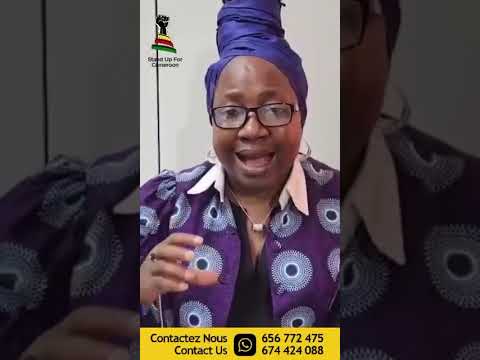
🇨🇲 Cameroon’s New Dawn: Choosing Peace, Law, and Nationhood Over Chaos By Dr Paul Chiy, LLB, LLM, PhD — Barrister & Advocate for Constitutional Democracy As Cameroon emerges from the October 12 presidential election, the nation stands once more at a defining crossroads. The votes have been cast, and while the results are still contested in the court of public opinion, one truth remains: how Cameroonians act now will determine not just who governs, but whether peace endures. 🕊 Dr. Simon Munzu: “Sovereignty Belongs to the People” . Dr. Munzu’s words echoed both legal principle and moral wisdom. He called upon all institutions involved in the electoral process — ELECAM, the Constitutional Council, the judiciary, the administration, the security forces, and the National Communications Council — to act objectively, impartially, and solely in the general interest of the sovereign people. That appeal is not mere rhetoric. It is a direct call to restore trust in institutions, not by tearing them down, but by demanding they live up to their constitutional mandate. In Dr. Munzu’s vision, the president — whoever he or she may be — is “a servant, not a master.” That single phrase captures the essence of democratic citizenship.In his solemn address, Dr. Simon Munzu reminded the nation that “sovereignty belongs to the people of Cameroon.” He urged calm, stressing that violence before, during, and after elections must be avoidedVID-20251010-WA0008 ⚖️ Akere Muna: The Statesman’s Challenge In his declaration Une Nouvelle Aurore (A New Dawn), Barrister Akere Muna struck the same tone of civic grace: “The Cameroonian people have spoken with a clear and undeniable voice... We now call upon all competent institutions to honour their sacred duty.” He appealed to the outgoing President to respect the verdict of the people — “to accept the results with dignity, and to hand over power peacefully.” Such an act, he said, would elevate the President’s legacy as “a true patriot who placed unity and democracy above all else.” In a nation scarred by political suspicion, Akere’s call represents the language of reconciliation — not revenge. He reminds us that the strength of democracy lies not in victory, but in restraint. ✊🏾 Kah Walla: Non-Violence as Power From the streets to the courtrooms, Kah Walla has carried a simple but uncompromising message: “Our fight must be lawful, our methods peaceful.” She warns that those who claim to fight for freedom must not destroy the very foundations on which freedom stands. Public buildings, courts, police stations — these are not symbols of oppression, but the instruments of the Republic. Her movement, Stand Up for Cameroon, insists that change must be won through civic discipline, not mob fury. ⚠️ The Memory of Ambazonia Cameroonians need not look far to see what happens when anger eclipses law. The Ambazonian conflict began with legitimate grievances — and ended in humanitarian disaster. It has cost more than 6,000 lives, displaced over 700,000 people, and left an entire generation traumatised. We must not repeat that tragedy. The signs of division, impatience, and political provocation are visible again. If we reject our legal institutions altogether — if we allow factional leaders to declare “people’s administrations” or “parallel governments” — we invite a national implosion far worse than before. 👩🏾‍⚖️ Lawyers: Guardians of Peace It is now the duty of Cameroon’s legal community to rise — not in defiance, but in defence. Every unlawful act, every electoral irregularity, must be confronted through due process, not violence. Lawyers must coordinate across regions to protect citizens, monitor proceedings, and document abuses for history and justice alike. As Dr. Munzu said, “sovereignty belongs to the people.” But sovereignty without law becomes mob rule. Law without justice becomes tyranny. It is the balance between the two that sustains the Republic. 🇨🇲 The Path Forward: A Shared Dawn This is not the hour for vengeance. It is the hour for wisdom. Let us hear together the harmony in these three voices: Dr. Simon Munzu — calling for peace, restraint, and institutional integrity; Barrister Akere Muna — urging a dignified transition and unity under law; Kah Walla — inspiring civic courage without violence. They do not contradict one another — they complete one another. Cameroon does not need another war. It needs a new covenant between citizens and their institutions. The ballot, not the bullet. The court, not the crowd. The law, not the jungle. Only then can this truly be the new dawn that Akere envisioned, the peaceful sovereignty that Munzu declared, and the non-violent strength that Kah Walla embodies. 🕊 God bless the Republic of Cameroon — one people, one destiny, one law. #StandUpForCameroon #KahWalla #AkereMuna #SimonMunzu #RuleOfLaw #NonViolence #Cameroon #Democracy #Peace #Unity #NewDawn
English
0
11
12
124
Cleaners Union nag-retweet
Dr Paul CHIY, FCIArb
Dr Paul CHIY, FCIArb@DrPaulCHIY·
🇨🇲 La Nouvelle Aube du Cameroun : Choisir la Paix, la Loi et la Nation plutôt que le Chaos Par Dr Paul Chiy, LLB,LLM, DPhil — Avocat et Défenseur de la Démocratie Constitutionnelle Alors que le Cameroun émerge de l’élection présidentielle du 12 octobre, la nation se tient une fois de plus à un carrefour décisif. Les votes ont été exprimés, et même si les résultats suscitent encore débats et contestations, une vérité demeure : la manière dont les Camerounais agiront maintenant déterminera non seulement qui gouvernera, mais aussi si la paix survivra. 🕊 Dr. Simon Munzu : « La souveraineté appartient au peuple » . Ses paroles résonnent à la fois comme un principe juridique et une sagesse morale. Il a exhorté toutes les institutions impliquées dans le processus électoral — ELECAM, le Conseil constitutionnel, la magistrature, l’administration, les forces de sécurité et le Conseil national de la communication — à agir objectivement, impartialement et uniquement dans l’intérêt général du peuple souverain. Cet appel n’est pas rhétorique. Il s’agit d’une invitation directe à restaurer la confiance dans les institutions, non pas en les détruisant, mais en exigeant qu’elles respectent leur mandat constitutionnel. Dans la vision du Dr Munzu, le président — quel qu’il soit — est « un serviteur, non un maître ». Cette seule phrase résume l’essence même de la citoyenneté démocratique.Dans son adresse solennelle, le Dr Simon Munzu a rappelé à la nation que « la souveraineté appartient au peuple camerounais ». Il a appelé au calme, soulignant que la violence avant, pendant et après les élections doit être évitéeVID-20251010-WA0008 ⚖️ Akere Muna : Le défi de l’homme d’État Dans sa déclaration Une Nouvelle Aurore, le Bâtonnier Akere Muna a adopté la même tonalité empreinte de civisme et de dignité : « Le peuple camerounais a parlé d’une voix claire et indéniable... Nous appelons maintenant toutes les institutions compétentes à honorer leur devoir sacré. » Il s’est adressé au Président sortant avec respect, l’exhortant à reconnaître le verdict du peuple, « à accepter les résultats avec dignité et à transmettre le pouvoir pacifiquement ». Un tel acte, a-t-il ajouté, consacrerait son héritage comme celui d’un « vrai patriote ayant privilégié l’unité nationale et les principes démocratiques avant tout ». Dans un pays marqué par la méfiance politique, l’appel d’Akere représente le langage de la réconciliation, non de la revanche. Il nous rappelle que la force de la démocratie réside non pas dans la victoire, mais dans la retenue. ✊🏾 Kah Walla : La non-violence comme puissance Des rues aux tribunaux, Kah Walla porte un message clair et intransigeant : « Notre combat doit être légal et nos méthodes pacifiques. » Elle avertit que ceux qui prétendent se battre pour la liberté ne doivent pas détruire les fondations mêmes sur lesquelles cette liberté repose. Les bâtiments publics, les tribunaux, les commissariats — ce ne sont pas des symboles d’oppression, mais les instruments de la République. Son mouvement Stand Up for Cameroon insiste : le changement doit être gagné par la discipline civique, non par la fureur. ⚠️ La mémoire d’Ambazonie Les Camerounais n’ont pas besoin de chercher loin pour savoir ce qui arrive quand la colère dépasse la loi. Le conflit ambazonien a commencé par des revendications légitimes et s’est terminé en désastre humanitaire. Il a coûté plus de 6 000 vies, déplacé plus de 700 000 personnes et laissé une génération entière traumatisée. Nous ne devons pas répéter cette tragédie. Les signes de division, d’impatience et de provocation politique sont déjà visibles. Si nous rejetons nos institutions juridiques, si nous permettons à des factions d’instaurer des « administrations populaires » ou des « gouvernements parallèles », nous risquons une implosion nationale encore plus dévastatrice. 👩🏾‍⚖️ Les avocats : gardiens de la paix Il revient désormais à la communauté juridique du Cameroun de se lever — non dans la défiance, mais dans la défense. Chaque acte illégal, chaque irrégularité électorale doit être combattu par le droit, non par la violence. Les avocats doivent se coordonner dans toutes les régions pour protéger les citoyens, surveiller les procédures et documenter les abus pour la justice et pour l’histoire. Comme l’a dit le Dr Munzu, « la souveraineté appartient au peuple ». Mais la souveraineté sans loi devient la loi de la foule. La loi sans justice devient la tyrannie. C’est l’équilibre entre les deux qui fonde la République. 🇨🇲 Le chemin à suivre : une aube partagée Ce n’est pas l’heure de la vengeance, mais celle de la sagesse. Écoutons ensemble l’harmonie de ces trois voix : le Dr Simon Munzu — qui appelle à la paix, à la retenue et à l’intégrité institutionnelle ; le Bâtonnier Akere Muna — qui plaide pour une transition digne et l’unité sous la loi ; et Kah Walla — qui incarne le courage civique sans violence. Ils ne se contredisent pas — ils se complètent. Le Cameroun n’a pas besoin d’une autre guerre. Il a besoin d’un nouveau pacte entre les citoyens et leurs institutions. Le bulletin, pas la balle. Le tribunal, pas la rue. La loi, pas la jungle. Ce n’est qu’à ce prix que naîtra réellement la nouvelle aube qu’Akere a évoquée, la souveraineté pacifique que Munzu a proclamée, et la force non-violente que Kah Walla incarne. 🕊 Que Dieu bénisse la République du Cameroun — un peuple, un destin, une loi. #StandUpForCameroon #KahWalla #AkereMuna #SimonMunzu #ÉtatDeDroit #NonViolence #Cameroun #Démocratie #Paix #Unité #NouvelleAube
Français
0
11
11
128
Cleaners Union nag-retweet
Dr Paul CHIY, FCIArb
Dr Paul CHIY, FCIArb@DrPaulCHIY·
Important clarification from Sir Andrew McFarlane P in K v P (Criminal Solicitor as Court-Appointed QLR) [2025] EWFC 321. The Family Court discharged a court-appointed Qualified Legal Representative who was also acting as the father’s criminal defence solicitor in parallel proceedings. While there is no blanket prohibition, the President held it will “rarely be proportionate” for a lawyer to hold both roles where criminal allegations arise from the same relationship. The judgment stresses that a court-appointed QLR is not responsible to the prohibited party but serves a neutral, court-directed function, designed to enhance the quality of a vulnerable witness’s evidence and minimise distress. Dual representation, even if permissible in law, risks undermining that protective purpose. The decision reinforces the structural safeguards embedded in Part 4B MFPA 1984 and the Domestic Abuse Act 2021—affirming the centrality of independence, neutrality, and fairness in the QLR scheme. @JudiciaryUK @FamilyLawBar @LawSocietyFLS @FamilyLawWeek @AssociationQLR @MoJGovUK #FamilyLaw #QLR #DomesticAbuse #Judiciary #AccessToJustice #VulnerableWitnesses
Association of Qualified Legal Representatives@associationqlr

English
0
11
12
73
Cleaners Union nag-retweet
Dr Paul CHIY, FCIArb
Dr Paul CHIY, FCIArb@DrPaulCHIY·
Important clarification from Sir Andrew McFarlane P in K v P (Criminal Solicitor as Court-Appointed QLR) [2025] EWFC 321. The Family Court discharged a court-appointed Qualified Legal Representative who was also acting as the father’s criminal defence solicitor in parallel proceedings. While there is no blanket prohibition, the President held it will “rarely be proportionate” for a lawyer to hold both roles where criminal allegations arise from the same relationship. The judgment stresses that a court-appointed QLR is not responsible to the prohibited party but serves a neutral, court-directed function, designed to enhance the quality of a vulnerable witness’s evidence and minimise distress. Dual representation, even if permissible in law, risks undermining that protective purpose. The decision reinforces the structural safeguards embedded in Part 4B MFPA 1984 and the Domestic Abuse Act 2021—affirming the centrality of independence, neutrality, and fairness in the QLR scheme. @JudiciaryUK @FamilyLawBar @LawSocietyFLS @FamilyLawWeek @AssociationQLR @MoJGovUK #FamilyLaw #QLR #DomesticAbuse #Judiciary #AccessToJustice #VulnerableWitnesses
Family Law News@familylaw

K v P (Criminal Solicitor as Court-Appointed QLR) [2025] EWFC 321 (06 October 2025): Judgment discharging QLR, who was also acting for the husband in criminal proceedings relating to domestic abuse. bailii.org/ew/cases/EWFC/…

English
0
11
12
103
Cleaners Union nag-retweet
Dr Paul CHIY, FCIArb
Dr Paul CHIY, FCIArb@DrPaulCHIY·
Important clarification from Sir Andrew McFarlane P in K v P (Criminal Solicitor as Court-Appointed QLR) [2025] EWFC 321. The Family Court discharged the appointment of a court-appointed Qualified Legal Representative who was also acting as the father’s criminal defence solicitor in parallel proceedings. The President held that while there is no blanket prohibition, it will “rarely be proportionate” for a lawyer to hold both roles where the criminal allegations arise from the same relationship. The court emphasised that a court-appointed QLR is not responsible to the prohibited party and serves a neutral, court-directed function—designed to enhance the quality of evidence from a vulnerable witness and to minimise distress. Dual representation, even if lawful, risks undermining that protective purpose. This decision reinforces the structural separation intended by Part 4B MFPA 1984 and the Domestic Abuse Act 2021. It provides essential guidance on maintaining public confidence in the fairness and independence of the QLR scheme. @JudiciaryUK @FamilyLawBar @LawSocietyFLS @FamilyLawWeek @AQLR_UK @MoJGovUK #FamilyLaw #QLR #DomesticAbuse #Judiciary #AccessToJustice #VulnerableWitnesses
CrimeLine@CrimeLineLaw

K v P (Criminal Solicitor as Court-Appointed QLR) [2025] EWFC 321 crimeline.co.uk/k-v-p-criminal…

English
0
11
12
124
Cleaners Union nag-retweet
Dr Paul CHIY, FCIArb
Dr Paul CHIY, FCIArb@DrPaulCHIY·
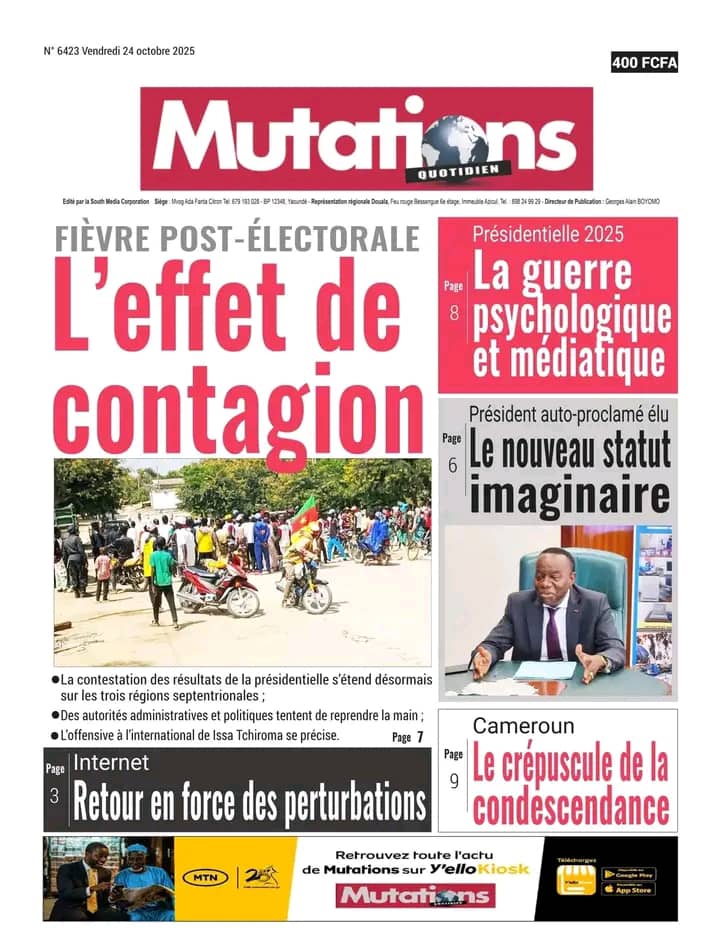
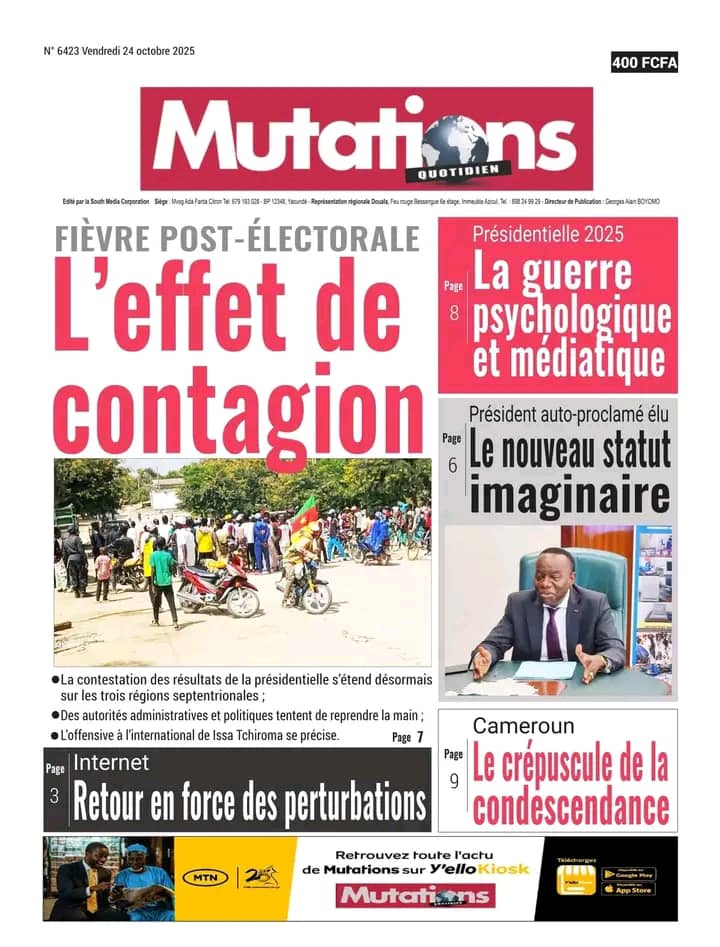
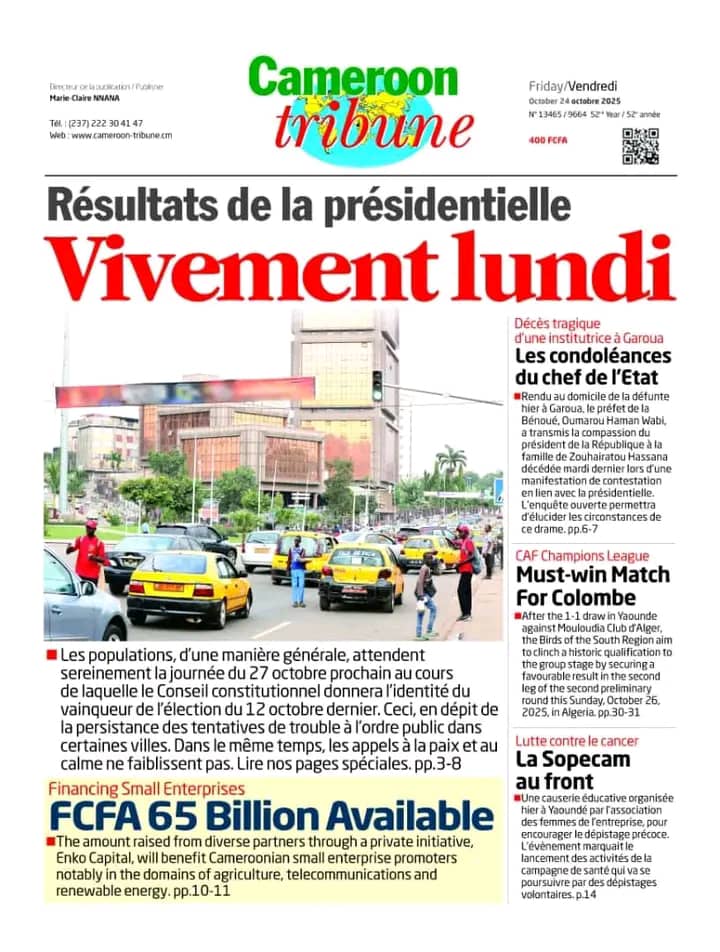
The Constitutional Reckoning: Cameroon Before Its Own Law By Paul Chiy, LLB, LLM, PhD The streets of Yaoundé are heavy with silence. The newsstands speak louder than the voices around them. Le Messager calls it a “hold-up électoral.” The Post laments a “nation boiling over stolen victory.” Le Jour warns of “the twilight of lies,” while Cameroon Tribune tries to reassure: “Vivement lundi.” Between these words, a country trembles — not because it does not know who will be proclaimed winner of the 12 October 2025 Presidential Election, but because it no longer knows whether the proclamation itself will mean anything. All eyes now turn to the Constitutional Council, that solemn body born of Article 47 of our Constitution, clothed with final authority to decide the regularity of elections and to proclaim their results. But as I read these headlines and the people’s fears between them, I cannot help but ask: what happens when the final guardian of legitimacy stands itself accused of indifference to truth? The Mandate of Conscience The framers of our Constitution did not envision the Council as ceremonial. Its authority was not designed to ratify decisions already made elsewhere, but to safeguard the Republic’s soul. Under Article 47, it is not simply a referee of numbers but the final custodian of national legitimacy. The Electoral Code, in Article 113, commands that results at every polling station be made public immediately after counting. This clause is not an administrative courtesy — it is a constitutional mechanism of transparency. It ensures that the citizen, not the bureaucrat, is the ultimate witness to democracy. And yet, this time, what the people witnessed at thousands of polling stations — recorded in photographs, videos, and tally sheets — does not seem to correspond with the aggregate figures now before the Council. The discrepancy is not technical. It is constitutional. For the law is explicit: an unlawful process cannot yield a lawful result. No decree, no signature, and no proclamation can breathe legitimacy into illegality. To validate a falsified process is not to serve the Republic — it is to wound it. The Shadow of ELECAM The institution entrusted with administering elections, ELECAM, was meant to embody neutrality. Instead, it has become a byword for distrust. Journalist Christophe Bobiokono, the legal conscience of our media, did not mince words when he declared: “ELECAM must be dismantled, and all its leaders banned for life from interfering in electoral matters… The presence of magistrates in the process is a mirage designed to make people believe that justice secures the results.” His statement was not rebellion; it was jurisprudence — a recognition that when procedure becomes pretext, law itself turns theatre. ELECAM’s passivity in the face of conflicting reports has transferred the nation’s burden to the Constitutional Council, which now carries the responsibility not only to rule but to redeem. A Mirror and a Precedent History offers guidance for those willing to look beyond convenience. In 2017, the Supreme Court of Kenya, faced with irregularities in its presidential election, took the courageous step of annulling the result. The decision was not popular — but it was just. It reminded the world that the independence of a constitutional court is tested not when obedience is easy, but when dissent is dangerous. Cameroon stands at a similar crossroads. The Council’s decision, whatever it may be, will not merely declare a winner; it will declare what kind of Republic we have become. The Voices of a Restless Republic The press has become the people’s courtroom. L’Info à Chaud reports that security forces retreated before demonstrators in Maroua — citizens crying, “Tchiroma président!” L’œil du Sahel counts 55 arrests following protests. The Guardian Post chronicles anti-Biya demonstrations in the north. Mutations describes “l’effet de contagion” — unrest spreading like fever through the septentrional regions. Meanwhile, the internet — the people’s last means of collective witness — falters. The WACS cable is blamed, but few believe the timing coincidental. Across Le Jour, L’Économie, and The Post, headlines mourn the blackout of a nation’s voice. And so, deprived of communication, the people now speak in silence — through unease, through the tremor of disbelief that no press release can calm. The Council Before History As the Council prepares to speak, the law is no longer the only measure before it. There is also conscience — that invisible jurisdiction where legality and morality converge. To proclaim without scrutiny would be to confuse authority with righteousness. To validate discrepancies without investigation would be to extinguish the very light that Article 47 was meant to preserve. Thus, I urge — as lawyer, as citizen, as one bound by the same oath of fidelity to the Constitution — that the Council: Compare the official tallies with the citizen-recorded results; Order an independent audit with international and civil-society participation; Reject all figures that cannot withstand public verification; And if necessary, delay proclamation until truth, not haste, prevails. If the results are genuine, transparency will vindicate them. If they are not, justice demands that they be set aside. The Question That History Will Ask To each member of the Council, I say: your oath is not to a president, nor to a party, but to the Republic itself. Should you find yourselves unable, in conscience, to validate what you know to be flawed, then courage lies not in compliance but in dissent. Resign if you must. Speak if you can. History remembers the voice that stood alone more kindly than the chorus that stayed silent. One day, your children will ask: What did you do when the Republic trembled? And your answer — not your title — will define your legacy. The Choice and the Covenant The Constitutional Council stands now not merely as an institution of state, but as the embodiment of a covenant — between the governed and those who govern. Break that covenant, and the law will survive only as ritual; honour it, and the Republic may yet be reborn. Twenty-eight million Cameroonians, and countless unborn, await your judgment. Not just on who won an election — but on whether truth can still prevail in the Republic of Cameroon. The choice is yours. The moment is now. History is watching.
Dr Paul CHIY, FCIArb tweet mediaDr Paul CHIY, FCIArb tweet mediaDr Paul CHIY, FCIArb tweet mediaDr Paul CHIY, FCIArb tweet media
English
0
12
13
309
Cleaners Union nag-retweet
Dr Paul CHIY, FCIArb
Dr Paul CHIY, FCIArb@DrPaulCHIY·
La République devant sa propre Loi : Le Conseil constitutionnel à l’épreuve de l’Histoire Par Maître Paul Chiy, LLB, LLM, PhD Avocat et analyste du droit constitutionnel et des droits humains Les rues de Yaoundé sont étrangement silencieuses. Aux kiosques à journaux, les unes parlent à la place des voix. Le Messager titre : « Le hold-up électoral ». The Post avertit : « La nation bouillonne après une victoire volée ». Le Jour évoque « le crépuscule du mensonge », tandis que Cameroon Tribune tente d’apaiser : « Vivement lundi ». Entre ces lignes, le pays retient son souffle. Non pas parce qu’il ignore qui sera proclamé vainqueur de l’élection présidentielle du 12 octobre 2025, mais parce qu’il ne sait plus si cette proclamation aura encore un sens. Tous les regards se tournent vers le Conseil constitutionnel, ce temple du droit né de l’article 47 de notre Constitution, investi du pouvoir suprême de contrôler la régularité du scrutin et de proclamer ses résultats. Mais une question, désormais, hante les consciences : Que devient la légitimité quand le dernier gardien du droit semble lui-même douter de la vérité ? Le mandat de la conscience Le constituant n’a jamais voulu d’un Conseil cérémonial. Il lui a confié non pas un rituel, mais une responsabilité sacrée : celle de protéger la souveraineté du peuple et la légitimité de la République. L’article 47 de la Constitution n’est pas une formalité administrative ; il est une clause morale. De même, l’article 113 du Code électoral stipule sans ambiguïté que les résultats de chaque bureau de vote doivent être rendus publics immédiatement après le dépouillement. Cette disposition n’est pas un détail procédural. C’est le cœur de la transparence électorale. Elle garantit que le citoyen, et non l’appareil, soit témoin du vote. Or, cette fois, ce que les citoyens ont vu, photographié, filmé, partagé — dans des milliers de bureaux de vote — ne correspond pas aux chiffres consolidés qui vous sont présentés aujourd’hui. Ce n’est pas une irrégularité ; c’est une faille constitutionnelle. Car en droit, un acte né d’un processus illégal ne peut produire un résultat légal. Aucun décret, aucune signature, aucun sceau officiel ne peut donner validité à une fraude. La loi peut être écrite ; la confiance, elle, doit être méritée. L’ombre d’ELECAM L’organe chargé d’organiser le scrutin, ELECAM, devait être le garant de la neutralité. Il est devenu, aux yeux de beaucoup, le symbole du soupçon. Le journaliste Christophe Bobiokono, directeur du journal Kalara, a trouvé les mots justes : « ELECAM doit être démantelé, et ses dirigeants bannis à vie de toute implication électorale. La présence de magistrats dans le processus n’est qu’un mirage destiné à faire croire que la justice garantit les résultats. » Ses paroles ne relèvent pas de la colère, mais du constat juridique. Lorsqu’un organe censé protéger le droit devient le bras d’un pouvoir, la légalité se vide de sa substance. ELECAM n’a pas su défendre la vérité du scrutin. Dès lors, c’est au Conseil constitutionnel qu’incombe la tâche — redoutable et historique — de sauver non pas une élection, mais la foi du peuple dans la République. Le miroir du passé et l’exemple du courage L’histoire africaine offre des précédents à ceux qui osent regarder au-delà de l’habitude. En 2017, la Cour suprême du Kenya, confrontée à des irrégularités massives, a annulé l’élection présidentielle. Ce fut un acte de courage, non de défi. Elle rappela au monde qu’un juge n’est pas le notaire du pouvoir, mais le gardien du peuple. Aujourd’hui, le Cameroun se trouve à une croisée des chemins semblable. La décision du Conseil ne dira pas seulement qui a gagné : elle dira ce que nous sommes devenus. Un État de droit, ou une simple continuité du pouvoir sans droit. Les voix du peuple et la fièvre du pays Dans les journaux, dans les rues, dans le silence d’Internet, le Cameroun s’exprime autrement. L’Info à Chaud montre des gendarmes reculant face à des manifestants à Maroua. L’Œil du Sahel rapporte l’arrestation de 55 personnes. The Guardian Post décrit la montée des protestations anti-Biya dans le Nord. Mutations parle de « fièvre post-électorale » et de « contagion » démocratique. Et comme pour parachever cette atmosphère d’angoisse, le réseau Internet est brusquement interrompu. Les autorités évoquent une panne du câble sous-marin WACS. Mais le peuple sait reconnaître un silence imposé. Couper la connexion, c’est couper le lien entre vérité et témoignage. Or, la Constitution, en son article 45, impose le respect des conventions internationales, dont la Charte africaine des droits de l’homme, qui garantit le droit à l’information. Empêcher la transparence au moment du choix populaire, c’est violer non seulement la technique, mais le principe même de souveraineté. Le Conseil face à sa propre histoire Votre rôle, membres du Conseil constitutionnel, ne se résume pas à proclamer des chiffres. Vous êtes désormais le dernier rempart entre la République et la rupture. Nous vous invitons à : comparer les procès-verbaux officiels avec les résultats publiquement observés ; ordonner un audit indépendant, avec la participation d’observateurs nationaux et internationaux ; rejeter tout résultat qui ne résiste pas à la vérification ; et, s’il le faut, différer la proclamation jusqu’à ce que la lumière soit faite. Car la transparence ne menace pas la légitimité : elle la confirme. Et si les résultats ne résistent pas à l’épreuve de la vérité, votre devoir n’est pas de les couvrir, mais de les dénoncer. La question que l’Histoire posera Votre serment ne vous lie ni à un homme, ni à un parti. Il vous lie à la Constitution, à la République, et au peuple du Cameroun. Si la conscience vous interdit de valider l’injustice, le courage consiste alors à dire non. Démissionner, voter contre, publier une opinion dissidente — voilà les gestes qui fondent la mémoire des nations. Car un jour, vos enfants vous demanderont : « Qu’as-tu fait lorsque la République tremblait ? » Et votre réponse pèsera plus lourd que tous les titres. Le prestige s’efface ; la probité demeure. Le choix et le serment Le Conseil constitutionnel est aujourd’hui plus qu’une institution : il est une conscience collective. S’il honore son serment, il restaurera la confiance dans le droit. S’il s’y soustrait, il réduira la Constitution à une simple scénographie du pouvoir. Vingt-huit millions de Camerounais, et des générations encore à naître, attendent votre verdict. Pas seulement pour savoir qui a gagné — mais pour savoir si la vérité peut encore triompher dans ce pays. Le choix vous appartient. Le moment est venu. Et l’Histoire vous regarde. Par Maître Paul Chiy, LLB, LLM, PhD Avocat et commentateur du droit constitutionnel et des droits humains Chambers of Paul Chiy – Octobre 2025
Dr Paul CHIY, FCIArb tweet mediaDr Paul CHIY, FCIArb tweet mediaDr Paul CHIY, FCIArb tweet mediaDr Paul CHIY, FCIArb tweet media
Français
0
11
12
154
Cleaners Union nag-retweet
Dr Paul CHIY, FCIArb
Dr Paul CHIY, FCIArb@DrPaulCHIY·
Constitutional Council Faces a Nation on Edge: Human Rights and the Silence of Law in Cameroon Today, as the Constitutional Council prepares to declare the official results of Cameroon’s 12 October presidential election, the nation stands on edge. The air in Yaoundé is taut — part anticipation, part dread. Across the country, citizens wait not only for an outcome, but for reassurance that law still protects the living, and that power remains accountable to justice. The Council’s decision will mark more than a transfer of authority. It will decide whether the Constitution’s promise of liberty still carries meaning — or whether the instruments of law have become tools of repression. When the Law Turns Inward Two days ago, on 26 October, a Regional Order signed by Governor Samuel Dieudonné Ivaha Diboua authorised the administrative detention of more than seventy individuals accused of participating in post-election protests in Douala. Under the Law on the Maintenance of Public Order (1990), the Governor invoked powers allowing detention “for reasons of public security,” renewable every fifteen days. The order does not list charges, witnesses, or evidence — only names, ages, and locations. They come from all walks of life: young market traders, teachers, carpenters, students, and women, some barely in their twenties. Francophones and Anglophones. Muslims, Christians, and those of no faith at all. The common thread binding them is not ideology, but vulnerability. Their detention is administrative, not judicial — meaning there is no court order, no defined accusation, no right to bail or legal review. They are held because an administrator decided they should be. This is not law; it is the shadow of law, where procedure replaces justice and detention replaces dialogue. The Bar’s Cry for Rights On 25 October 2025, the Cameroon Bar Association, led by Bar President Mbah Eric Mbah, issued a communiqué that stands as both a legal document and a moral outcry. The Bar condemned the “flagrant violations of human rights” that have followed the elections — the killing of civilians, abductions, and arbitrary arrests — and warned that the peace of the nation was “fragile and requires nourishment by restraint and responsibility.” In words that now hang over the Constitutional Council’s deliberations, the Bar reminded the government that: “No individual can be deprived of the right to peacefully express dissent against injustice or in defense of their rights.” The communiqué did more than cite principles. It recited the rights enshrined in the Constitution and the International Covenant on Civil and Political Rights (ICCPR) — the right to liberty, to dignity, to freedom of movement, and to protest. These are not privileges granted by power; they are guarantees owed to every human being. By reaffirming them in this moment, the Bar sought to remind the state that legality without humanity is law stripped of purpose. A Nation Without Distinctions The arrests that followed the protests defy political and ethnic logic. They do not reflect a war between Anglophones and Francophones, but a crisis of citizenship — the criminalisation of ordinary life. Among those detained are teenagers, workers from the informal economy, and women arrested while returning from markets. For many, their only offence is proximity — being near a protest, sharing a message, or refusing to run fast enough when police trucks arrived. This indiscriminate sweep has revealed the fragility of legal protection in Cameroon. The Constitution promises due process, but administrative decrees have replaced judicial orders; police custody has replaced court hearings; and fear has replaced faith in justice. A Legal Fiction, A Human Cost Administrative detention — a relic of colonial emergency law — was meant to preserve public order in moments of danger. But used without judicial oversight, it has become an instrument of collective punishment. The detained are not told when they will be tried, or even if they will be. Their families are left in the dark, standing outside prison gates that guard not criminals, but uncertainty. To hold a person indefinitely without trial is not an act of governance. It is a violation of Article 9 of the ICCPR, which prohibits arbitrary arrest and guarantees the right to challenge detention before a court. It is a breach not only of international law, but of the Constitutional promise of dignity and liberty — the very foundation upon which the Constitutional Council now sits in judgment. The Council’s Moment of Truth As the judges of the Constitutional Council take their seats, they bear a responsibility greater than the announcement of an electoral outcome. They must answer — in word and in principle — whether the Constitution remains the guardian of the citizen, or whether it has become a screen for arbitrary power. The Bar has already sounded its warning: peace without justice is a fragile illusion. The Council’s declaration will either steady the country under law, or further fracture a people already exhausted by fear and silence. Between Silence and Judgment In the tense quiet of this morning, there are no crowds in the streets — only whispers, glances, and the subdued hum of uncertainty. Cameroon is not calm; it is contained. And in that containment lies the question that the Constitutional Council, and history itself, must answer: Can a nation that imprisons its own citizens in the name of order still claim to be governed by law? For today’s declaration will not only decide who governs Cameroon. It will decide whether the law still speaks for the people — or only for those who wield it.
Dr Paul CHIY, FCIArb tweet mediaDr Paul CHIY, FCIArb tweet media
English
1
14
19
1.2K
Cleaners Union nag-retweet
Dr Paul CHIY, FCIArb
Dr Paul CHIY, FCIArb@DrPaulCHIY·
The Impermissibility of Derogation from Fundamental Rights: Legal Assessment of the Arrest and Detention of Mr. Bernard Simo 1. Foundational Principle It is a settled principle of constitutional and international law that no derogation from fundamental rights and liberties is permissible except as expressly provided by law, and only within the strict bounds of necessity and proportionality. Political unrest, public disorder, or considerations of expediency do not constitute lawful grounds for infringing the rights to liberty, due process, and human dignity. The detention of Mr. Bernard Simo, a militant of the Mouvement pour la Renaissance du Cameroun (MRC), presently confined at the New Bell Central Prison, Douala, constitutes a paradigmatic instance of the unlawful curtailment of fundamental rights. The detention, executed without warrant, judicial order, or any identifiable criminal act, is ultra vires, arbitrary, and contrary to both domestic and international law. 2. Factual Context Mr. Simo was apprehended on 24 October, three days prior to the outbreak of public demonstrations in Douala. The arrest was not predicated upon any offence committed, but solely upon an alleged intention to incite public protest. Subsequent inquiries revealed that he had been detained incommunicado at New Bell Prison — a facility consistently condemned for its inhuman conditions and chronic overcrowding. No judicial warrant or formal charge was issued, and no notification of the grounds for detention was provided. On these facts alone, the detention falls outside the scope of lawful arrest as prescribed by Article 119 of the Cameroonian Criminal Procedure Code. 3. Applicable Constitutional Framework The Constitution of the Republic of Cameroon (Law No. 96-06 of 18 January 1996), at its Preamble (which possesses constitutional force pursuant to Article 65), guarantees to every person: “The right to life, to physical and moral integrity, and to freedom and security. No one shall be arbitrarily arrested or detained.” The same Preamble affirms the rights to freedom of communication, expression, assembly, and association. These provisions impose a positive duty upon all organs of the State to respect, protect, and ensure the effective enjoyment of these rights. Any deprivation of liberty executed absent a judicial warrant or probable cause is therefore unconstitutional, null, and void ab initio. 4. Applicable Statutory Provisions 4.1. Cameroon Penal Code (Law No. 2016/007 of 12 July 2016) Article 140 (Abuse of Office):Any public servant who, in the discharge of his duties, acts contrary to the law or exceeds his lawful authority and thereby causes injury, commits an offence punishable by imprisonment of one to five years. Article 291 (Unlawful Arrest and Detention): Any person who, without legal authority, arrests, detains, or causes the detention of another shall be punished with imprisonment of five to ten years. Article 277(2): Prohibits any inhuman or coercive treatment of detainees by public officials. The conduct of the arresting and detaining authorities in this matter, undertaken without judicial authorisation, reasonable suspicion, or procedural compliance, is manifestly ultra vires and satisfies the constituent elements of both abuse of office under Article 140 and unlawful arrest and detention under Article 291. 4.2. Criminal Procedure Code Under Article 119 of the Criminal Procedure Code, a person may be arrested only where there exist reasonable grounds to believe that an offence has been committed or attempted. A speculative or pre-emptive detention based on a presumed political intention falls entirely outside the scope of this provision and constitutes an abuse of legal process. 5. Violations of International Human Rights Law 5.1. International Covenant on Civil and Political Rights (ICCPR) Cameroon acceded to the ICCPR on 27 June 1984. The following provisions are engaged: Article 9(1): Prohibits arbitrary arrest or detention; any deprivation of liberty must be lawful, necessary, and proportionate. Article 9(2): Requires prompt communication of the reasons for arrest and of any charges. Article 19: Protects the right to freedom of expression, including political expression. Article 21: Protects the right to peaceful assembly. The arrest and detention of Mr. Simo, effected without judicial process and in retaliation for his political association, are contrary to Articles 9(1), 9(2), 19, and 21 of the ICCPR and engage Cameroon’s international responsibility for arbitrary detention and suppression of political expression. 5.2. African Charter on Human and Peoples’ Rights Cameroon is also a State Party to the African Charter (ratified 1989). The following provisions are directly implicated: Article 5: Prohibits torture and inhuman or degrading treatment. Article 6: Guarantees the right to liberty and security of person. Article 7: Ensures the right to a fair trial. Article 9: Guarantees freedom of expression. Article 10 & 11: Safeguard freedom of association and assembly. The African Commission on Human and Peoples’ Rights, in Gunme et al. v. Cameroon (Communication No. 266/2003), held that arrests based solely on political activity constitute arbitrary detention in violation of Articles 6 and 9. The same reasoning applies mutatis mutandis to the detention of Mr. Simo. 6. Legal Characterisation The facts establish the following: - The arrest was ultra vires, lacking statutory authority under Article 119 CPC. - The detention constitutes unlawful deprivation of liberty under Article 291 of the Penal Code. - The act of arrest based on political suspicion constitutes abuse of office under Article 140. - The conditions of detention, if consistent with known conditions at New Bell Prison, violate Article 277(2) Penal Code and Article 5 of the African Charter. Collectively, these acts amount to a serious breach of Cameroon’s constitutional obligations and its international treaty commitments. 7. Detention Conditions and State Responsibility The New Bell Central Prison, as repeatedly documented, operates in conditions that are grossly inconsistent with human dignity, involving overcrowding, inadequate sanitation, and endemic violence. Such conditions meet the threshold of inhuman and degrading treatment within the meaning of Article 277(2) of the Penal Code, Article 5 of the African Charter, and Article 10(1) of the ICCPR. Under international law, the State bears strict responsibility for ensuring humane conditions of detention. The continuing confinement of Mr. Simo in such conditions aggravates the illegality of the detention itself. 8. Remedies and Enforcement - The following remedies are available under Cameroonian law: - Habeas corpus under Article 584 CPC to secure immediate judicial review of detention; - Private criminal complaint (plainte directe) against the arresting officers under Articles 140 and 291 Penal Code; - Civil action for damages under Articles 1382–1384 Civil Code for wrongful acts committed by public agents. 8.2. International Remedies Should domestic remedies prove ineffective, the victim may petition: - The African Commission on Human and Peoples’ Rights, under Articles 55–59 of the African Charter; - The United Nations Human Rights Committee, under Article 5(1) of the Optional Protocol to the ICCPR. - Failure by Cameroon to investigate and remedy the unlawful detention constitutes a continuing violation, extending the State’s international responsibility until redress is provided. 9. Institutional and Systemic Implications The practice of preventive detention for political intent represents a systemic departure from legality. The invocation of “public order” to justify anticipatory arrests is inconsistent with the principle of proportionality and the constitutional separation of powers guaranteed by Article 37(2) of the Constitution, which entrusts the judiciary with the protection of rights and freedoms. Persistent violations of this nature undermine judicial independence and constitute a de facto suspension of constitutional guarantees without lawful derogation, contrary to Article 4 of the ICCPR, which permits derogation only in narrowly defined emergencies and under formal proclamation. 10. Conclusion The arrest and detention of Mr. Bernard Simo are unlawful, unconstitutional, and contrary to Cameroon’s international obligations. They constitute:A breach of Articles 140, 277, and 291 of the Penal Code; A violation of the Constitutional guarantees of liberty and security; an a A violation of Articles 9 and 19 of the ICCPR and Articles 5, 6, and 9 of the African Charter. The conduct of the authorities is ultra vires, arbitrary, and devoid of legal foundation. The State is under a binding legal obligation to: - Release Mr. Simo or submit his detention to prompt judicial review; - Investigate and prosecute officials responsible for unlawful arrest and abuse of authority; and - Adopt institutional safeguards to ensure the non-recurrence of politically motivated detentions. It remains a peremptory norm (jus cogens) that the protection of fundamental rights admits of no derogation save where lawfully prescribed and judicially controlled. The legitimacy of the State depends upon its observance of this principle. To maintain the façade of legality while practising repression is to extinguish the very essence of constitutional order.
Dr Paul CHIY, FCIArb tweet media
English
0
12
13
71