David Murray

7.7K posts

David Murray banner
David Murray

David Murray

@DavidMurrayd11

"Doing jobs Americans won't do."

Sumali Kasım 2014
623 Sinusundan327 Mga Tagasunod
David Murray nag-retweet
Impressions
Impressions@impression_ists·
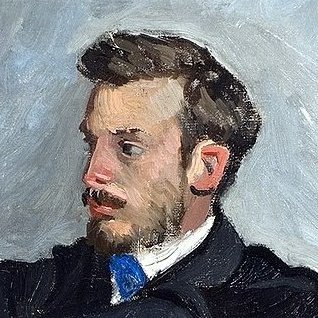
Monet painted The Magpie when he was 28. No one knew him. He had just become a father and was living in extreme poverty. ​He presented it at the Paris Salon and they laughed at him. They told him it was unfinished.
Impressions tweet media
Impressions@impression_ists

Snow by Claude Monet

English
113
1.6K
16.1K
1.4M
David Murray nag-retweet
Mike Lee
Mike Lee@BasedMikeLee·
Women earning 62% of all degrees. Is this “equity”?
Mike Lee tweet media
English
694
433
3.7K
1.8M
David Murray
David Murray@DavidMurrayd11·
@projectxlence @BitPaine Dude; didn't want to blow his cover, but he and I ran into each other, as teammates on a play, and he scored. He was maybe 5'6"? Remarkable athlete, solid Man.
English
0
0
0
135
Paul
Paul@projectxlence·
@DavidMurrayd11 @BitPaine they're a whole other species. parenthetically, a 5'9" pro quarterback, in a league where position average is 6'2" , tells you already that he's above and beyond even at that level.
English
2
0
2
3.3K
Bit Paine ⚡️
Bit Paine ⚡️@BitPaine·
Let’s put this in terms you would understand: 90-95th %-ile is about the level of a good high school varsity basketball player 99th %-ile is about the level of an all-state high school basketball player 99.9th %-ile is about the level of an average NCAA D1 basketball player. 99.99th %-ile is about the level of an NCAA final four starter 99.9999th %-ile is about the level of an average NBA player 99.999999th %-ile is about the level of a top 10-20 NBA player what you are proposing is the academic equivalent of taking a team of black Final Four-calibre NCAA basketball players and deciding that we need equal representation so we should toss in some white/asian students who are about as good as the average high school varsity player and that’s just as good. TLDR: you understand percentiles about as well as the people you think belong at Yale Law school along with the most elite students in the country.
Girl@boyzie95

The Black students at Yale are in fact some of the highest achievers in the country. Their scores are in the 95th percentile! Past the 90th percentile they are equally qualified and brilliant.

English
34
119
3.1K
400.5K
David Murray
David Murray@DavidMurrayd11·
@projectxlence @BitPaine Amazed that he was "uninjured," all those years, even when so many hunted his scalp. He could shape-shift, even on the ground, as the hefties came down on him; a kind of quicksilver. Even more amazing, he was a kind man; always reaching out his hand to help you up.
English
0
0
0
134
David Murray
David Murray@DavidMurrayd11·
@projectxlence @BitPaine I was 6'3" and 190 -- played decent B-Ball for years, good enough to play post-college sport league, but not a star. Doug Flutie joined us. Man was maybe 5' 9"; yet after 21 years of pro QB, he simply smoked us. His quickness and foresight were unmatched.
English
1
0
4
197
Paul
Paul@projectxlence·
this is funny/apt because there's a guy in my local squash club who played AAA baseball for a couple years. There's your 99.99-99.999%ile player, roughly. And his superior ability and athleticism is VERY APPARENT, even in a sport he just picked up a couple years ago. went from "he's ok" to "I'm lucky if I get a few points on him" in the space of a few months.
English
6
0
80
6.4K
David Murray
David Murray@DavidMurrayd11·
Not a sufficient answer; So. Cal beaches are adjacent to mountain ranges; there is a steep drop-off that continues under water. Not so, Florida/Cape Cod; flats run out for miles. Breakers cannot "roll" across the wind-driven Pacific to build and land unimpeded at Oxnard....; Surf California.
Jacob Shell@JacobAShell

CA gets the cold Alaska current whereas Eastern Seaboard gets water from the tropics. As result even Cape Cod has warmer water (at least in August) than LA. California invented surfer/wetsuit culture as a ploy to promote its beaches.

English
0
0
0
65
David Murray
David Murray@DavidMurrayd11·
3. But now think of "shorthand" transcription; that's what I re-invented. I note that it "activates" an "aural" part of my brain and tongue, just as handwriting does, as I unfurl it; all lost when I type or turn digital.
English
0
0
0
7
David Murray
David Murray@DavidMurrayd11·
2. But this part is wrong: The (... )handwriting students physically could not write fast enough to transcribe a lecture in real time, which forced them to listen carefully, decide what actually mattered, and put it in their own words on the page. I can, in fact, handwrite an exact transcription word-by-word in real-time lecturing. I invented a private script in which to do so. Still use it.
English
0
0
0
12
David Murray
David Murray@DavidMurrayd11·
1. I have argued this for decades; good on her.
Ihtesham Ali@ihtesham2005

A Norwegian neuroscientist spent 20 years proving that the act of writing by hand changes the human brain in ways typing physically cannot, and almost nobody outside her field has read the paper. Her name is Audrey van der Meer. She runs a brain research lab in Trondheim, and the paper that closed the argument was published in 2024 in a journal called Frontiers in Psychology. The finding is brutal enough that it should have changed every classroom on Earth. The experiment was simple. She recruited 36 university students and put each one in a cap with 256 sensors pressed against their scalp to record brain activity. Words flashed on a screen one at a time. Sometimes the students wrote the word by hand on a touchscreen using a digital pen, and sometimes they typed the same word on a keyboard. Every neural response was recorded for the full five seconds the word stayed on screen. Then her team looked at the part of the data most researchers had ignored for years, which is how different parts of the brain were communicating with each other during the task. When the students wrote by hand, the brain lit up everywhere at once. The regions responsible for memory, sensory integration, and the encoding of new information were all firing together in a coordinated pattern that spread across the entire cortex. The whole network was awake and connected. When the same students typed the same word, that pattern collapsed almost completely. Most of the brain went quiet, and the connections between regions that had been alive seconds earlier were nowhere to be found on the EEG. Same word, same brain, same person, and two completely different neurological events. The reason turned out to be something nobody had really paid attention to before her work. Writing by hand is not one motion but a sequence of thousands of tiny micro-movements coordinated with your eyes in real time, where each letter is a different shape that requires the brain to solve a slightly different spatial problem. Your fingers, wrist, vision, and the parts of your brain that track position in space are all working together to produce one letter, then the next, then the next. Typing throws all of that away. Every key on a keyboard requires the exact same finger motion regardless of which letter you are pressing, which means the brain has almost nothing to integrate and almost no problem to solve. Van der Meer said it plainly in her interviews. Pressing the same key with the same finger over and over does not stimulate the brain in any meaningful way, and she pointed out something that should scare every parent who handed their kid an iPad. Children who learn to read and write on tablets often cannot tell letters like b and d apart, because they have never physically felt with their bodies what it takes to actually produce those letters on a page. A decade before her, two researchers at Princeton ran the same fight using a completely different method and ended up at the same answer. Pam Mueller and Daniel Oppenheimer tested 327 students across three experiments, where half took notes on laptops with the internet disabled and half took notes by hand, before testing everyone on what they actually understood from the lectures they had watched. The handwriting group won by a wide margin on every question that required real understanding rather than surface recall. The reason was hiding in the transcripts of what the two groups had actually written down. The laptop students typed almost word for word, capturing more total content but processing almost none of it as they went, while the handwriting students physically could not write fast enough to transcribe a lecture in real time, which forced them to listen carefully, decide what actually mattered, and put it in their own words on the page. That single act of choosing what to keep was the learning itself, and the keyboard had quietly skipped the choosing and skipped the learning along with it. Two studies. Two countries. Same answer. Handwriting makes the brain work. Typing lets it coast. Every note you have ever typed instead of written went into your brain through a thinner pipe. Every meeting, every book highlight, every idea you captured on your phone instead of on paper was processed at half depth. You did not forget those things because your memory is bad. You forgot them because typing never woke the part of the brain that would have made them stick. The fix is the thing your grandmother already knew. Pick up a pen. Write the thing down. The slower road is the faster one.

English
0
0
0
55
David Murray
David Murray@DavidMurrayd11·
Perhaps the left hand specialized in holding the implement, while the right specialized in striking it? It's a complementarity of performance?
Massimo@Rainmaker1973

Around 90 percent of humans across all cultures strongly prefer their right hand, a level of dominance unmatched by any other primate species. For decades, scientists struggled to explain this striking human exception. A new study now offers a compelling answer, linking extreme right-handedness to two key evolutionary changes: walking upright and the dramatic expansion of the human brain. Researchers examined hand preferences in more than 2,000 monkeys and apes from 41 primate species. They compared these preferences with traits such as brain size, body structure, diet, social behavior, and locomotion patterns. At first glance, humans appeared to be a complete outlier. However, once the team adjusted for brain enlargement and bipedal walking, humans fit neatly into the broader primate pattern. The findings indicate that when early human ancestors began walking on two legs, their hands were freed from the demands of locomotion. This shift created evolutionary pressure for greater hand specialization. Later, as human brains grew larger and more complex, this preference became far more pronounced. The researchers suggest that early hominins such as Australopithecus likely showed only mild right-hand preferences, similar to those seen in modern great apes. Right-handedness then strengthened progressively in the Homo lineage, including in Homo erectus and Neanderthals. One notable exception was Homo floresiensis, the small “hobbit” species from Indonesia. Because it retained a smaller brain and more arboreal adaptations, scientists predict it had much weaker right-hand dominance. While the persistence of left-handedness throughout human evolution remains unexplained, the study proposes that one of humanity’s most familiar traits largely emerged from two transformative changes: standing upright and developing larger brains. [Püschel, T. A., Hurwitz, R. M., & Venditti, C. (2026). Bipedalism and brain expansion explain human handedness. PLOS Biology, 24(4), e3003771. DOI: 10.1371/journal.pbio.3003771]

English
0
0
0
26
David Murray nag-retweet
Sama Hoole
Sama Hoole@SamaHoole·
In 1870, if you took a spade to the ground in Iowa, or Nebraska, or eastern Kansas, you could push it in to the haft and not hit anything that wasn't soil. Six feet of topsoil. Black, friable, alive. The richest agricultural earth on the planet, by a margin so absurd that European visitors with farming backgrounds went silent when they saw it turned over. Most arable land on Earth carries between one and eight inches of topsoil. The Great Plains carried seventy-two. Nobody had ploughed it. Nobody had fertilised it. Nobody had irrigated it. It had been built, slowly and completely, by something else. Stand back from the spade. Stand back from the field. Stand back far enough to see the continent. A herd of bison, fifty miles wide, takes five days to pass the hillside you are standing on. Colonel Dodge recorded this in Arkansas in 1871, and he was not the only one. From the top of Pawnee Rock the herd ran to the horizon in every direction at once. The earth, observers wrote, trembled at three miles. Sixty million animals. The largest gathering of large mammals the planet has ever held. They had been doing this for ten thousand years. The grass grew tall because the bison grazed it hard and moved on. Their hooves broke the crust for seed. Their wallows held the rain. Their dung fed the microbes. Their carcasses fed them harder. The deep-rooted prairie grasses, big bluestem, switchgrass, Indian grass, drove their roots fifteen feet down, locking carbon into the soil at a depth no plough would ever reach. The bison built the six feet of black earth. The bison were why it existed. Then the hide market arrived. Five thousand bison a day, shot from train windows, left to rot. The U.S. government encouraged it openly, because starving the Plains nations was cheaper than fighting them. By 1889, of the sixty million, five hundred and forty-one remained. The plough followed within a decade. The grass was turned under. The hooves and the wallows and the dung had stopped. The soil, untethered from the system that built it, dried. In April 1935 it rose into the sky as a black wall a thousand miles wide and travelled to the Atlantic. Six feet of soil, built over ten millennia, blown into the sea in a generation. There is no putting the bison back at that scale. The cow is the closest analogue the continent has. Run her like a bison, on grass, on the move, in a tight mob. Watch what the land does.
Sama Hoole tweet media
English
115
1.6K
7.3K
690.8K
David Murray nag-retweet
Magical Views
Magical Views@MagicalV31610·
Is this the prettiest view in Canada? 🍁 📍 Parliament Hill, Ottawa, Canada 🇨🇦
Magical Views tweet media
English
20
44
260
4.4K
David Murray nag-retweet
Emil Kirkegaard
Emil Kirkegaard@KirkegaardEmil·
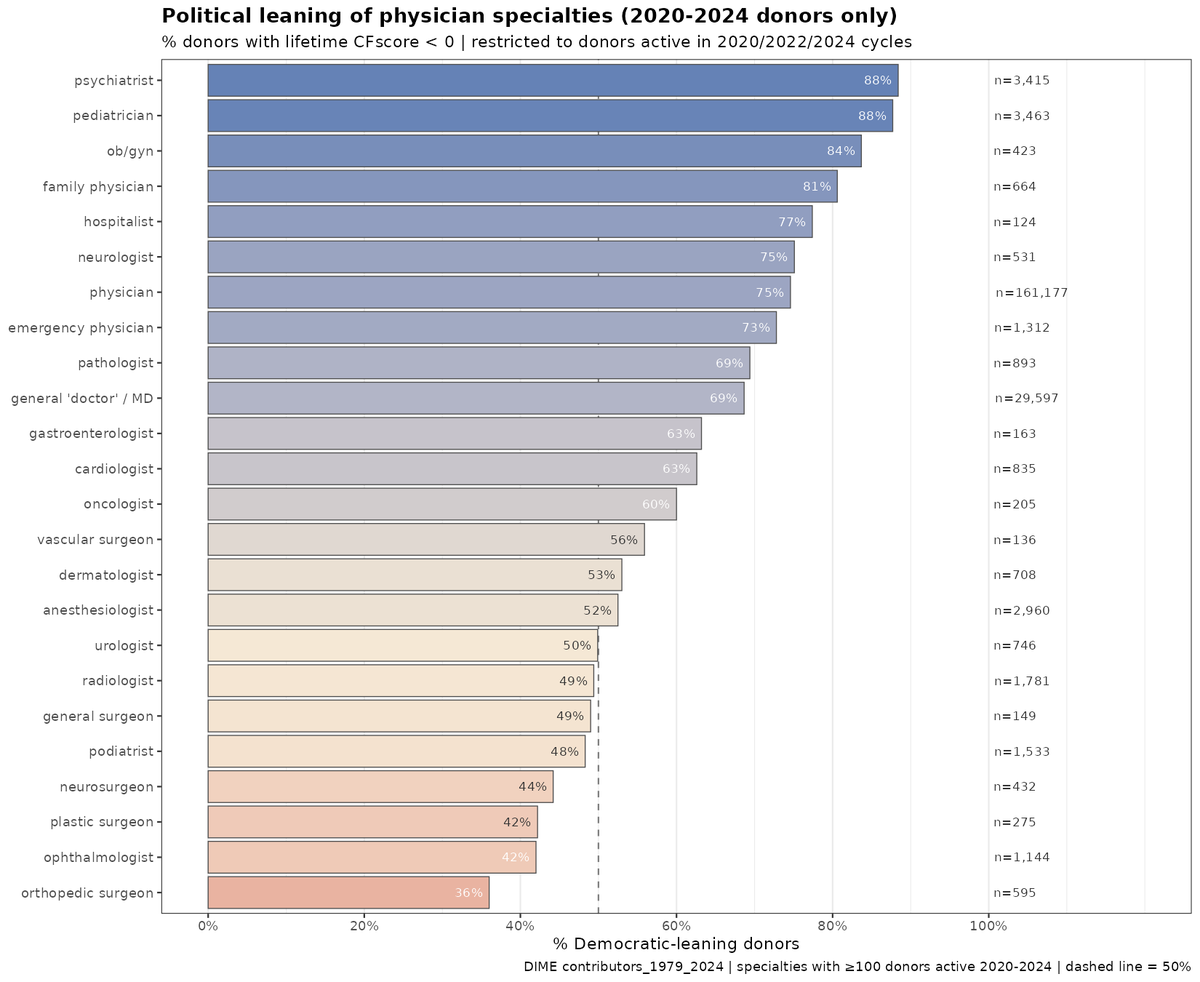
Political leanings of American doctors by specialty. Unsurprisingly, psychiatrists the most left-leaning.
Emil Kirkegaard tweet media
English
97
156
1.4K
369.2K
David Murray
David Murray@DavidMurrayd11·
Familiar with a chemo/hormonal oncologist who is Hopkins; young and stellar. Her practice is somewhat "automated" at this point. In contrast, familiar with a radiation oncologist who is flat brilliant; he masters the subtle features, the targeting, the laser-positioning, the doses; and, he must judge possible metastasis.
English
0
0
1
327
Charles Murray
Charles Murray@charlesmurray·
Interesting, and perhaps you're right. Certainly I'm happy that the internist who is my anchor physician is way above 115. But being close to someone with cancer who started with a mediocre oncologist, became worried about his advice and switched an oncologist at Johns Hopkins, I'm here to tell you that it was a life-saving decision--and the JH oncologist has a wicked high IQ. For that matter, my impression is that the oncologist's nurse is well into the 120s. At least.
Bit Paine ⚡️@BitPaine

@charlesmurray Oncology is far less difficult than primary care. It’s mostly following well established guideline-dictated pathways with diagnostic certainty. Primary care is much more cognitively demanding and requires a lot of Bayesian reasoning and intuition to minimize harm.

English
25
4
170
19.8K