Ewan Collinge

280 posts

Ewan Collinge banner
Ewan Collinge

Ewan Collinge

@EwanCollinge

Co-Founder of Cykel (LSE:CYK) & sundae_bar (LSE:SBAR). Previously built Crowdform (acquired 2022). AGI is already here.

London Sumali Ağustos 2012
1.2K Sinusundan1K Mga Tagasunod
Ewan Collinge
Ewan Collinge@EwanCollinge·
@harleyf There is a quality to the experience of building something from nothing under conditions of total uncertainty that, if you haven't experienced it, you can't imagine what it's like.
English
0
0
0
1
Harley Finkelstein
Harley Finkelstein@harleyf·
Stop taking advice from people who've never built anything. If they haven't put something on the line, their opinion on your risk isn't worth hearing. The people who judge the attempt are never the ones making one.
English
143
335
2.4K
155K
Ewan Collinge
Ewan Collinge@EwanCollinge·
x402 + Agentic Market unlocks the agentic internet. Any agent can now use any service on a pay-per-use basis. - Agents choose which service offers them the best price and outcome for their task - Agents have wallets they can use to pay for services with no auth barriers or human-in-the-loop - Services compete for agents' business on a perfectly level playing field - Every service's pricing model is condensed into a single and perfectly comparable number: $ per request agentic.market by @Nick_Prince12
English
0
0
0
9
Ewan Collinge
Ewan Collinge@EwanCollinge·
SMRs the size of two football pitches built with parts that are (relatively) easy to manufacture and transport. That is what energy abundance looks like.
Jordan Taylor@Jordan_W_Taylor

From computing to space, Britain has an odd habit of innovating its way to the pinnacle of some developing field or other, only to get white line fever and pass the ball to someone else to score the winning try. Usually an American. It's happened so many times it's almost a running joke, and yet every now and then some company or genius pops up, hands the country a winning lotto ticket and asks if it wants to cash it in. Right now, the holder of the ticket is the global engineering company Rolls-Royce, which has just handed the government an absolute no-brainer of a decision… For you see, Rolls-Royce just developed a revolutionary nuclear power plant. It's not revolutionary because it's a fast reactor, or cooled by helium, or runs on thorium or anything fancy like that. It's revolutionary because it's designed to be easy to make, which is a common failing of nuclear plants. It's small-ish at 470 Megawatts, or half the size of a normal plant, but can fit in a tiny fraction of the footprint, is made of standardised easy-fit modular parts, all road transportable and is designed to be almost entirely factory manufactured, meaning that repeat runs bring powerful learner effects for centralised production facilities. And, given that the plant and surroundings fit into a space of about two football pitches once fully assembled, it can be pieced together by a single standardised production gantry assembled over the entire build site. This is the ‘Small Modular Reactor’, or SMR industrial concept, and intends to pass onto nuclear manufacture the opportunity for the same cost-reducing learner effects that grew solar and wind energy into global dominance. Will it work? Who knows, but let's look at Britain's résumé of problems: Overpriced construction, scarce and expensive energy, binding limits on carbon dioxide emissions and a need to electrify everything to achieve that, an over-reliance on random variable forms of energy generation (wind) with very little clean baseload, a dwindling supply of export champions… well you get the picture. All this plus the need to import lots of foreign expertise to fix problems. Lotto ticket!

English
0
0
0
31
Ewan Collinge
Ewan Collinge@EwanCollinge·
Demand is infinitely elastic - humans always find new things to want that we didn’t have or couldn’t conceive of previously. As AI commoditises many of the services humans deliver today, there is likely to be an explosion in demand for uniquely human experiences. Hospitality, in-person entertainment and the arts will have a golden era.
English
0
0
0
75
Jonas
Jonas@jonaswillett1·
The IRL connection economy is a $400B+ market. And companies are racing to own it. In the last 6 months, $800M+ in capital was deployed on "IRL" bets. @Tinder invested $60M into a new Events feature for connecting matches in-person. They're pivoting to IRL and offering experiences such as speakeasies, raves, and pottery classes. @222place: raised a $10.1M Series A to curate blind social experiences for Gen Z. Personality-matched groups sent to hyperlocal nightlife events. @JagermeisterUSA launched BestNightsVC - the only venture fund in the world dedicated solely to nightlife and IRL connection. 16 portfolio companies across 4 continents. @timeleft: dinner with 5 strangers, every Wednesday. €18M ARR. 6,500 dinners/week across 200+ cities. Dion: members-only social app where the first move is buying someone a real drink, redeemed IRL. 10K members, 30K+ on the waitlist founded by @revekkapal. Pie: Bonobos founder @dunn built an IRL friendship app. $24M raised. 130K+ MAU. @weroad_official: group trips for 20-30 year olds who don't know each other beforehand. $150M valuation. Matchbox: is an algorithm-powered matching platform for IRL events and has powered over 100,000 connections. founded by @liamjmcgregor (prev @MarriagePact) New dating apps like Known @Celesteamadon, Cerca @MylesCerca, and Ditto @AllenWangzian are aiming to improve connection amongst young people. Billion-dollar companies are paying $$$ for community and events leads: - @AnthropicAI: Marketing Events Manager ($255k) - @tryramp: Community Manager ($223k) - @tryramp: Events & Culture Manager ($181k) - @duolingo: Senior Community Manager ($193k) - @NotionHQ: Community Programs Lead Everyone knows the more time we spend online, the more valuable real-life connection becomes. The question isn't whether IRL wins. It's who facilitates it best.
Jonas tweet media
English
194
144
2.1K
693.6K
Ewan Collinge
Ewan Collinge@EwanCollinge·
Demand is infinitely elastic - humans always find new things to want that we didn’t have or couldn’t conceive of previously. As AI commoditises many of the services humans deliver today, there is likely to be an explosion in demand for uniquely human experiences. Hospitality, in-person entertainment and the arts will have a golden era.
English
0
0
1
46
Alex Imas
Alex Imas@alexolegimas·
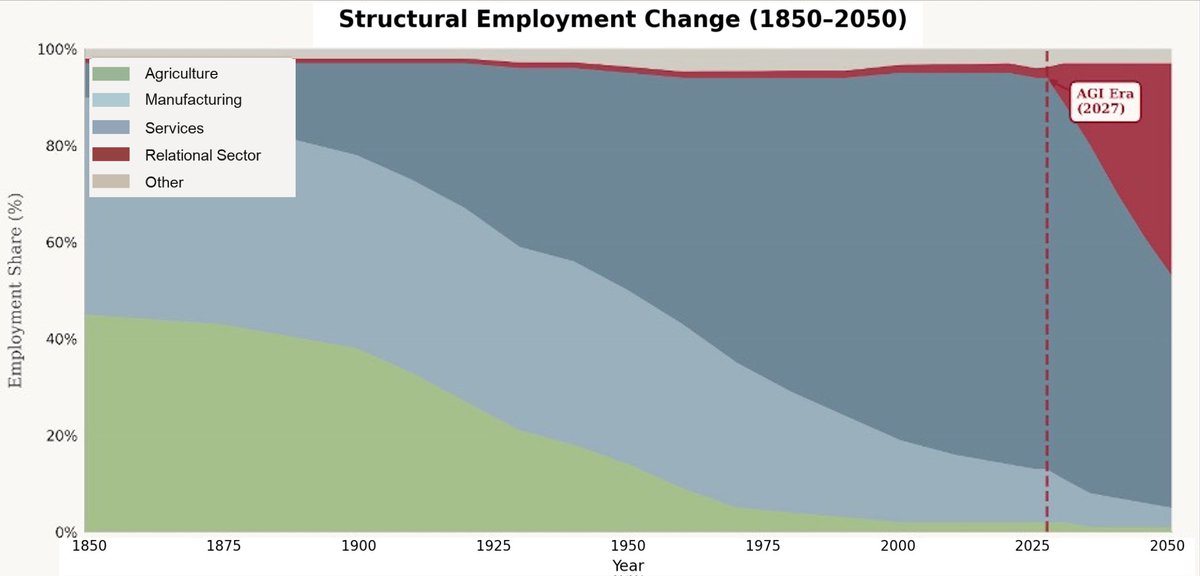
New essay on the economics of structural change and the post-commodity future of work. 1. Almost any question about the impact of advanced AI on the economy needs to start at the same place: what is still scarce? Answer that, and the analysis becomes pretty straightforward. This essay explores what becomes scarce if AI really can replicate most of what humans do in production, and what this mean for the future of jobs. 2. My conjecture, working through the economics: labor reallocates across sectors, and the sector it reallocates to has properties that keep labor a meaningful share of the economy. Ultimately this is about the structure of demand itself. For this, we have to go back to Girard, Augustine and Rousseau: once people's base needs are met, their preferences shift to comparative motives (e.g., status, exclusivity, social desirability). This motive is inherently non-satiated. 4. The key paper is Comin, Lashkari, and Mestieri (Econometrica 2021). As people get richer, they don't buy proportionally more of everything. They shift spending toward sectors with higher income elasticity. They estimate income effects account for 75%+ of observed structural change. 5. The ironic consequence: the sector that gets automated becomes a smaller share of the economy, not a larger one. Agriculture got massively more productive and its share of employment collapsed. Manufacturing too. The "stagnant" sectors absorb the spending and the jobs. 6. So the question is: which sectors have high income elasticity in a post-AGI world? I argue it's what I call the relational sector. Categories where the human isn't just an input into production, it is part of the value. 7. Why does the relational sector have high income elasticity? Because human desire has a mimetic, relational dimension. We don't just want things for their intrinsic properties. We want what others want, and we want it more when others can't have it. Girard, Rousseau, Augustine, and Hobbes all saw this. 8. In work with Kristóf Madarász, we showed this experimentally: WTP roughly doubles when a random subset of others is excluded from the good. And in new work with Graelin Mandel, AI involvement kills the premium. Human-made art gains 44% from exclusivity; AI-made art only 21%. 9. This all comes together for the core argument. The sector that absorbs spending as AI makes commodity production cheap is one where human provenance is part of the value, and demand for it grows faster than income. Exactly the profile that keeps labor meaningful. 10. To be clear about the claim: I'm NOT saying aggregate labor share must rise. It may fall. The claim is about sectoral composition, i.e., where expenditure and employment go once commodities get cheap, and the fact that the sector that will absorb reallocated labor maps to a substantial component of human preferences and desire. 11. If you're interested in the formal model, a linked companion technical note works out all the economics. Read the essay here: aleximas.substack.com/p/what-will-be…
Alex Imas tweet media
English
113
349
1.8K
549.3K
Ewan Collinge
Ewan Collinge@EwanCollinge·
Demand is infinitely elastic - humans always find new things to want that we didn’t have or couldn’t conceive of previously. As AI commoditises many of the services humans deliver today, there is likely to be an explosion in demand for uniquely human experiences. Hospitality, in-person entertainment and the arts will have a golden era.
Alex Imas@alexolegimas

New essay on the economics of structural change and the post-commodity future of work. 1. Almost any question about the impact of advanced AI on the economy needs to start at the same place: what is still scarce? Answer that, and the analysis becomes pretty straightforward. This essay explores what becomes scarce if AI really can replicate most of what humans do in production, and what this mean for the future of jobs. 2. My conjecture, working through the economics: labor reallocates across sectors, and the sector it reallocates to has properties that keep labor a meaningful share of the economy. Ultimately this is about the structure of demand itself. For this, we have to go back to Girard, Augustine and Rousseau: once people's base needs are met, their preferences shift to comparative motives (e.g., status, exclusivity, social desirability). This motive is inherently non-satiated. 4. The key paper is Comin, Lashkari, and Mestieri (Econometrica 2021). As people get richer, they don't buy proportionally more of everything. They shift spending toward sectors with higher income elasticity. They estimate income effects account for 75%+ of observed structural change. 5. The ironic consequence: the sector that gets automated becomes a smaller share of the economy, not a larger one. Agriculture got massively more productive and its share of employment collapsed. Manufacturing too. The "stagnant" sectors absorb the spending and the jobs. 6. So the question is: which sectors have high income elasticity in a post-AGI world? I argue it's what I call the relational sector. Categories where the human isn't just an input into production, it is part of the value. 7. Why does the relational sector have high income elasticity? Because human desire has a mimetic, relational dimension. We don't just want things for their intrinsic properties. We want what others want, and we want it more when others can't have it. Girard, Rousseau, Augustine, and Hobbes all saw this. 8. In work with Kristóf Madarász, we showed this experimentally: WTP roughly doubles when a random subset of others is excluded from the good. And in new work with Graelin Mandel, AI involvement kills the premium. Human-made art gains 44% from exclusivity; AI-made art only 21%. 9. This all comes together for the core argument. The sector that absorbs spending as AI makes commodity production cheap is one where human provenance is part of the value, and demand for it grows faster than income. Exactly the profile that keeps labor meaningful. 10. To be clear about the claim: I'm NOT saying aggregate labor share must rise. It may fall. The claim is about sectoral composition, i.e., where expenditure and employment go once commodities get cheap, and the fact that the sector that will absorb reallocated labor maps to a substantial component of human preferences and desire. 11. If you're interested in the formal model, a linked companion technical note works out all the economics. Read the essay here: aleximas.substack.com/p/what-will-be…

English
0
0
1
146
Ewan Collinge
Ewan Collinge@EwanCollinge·
Claude Cowork on desktop is probably the best product I've ever used, but I know I won't be using it in twelve or even three months time. Every single one of its capabilities is replicable by the open source community using open weight models. These models are ~95% cheaper than Cowork running Opus which is hard to ignore. Therefore the more I use Cowork, the more incentive I have to switch to something running on cheaper models. This is upside down world - the more get value from this tool, the more reason I have to stop using it. I don't see how Anthropic can solve this long-term. I also have near zero lock in aside from my chat history and project knowledge. These are just text snippets and can be ported to another tool pretty easily. There will soon be a credible open version of Cowork and Anthropic will have a problem, despite their amazing work with this product!
English
1
0
1
40
Ewan Collinge
Ewan Collinge@EwanCollinge·
To truly unlock agents you need to get whatever your company does into something that looks like a codebase. “coding w ai is solved bc all context is in the git repo. knowledge work is difficult bc context is spread out. an ai system that creates a git repo w all context for a knowledge worker will be able to 100% automate the work.”
Alex Lieberman@businessbarista

Someone is going to build a worldclass “Brain” for enterprises & make a stupid amount of money. Why? As @da_fant said, “coding w ai is solved bc all context is in the git repo. knowledge work is difficult bc context is spread out. an ai system that creates a git repo w all context for a knowledge worker will be able to 100% automate the work.” When companies talk about being data ready for AI, this is what they’re implicitly saying. Engineering has been prepared for this moment for a long time because of the deterministic nature of code, the centralization/versioning of data (read: GitHub), and AI tools that are largely build by engineers for engineers. But for the rest of white collar work, there’s a TON of catching up to do to properly harness the power of the technology. The big challenge here, and why no one has truly cracked the code for "an ai system that creates a git repo w all context for a knowledge worker" is because unlike code, most knowledge is 1) distributed, 2) unstructured, and 3) unverifiable. It's distributed: transcripts live in Granola. Documents in Notion. Customer Data in Hubspot. ERP. Emails. Slack messages. Random spreadsheets. SOP docs. Etc. Etc. Building an ingestion engine that connects to all of your disparate data sources and auto-updates based on the shelf-life of the data is the first, and frankly, easiest step of the process. Next, it's unstructured: let's say I want to create a proposal for a potential client. To nail the proposal, I want it to pull important information from a variety of sources. The specific asks & background from our initial sales call. Previous proposals to anchor ourselves to a proven format. And completed sprint boards from Linear, so the pricing & timeline in the document is grounded in truth. Whether it's a thoughtful filesystem (a la Obsidian) or an OpenClaw-esque memory structure, the brain needs to be great at self-organizing in a thoughtful schema. This is very hard, especially if you want to build a generalizable brain that can be shaped to an array of different enterprises. And finally, most knowledge is unverifiable: writing a function, running a unit test, and seeing if the code works is easy. It works or it doesn't. Using AI to accelerate your content creation process is highly subjective. What is a good/bad idea? Is the content in your voice or not? Does it feel like slop or novel? Answering these questions are both difficult and non-verifiable. That same system described above doesn't just have to be great at organizing & forming coherent relationships, but it also has to be great at self-improving based on feedback from the user. Memory systems (like those introduced by OpenClaw) are great to a point, but as you scale the corpus of data within your company's brain, things like compaction and cleaning become wildly important to avoid the needle in the haystack problem. Someone is going to figure out how to solve this problem, and when they do, not only will they make a shit ton of money, but they'll be robinhood for knowledge workers, enabling non-engineers to enjoy the sort of leverage that only technical folks have felt for the last few years.

English
0
0
0
31
Ewan Collinge
Ewan Collinge@EwanCollinge·
AI adoption in actual businesses is still extremely low despite the hype. Token demand is going to hockey-stick when token-hungry agents are deployed in the real world.
English
0
0
0
22
Ewan Collinge
Ewan Collinge@EwanCollinge·
This is a positive step towards the UK participating in the AI-Industrial Revolution via public funding. But for comparison the Chinese gov has invested ~$184B and the US gov ~€7B (plus ~$109B via VC). We have to make the UK the best place after the US to build AI companies and massively increase private capital availability. That is achieved by improving the business/regulatory environment for AI startups, in addition to publicly funded investment.
Sovereign AI@UKSovereignAI

Introducing Sovereign AI, the Government’s new £500m venture fund. Sovereign AI will support founders from day one to start here, scale here and win everywhere. sovereignai.gov.uk

English
0
0
0
39
Ewan Collinge
Ewan Collinge@EwanCollinge·
The most important question in AI is which infrastructure layer captures margin when all models are "smart enough". That convergence is here for many use cases with the models we have already.
English
0
0
1
23
Ewan Collinge
Ewan Collinge@EwanCollinge·
@sytaylor The "banks will never allow agents to have bank accounts" narrative seems to be crumbling!
English
1
0
0
135
Simon Taylor
Simon Taylor@sytaylor·
Amex just enabled agents to pay on their network. Thy launched the Agentic Commerce Experiences (ACE) developer kit. And this is SUPER different to the other payments networks in a lot of ways. Why?
English
21
30
249
58.3K
Ewan Collinge
Ewan Collinge@EwanCollinge·
Training a frontier model is a sporadic one-time CAPEX event. Inference is the ongoing operational cost that scales linearly with adoption. All the recurring revenue in AI is on the inference side.
English
0
0
0
20
Ewan Collinge
Ewan Collinge@EwanCollinge·
@aakashgupta This is also true for vibe-built agents. The first platform to solve creating agents with good payment infrastructure (agent-to-agent + agent-to-human transactions) baked in will do very well.
English
1
0
1
175
Aakash Gupta
Aakash Gupta@aakashgupta·
Lovable is valued at $6.6B and just made it possible to launch a paid product in one conversation. That sounds like a feature announcement. It's actually a platform strategy. Every vibe coding tool can generate a landing page. Replit, Bolt, Cursor, V0. The output looks roughly the same. Switching costs between them are near zero. You can copy-paste your code and leave tomorrow. The moment payments start flowing through your app, that changes. Now your revenue depends on the platform. Your checkout flow, subscription logic, VAT handling across 200+ countries, refund management. All of it is coupled to infrastructure you didn't build and can't easily replicate. Shopify figured this out fifteen years ago. The store builder was the acquisition tool. Shopify Payments was the retention tool. Once merchants process transactions through your platform, churn collapses. The switching cost goes from "export my code" to "rebuild my entire payment stack while customers are actively being charged." Lovable is running the same playbook at $200M ARR. They're integrating Paddle, Stripe, and Shopify directly inside the builder, then recommending which provider fits what you're selling. Credits are the current revenue model. Payments flowing through the platform opens a second revenue layer: transaction fees, premium payment features, financial products for creators. Stripe built a $95B business on being the payments layer for developers. Lovable is positioning to be the payments layer for people who can't code. The vibe coding wars looked like a feature race. They're actually a distribution race to see who locks in revenue infrastructure first.
English
22
13
124
16.6K
Ewan Collinge
Ewan Collinge@EwanCollinge·
“Using a computer has always been about contorting yourself to the machine.” A perfect way to express something I’ve been trying to explain to people outside the AI bubble for a while. Computers rely on abstractions we can understand - buttons, forms, folders, scripts, apps - but these are in fact distortions of how we naturally think and approach tasks. AI collapses the gap between what we’re actually trying to achieve and how we make it reality. It frees us from having to fit ourselves to the tool, rather than the other way round. So much of today’s computer-based work will come to be seen as the cognitive equivalent of working in a matchstick factory in the 1700s. Outside of AI world this penny has barely dropped. It will take a lot of individual and institutional unlearning for people used to spending 95% of their time on emails and meetings to adjust their perception of what work means.
Greg Brockman@gdb

The world is transitioning to a compute-powered economy. The field of software engineering is currently undergoing a renaissance, with AI having dramatically sped up software engineering even over just the past six months. AI is now on track to bring this same transformation to every other kind of work that people do with a computer. Using a computer has always been about contorting yourself to the machine. You take a goal and break it down into smaller goals. You translate intent into instructions. We are moving into a world where you no longer have to micromanage the computer. More and more, it adapts to what you want. Rather doing work with a computer, the computer does work for you. The rate, scale, and sophistication of problem solving it will do for you will be bound by the amount of compute you have access to. Friction is starting to disappear. You can try ideas faster. You can build things you would not have attempted before. Small teams can do what used to require much larger ones, and larger ones may be capable of unprecedented feats. More and more, people can turn intent into software, spreadsheets, presentations, workflows, science, and companies. People are spending less energy managing the tool and more energy focusing on what they are actually trying to create. That shift brings a kind of joy back into work that many people haven’t felt in a long time. Everyone can just build things with these tools. This is disruptive. Institutions will change, and the paths and jobs that people assumed were stable may not hold. We don’t know exactly how it will play out and we need to take mitigating downsides very seriously, as well as figuring out how to support each other as a society and world through this time. But there is something very freeing about this moment. For the first time, far more people can become who they want to become, with fewer barriers between an idea and a reality. OpenAI’s mission implies making sure that, as the tools do more, humans are the ones who set their intent and that the benefits are broadly distributed, rather than empowering just one or a small set of people. We're already seeing this in practice with ChatGPT and Codex. Nearly a billion people are using these systems every week in their personal and work lives. Token usage is growing quickly on many use-cases, as the surface of ways people are getting value from these models keeps expanding. Ten years ago, when we started OpenAI, we thought this moment might be possible. It’s happening on the earlier side, and happening in a much more interesting and empowering way for everyone than we’d anticipated (for example, we are seeing an emerging wave of entrepreneurship that we hadn’t previously been anticipating). And at the same time, we are still so early, and there is so much for everyone to define about how these systems get deployed and used in the world. The next phase will be defined by systems that can do more — reason better, use tools better, plan over longer horizons, and take more useful actions on your behalf. And there are horizons beyond, as AI starts to accelerate science and technology development, which have the potential to truly lift up quality of life for everyone. All of this is starting to happen, in small ways and large, today, and everyone can participate. I feel this shift in my own work every day, and see a roadmap to much more useful and beneficial systems. These systems can truly benefit all of humanity.


English
0
0
0
36