Jonathan Guyer@mideastXmidwest
How does Tony Blinken reconcile his Gaza legacy?
Speaking at the Harvard Kennedy School, former Secretary of State Antony Blinken was asked yesterday about how he sees Gaza — and whether the Biden administration should have cut off arms to Israel.
The moderator, New York Times journalist David Sanger, described Gaza as probably the "weakest" part of the diplomat's legacy.
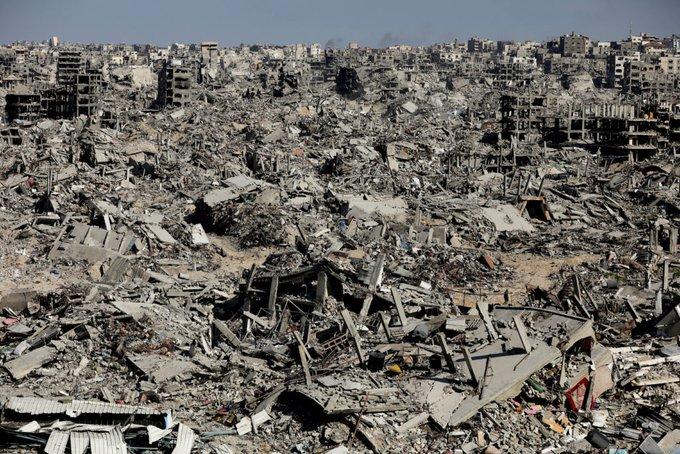
"Of course, for me, coulda woulda shoulda, is something that will always be there when it comes to Gaza," Mr. Blinken said. "Given the level of human suffering, given the horrific loss of of life among Palestinian women, men, children — you can't help but ask yourself on a regular basis, could we should we have done something different?"
A Harvard student pushed further during the Q&A. He asked the former secretary of state more specifically about the 2024 USAID conclusion that Israel had blocked aid to Palestinians despite Mr. Blinken telling Congress the opposite, overriding experts to continue sending weapons to Israel.
"You had opportunities to distance yourself and your administration from arming Israel, which committed what leading Holocaust scholars and human rights agencies call a genocide," the student said. "You rejected them and continued arming Israel. This is your legacy. How do you justify to the countless Palestinians, including thousands of children, that died from your decisions?"
The student then read the names of several young children were killed in Gaza. "How do you reconcile with this and how do you reconcile with your legacy?"
"This is something that I grappled with and will continue to grapple with for as long as I can see into the future," Mr. Blinken said.
"Could we, should we have done things differently such that the suffering that people endured, the loss of the children you just listed and so many others could have been averted. The short answer is: Maybe yes.
"We had to make judgments. We had to make judgments in real time about how to try to get to a better place. We made those judgments. People will make their own judgments about what we did and what we didn't do.
"But let me just add a few things... and my great friend Samantha [Power] is here and we had this, you know, ongoing discussions in our own administration on the question of the assistance that was getting or not getting to Palestinians in Gaza throughout 2024. I was on this every single day, literally every single day. And we had a series of reports come out suggesting that there was an imminent famine that was about to happen. And then the next report would say actually fewer people are in danger even though people were leading terribly hard and difficult lives.
"That didn't just happen. It happened because every single day we were on the Israelis to try to get assistance in, to open more crossing points, to flood the zone. They did that profoundly inadequately. They did that in ways that were not the way I would like to have seen it done, but we got some of that done.
"When the report that you referred to came out and this was the product of the so-called NSM, the national security memorandum. If you look at that report, it lays out a lot of the actions that Israel were taking that were of more than deep concern to us. And I think that report actually served a very useful function in motivating the Israelis to do better. Not to do as much as they should have and as we would have wanted, but to do better. And at various points the aid went up, the number of trucks going in went up. The distribution even with the trucks going in was a huge problem. Looting, criminality, etc., all difficult problems that are really hard to control for.
"But yes, of course, you couldn't be and I wouldn't be human if I didn't ask myself every day, could we have done things differently.
"The one thing I want to suggest to you as well… I believe and look maybe I'm wrong that the nature of the the trauma in Israel, which is, there's no hierarchy of trauma, the trauma in Israel, the trauma among Palestinians, the same. The loss of a Palestinian life, the loss of Israeli life, the same. But on the Israeli side, the trauma was such that I believe the determination across that society to take the actions that they took in Gaza was such that irrespective of what we did, they would have continued to do what they did. And cutting off arms, sure, that was an option. But I don't actually believe that at least in the near term, it would have changed things.
"And I also believe it would have led to an even wider war as Israel's enemies, and they were multiple, jumped in and that only would have extended the war in Gaza, not ended the war in Gaza.
"We thought that the best way to get to an end, to protect people, to help people, was to get to a ceasefire, with hostages coming out and with aid going in. And you know I fully—more than respect—I empathize with people who felt this so, so deeply. I do remain with a question in my mind about why barely a word was spoken in all those months about Hamas, which was an actor too and is responsible for so much of what happened.
"But yes, we all look at it, I certainly look at it, and say maybe we could have done differently. Maybe we could have done better by the people. I wish we could have."