John W. Farrell

22.8K posts

John W. Farrell banner
John W. Farrell

John W. Farrell

@JohnWFarrell

Author @BasicBooks, @Prometheusbks, @SHB_books, Contributor @commonwealmag @WSJ @aeonmag @NautilusMag @USCatholic @ChristianCent

Boston Sumali Şubat 2009
4.6K Sinusundan5.1K Mga Tagasunod
John W. Farrell nag-retweet
The New Yorker
The New Yorker@NewYorker·
New scholarship reconsiders the apostle St. Paul, who turned a Jewish sect into a world religion—and whose legacy remains contested two millennia later. newyorker.com/magazine/2026/…
English
3
23
112
21.8K
John W. Farrell nag-retweet
Garry Kasparov
Garry Kasparov@Kasparov63·
Péter Magyar’s Lesson for America: The Center Can Hold. My latest Next Move on Hungary's overwhelming winner over Kremlin lackey Orbán--and on the importance of seeing populism as not inevitable or eternal. Real conservatives can win without the ultra-nationalism. Link below.
English
26
217
1.3K
38.2K
John W. Farrell nag-retweet
Daily Mail
Daily Mail@DailyMail·
Putin's 'poison empire' revealed, with thousands of scientists linked to secret laboratories accused of testing toxins on humans trib.al/TGzXya0
English
33
409
609
26.6K
John W. Farrell nag-retweet
Ethan Siegel
Ethan Siegel@StartsWithABang·
Everything in the Universe changes by adding enough mass What sets the dividing line between rocky planets, gas giants, brown dwarfs, and stars of different colors and lifetimes? One parameter alone, mass, explains almost all of it. bigthink.com/starts-with-a-…
English
1
3
19
549
John W. Farrell
John W. Farrell@JohnWFarrell·
"On April 12, the day of Hungary’s parliamentary elections, the Conservative Political Action Conference (CPAC) posted on social media that it was closely watching the election and stood firmly behind Prime Minister Viktor Orbán." Richardson for 4.13.26 open.substack.com/pub/heathercox…
English
0
0
0
7
John W. Farrell nag-retweet
Dustin
Dustin@r0ck3t23·
Mo Gawdat spent years inside the machine at Google X. Now he is saying out loud what the economists will not. Gawdat: “The very base of capitalism, which is labor arbitrage, to hire you for a dollar and then sell what you make for two, is going to disappear.” That is not a prediction. That is a coroner’s report on a system that has not stopped breathing yet. Capitalism was never about innovation. It was about one equation. Buy human time cheap. Sell the output high. Pocket the spread. Every empire. Every fortune. Every supply chain on Earth was built on that margin. AI just closed it to zero. A humanoid robot now costs $9,000. It does not sleep. It does not negotiate. It does not quit. It runs every hour of every day at a quality ceiling no biological worker will ever touch. When production costs fall to nearly nothing, the entire pricing structure of the global economy falls with it. But here is what every CEO celebrating margin expansion has not thought through for five minutes. Gawdat: “Even if you can have all of the productivity gains in the world, by firing people consistently, nobody’s able to buy what you’re making.” That single sentence should end every strategy meeting on the planet. Capitalism is a closed loop. You pay workers. Workers become consumers. Consumers buy products. Revenue funds the next payroll. Cut the worker and you do not just eliminate a cost. You eliminate the customer. Every company racing to automate headcount out of existence is quietly engineering the death of its own demand. They are building the most efficient production systems in human history to sell to a population that no longer has income. 50% unemployment is not a recession. It is the demand side of the economy going permanently dark. You cannot push infinite supply into zero purchasing power. The math does not care about your earnings call. Gawdat: “Wealth is going to have very little meaning for most of us in a few years’ time.” This is where it turns on the people who think they are winning. If production approaches zero cost, scarcity begins to dissolve. And scarcity is the only reason money holds value in the first place. The billionaire class is stockpiling a currency that is quietly losing its reason to exist. Gawdat: “So the entire capitalist model has to be rethought.” He is right. And nobody in power is doing the rethinking. Every board meeting about efficiency is a conversation about dismantling the very economic engine that made the board meeting possible. The question was never whether AI could produce enough. It was whether capitalism could survive its own success. The machine does not just replace the worker. It erases the consumer. And a system that can produce everything but sell nothing is not an economy. It is a machine that perfected itself into extinction.
English
276
716
1.5K
86.7K
John W. Farrell nag-retweet
Mike Young
Mike Young@micyoung75·
Applebaum's line is the one to hold: "If Orbán can lose, then his Russian and American admirers can lose too." The model was supposed to be unbeatable. Capture the courts first. Then the media. Rewrite the electoral rules so challengers need a landslide just to break even. Build the international network of illiberal funders and validators. Make corruption invisible by making it structural. Magyar beat it anyway... and the tapes that broke late in the campaign showed why it was vulnerable. Orbán spent 16 years railing about foreign interference - Soros, Brussels, migrants - while privately telling Putin he was the mouse to his lion. The sovereignty rhetoric was a performance. The dependency was real. The crowd at Heroes' Square Friday night chanted "Russians, go home." Same words as 1956. Seventy years later, same answer. The EU's blocked €90 billion Ukraine loan now has a path. Putin loses his primary EU veto. The MAGA movement loses its proof of concept. History does not bend. It gets pushed.
Mike Young tweet media
Anne Applebaum@anneapplebaum

They thought history was somehow bending in their direction. But that's not how history works. On Orban, and the illiberal leaders from around the world who flocked to support him: theatlantic.com/ideas/2026/04/…

English
29
1.2K
3K
57.2K
John W. Farrell nag-retweet
chiky handler
chiky handler@chiky_handlr·
This was in 1999 She was a fucking Escort working for Epstein and Donald Trump was married to his 2nd wife Marla Retweet so that the truth spreads
English
849
13.9K
28.6K
1.1M
John W. Farrell nag-retweet
Kate from Kharkiv
Kate from Kharkiv@BohuslavskaKate·
APPLEBAUM: What JD Vance said is affront and outrage because war in Ukraine is not about 'few kilometers'. The war is about whether Ukraine gets to exist as a nation. And Russia never said they want ceasefire. Russia has never given up their main war aim, which remains the conquest or control of all of Ukraine. They've never conceded that Zelenskyy is the legitimate leader of Ukraine. None of this has ever happened.
English
65
2.5K
9K
125.4K
John W. Farrell nag-retweet
cginisty
cginisty@cginisty·
🔴 Pendant que Trump annonce son blocus, la Chine coupe discrètement le robinet de l'acide sulfurique. Personne n'en parle mais c'est pourtant l'une des décisions les plus lourdes de conséquences de cette crise. Commençons par les bases, parce que ce sujet est peu connu mais d'une importance capitale. L'acide sulfurique est l'un des produits chimiques industriels les plus utilisés dans le monde. Sans lui : - Pas d'engrais phosphatés, donc moins de nourriture. - Pas d'extraction de cuivre, donc moins de câbles électriques, d'infrastructures, de transition énergétique. - Pas de batteries, donc moins de véhicules électriques. - Pas de raffinage pétrolier. - Pas de textiles. C'est une molécule invisible qui se trouve au cœur de presque tout ce que la civilisation industrielle produit. Le 10 avril 2026, la Chine a annoncé qu'elle suspendrait ses exportations d'acide sulfurique à partir de mai, frappant les industries des métaux et des engrais déjà éprouvées par les perturbations de la guerre en Iran. Ce timing n'est pas anodin. Il coïncide avec l'annonce du blocus américain d'Ormuz. Pour comprendre l'ampleur du choc, il faut mesurer ce qui se passe simultanément sur trois fronts. - Premier front : la fermeture du Détroit d'Ormuz bloque les exportations de soufre du Moyen-Orient, région qui produit un tiers du soufre mondial, matière première de l'acide sulfurique. - Deuxième front : la Chine ferme ses exportations d'acide sulfurique fini, privant le marché mondial de ses deux principales sources d'approvisionnement en même temps. Résultat : les prix du soufre ont déjà bondi de 70% depuis le début du conflit. Les prix de l'acide sulfurique au Chili ont augmenté de 44% en un seul mois. - Troisième front, les conséquences en cascade : le Chili, premier producteur de cuivre mondial, importe plus d'un million de tonnes d'acide sulfurique chinois par an. Environ 20% de sa production de cuivre dépend de procédés nécessitant cet acide. La République Démocratique du Congo, la Zambie et l'Indonésie pour le nickel sont également directement touchées. Moins de cuivre, c'est moins d'infrastructures électriques mondiales. Moins d'engrais, c'est une pression supplémentaire sur la sécurité alimentaire mondiale dans un contexte où les marchés agricoles sont déjà sous tension. Un analyste de CRU résume : "La perte des volumes chinois sera difficile à compenser, étant donné la pénurie parallèle de matières premières en soufre." Voici finalement ce que cette séquence révèle sur la stratégie chinoise. Pékin n'a pas besoin de déclarer la guerre. Il lui suffit de fermer un robinet. C'est exactement la doctrine de la guerre économique asymétrique que la Chine pratique méthodiquement depuis quinze ans : utiliser sa position dominante dans les chaînes d'approvisionnement mondiales comme levier de pression sans confrontation militaire directe. Chaque fois, la méthode est la même : identifier le point de dépendance invisible, attendre le moment de tension maximale, puis fermer le robinet. Tout simplement. Trump, lui, annonce un blocus maritime spectaculaire en majuscules sur Truth Social. La Chine répond par une décision bureaucratique discrète transmise à ses producteurs par voie interne. L'un joue au théâtre. L'autre joue aux échecs. Dans Le Pantin de la Maison Blanche, j'analyse comment cette administration répond aux crises avec des instruments du XXe siècle face à des adversaires qui ont construit des armes du XXIe. Un blocus naval est une arme de 1962. La maîtrise des chaînes d'approvisionnement mondiales est une arme de 2026. Et pendant que Trump tweete "BLOWN TO HELL" (Explosé en Enfer), Pékin coupe tranquillement la molécule dont dépend la production alimentaire mondiale. La guerre dont personne ne parle est souvent la plus efficace. 📖 Le Pantin de la Maison Blanche → amazon.fr/dp/B0GPCCMS68/
cginisty tweet media
Français
122
2.7K
4.6K
179.4K
John W. Farrell nag-retweet
Edward Feser
Edward Feser@FeserEdward·
A worrying 🧵 Just war doctrine requires that a proposed military action not be likely to make things worse. The domino effect described here is among the things that a serious application of the doctrine would take into consideration before plunging into war. As always, the hotheads who dismiss just war conditions as unrealistic are the ones with no grip on reality.
Robert A. Pape@ProfessorPape

Within 10 days, parts of the global economy will start running short of critical goods After 30 years studying economic sanctions and blockades, I don’t say this lightly: --Not just higher prices --Shortages. Markets are not ready for this


English
12
28
203
13.2K
John W. Farrell nag-retweet
Gandalv
Gandalv@Microinteracti1·
There is a video circulating on the internet that is difficult to watch. A woman sits on a pavement in Louisville, Kentucky. She is wearing a hospital gown. It is 36 degrees outside. Her belongings, everything she apparently owns, are in a plastic bag on the concrete beside her. Behind her, through the glass doors she has just been escorted through, the hospital hums along as normal. The security guards who brought her here have already gone back inside. She couldn’t afford her bill. This is not a scene from a developing nation or a history book. This is the United States of America. The country in which it happens has spent decades telling the rest of the world that it has the highest GDP on earth. Which is a bit like a restaurant proudly displaying its bill on the wall. Enormous number. Terrible meal. The lobster was frozen, the wine came from a box. Europe, by comparison, has spent the better part of a century building something rather different. The food, for a start, is extraordinary. Not in a showy way, but in the way that a simple lunch in Lyon or a glass of wine on a terrace in Lisbon reminds you that eating is one of the genuinely good things about being alive. The wine is the wine that the rest of the world has spent generations attempting to replicate, mostly without success. Roughly 35 percent of Europeans live with a chronic illness. In America, that number is 76 percent. The difference is not genetic. It is architectural. It is the slow accumulation of decent food, walkable cities, actual holidays, and a healthcare system that does not require you to crowdfund your own appendix. Europeans work fewer hours. They have more purchasing power on a smaller salary once you subtract the cost of health insurance, medical debt, and the private school their child needs because the local public one has a metal detector at the entrance. They live, on average, about ten years longer. Not ten years of decline and doctor visits, but ten years of being a person in the world. In the first quarter of 2025, the number of Americans leaving the United States doubled compared to the previous quarter.  Europe was their top destination. Not for a sabbatical or a gap year. Permanently. These are not people who failed. These are people who did the maths. There is a man somewhere in America right now who has worked fifty-hour weeks for forty years, taken one week off when his employer permitted it, and will, statistically, be dead before he sees seventy. And there is another man, not very far away on a map but an entire civilisation removed in practice, sitting on a terrace in the afternoon sun with a glass of something cold and no particular place to be. He has had six weeks off every summer since 1987. He knows his neighbours by name. The first man’s country has the higher GDP. The first man’s country tops the Gross Domestic Product (GDP) index. The second man tops the Quality of Life Index (QLI). The better health. The longer life. The afternoon. MAGA America calls that losing. Ask anyone. Gandalv / @Microinteracti1
English
619
5.1K
11.3K
762.3K
John W. Farrell nag-retweet
David French
David French@DavidAFrench·
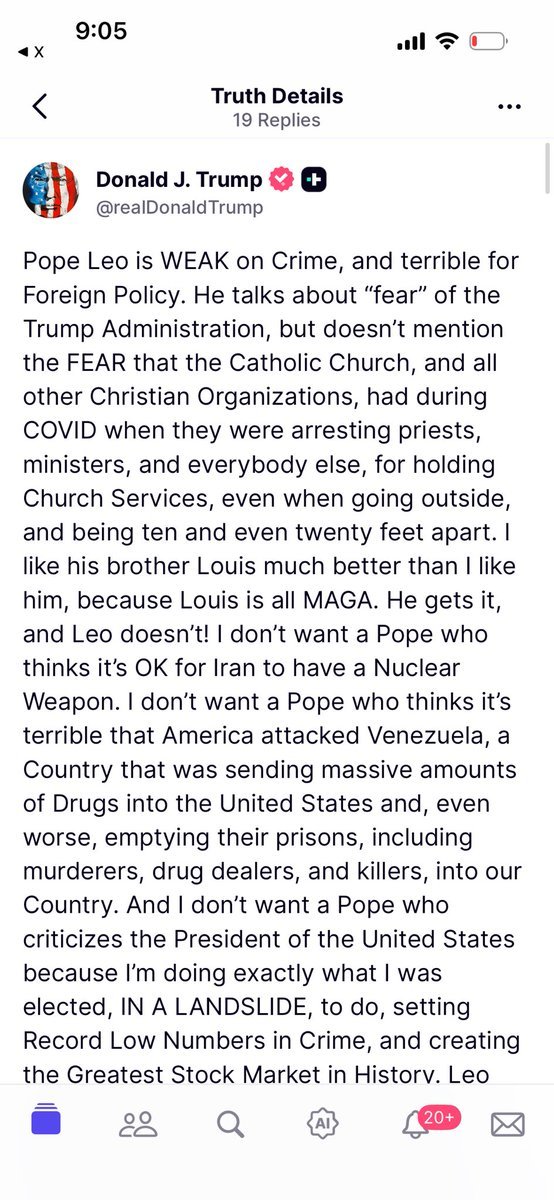
There is behavior that's so self-evidently deranged that merely seeing it should lead to fury and disgust. I'm concerned, however, that some evangelicals are so influenced by Trump that they won't unite with their Catholic brothers and sisters in response to Trump's blasphemy and intolerable attacks on the pope, but will instead turn against them.
David French tweet mediaDavid French tweet mediaDavid French tweet media
English
327
1.3K
6.4K
248.5K
John W. Farrell nag-retweet
Anne Applebaum
Anne Applebaum@anneapplebaum·
They thought history was somehow bending in their direction. But that's not how history works. On Orban, and the illiberal leaders from around the world who flocked to support him: theatlantic.com/ideas/2026/04/…
English
51
952
2.5K
108.9K