
Primary Vision

6.5K posts

Primary Vision banner
Primary Vision

Primary Vision

@PrimaryVision

Data-driven insights & expert commentary on the oil & gas industry. U.S. Frac Spread Count, Frac Job Count, EFRACS Analytics console and more!

Serving The Globe Sumali Haziran 2013
1.2K Sinusundan2.9K Mga Tagasunod
Primary Vision
Primary Vision@PrimaryVision·
If you want to understand where U.S. oilfield activity is heading, start with Frac Spread Count. It tracks active pressure pumping spreads weekly, which makes it one of the most useful indicators for reading completion intensity, market turning points, and near term production direction. This week's Frac Spread Count is now live on EFRACS. If you haven’t subscribed yet, now’s the moment. Access the exclusive oil data. efracs.primaryvision.co/landing/ #primaryvision #oildata #efracs

Primary Vision tweet media
English
0
0
0
57
Primary Vision
Primary Vision@PrimaryVision·
The headline oil price only tells part of the story. The spread between crude grades tells you where the real pressure is building. Brent may be the global reference point, but Murban, Mars Blend, Louisiana Light, and the OPEC Basket are each pricing in something different, quality, logistics, refinery preference, and geopolitical risk. In our latest Free Read, we unpack why today’s market is not seeing a uniform oil shock, but a highly uneven repricing across grades and routes. If you want to understand what the market is actually saying, start with the gaps. Read the full article. efracs.primaryvision.co/landing/ #efracs #Primaryvision #fracspreadcount
Primary Vision tweet media
English
0
0
0
120
Primary Vision
Primary Vision@PrimaryVision·
China's trade data came in at nearly triple the forecast. Most coverage filed it under "strong number" and moved on. Export growth at 21.8%. Imports up 19.8%. A record $213.6 billion surplus. The front-loading narrative — companies moving goods ahead of shifting tariff conditions — was the explanation most reached for first. It's not wrong. But it's incomplete. Front-loading ahead of a U.S. trade meeting doesn't explain simultaneous acceleration across every major non-U.S. destination at once. That pattern points to something structural, not just tactical. And structural shifts in where Chinese goods are flowing have consequences that extend well beyond the trade desk. What that means for global demand, commodity flows, and the energy market read — that's what we unpack for our readers. Access the full report. efracs.primaryvision.co/landing #China #TradeData #GlobalMacro
Primary Vision tweet media
English
0
0
0
153
Primary Vision
Primary Vision@PrimaryVision·
Most people track frac demand. Far fewer understand frac supply — and right now, that's the more important side of the equation. This week's Monday Macro View breaks down U.S. frac supply — who holds the horsepower, how the market has restructured, and what that means for the activity outlook heading into the back half of 2026 Access the full report. efracs.primaryvision.co/landing/ #mmv #primaryvision #efracs #oilmarkets
Primary Vision tweet media
English
0
0
0
108
Primary Vision
Primary Vision@PrimaryVision·
Primary Vision was featured in The News International this month, with our analyst Osama Rizvi addressing a key question at the SDPI webinar on rising energy costs and the future of sustainable industry in Pakistan. The diagnosis is straightforward, even if the fix isn't. Most of Pakistan's refineries still run on outdated hydro-skimming technology — designed for an era that has passed. The output? Furnace oil. The demand? High-speed diesel. That mismatch means 40–45% of refined products still have to be imported, at whatever price the global market is charging that week. When your refining configuration doesn't match your demand profile, you don't just have an efficiency problem. You have a permanent vulnerability — one that gets more expensive every time global oil prices move. The conversation about shifting toward electricity and renewables is real and necessary. But it sits on top of a foundation that hasn't been fixed yet. You can't transition away from something you're still structurally dependent on importing. This is the kind of ground-level energy analysis that doesn't make it into the headline numbers — but shapes every policy decision that follows. Primary Vision covers energy markets where the data actually lives — from U.S. frac activity to industrial energy policy. The full picture is on EFRACS. Read the full report. efracs.primaryvision.co/landing/ #pressrelease #primaryvision #efracs #Oildata
Primary Vision tweet media
English
0
0
0
169
Primary Vision
Primary Vision@PrimaryVision·
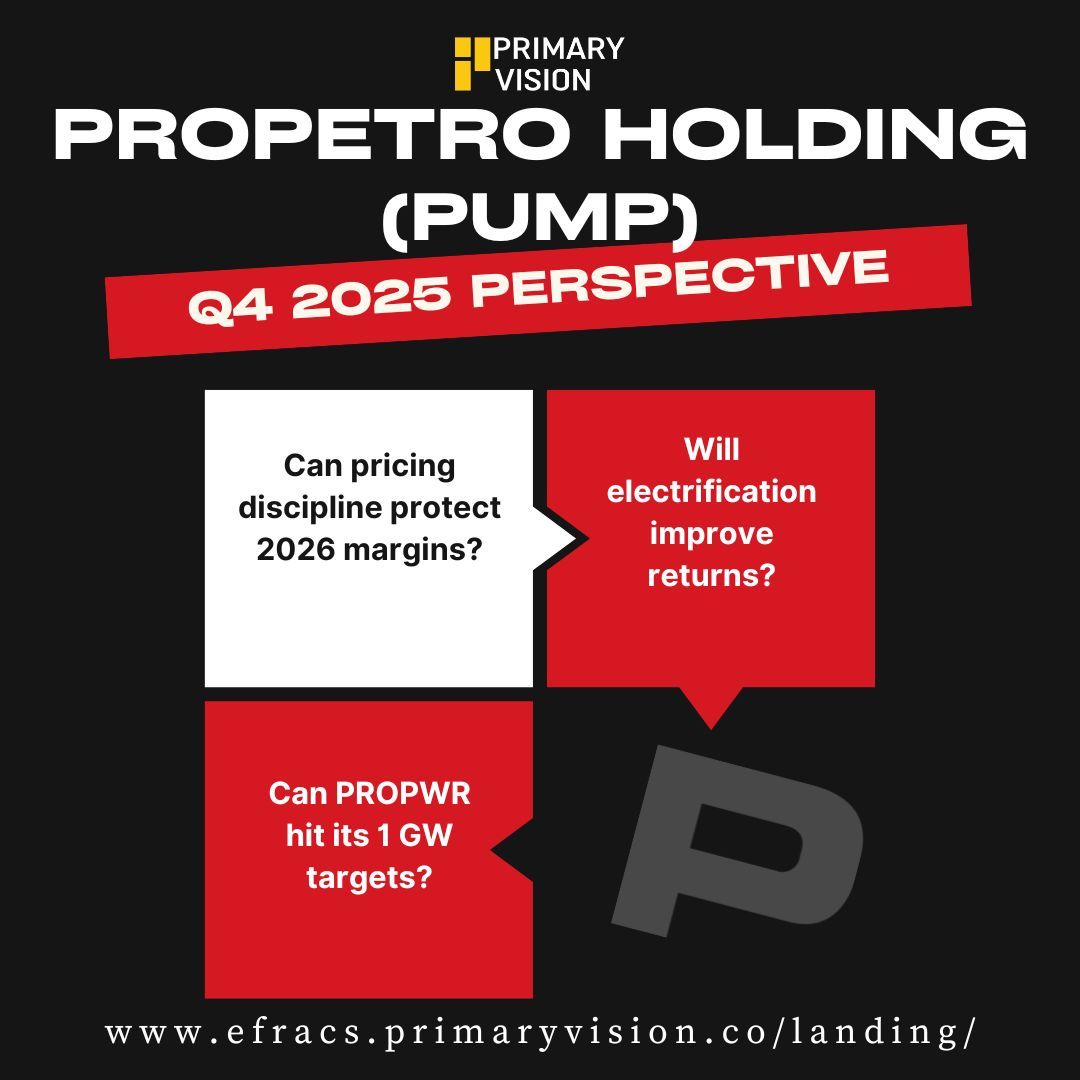
ProPetro closed out 2025 with three questions that will define everything that comes next. None of them have easy answers. The first is about pricing discipline. The completion market is softer, customers are pushing back, and the temptation to chase utilization at the cost of margins is real. Can ProPetro hold the line on pricing when the alternative is idle equipment? The second is about electrification. PROPWR — ProPetro's electric frac technology — is the strategic bet the company is making on where the industry is heading. The economics of electric fleets are genuinely better on paper. But better on paper and better in the field, at scale, across different basin conditions, are two different things. Will the returns actually show up? The third is the most concrete: the 1 GW deployment target. That's not a vision statement — it's a number. Either the contracts are there to support it or they aren't. Either the customer appetite for electric frac at that scale materializes in 2026 or the timeline slips. Here's what connects all three questions: you can't answer any of them from an earnings transcript alone. Pricing discipline shows up in utilization data before it shows up in reported margins. Fleet deployment trends are visible in completion activity week by week. That's exactly what Primary Vision tracks — basin-level frac spread counts and horsepower utilization data that give you the ground truth before the quarterly numbers confirm it. If you're watching PUMP in 2026, you should be watching our data alongside it. efracs.primaryvision.co/landing/ #pump #primaryvision #efracs #oilmarkets
Primary Vision tweet media
English
0
0
0
135
Primary Vision
Primary Vision@PrimaryVision·
Baker Hughes reported 553 active drilling rigs in the U.S. this week. That's a week-over-week gain. But here's the number that doesn't make the headline: we're still 39 rigs below where we were at this exact point last year. So which story is true — recovery or structural decline? The honest answer is that rig count alone won't tell you. It never does. Rigs tell you where operators are pointing. Frac spreads tell you what's actually being completed. Production data tells you what came out the other end — weeks later, after the moment to act has already passed. Primary Vision was featured in OilPrice.com this week covering exactly this dynamic. What the rig count is telling us, what it isn't, and what our completion activity data shows beneath the surface that's the conversation worth having. Full feature at: efracs.primaryvision.co/landing/ #pressrelease #primaryvision #oilprice #fsc
Primary Vision tweet media
English
0
0
0
163
Primary Vision
Primary Vision@PrimaryVision·
IN CASE YOU MISSED IT - WEEKLY RECAP CAPTION Monday Macro View - Wild Swings in Oil Prices $30 up, $30 down—one of the most volatile weeks in oil market history. While headlines focus on price direction, fewer are asking: What does this mean for U.S. shale, the world's largest oil producer? Gas prices are climbing—will activity shift to gas-dominant basins? Can U.S. producers replace Middle Eastern barrels? Market Sentiment Tracker - One Strait, Every Wallet The U.S. economy just posted one of its largest payroll revisions in years. Consumer confidence is falling. Pump prices are rising. Will the U.S. reconsider its position on the conflict? What does this mean for Europe and China? Perspectives - NOV & Patterson-UTI Earnings Two critical questions heading into 2026: Can Patterson-UTI benefit if activity stabilizes—through tighter horsepower, digital completions, and international growth? Can NOV manage North American weakness while using restructuring, backlog strength, and offshore momentum to drive long-term upside? What do their outlooks reveal about capital discipline, international demand, and valuation? Free Read - IEA Emergency Release: Why Did Prices Go Up? IEA and partner countries just executed one of the largest emergency oil releases in history. Oil prices went up instead of down. Why? Will the release calm markets or fuel more volatility? Read the full analysis. efracs.primaryvision.co/landing/ #recap #pprimaryvision #efracs
English
0
0
0
236
Primary Vision
Primary Vision@PrimaryVision·
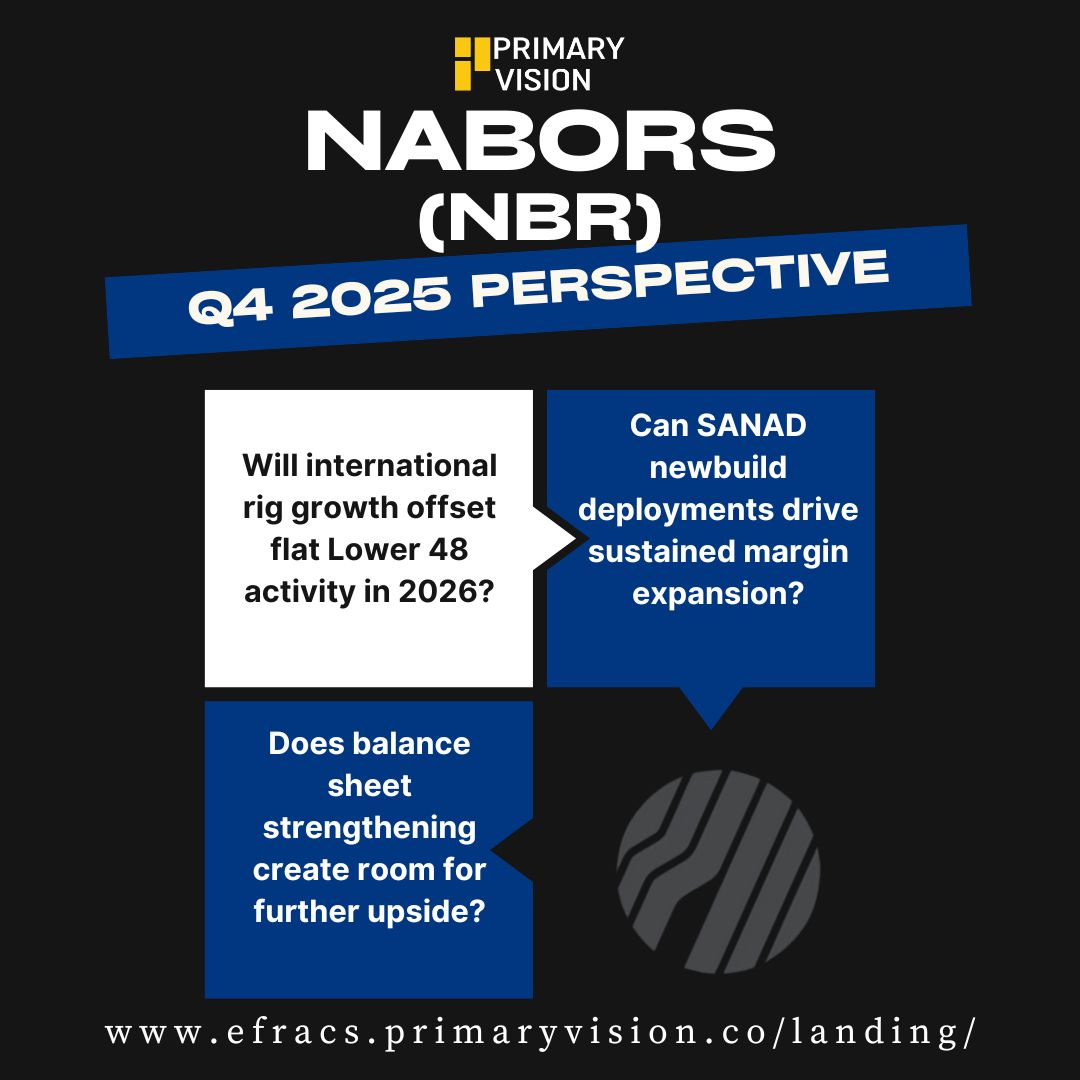
Three questions from the earnings call: Will international rig growth offset flat Lower 48 activity in 2026? Can SANAD newbuild deployments drive sustained margin expansion? Does balance sheet strengthening create room for further upside? Here's what rig count won't tell you: Nabors is adding rigs internationally. But rigs measure drilling activity, not production. The gap between a drilled well and a producing well is completion activity—frac spreads, horsepower deployment, job duration. That's the data point missing from the rig count narrative. Want to see what completion activity actually looks like? Explore the data. efracs.primaryvision.co/landing/ #primaryvision #nabors #oilmarkets
Primary Vision tweet media
English
0
0
0
167
Primary Vision
Primary Vision@PrimaryVision·
When oil moves, operators react. They always have. The question is how fast, how hard, and in which basins — and that's not something you can guess your way through. 15 years of tracking frac activity teaches you something the headlines never will: price is the trigger, but completion activity is the real signal. The lag between an oil price move and what actually happens on the ground — that's where the edge lives. Most people are still looking at the price. We're already watching what operators are doing about it. That pattern has played out through every cycle we've tracked — 2015, 2020, 2022, and everything in between. The playbook isn't identical each time, but the behavior rhymes. And when you have 15 years of ground-level frac activity data, you stop guessing and start recognizing. Primary Vision has been counting frac spreads since before most energy dashboards existed. That history — and what it tells us about right now — lives on EFRACS. SIGN UP NOW! efracs.primaryvision.co/landing/ #PrimaryVision #EFRACS #FracSpreadCount #OilPrices
Primary Vision tweet media
English
0
0
0
187
Primary Vision
Primary Vision@PrimaryVision·
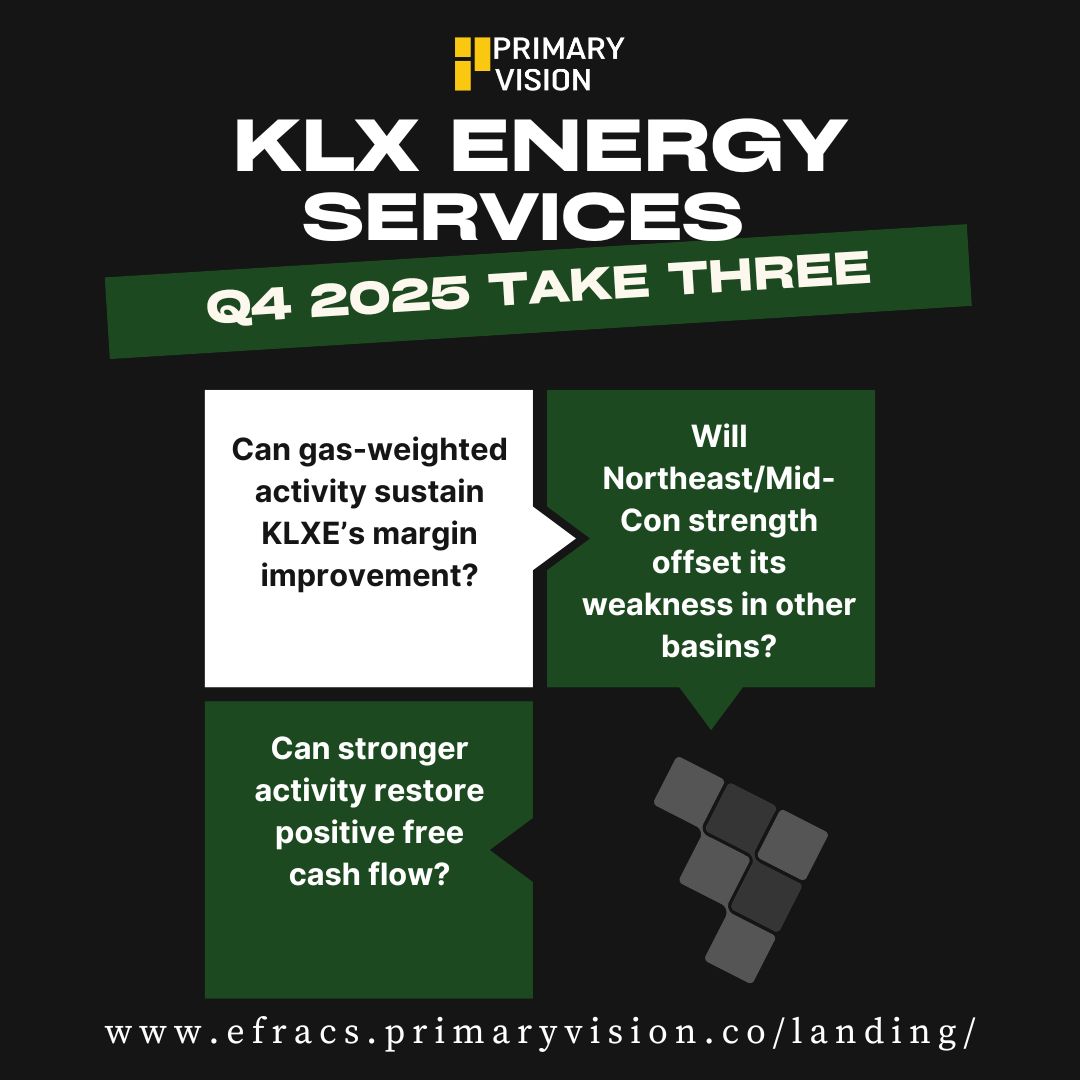
KLX Energy Services had an interesting Q4. But honestly, the questions it leaves behind matter more than the quarter itself. Three things are sitting on the table heading into 2026. Gas-weighted basins have been KLXE's quiet tailwind. The Northeast and Mid-Con held up while other areas softened. But a tailwind in one region only carries so far — the real test is whether that strength is enough to cover the gaps elsewhere, or whether the basin mix starts working against them. Then there's margins. Gas activity helped. But sustained margin improvement needs more than a favorable mix — it needs pricing to hold and utilization to follow. One good quarter of margin movement is encouraging. Two or three in a row is a thesis. And underneath all of it — free cash flow. That's the number that tells you whether the business is actually turning a corner or just managing its way through a difficult cycle. Positive free cash flow in this environment would mean something real. These three questions aren't separate. They're the same question asked three different ways: is KLXE's 2026 story one of genuine recovery, or a holding pattern? Which basins are actually holding activity right now — and which ones are quietly softening? Read the full report. efracs.primaryvision.co/landing/ #fsc #primaryvision #klx
Primary Vision tweet media
English
0
0
0
132
Primary Vision
Primary Vision@PrimaryVision·
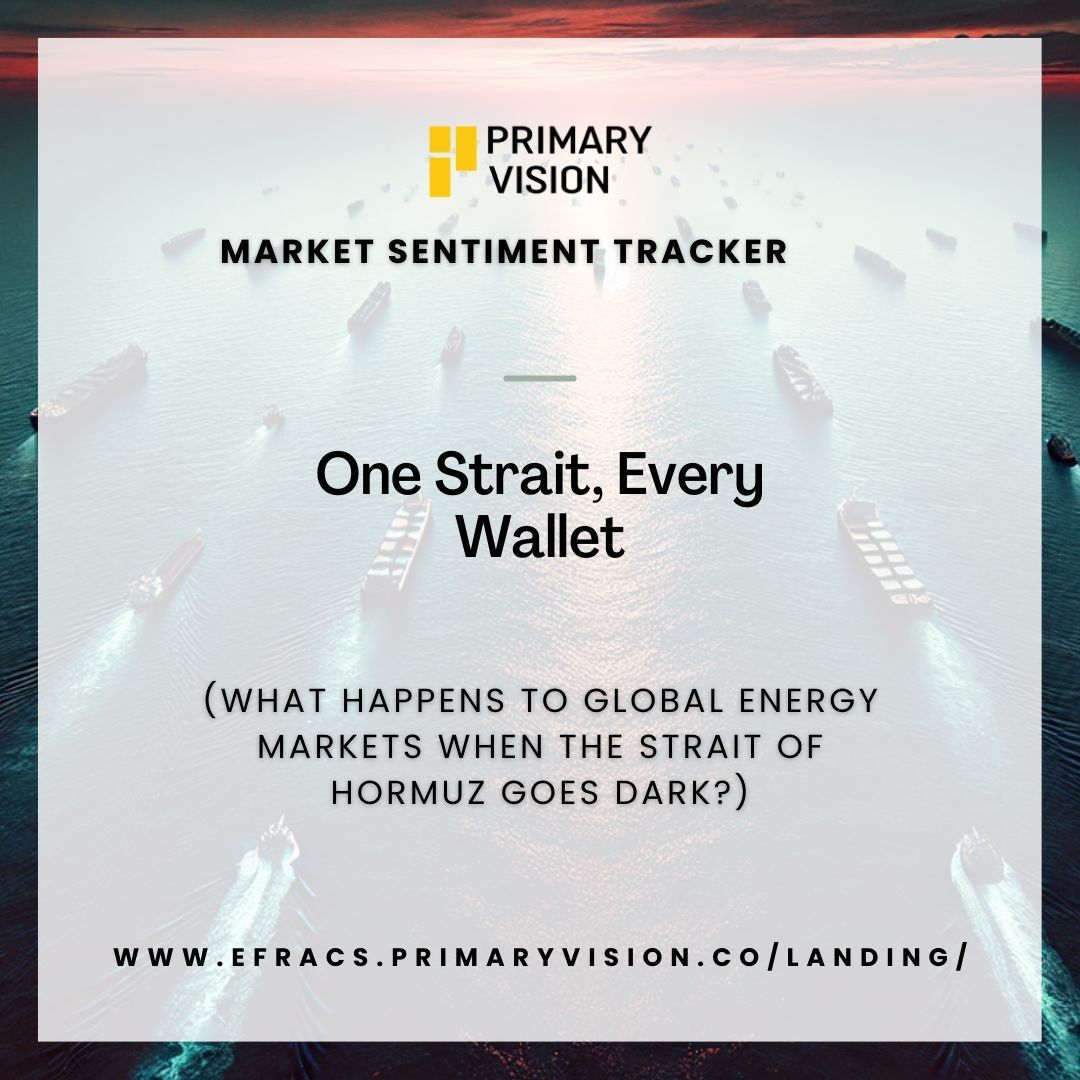
Brent was at $62 in January. By March 9, it was touching $119.50. One strait. Every wallet. Traffic via Strait of Hormuz, carrying roughly a fifth of the world's traded oil daily, is down by 95%. Higher oil prices are also converging on existing economic issues such as wreaking U.S. sentiment, European gas storage at 30% capacity and China navigating fragile domestic demand.  What that means for supply response, production trajectory, and the downstream consequences of a sustained Hormuz disruption — that analysis is exclusively available on EFRACS. The full picture is behind the link. efracs.primaryvision.co/landing/ #Hormuz #OilPrice #OperationEpicFury #EnergyMarkets #PrimaryVision
Primary Vision tweet media
English
0
0
0
177
Primary Vision
Primary Vision@PrimaryVision·
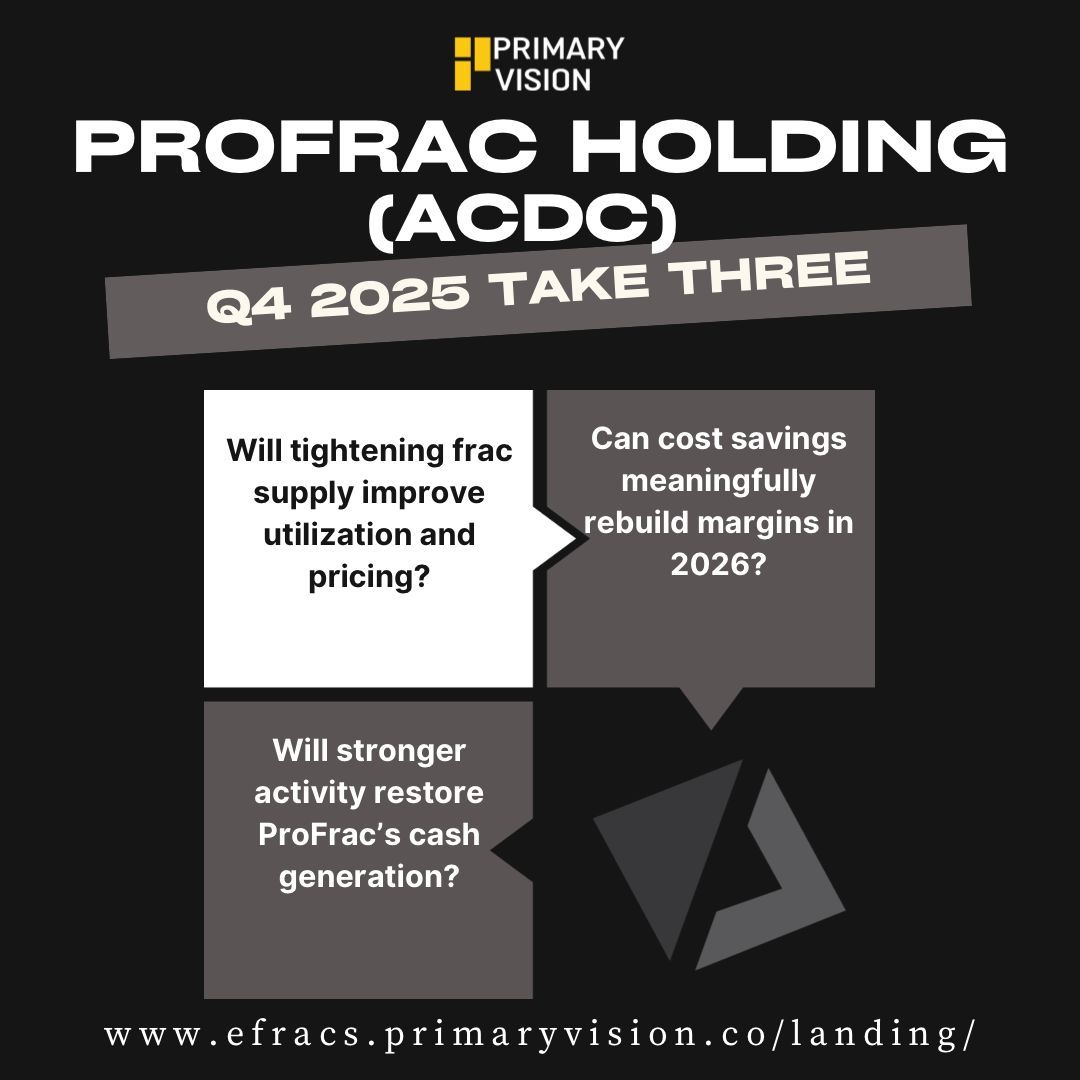
Three questions define ProFrac’s 2026 story. The completion market is tightening. Frac fleets are coming offline, horsepower is being high-graded, and the industry is quietly consolidating capacity. The question isn’t whether supply is shrinking — it’s whether the pace is fast enough to move utilization and pricing in ProFrac’s favor before the macro softness does further damage. Cost restructuring is visible in the numbers. But cost savings that don’t translate into margin recovery are just defense. The real question is how much of that efficiency work converts into EBITDA expansion when activity levels are still finding their floor. And underpinning both — cash generation. ProFrac’s ability to rebuild free cash flow in 2026 depends on whether activity recovery arrives early enough, and strong enough, to do the heavy lifting. These aren’t independent questions. The answer to each one shapes the answer to the next. At Primary Vision, our frac spread count and completion activity data sit directly at the intersection of all three. Where utilization is actually trending, which basins are holding, and what the forward activity picture looks like — that’s what our EFRACS reflect. Access the full article. efracs.primaryvision.co/landing/ #acdc #primaryvision #oilmarkets
Primary Vision tweet media
English
0
0
0
146
Primary Vision
Primary Vision@PrimaryVision·
The frac spread count is one of the most direct indicators of completion activity in the U.S. oil and gas industry. When a spread is active, a well is being completed. When spread counts fall, completions slow, and production growth follows with a lag. For investors, analysts, and operators, the frac spread count is an early signal — upstream of production data, upstream of earnings, and upstream of price moves. By the time the production numbers reflect a slowdown, the spread count already told you it was coming. That's the intellectual property behind EFRACS. Not just data — a sharper, earlier read on where the market is actually heading. Sign up now for exclusive data! efracs.primaryvision.co/landing/ #FracSpreadCount #CompletionActivity #OilandGas #PrimaryVision
Primary Vision tweet media
English
0
0
0
103
Primary Vision
Primary Vision@PrimaryVision·
Oil crossed $100. A major global LNG facility went offline. And North American completions activity is in the middle of a notable recovery. Three things moving at once — and they're not telling the same story. This week's Monday Macro View is out. Want to read the full article? efracs.primaryvision.co/landing/ #primaryvisoin #mmv #oilmarkets
Primary Vision tweet media
English
0
0
0
117
Primary Vision
Primary Vision@PrimaryVision·
NOV enters 2026 with a $4.34 billion backlog and an offshore market it believes is at the start of a multi-year upcycle. The setup is more interesting than the stock price suggests. U.S. upstream spending is expected to soften this year — mid-single-digit activity declines, oversupply weighing on oil prices, operators staying cautious. That's the headline risk. But NOV's story in 2026 isn't primarily a U.S. onshore story. At Primary Vision, our proprietary frac spread count, completion activity tracking, and equipment utilization data give you a ground-level read that sell-side estimates alone don't capture. That context is what shapes our full NOV outlook. The complete analysis, including peer valuation benchmarking and our forward activity read, is exclusively available on the Primary Vision platform — EFRACS. Access the full report. efracs.primaryvision.co/landing/ #nov #oildata #primaryvision
Primary Vision tweet media
English
0
0
0
134
Primary Vision
Primary Vision@PrimaryVision·
According to Baker Hughes' latest data, total active drilling rigs in the United States reached 551 this week. That's a week-over-week gain, but it sits 41 rigs below where we were at this same point last year. Primary Vision was featured in OilPrice.com this week. Our analysis on U.S. drilling and completion activity — including frac spread count, deployed horsepower trends, and forward outlook — is what we do every week for our subscribers. If the rig count number catches your eye, the data behind it is worth a closer look. Access the full article. efracs.primaryvision.co/landing/ #primaryvision #pressrelease #oilprice #fracspreadcount
Primary Vision tweet media
English
0
0
0
130
Primary Vision
Primary Vision@PrimaryVision·
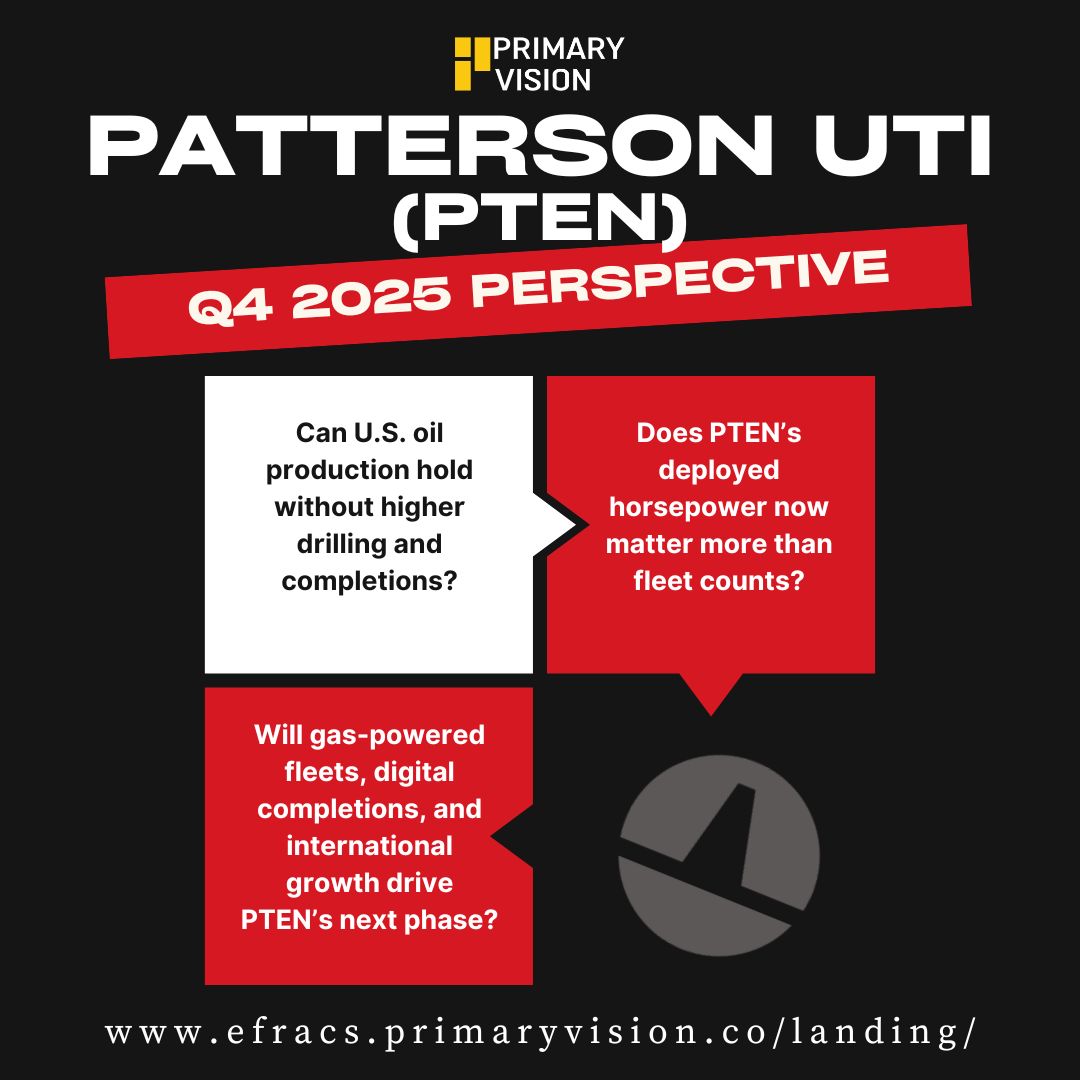
Patterson-UTI Energy reported $1.2 billion in Q4 revenue and raised its quarterly dividend by 25%. The headline numbers look stable. Our data tells a more complicated story. Spread count is declining across the industry — but that metric is increasingly misleading. The real signal is deployed horsepower, and what we're tracking at Primary Vision suggests the completion market is tighter than the surface numbers imply. Spare capacity is thin, and the directional shift in PTEN's asset strategy is deliberate, not reactive. On the drilling side, U.S. rig guidance for Q1 2026 sits in the low-to-mid 90s. Whether that holds — or whether production pressure forces operators back to the table — depends on dynamics that quarterly earnings calls don't fully surface. Internationally, moves in Argentina and the Middle East are worth watching. Capital-efficient redeployment of idle assets into high-activity basins is a margin story as much as a growth one. PTEN cut gross capex by roughly 15% for 2026. How that interacts with asset sales, fleet high-grading, and the broader completions equipment cycle is where our analysis focuses. At 4.7x EV/EBITDA against a five-year average of 8.2x, the multiple compression is visible. Whether that's value or a warning depends on which direction activity goes from here. Our full read — including frac spread data, horsepower utilization trends, and peer valuation context — is available to Primary Vision subscribers. Read the full article. efracs.primaryvision.co/landing/ #pattersonuti #primaryvision #keytakeaways #oildata #fracspreadcount
Primary Vision tweet media
English
0
0
0
151