UpscPrelimsIntel
1.2K posts

UpscPrelimsIntel
@UpscIntel
I will help you clear UPSC CSE PRELIMS 2026 | Cleared Forest cutoff, wrote 3 Mains (combined) | Only Prelims refined content and strategy will be tweeted.
Delhi, India Sumali Aralık 2025
82 Sinusundan1.6K Mga Tagasunod
Naka-pin na Tweet

#UPSC Intel Advice 🚨
If you want to clear Prelims 2026, follow this:
1.Standard Sources → full-throttle ratta.
2.PYQs → solve • learn • repeat.
3.CSAT → treat it like CAT level.
4.Current Affairs → one source.
5.Mocks → 6000 quality questions.
No revision = no retention
English

UpscPrelimsIntel nag-retweet

Coin Names – Dynasty Wise
⸻
Ancient India
Mahajanapadas (6th century BCE)
•Karshapana / Pana – Silver punch-marked coins
•First metallic currency in India
⸻
Mauryan Empire
•Continued Punch-marked coins
•State-controlled minting
⸻
Indo-Greeks
•Drachma
•Tetradrachma
•Bilingual coins (Greek & Kharoshthi)
•First portrait coins in India
⸻
Shakas (Western Kshatrapas)
•Silver coins
•Ruler’s bust on obverse
⸻
Kushanas
•Gold Dinar
•Also copper coins
•Depictions of Greek, Iranian, Indian deities
⸻
Satavahanas
•Lead coins (distinctive feature)
•Potin coins
•Ship motif (maritime trade)
⸻
Guptas
•Gold Dinar (high purity)
•Types: Archer, Tiger-slayer, Ashvamedha, Lyrist
•Limited silver coins
⸻
Vakatakas
•Mostly copper coins
⸻
Early Medieval India
Harsha
•Silver coins imitating Gupta style
⸻
Cholas
•Gold Kalanju
•Tiger emblem
⸻
Cheras
•Bow and arrow symbol coins
⸻
Pandyas
•Fish emblem coins
⸻
Delhi Sultanate
Iltutmish
•Silver Tanka
•Copper Jital
•Standardised Islamic coinage
⸻
Alauddin Khalji
•Increased token copper currency circulation
⸻
Muhammad bin Tughlaq
•Introduced Token Currency (brass/copper)
⸻
Mughal Period
Babur & Humayun
•Continued Timurid coin tradition
Sher Shah Suri
•Standardised Silver Rupiya
•Copper Dam
Akbar
•Gold Mohur
•Silver Rupiya
•Copper Dam
Jahangir
•Zodiac coins
⸻
South Indian Kingdoms
Vijayanagara
•Gold Pagoda (Varaha)
•Also called Hun
⸻
Hoysalas
•Gold coins with royal symbols
⸻
Marathas
•Shivrai copper coins
⸻
European Influence in India
Portuguese
•Xerafim
•Cartaz system linked trade control
British
•Uniform Rupee system (1835 Coinage Act)
⸻
Associations
•Punch-marked → Mahajanapada / Mauryan
•Drachma → Indo-Greek
•Dinar → Kushana / Gupta
•Tanka & Jital → Iltutmish
•Rupiya → Sher Shah Suri
•Mohur → Mughals
•Pagoda → Vijayanagara
English

Officers of Different Dynasties
Mauryan Administration
Samaharta → Revenue collection
Sannidhata → Treasury
Amatya → Officials/Ministers
Senapati → Army chief
Dhamma Mahamatra → Dhamma propagation
Antapala → Frontier officer
Nagarika → City administration
Yukta → Subordinate official
⸻
Gupta Administration
Kumaramatya → High officials
Sandhivigrahika → Foreign affairs
Mahadandanayaka → Military/judicial
Uparika → Provincial governor
Vishayapati → District head
Ayuktaka → Executive officer
⸻
Delhi Sultanate
Wazir → Finance/PM
Ariz-i-Mamalik → Military
Diwan-i-Risalat → Religious affairs
Diwan-i-Insha → Correspondence
Barid-i-Mamalik → Intelligence
Qazi → Judicial officer
Muhtasib → Market control/morality
Amil → Revenue collector
⸻
Mughal Administration
Wazir / Diwan-i-Ala → Finance
Mir Bakshi → Military/pay
Sadr-us-Sudur → Religious endowments
Qazi-ul-Quzat → Chief judge
Kotwal → City police
Faujdar → Military officer (district)
Amil / Amalguzar → Revenue
Bitikchi → Record keeper
Qanungo → Revenue records
Patwari → Village accountant
⸻
Chola Administration
Perundanam → Higher officials
Sirudanam → Lower officials
Adhikari → Officer
Variyam members → Committee officials
Nattar → Nadu-level authority
Sabha / Ur officials → Village administration
⸻
Vijayanagar Empire
Mahapradhani → Chief minister
Dandanayaka → Military
Nayaka → Provincial/military governor
Rayasam → Secretary
Karanikam → Accountant
Dalavayi → Commander-in-chief
⸻
Maratha Administration (Ashtapradhan)
Peshwa → Prime minister
Amatya / Mazumdar → Finance
Sachiv → Secretary
Mantri → Intelligence
Senapati → Army chief
Sumant / Dabir → Foreign affairs
Nyayadhish → Judiciary
Panditrao → Religious affairs
⸻
Satavahana
Amatya → Minister
Maharathi → Military/feudal lord
Mahabhoja → Local chief
⸻
Rashtrakuta
Rashtrapati → Provincial head
Vishayapati → District head
Bhogapati → Local officer
⸻
Bahmani Sultanate
Wazir → PM
Tarafdar → Provincial governor
Kotwal → City administration
Filipino
UpscPrelimsIntel nag-retweet

🏛️ Mauryan Dynasty — Officers
•Amatya → High civil servants
•Mantriparishad → Council of ministers
🌾 Revenue & Administration
•Samaharta → Chief revenue collector
•Sannidhata → Treasurer, stores & granaries
•Gopa → Village records (land, crops, population)
•Sthanika → Officer over ~800 villages
⚖️ Justice & Law
•Rajjukas → Judicial officers + land measurement, revenue assessment
•Dharma Sthiya → Civil judges
•Kantaka Sodhaka → Criminal judges
🏙️ Urban Administration
•Nagarika → City governor
⚔️ Military
•Senapati → Commander-in-chief
🕵️ Intelligence
•Gudhapurusha → Spies
🌱 Economy & Public Works
•Sitadhyaksha → Agriculture
•Akaradhyaksha → Mines
•Pautavadhyaksha → Weights & measures
English

Narco Test (Narcoanalysis)
⸻
What is Narco Test?
•A forensic investigation technique
•Uses drugs like Sodium Pentothal (truth serum)
•Puts subject in a sedated / hypnotic state
•Aim: Extract information when conscious control is reduced
⸻
How it Works
•Drug administered intravenously
•Person enters semi-conscious state
•Investigators ask questions → responses recorded
⸻
Legal Position in India
Supreme Court Judgment
•Selvi vs State of Karnataka (2010)
Key Rulings
•Involuntary narco test is unconstitutional ❗
•Violates:
•Right against self-incrimination (Article 20(3))
•Right to personal liberty (Article 21)
•Can be conducted only with consent
⸻
Evidentiary Value
•Results are not admissible as evidence directly
•Can be used for investigation leads only
English

Indian-Launched Global Alliances / Initiatives
⸻
International Solar Alliance (ISA)
•Launched by: India + France
•Year: 2015 (COP21, Paris)
•Focus: Solar energy promotion in tropical countries
⸻
Coalition for Disaster Resilient Infrastructure (CDRI)
•Launched by: India
•Year: 2019
•Focus: Disaster-resilient infrastructure
⸻
Global Biofuel Alliance (GBA)
•Launched by: India
•Year: 2023 (G20 Summit, Delhi)
•Focus: Biofuel adoption & cooperation
⸻
Mission LiFE (Lifestyle for Environment)
•Launched by: India
•Year: 2021 (COP26, Glasgow)
•Focus: Sustainable lifestyle practices
⸻
International Big Cat Alliance (IBCA)
•Launched by: India
•Year: 2023
•Focus: Conservation of big cats (tiger, lion, leopard, etc.)
⸻
Global Initiative on Digital Public Infrastructure (DPI)
•Launched by: India (G20 2023)
•Focus: Digital infrastructure sharing (UPI, Aadhaar model)
⸻
Global River Cities Alliance (GRCA)
•Launched by: India
•Year: 2023
•Focus: River-centric urban development & river rejuvenation
⸻
Cities Coalition for Circularity (C-3)
•Launched by: India (G20 2023)
•Focus: Circular economy in cities (waste, resource efficiency
English

Largest Endorheic Lake - Caspian Sea
•Also the largest inland water body globally
⸻
Location
•Between:
•Russia
•Kazakhstan
•Turkmenistan
•Iran
•Azerbaijan
⸻
Key Characteristics
•Endorheic basin → No outlet to ocean
•Water lost mainly through evaporation
•Salinity varies:
•North → fresh
•South → saline
⸻
Rivers Draining Into It
•Volga River (largest contributor)
•Ural River
•Kura River
English
UpscPrelimsIntel nag-retweet

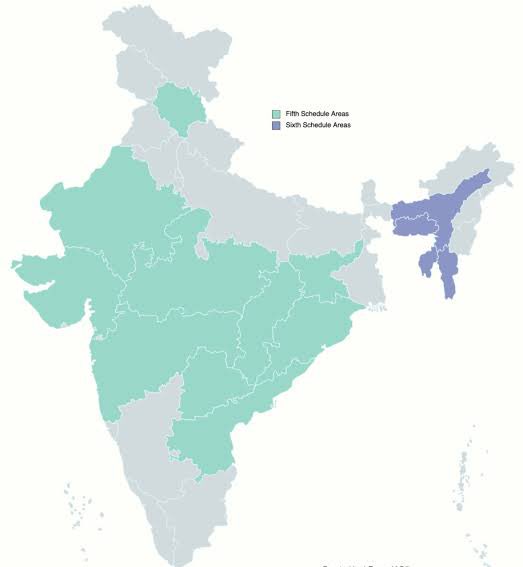
Fifth and Sixth Schedule are important topics for Prelims ⬇️
FIFTH SCHEDULE
(Administration of Scheduled Areas & STs)
🔹 APPLICABLE TO
•Scheduled Areas in:
•Odisha
•Chhattisgarh
•Jharkhand
•Madhya Pradesh
•Maharashtra
•Telangana
•Andhra Pradesh
•Gujarat
•Rajasthan
•Himachal Pradesh
(Not applicable to NE states except some parts)
⸻
🔹 KEY FEATURES
•Governor has special powers
•Tribes Advisory Council (TAC):
•Mandatory where Scheduled Areas exist
•Governor can:
•Make regulations for peace & good governance
•Restrict land transfer to non-tribals
•Regulate money-lending
•President:
•Declares Scheduled Areas
⸻
🔹 IMPORTANT POINTS
•PESA Act, 1996 applies here
•No autonomous districts
•State laws may not apply automatically
⸻
🔵 SIXTH SCHEDULE
(Administration of Tribal Areas in North-East India)
🔹 APPLICABLE TO
•Assam
•Meghalaya
•Mizoram
•Tripura
⸻
🔹 KEY INSTITUTIONS
•Autonomous District Councils (ADCs)
•Autonomous Regional Councils (ARCs)
⸻
🔹 POWERS OF ADCs
•Legislative powers over:
•Land
•Forests (except reserved forests)
•Shifting cultivation
•Village administration
•Judicial powers:
•Village courts (customary law)
•Financial powers:
•Taxes, tolls, fees
⸻
🔹 ROLE OF GOVERNOR
•Can modify or annul ADC laws
•Can dissolve councils
❌ PESA applies to Fifth, not Sixth Schedule
❌ Sixth Schedule has legislative & judicial powers
❌ Fifth Schedule areas are declared by President, not Governor
❌ ADCs exist only under Sixth Schedule
❌ Sixth Schedule ≠ all NE states (not Nagaland, Manipur, Arunachal)
#UPSC #upscpreparation #UPSCPrelims2026 #India #Northeast


English
UpscPrelimsIntel nag-retweet

Himalaya states and UT
Jammu & Kashmir
Ladakh
Himachal Pradesh
Uttarakhand
Sikkim
Arunachal Pradesh
Nagaland
Manipur
Mizoram
Tripura
Meghalaya
Assam
West Bengal
Western Ghats States
Gujarat (small stretch near Dang)
Maharashtra
Goa
Karnataka
Kerala
Tamil Nadu
Aravalli Range States
Gujarat
Rajasthan
Haryana
Delhi
हिन्दी

Recommending / Selection Committees for constitutional and statutory bodies
⸻
Election Commission of India (ECI)
•Prime Minister (Chairperson)
•Leader of Opposition (Lok Sabha)
•Union Cabinet Minister (nominated by PM)
⸻
National Human Rights Commission (NHRC)
•Prime Minister (Chairperson)
•Speaker of Lok Sabha
•Home Minister
•Leader of Opposition (Lok Sabha)
•Leader of Opposition (Rajya Sabha)
•Deputy Chairman of Rajya Sabha
⸻
Central Information Commission (CIC)
•Prime Minister (Chairperson)
•Leader of Opposition (Lok Sabha)
•Union Cabinet Minister (nominated by PM)
⸻
Central Vigilance Commission (CVC)
•Prime Minister (Chairperson)
•Home Minister
•Leader of Opposition (Lok Sabha)
⸻
Central Bureau of Investigation (CBI Director)
•Prime Minister (Chairperson)
•Chief Justice of India (or nominee)
•Leader of Opposition (Lok Sabha)
⸻
Lokpal
•Prime Minister
•Speaker of Lok Sabha
•Leader of Opposition (Lok Sabha)
•Chief Justice of India (or nominee)
•One eminent jurist (by President)
⸻
Pattern
PM → common in all
CJI → CBI + Lokpal
Home Minister → NHRC, CVC
Union Cabinet Minister → ECI, CIC
English

Important Borders / Corridors / Passes
Torkham Border
•Afghanistan – Pakistan
•Khyber Pass
⸻
Chaman Border
•Afghanistan – Pakistan
•Near Kandahar–Balochistan route
⸻
Wakhan Corridor
•Afghanistan’s narrow strip
•Borders: China, Pakistan, Tajikistan
•Buffer between British India & Russia
⸻
Khunjerab Pass
•Pakistan – China
•Highest paved border crossing
⸻
Nathu La Pass
•India – China (Sikkim)
•Trade route
⸻
Jelep La Pass
•India – China (Sikkim)
⸻
Shipki La Pass
•India – China (Himachal Pradesh)
⸻
Lipulekh Pass
•India – Nepal – China (tri-junction)
•Kailash Mansarovar route
⸻
Rohtang Pass
•Within India (Himachal Pradesh)
•Connects Kullu–Lahaul
⸻
Zojila Pass
•J&K – Ladakh
•Connects Srinagar–Leh
⸻
Banihal Pass
•J&K
•Pir Panjal range
⸻
Karakoram Pass
•India – China (Ladakh)
⸻
Pangsau Pass
•India – Myanmar
•Stilwell Road
⸻
Moreh–Tamu Border
•India – Myanmar
•Major trade point
⸻
Petrapole–Benapole
•India – Bangladesh
•Largest land port
⸻
Attari–Wagah
•India – Pakistan
•Punjab border
⸻
Recall
Torkham → Afghanistan–Pakistan
Wakhan → Afghanistan–China link
Nathu La → India–China
Lipulekh → Tri-junction
Attari → India–Pakistan
Dansk

Soil Orders (USDA)
(often asked in CDS, Geoscientist)
Andisol
•Origin: Volcanic ash (magma-derived)
•Feature: Highly fertile
⸻
Histosol
•Origin: Organic matter
•Feature: High humus, waterlogged areas
⸻
Gelisol
•Condition: Permafrost
•Region: Arctic / tundra
⸻
Inceptisol
•Type: Young soil
•Feature: Weak horizon development
⸻
Entisol
•Type: Very recent soil
•Feature: Little to no profile development
⸻
Alfisol
•Type: Moderately leached
•Feature: Fertile
⸻
Ultisol
•Type: Highly leached
•Feature: Acidic, low fertility
⸻
Oxisol
•Type: Extremely weathered
•Feature: Found in tropical regions
⸻
Aridisol
•Type: Desert soil
•Feature: Low organic matter
⸻
Mollisol
•Type: Grassland soil
•Feature: Very fertile, rich in humus
⸻
Spodosol
•Type: Acidic soil
•Feature: Ash-grey horizon
⸻
Vertisol
•Type: Clay-rich soil
•Feature: Shrinks and cracks
⸻
Recall
Andisol → Volcanic
Histosol → Organic
Gelisol → Permafrost
Entisol → New
Inceptisol → Young
Mollisol → Grassland
English
UpscPrelimsIntel nag-retweet

@DailyGkzone •Drain Theory → Dadabhai Naoroji
•Book → Poverty and Un-British Rule in India
•British MP → First Indian
•INC President thrice → 1886, 1893, 1906
•Title → Grand Old Man of India
English
UpscPrelimsIntel nag-retweet

1. The Economic History of India
Author: Dadabhai Naoroji (1901)
•Introduced the famous Drain of Wealth Theory
•Explained how British rule led to economic impoverishment of India
•One of the earliest systematic economic critiques of colonialism
⸻
2. Poverty and Un-British Rule in India
Author: Dadabhai Naoroji
•Detailed empirical study of poverty in colonial India
•Used official data on revenue, trade, salaries, and expenditure
•Strengthened the economic basis of Indian nationalism
⸻
3. Indian Economy
Author: Radhakamal Mukerjee
•Early interdisciplinary analysis combining economics and sociology
•Emphasised relationship between economy, society, and environment
•Highlighted structural issues in Indian economy
⸻
4. The Industrial Development of India
Author: R.C. Dutt
•Discussed decline of indigenous industries under British rule
•Examined impact of colonial trade policies on artisans and handicrafts
•Focused on industrial stagnation and dependency
⸻
5. Economic History of India under Early British Rule
Author: R.C. Dutt
•Comprehensive account of land revenue systems and taxation
•Analysed economic consequences of early British administration
•Complemented nationalist economic critiques of colonial rule
⸻
6. The Discovery of India
Author: Jawaharlal Nehru
•Explored India’s historical and economic evolution
•Reflected ideas on planning, industrialisation, and social justice
•Linked economic development with national reconstruction
⸻
7. Hind Swaraj
Author: M.K. Gandhi
•Critiqued modern industrial civilisation
•Advocated self-sufficient village-based economy
•Emphasised ethical and sustainable economic living
⸻
8. Indian Economic Problems
Author: M.G. Ranade
•Discussed agricultural distress, industrial development, and finance
•Reflected moderate reformist economic thinking
•Early attempt to analyse India’s economic challenges
English

UpscPrelimsIntel nag-retweet

Raja Ram Mohan Roy (1772–1833)
Identity
•Pioneer of Indian social and religious reform
•Known as the “Father of Indian Renaissance”
⸻
Key Contributions
Social Reforms
•Led the movement against Sati → instrumental in its abolition (Regulation XVII, 1829) under Lord William Bentinck
•Opposed polygamy, child marriage; supported widow remarriage
•Advocated women’s rights and inheritance reforms
Religious Reforms
•Founded Brahmo Sabha (1828) → later Brahmo Samaj
•Promoted monotheism, rational worship
•Criticised idol worship and ritualism
•Drew from Upanishads, advocated ethical universalism
Educational Ideas
•Supported modern, scientific education
•Advocated teaching of English, science, mathematics
•Opposed exclusive focus on traditional Sanskrit education
Political & Administrative Thought
•Supported freedom of press
•Criticised oppressive revenue and judicial practices
•Favoured constitutional governance and rule of law
⸻
Publications & Journals
•Sambad Kaumudi (Bengali)
•Mirat-ul-Akbar (Persian)
•Tuhfat-ul-Muwahhidin (Persian work on monotheism)
•Translations of Upanishads into Bengali and English
⸻
Associations
•Close interaction with British liberals
•Sent as envoy of the Mughal Emperor Akbar II to England (1831)
⸻
Death
•Died in 1833 at Bristol, England
•Buried at Arnos Vale Cemetery
Organisations Formed / Associated
•Atmiya Sabha (1815)
Early reformist group in Calcutta; discussion on monotheism and social reform.
•Brahmo Sabha (1828)
Promoted monotheism, rational religion; later evolved into Brahmo Samaj.
•Brahmo Samaj (formalised later)
Major socio-religious reform movement advocating ethical theism and social reform.
⸻
Literary Contributions
Books / Treatises
•Tuhfat-ul-Muwahhidin (1804, Persian)
Advocacy of monotheism and rational religion.
•Precepts of Jesus (1820)
Ethical teachings of Christianity without theological dogma.
•A Defence of Hindu Theism
Justification of monotheism based on Hindu scriptures.
Translations & Religious Texts
•Upanishads (Isa, Kena, Katha, Mandukya) – translated into Bengali & English.
•Vedanta texts – to promote rational interpretation of Hindu philosophy.
Journals / Newspapers
•Sambad Kaumudi (Bengali)
Social reform, anti-Sati campaign.
•Mirat-ul-Akhbar (Persian)
Political and administrative critique; closed due to press restrictions.
English

Q Which one among the following statements regarding igneous rock is correct? (CDS 2026)
(a) When magma cools deep in the Earth's interior, it results in the formation of fine-grained igneous rocks.
(b) Basalt is a type of intrusive igneous rock.
(c) Most of the minerals of igneous rocks are silicates.
(d) Extrusive igneous rocks often undergo lithification
English