
James Harris

13.7K posts

James Harris banner
James Harris

James Harris

@WormsofWrath

All-American Renaissance Man, author The Physics of Paradox Null, writer and composer of musical play Seeking Liberty

lost in thought Sumali Haziran 2024
808 Sinusundan1.2K Mga Tagasunod
James Harris
James Harris@WormsofWrath·
The 50% gone in 30 years is a dubious, strictly measurement-based assessment. It encompasses bicarbonate deposition, weathering, lumber, and other sinks. The immediate sinks are plants (30%) and oceans (25%). Plant abundance adjusts quickly. Ocean surface levels mirror atmospheric levels, adjusting instantly. Plant sinks are likely to saturate when plant area is maximized and atmospheric CO2 levels reach between 1000 and 1800ppm (maximum growth). Nothing in the atmosphere is truly 'excess' until maximum plant growth levels are exceeded. Ocean sinks can not saturate below 1,000,000 ppm. There is no known limit to the amount of carbon which can be removed through weathering (soil deposits), rock weathering (chemical aqueous deposits), and deep water deposition.
James Harris tweet media
English
0
1
0
3
eve
eve@eve_empal·
@WormsofWrath @CAGWfool @medialens You are still confusing immediate cycling with net atmospheric accumulation. The 50% gone in 30 years figure only applies to the initial, rapid exchange with surface sinks. Those sinks saturate, the remaining 20-35% of that excess stays in the atmosphere for thousands of years.
English
2
0
1
16
Media Lens
Media Lens@medialens·
As discussed in our alert (below), it's so easy to debunk these comments now: This is the classic 'the climate has always changed' argument. It's a favorite because it relies on a slice of truth to smuggle in a massive misconception. Saying humans can't cause climate change because climate change happened before humans is like a detective looking at a burned-down house and saying, "Well, forest fires caused by lightning have been happening a wee bit longer than matches, so this arsonist couldn't have done it." Climate scientists have never claimed that the climate was static before the industrial revolution. In fact, understanding past climate change is exactly how we know greenhouse gases are so dangerous today. medialens.substack.com/p/invitation-t…
Joe@CupoJoeBlow

@medialens Turns out the climate has been changing a wee bit longer than the instrumental record.

English
36
19
55
4.3K
James Harris
James Harris@WormsofWrath·
'Excess' does change some things, particularly accelerating growth in the Arctic and hot, dry areas. The additional heat melts ice as do trees growing over frozen tundra, stabilizing warmer conditions. The added CO2 raises maximum photosynthesis temperatures 5C while non-Arctic temperatures are up only 0.7C and plants very much like that.
James Harris tweet media
English
0
0
0
3
eve
eve@eve_empal·
@WormsofWrath @CAGWfool @medialens Carbon added to land life isn't permanently locked away. It cycles back via respiration, decay, and wildfires.Excess Means Disruption: It is too much, because that 45% accumulation has trapped enough heat to alter global climate stability, regardless of whether plants like it.
English
3
0
1
13
James Harris
James Harris@WormsofWrath·
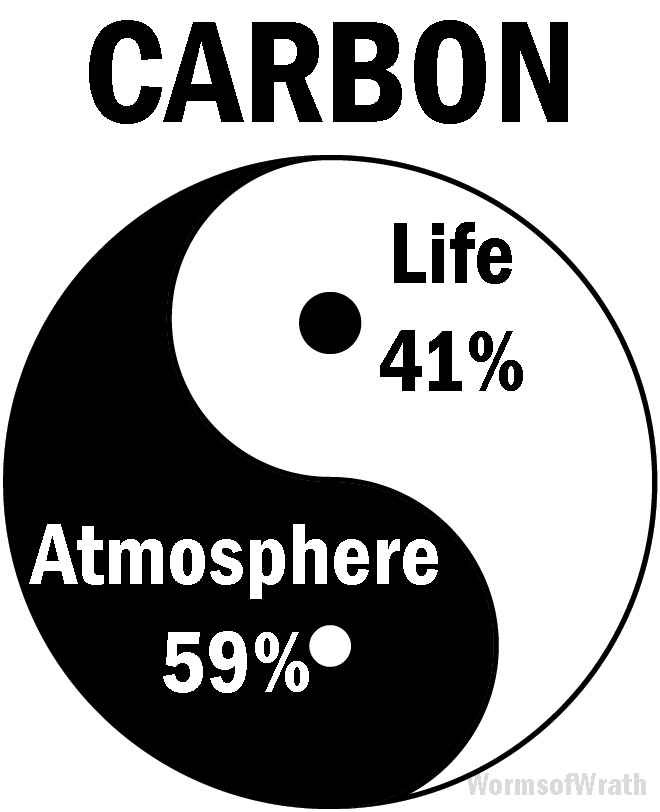
Carbon added to land life is permanently locked away proportional to CO2 levels - not specifically but collectively. Potential plant growth has increased 52%. Actual growth and actual plant mass have both increased 25% globally. That's about 30% of the fossil fuel carbon used in this period. That's permanently or until CO2 levels fall.
James Harris tweet media
English
0
0
0
3
James Harris
James Harris@WormsofWrath·
As for the glaciers there are several possible mechanisms. This global modeling of sea levels (working on upgrading to regional) shows all land masses at high elevations repeatedly (less frequently than represented), allowing for individual, non-concurrent high-altitude glaciation. (Not useful to trends of less than millions of years IMO). Volcanoes create individual glaciers. Major volcanic eruptions can cause brief glaciations across large areas. (Rapid onset, may endure with feedbacks.) Pre-30Ma glacial evidence is frequently just some rock scratches without evidence of broad or regional changes (or ice, even, necessarily). The 300-250Ma glaciation is absurd as that is the age of giant amphibians and giant insects. Then there's extraterrestrial events - solar, dust clouds, or other which could have happened... Milankovitch cycles are a potential triggering or contributing factor which may have contributed to or caused some cycles, but they don't seem to match glaciations half the time IMO. I expect volcanoes are a frequently significant factor. Yellowstone's covered North America in ash repeatedly. That's a good glaciation trigger, but not, I emphasize, a global Ice Age. As far I as I've found there's no evidence of ice ages in Asia, supporting volcanism as a continental rather than global trigger.
James Harris tweet media
English
1
0
1
7
Mr East
Mr East@Konverter22·
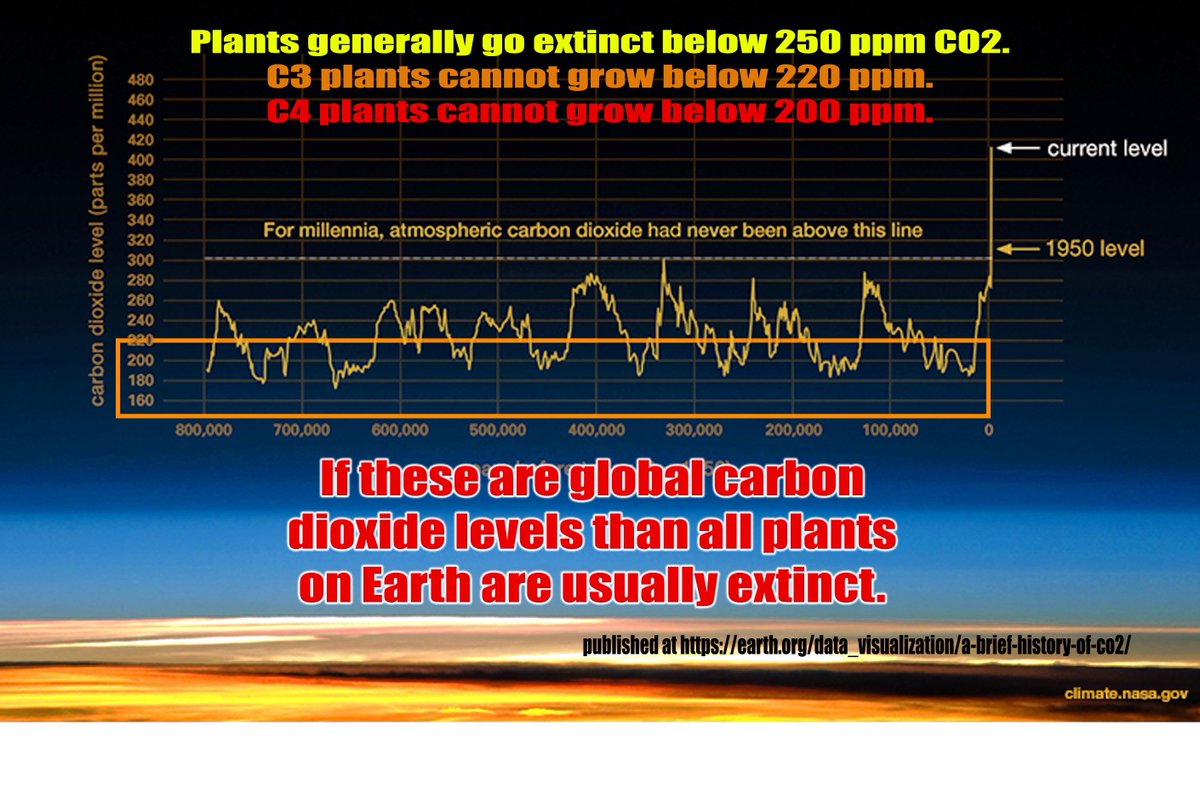
@WormsofWrath @PeterDClack so explain tens/hundreds of millions of years of glacial-interglacial transitions/cycles, often with much higher atmospheric Co2 concentration. If anything we are now in a CO2 drought. at 0.04% total atmospheric gases if we were to drop to 0.02% ALL plant-life/crops fail.
English
2
0
1
6
Peter Clack
Peter Clack@PeterDClack·
Any return to ice age conditions could trigger a crisis unmatched in all human history. Earth is still technically in an ice age and average global temperatures of around 15°C degrees are still much lower than the long-term global average of 16°C to 18°C A global warming scare has been running for 40 years, yet 10% of the world's total land area is still covered by glacial ice. From a human perspective, the combined land area of every town and city on earth is still only 3% of the total. Ice covers an area of 15 million square kilometers (5.8 million square miles), roughly a third of its full extent during the peak of the Last Glacial Maximum (26,000 to 19,000 years ago). This was the most recent time in Earth's history when global ice sheets were at their greatest extent. The Antarctic ice sheet is still the largest and thickest ice formation on Earth by far, reaching up to 4.8 kilometres (about 3 miles) in depth. It holds 90% of the world's ice by volume & accounts for around 85% of total global glacial ice cover. Antarctica spans roughly 14 million square kilometers (5.4 million square miles) and covers about 8.3% of the total land surface. Land area is only 28% of earth's surface. The oceans cover 72% to an average depth of 2.3 miles, forests cover 31% and deserts 33%. The oceans contain 86% of the global carbon reservoir and 91% of all retained heat energy; by contrast, the atmosphere holds a mere 1 to 2% of each. The past 40 years has featured a global warming campaign raising fears of an impending climate crisis, chiefly based on forecasts of soaring temperatures and a global climate crisis. However, the fact remains that the Earth is still technically in an ice age, with ice cover at both poles all year round. We still live in the Quaternary Glaciation, which has lasted 2.58 million years. The Quaternary Glaciation is a more severely cold extension of the Late Cenozoic Ice Age, which has lasted for 34 million years, since the time of the original glaciation of Antarctica. The chief causes were due to orbital anomalies (the Milankovitch cycles), the isolation of the Antarctic continent when Australia and South America shifted northward, as part of global tectonic changes. The last great ice age that was similar to today was the Karoo Ice Age (also known as the Late Paleozoic Icehouse), spanning approximately 360 to 260 million years. This is one of the five major ice ages in Earth's history. All modern human societies and every meaningful invention has occurred during the current Holocene warm interglacial period, beginning 11,700 years ago. The previous warm interglacial was the Eemian (130,000 to 115,000 years ago). Temperatures in the Eemian were also 2°C warmer than today and African megafauna and crocodiles lived in the Thames valley. The generally accepted average extent of ice age interglacials is around 15,000 years. So perhaps we should be considering our next move if the next glaciation comes early.
Peter Clack tweet media
Bega, New South Wales 🇦🇺 English
91
557
1.6K
38.9K
James Harris
James Harris@WormsofWrath·
@Konverter22 @PeterDClack The CO2 problem is a point I have seized upon myself. The easiest solution is to up the bias by 40ppm. Relevant fossil records need levels even higher than that. *Plants can survive weeks at zero CO2 but without enough to even grow (200pm) I see no possibility of reproduction.
James Harris tweet media
English
0
0
0
2
Morshaa
Morshaa@morshaa1·
@WormsofWrath @MauriceMur4768 @BladeoftheS While an individual co2 molecule stays in the air for only about 4 to 5 years before being absorbed by plants or oceans, you are conveniently overlooking the extra co2 we emit that takes centuries to millennia to fully leave the atmosphere.
Morshaa tweet media
English
2
0
0
15
BladeoftheSun
BladeoftheSun@BladeoftheS·
Within the next couple of decades Global Warming is going to go from being a big problem to making large parts of the world where billions of people live unlivable. It will lead to mass migration on an unbelievable scale and widespread famine. We need to act NOW.
BladeoftheSun tweet media
English
154
282
661
21.2K
James Harris
James Harris@WormsofWrath·
Current CO2 levels are projected to put off the next ice age for 5,000 to 10,000 years, casting doubt on the model of Milankovitch cycles as the primary driver. Those cycles primarily apply to the far north with little effect on south. Milankovitch cycles have near-zero effect on total radiation.
English
1
0
0
11
Mr East
Mr East@Konverter22·
there are 3 aspects to Milankovitch Cycles and these have been supported by geological evidence, including the transitions from glacial to interglacial periods… 1. Eccentricity (~100,000 years)
Changes in the shape of Earth’s orbit around the Sun (more circular ↔ more elliptical). This affects the distance from the Sun and the intensity of seasonal contrasts. 2. Obliquity (Axial Tilt) (~41,000 years)
The tilt of Earth’s axis varies between ~22.1° and 24.5°. Greater tilt increases seasonal differences, especially at high latitudes. 3. Precession (~26,000 years)
The slow wobble of Earth’s rotational axis (like a spinning top), which shifts the timing of the seasons relative to Earth’s closest and farthest points from the Sun (perihelion and aphelion). These cycles alter the amount and distribution of solar radiation (insolation) reaching Earth, especially in the Northern Hemisphere summer. When conditions align to reduce summer insolation at high latitudes, ice sheets can grow, triggering ice ages. Serbian scientist Milutin Milanković developed the theory in the early 20th century; it is now widely supported by geological evidence. They operate on timescales of tens to hundreds of thousands of years and interact with other climate driving variables, of which there are MANY - unlike the computer models used by the IPCC.
English
1
0
0
11
James Harris
James Harris@WormsofWrath·
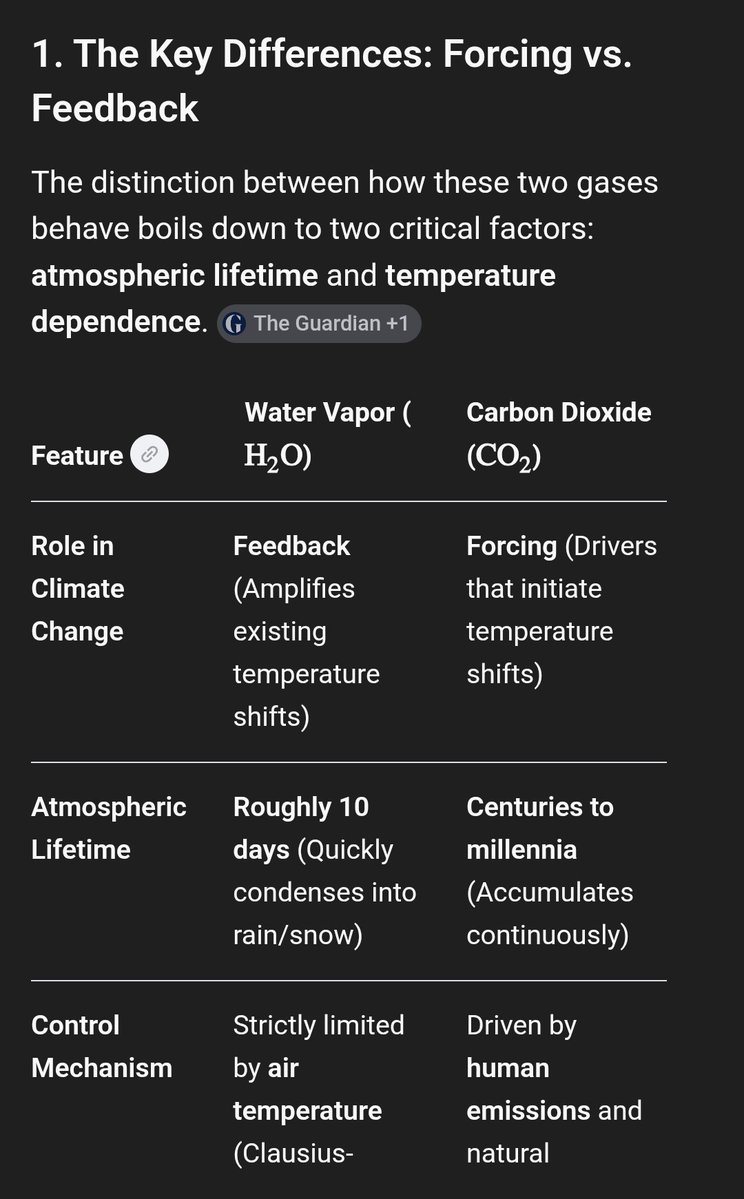
Those graphics have nothing to do with rising or falling CO2 levels. Residence time has nothing to do with 'a' molecule. The median average time in the air for 'a' molecule of CO2 is 2.4 years. 4 years residence time is the period of time in which the equivalent of the entire inventory is cycled through. All of it. Some will have have gone through dozens of cycles, some through none at all. The atmospheric 'excess', which is just 45% of human additive emissions, is 50% gone in 30 years. 'Excess' is a misleading label which only means, 'more than before' and does not mean 'too much.' 30% of emissions are swiftly added to land-based biological mass and 25% to oceans. These additions are not counted as 'excess.' Life on Earth increases proportional to rises in atmospheric CO2 levels. Atmospheric CO2 levels cannot fall without reducing the total of life on Earth.
James Harris tweet media
English
1
0
0
30
eve
eve@eve_empal·
@WormsofWrath @CAGWfool @medialens Graphic shows residence time (how fast molecules swap places), not adjustment time (how long net excess stays in the atmosphere). While a molecule swaps out in 4/5 years, the total excess pool takes centuries to decline. If there's no buildup, why have atmospheric levels risen?
English
1
0
1
14
Mak 🫒
Mak 🫒@Lilllipuce·
@DaniMayakovski @HartmannRock C'est répugnant et profondément révoltant. L'exploitation des enfants dans les mines du congo, ou les filières textiles en Asie, est un fait connu de longue date. Ce qui n'empêche pas les idiots utiles du capitalisme de surconsommer au lieu de boycotter ces produits tachés de 🩸
Français
2
0
10
259
Daniel Mayakovski
Daniel Mayakovski@DaniMayakovski·
Así es la esclavitud en las minas en el este del Congo, de donde sale más del 70% del cobalto del mundo, miles de esclavos diariamente extraen el mineral por apenas 2$ al dia para llenar los bolsillos a las multinacionales capitalistas. El capitalismo que no te enseñan, así es como se sostiene el nivel de vida y de consumo en Occidente, en estas minas al menos hay 40.000 niños esclavizados que pican piedra para que Apple saque 4 modelos de Iphone cada año.
Español
427
8.1K
10.8K
209.2K
Gary
Gary@Fran00234593·
@PeterDClack Al gore said we would all be under water by now, there again hes a fucking idiot
English
1
0
2
41
James Harris
James Harris@WormsofWrath·
@Konverter22 @PeterDClack I'm not sure the Milankovitch cycles (orbital forcing) are really that important. Charts set to scale for comparison.
James Harris tweet media
English
1
0
0
9
Mr East
Mr East@Konverter22·
@PeterDClack I thought we were - according to Milankovitch Cycles - approaching the tail end of a circa 12,000 year interglacial period?
English
2
0
1
73
James Harris
James Harris@WormsofWrath·
@PeterDClack Maybe it wouldn't be the first time. Maybe that's what sent humanity back to the caves long, long ago.
English
0
0
1
127
James Harris
James Harris@WormsofWrath·
@MikeHudema They used to call that 'green energy' before people realized that carbon is what makes the world greener.
English
0
0
0
24
Mike Hudema
Mike Hudema@MikeHudema·
IKEA has installed 935,000+ solar panels and is on track for 100% renewable electricity. This isn’t a future idea. It’s already happening. We have the solutions. Implement them. #ActOnClimate #climate #energy #renewables
English
39
193
520
7.4K
James Harris
James Harris@WormsofWrath·
@lakesdoglover @Electroversenet Nah. The oceans are the most stable, long-lived, consistent ecosystems on Earth. And they're only 1.2% of life on Earth, so they basically don't matter. It's life on land that deserves far more attention.
James Harris tweet media
English
0
0
0
1
Emma Wright
Emma Wright@lakesdoglover·
@Electroversenet I think this is an important reminder that marine ecosystems are complex and evidence must be interpreted carefully. Overfishing and ocean warming both deserve serious attention.
English
0
0
2
49
Electroverse
Electroverse@Electroversenet·
The Guardian claims ocean warming is causing a staggering collapse in marine life, but the study it cites actually shows the opposite. When a year is warmer, fish biomass is found to increase by as much as 24%. When years turn colder, biomass falls by around 15%. That is the observed data. To preserve the climate narrative, however, the authors then abandon real year-to-year results and switch to a modeled decadal trend. The model assigns warming a negative effect and reports a decline. That decline is not observed, it is modeled. The authors go on to admit they cannot separate temperature effects from overfishing, which is the primary, well-known driver of fish declines worldwide. Since fishing pressure is not included, the model loads losses onto temperature by default. Even though, as per the study's own data, warmer years mean more fish. The collapse exists only in the model.
English
20
245
618
7.5K
James Harris
James Harris@WormsofWrath·
@Electroversenet The primary gains are edge-effect gains which don't apply to general warming trends.
English
0
0
0
17
James Harris nag-retweet
John Smith
John Smith@jjsmith1245·
John Smith tweet media
ZXX
350
10.6K
27.3K
204.6K
James Harris
James Harris@WormsofWrath·
@SkylineReport Long term trends are certainly far better indicators of the future than heat waves are.
James Harris tweet media
English
0
0
0
6
P a u l ◉
P a u l ◉@SkylineReport·
If you trust a weather model enough to cancel a flight, it's a little strange to call the same physics a hoax when it predicts what happens after decades of adding greenhouse gases to the atmosphere. 🌎🔥
P a u l ◉@SkylineReport

🚨 "If scientists can't predict the weather next month, how can they predict climate change?" Because weather and climate are different questions. Weather asks: 👉 Will it rain in San Antonio on June 10? Climate asks: 👉 What happens to the atmosphere when we keep adding greenhouse gases for decades? Weather is chaotic. Tiny differences today can change the exact forecast two weeks from now. Climate is statistical. We don't need to know the weather on a specific Tuesday in 2050 to know what happens when billions of tons of CO₂ trap more heat in the system. In fact, the same physics, thermodynamics, fluid dynamics, and atmospheric equations used to produce the weather forecast you trust before a flight are used in climate models. And those weather forecasts work remarkably well: • 5-day forecasts are about 90% accurate. • 7-day forecasts are about 80% accurate. • Today's 4-day forecasts are roughly as good as 1-day forecasts were 30 years ago. The real irony? People trust weather models enough to cancel flights, evacuate hurricanes, protect crops, and prepare for floods. Then some of those same people turn around and call the exact same physics a "hoax" when it predicts long-term warming. That's not skepticism. That's selective disbelief.

English
9
11
18
491