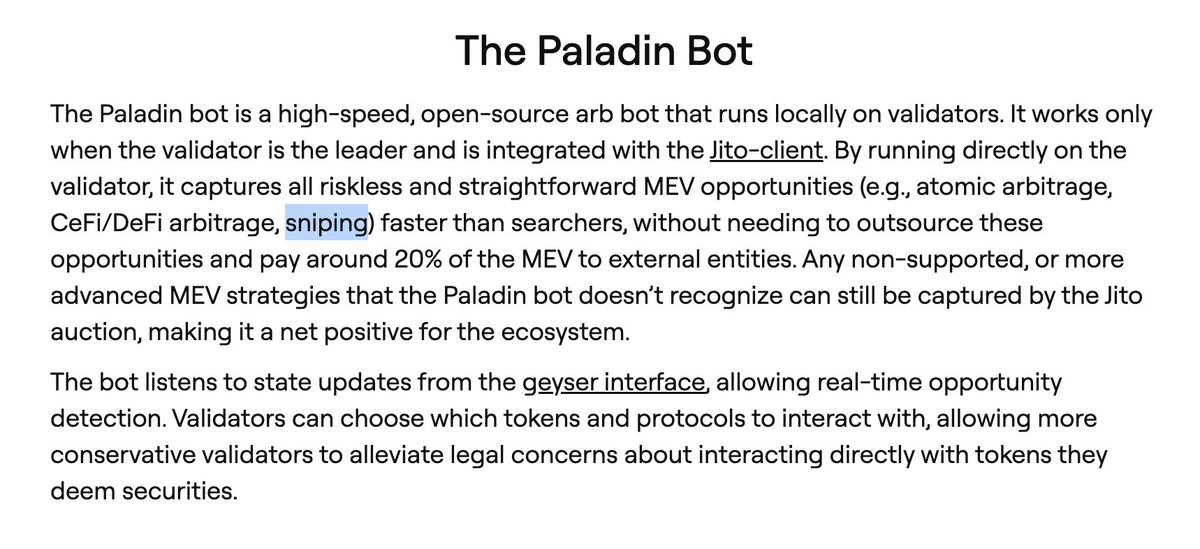
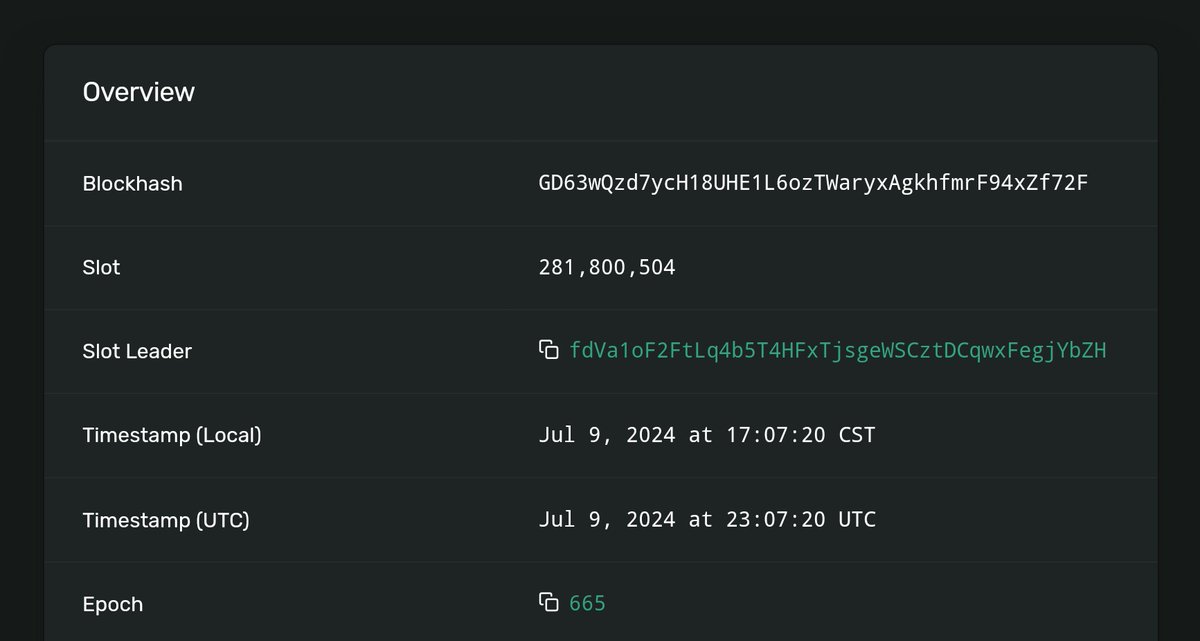
This is exactly what happens when your route is generated off chain and executed on chain
@ArcherExchange_ inverts this by performing truly full on-chain routing and giving users the tightest spreads
And yes, our short and longer duration markouts are positive
Solana Transaction Execution Lock Relaxation Proposal
A scheduler (both leader and replay) change that has a theoretical improvement of less than ~2x. No protocol changes needed.
Idea: Drop transaction read locks right away after loading the account state.
Why? This allows upcoming transactions that write-lock the same account to start executing immediately. Pipeline efficiency potential increases significantly (depending on shape).
How? Enforce linearizability requirements. While sub-sequent transactions write locking the same account can start execution, they cannot be recorded as before the reading transaction.
All account states are locked, read and frozen at the start of the transaction; this keeps things consistent throughout execution of the reading transaction.
The linearizability concept happens at the commit/record level; even though the reading and writing transactions might be happening at the same time; the read will always be recorded before the write.
In the case of failure; write transaction is unblocked from commit.
Now that transaction batches can be conflicting (recent change), the trade off here would be the savings of locking and loading the account in one thread and then execute sequentially versus finding an optimized boundary in the graph to split and put into another thread (paying the price for the cross-thread communication). For 'heavy' transactions this could exceed the cross-core optimization.
Generally the less restrictions for ordering, the more flexibility the execution pipeline has and the more efficiently it can schedule.
Flow of Value > Store of Value
Technologies, systems and protocols that enable compute, dynamic state changes, and real transactions are far more interesting than static, HODL til you die, sinks for capital.
Holding has it's place; but it is inherently stagnating on it's own.
Why Perpetual Derivatives?
By volume, most people's recent interactions with investments is not truly tied to ownership; they usually don't care about having voting or creditors rights. They want to 'catch' what they consider is the right direction; this could be a hunch or a sophisticated, programmatic control of exposure.
Obfuscated behaviour.
Unilateral fee schedules.
Permissioned custody.
Lack of capital flexibility.
Un-aligned interests.
These costs are simply too high.
The necessity for truly decentralized financial venues is obvious: why would we let the most important elements of our modern financial and economic system (price discovery and capital movement) be centralized and obfuscated as opposed to decentralized, distributed and transparent?
While decentralization itself is not a selling point to most people; it's downstream effects result in tremendous value for them. They are no longer 'under the boot' due to a power imbalance.
Our goal now (as an industry) should be to mitigate the downsides (invest in UX and security), maximize the upsides (steer away from short-term max-extract, build market-collaborative mechanisms); and spread our message in a non-frenetic way (cryptos brand is quite tainted; we need to level out). Not easy in any way.
We have all the right ingredients to deliver good products; we just have to learn to cook properly.
As much as it may pain the pure-builder-class; technological sophistication itself cannot replace good products. And what makes a product 'good' involves zooming out and seeing how you, your message, your mechanisms, your system; fit into the greater world (markets, players, culture, humanity). Don't write these off as 'implementation details'. The same goes for hype-men/women, distributors and marketers; just in the opposite direction; don't over-promise or in many ways; lie.
There has to be a holism between the product, the message and where it fits in the world. The old, non-philosophical term is PMF (Product Market Fit).
DeFi Products (like truly decentralized exchanges) will achieve incredible total financial market capture/liftoff in the next few years if they are able to pull this off properly.
if you think the prize for perp DEXs is outcompeting Binance and other CEXs, you're thinking too small...that's only phase 1
phase 2 is eating tradfi options volume -- a large chunk of which is just retail and institutions looking for delta-one, directional leverage
phase 3 is perps on anything with a data feed
Prices are magical because they effectively compress what a society values; and this itself is insanely useful. It captures the relationships between entities and concepts in the world; and relationships really are everything; anything is defined by its distance, connections, and direction from other things (both meta-physically and physically).
As a gift to the Solana community for Breakpoint 2025, we've decided to open-source `peephole` github.com/ergonia/peepho…
peephole: Zero-copy account parsing for Solana programs
solana_program::entrypoint::deserialize allocates `AccountInfo` structs and copies account data. peephole skips that with a zero-alloc and zero-copy view over the account and instruction data.
Real-world: 51 CU oracle update, 67 CUs for 3 oracle updates, 12 CU trading contract, and many others.
h/t @zft_send
1/ A thing I keep hearing more and more is that RFQs are always better for swappers. This is wrong
We can all agree that the RFQ provider has a free option. The value of that option comes at the expense of someone. Most people think it comes entirely from the passive LPs. Not so
The root cause analysis (RCA) report on last week's network patch is now available. Thanks to the entire @solana community for all your work getting this update out.
anza.xyz/blog/agave-net…