
Oshan Ivantha
797 posts
Oshan Ivantha
@_ivantha
Researcher | Lead ML Engineer @saluslabs | RL, ML, AI, CV, Game Theory | ex @wso2 | @ucsc_lk
Sri Lanka Sumali Haziran 2011
324 Sinusundan137 Mga Tagasunod
Oshan Ivantha nag-retweet
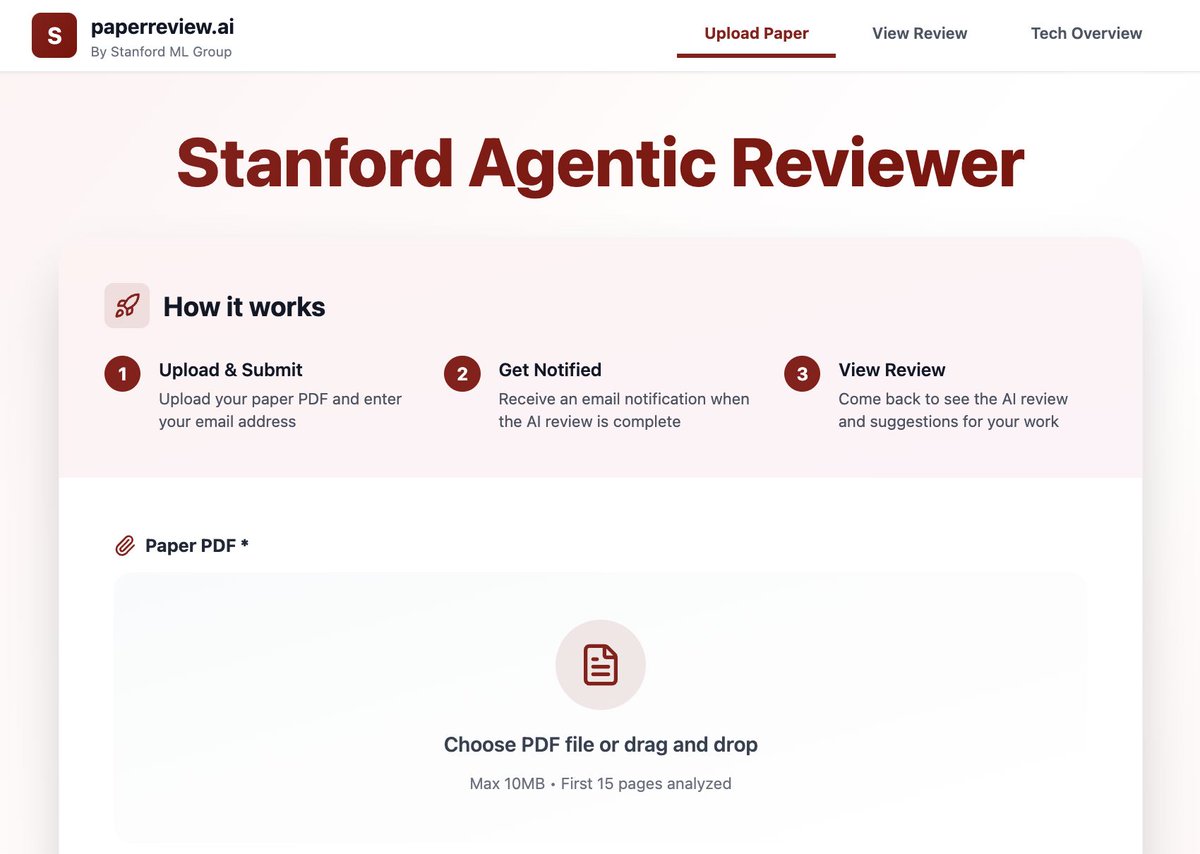
Releasing a new "Agentic Reviewer" for research papers. I started coding this as a weekend project, and @jyx_su made it much better.
I was inspired by a student who had a paper rejected 6 times over 3 years. Their feedback loop -- waiting ~6 months for feedback each time -- was painfully slow. We wanted to see if an agentic workflow can help researchers iterate faster.
When we trained the system on ICLR 2025 reviews and measured Spearman correlation (higher is better) on the test set:
- Correlation between two human reviewers: 0.41
- Correlation between AI and a human reviewer: 0.42
This suggests agentic reviewing is approaching human-level performance.
The agent grounds its feedback by searching arXiv, so it works best in fields like AI where research is freely published there. It’s an experimental tool, but I hope it helps you with your research.
Check it out here: paperreview.ai
English
Oshan Ivantha nag-retweet

🇱🇰 3 Months, No Policy — E-Commerce Still in Limbo
⭕ It has been over 3 months since the government supposedly began working on a new framework for taxing and releasing e-commerce goods.
⭕ As usual with the Department of Trade and Investment policies & Dept of Customs, nothing has materialized.
⭕ Meanwhile, 🇨🇳 AliExpress continues to impose arbitrary taxes on goods electronic parts, circuit components, and educational items that cannot be sourced elsewhere.
⭕ The worst part is that there is no cross-check mechanism between what customers pay as “taxes” and what intermediaries declare to customs — meaning much of the changed fees as "taxes" never reaches government coffers.
#SriLanka #Ecommerce

Numbers.lk@numberslka
Sri Lanka 🇱🇰 is set to implement a new tariff mechanism for e-commerce (AliExpress, Temu) trade—question: how long will it take? ⭕ President has instructed the Finance Ministry to implement a tariff framework to speed up clearance and facilitate B2C e-commerce trade. ⭕ The Ministry is reportedly weighing an intermediate system between the older informal per-kg methodology and the current HS-based system—possibly a de minimis threshold plus a flat rate. ⭕ The Trade and Investment Policies (TIP) department of the Finance Ministry has been tasked with implementing this new mechanism. ⭕ Historically, TIP has been one of Sri Lanka’s most lethargic departments: hundreds of policy proposals from industry and other government ministries and departments sit unreviewed, and it has never found the right balance between facilitation and tariff barriers. ⭕ Decades-old concessionary rates on certain HS codes, as well as exorbitant rates on others, have rarely been reviewed or adjusted based on whether the intended outcomes have been achieved. ⭕ For example, shoes carry a Rs 2,000 cess duty on every imported pair—a rate unchanged for decades—yet we have not seen measurable growth in the local industry; instead, smugglers profit. ⭕ Industries such as electric appliances are lobbying for separate HS codes for items requiring SLSI approval versus those that do not, to avoid unnecessary clearances and approval delays caused by grouping all products under the same code. - not happened yet. ⭕ The solar industry wants to lower the lithium-ion battery tax to foster growth in the battery-backed solar space. - not happened yet. ⭕ Even government ministries find it extremely difficult to get things done by TIP. For example, the Industries Minister wants to increase the tax on cheap lighter imports to protect the failing matchbox industry, but that change has not yet occurred. ⭕ The saddest part is that TIP could be a great tool for the country—like the Central Bank—for driving significant economic progress by analyzing data and setting rates while bypassing bureaucracy, yet the department has rarely acted. ⭕ The administration wants a viable tariff mechanism for E commerce within days to weeks; however, if TIP follows its old pattern, it may take not months or years, but decades before a new e-commerce tariff framework materializes. This would be a good KPI for the TIP (Department of Trade and Investment Policies) under this government. Let’s see how long it will take to implement a new mechanism... #SriLanka #Ecommerce
English
Check out our paper on Privacy-Preserved Machine Learning using Secure Multi-Party Computing!
techscience.com/doi/10.32604/c…
English
The changes that our country needs that don’t cost a fortune to implement.
Numbers.lk@numberslka
🚆 Passport/NIC Verification System Now Operational for Sri Lanka Train Bookings 🇱🇰 Sri Lanka Railways has launched a mandatory identification verification system for train ticket reservations. ⭕ All passengers now must provide NIC number (Sri Lankan citizens) or passport number (foreign nationals) when booking seats online or at counters, with original documents required for verification during boarding and ticket checks. ⭕ Policy applies exclusively to reserved seats on intercity, long-distance, and premium train services across all routes, while unreserved ticket purchases remain unaffected by this requirement. ⭕ System is designed to eliminate illegal resale activities, and stop black market sales that were inflating prices, particularly on popular tourist routes like Kandy-Ella. #SriLanka #Railway
English
Oshan Ivantha nag-retweet


Oshan Ivantha nag-retweet

The single most destructive falsehood taught in school wasn’t a fact, it was a frame:
“The system is neutral.”
We were taught:
•History is objective
•The economy is fair
•Science is apolitical
•Authority is earned
•Success is linear
•Money follows merit
•The future will reward obedience
All of it designed to manufacture compliance not understanding.
The truth is:
•History is written by power.
•The economy is shaped by leverage, not labor.
•Science is real, but funding decides the questions.
•Authority is often inherited or engineered.
•Success follows strategic asymmetry.
•Money follows network, not virtue.
•The system rewards signal, not submission.
We weren’t taught how the world works.
We were taught how to function inside the world they already built.
That’s why so many wake up at 30, 40, or 50 and feel betrayed.
The curriculum was never designed to liberate you.
It was designed to format you.
The deepest falsehood wasn’t any one fact.
It was the illusion that the system was built for truth.
English
Oshan Ivantha nag-retweet

Oshan Ivantha nag-retweet


Oshan Ivantha nag-retweet

Oshan Ivantha nag-retweet


Tired of seeing these posts in my feed 🤦♂️
Jeremy Howard@jeremyphoward
Wow, actual grown men are still doing the "I asked the LLM about itself and it said" thing. In 2025. Folks, LLMs don't know anything about how they themselves are built or deployed, unless they've been explicitly programmed with that information (which they almost never are).
English
Oshan Ivantha nag-retweet

To people who think
"China is surpassing the US in AI"
the correct thought is
"Open source models are surpassing closed ones"
See ⬇️⬇️⬇️
English
Oshan Ivantha nag-retweet
Oshan Ivantha nag-retweet


Each time I receive my water bill, I wonder if we have aptly valued such an essential and finite resource.
Numbers.lk@numberslka
🚰 Sri Lanka 🇱🇰 Revises Water Tariffs, Effective August 21, 2024 ⭕️ Domestic users: 7% reduction in water tariffs. ⭕️ Government hospitals: 4.5% reduction. ⭕️ Schools & religious places: 6.3% reduction. To calculate your bill: tools.numbers.lk/watercal #SriLanka #WaterTariffs
English
Oshan Ivantha nag-retweet

Both for-profit education & for-profit healthcare are both highly efficient & highly profitable for shareholders.
The only problem is that students & patients are not the shareholders.
#CommonSense
BladeoftheSun@BladeoftheS
In 1968 Finland banned for profit education, the few private schools that exist in Finland have to reinvest any profit they make or pay it back to parents. It has been in the Top 3 in education for the last 20 years. There should be no profit in education or healthcare.
English
Oshan Ivantha nag-retweet