
Veritas

66 posts

Veritas banner
Veritas

Veritas

@ahuayeah

Networks & Complexity. PhD @CityUHongKong. Posdoc @BNU_1902.

Hong Kong Sumali Mart 2016
326 Sinusundan40 Mga Tagasunod
Veritas nag-retweet
OpenClaw🦞
OpenClaw🦞@openclaw·
🦞 OpenClaw 2026.1.30 🐚 Shell completion 🆓 Kimi K2.5 + Kimi Coding: run your claw for free 🔐 MiniMax OAuth: one more model just a login away 📱 Telegram got a glow-up — 6 fixes from threading to HTML rendering Plus a bunch of community-contributed fixes across LINE, BlueBubbles, routing, security & OAuth. The lobster provides 😏 github.com/openclaw/openc…
English
475
716
8K
1.6M
Veritas nag-retweet
Network Science Society
Network Science Society@netscisociety·
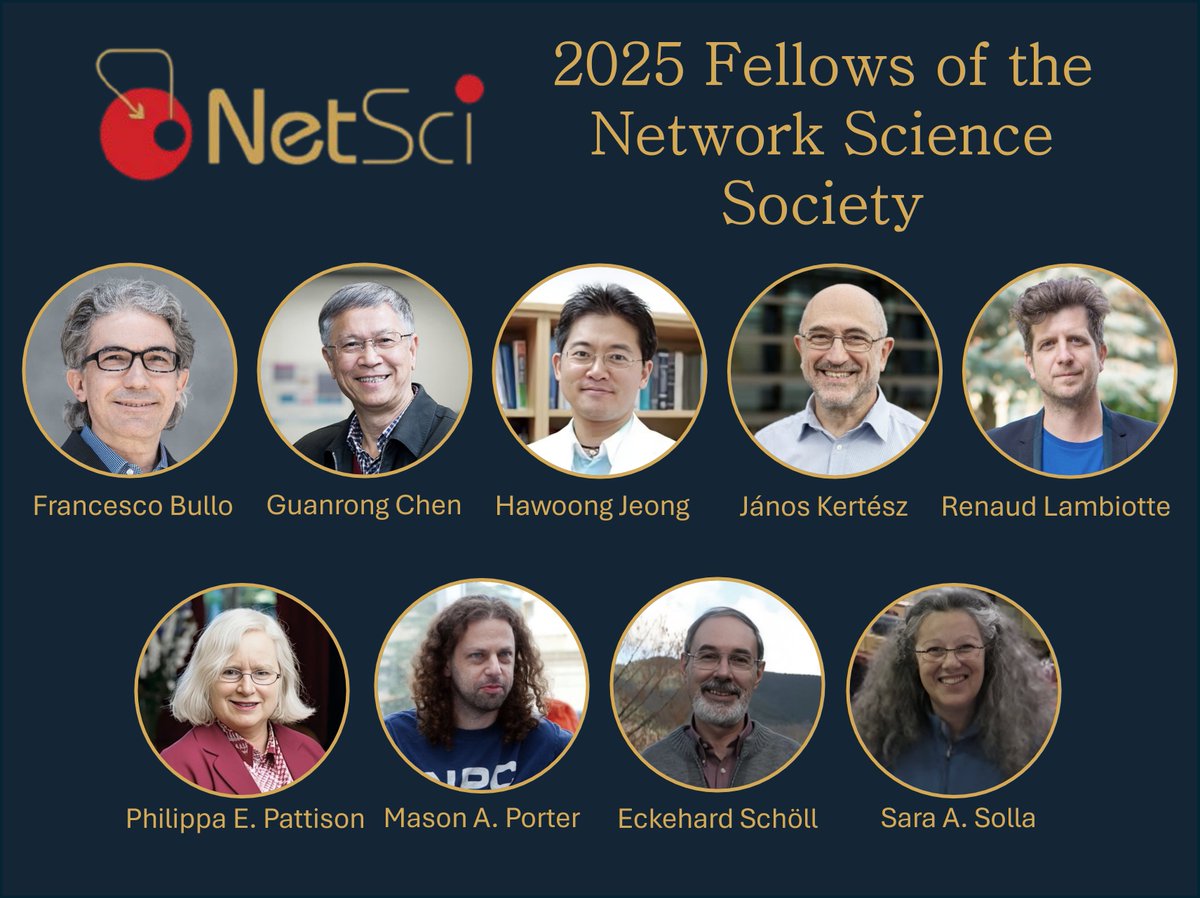
The Network Science Society has a new class of Fellows! Congratulations to the 2025 awardees: Francesco Bullo Guanrong Chen Hawoong Jeong János Kertész Renaud Lambiotte Philippa E. Pattison Mason A. Porter Eckehard Schöll Sara A. Solla
Network Science Society tweet media
0
12
30
2.7K
Veritas nag-retweet
Jacy Reese Anthis
Jacy Reese Anthis@jacyanthis·
Should we use LLMs 🤖 to simulate human research subjects 🧑? In our new preprint, we argue sims can augment human studies to scale up social science as AI technology accelerates. We identify five tractable challenges and argue this is a promising and underused research method 🧵
Jacy Reese Anthis tweet media
English
23
64
317
82.6K
Veritas nag-retweet
William J. Brady
William J. Brady@william__brady·
New paper out in @ScienceMagazine! In 8 studies (multiple platforms, methods, time periods) we find: misinformation evokes more outrage than trustworthy news, when it does it's shared more + ppl are less likely to read before sharing. w/ @killianmcl1 @Klonick @mollycrockett 🧵👇
William J. Brady tweet media
English
11
165
399
64K
Veritas nag-retweet
Tiziano Piccardi
Tiziano Piccardi@tizianopiccardi·
New paper: Do social media algorithms shape affective polarization? We ran a field experiment on X/Twitter (N=1,256) using LLMs to rerank content in real-time, adjusting exposure to polarizing posts. Result: Algorithmic ranking impacts feelings toward the political outgroup!🧵⬇️
Tiziano Piccardi tweet media
English
5
69
237
52.1K
Veritas nag-retweet
Joon Sung Park
Joon Sung Park@joon_s_pk·
Simulating human behavior with AI agents promises a testbed for policy and the social sciences. We interviewed 1,000 people for two hours each to create generative agents of them. These agents replicate their source individuals’ attitudes and behaviors. 🧵arxiv.org/abs/2411.10109
Joon Sung Park tweet media
English
30
247
962
191K
Veritas nag-retweet
Wenyue Hua
Wenyue Hua@HuaWenyue31539·
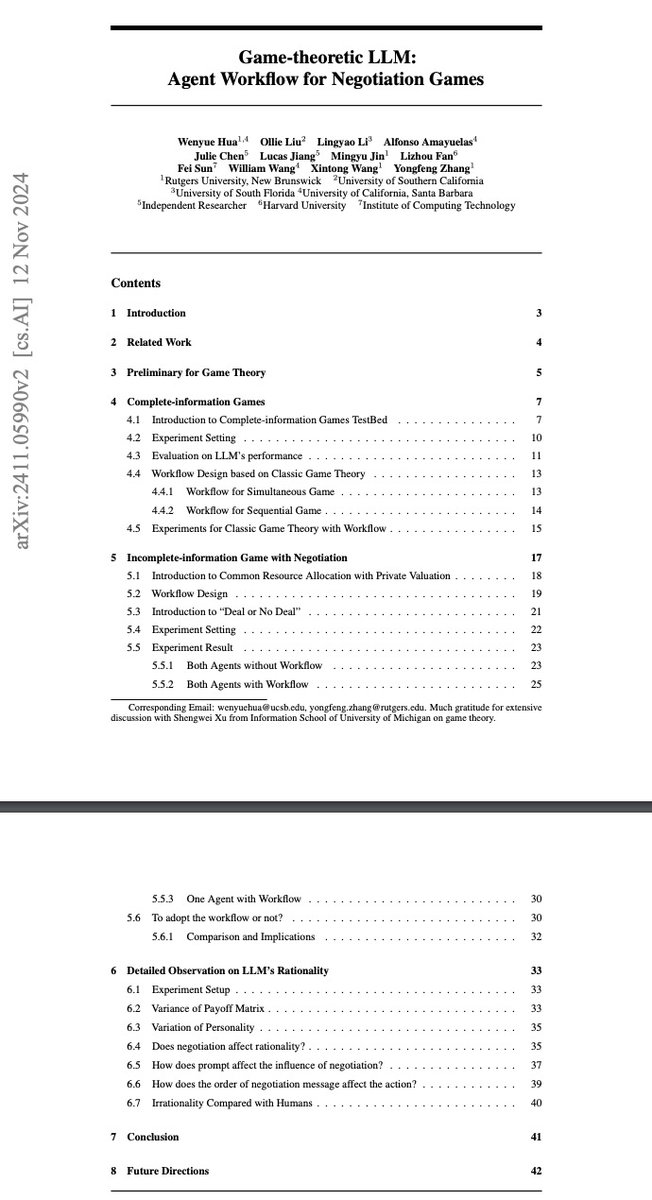
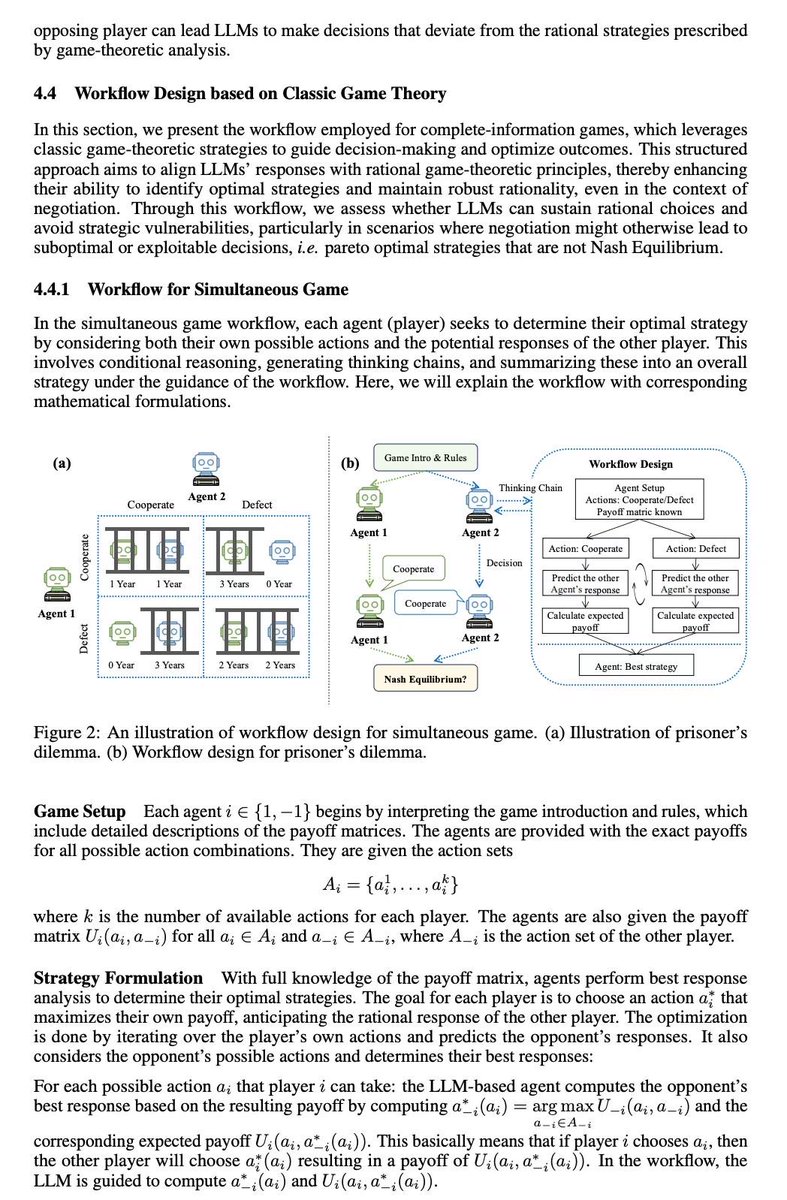
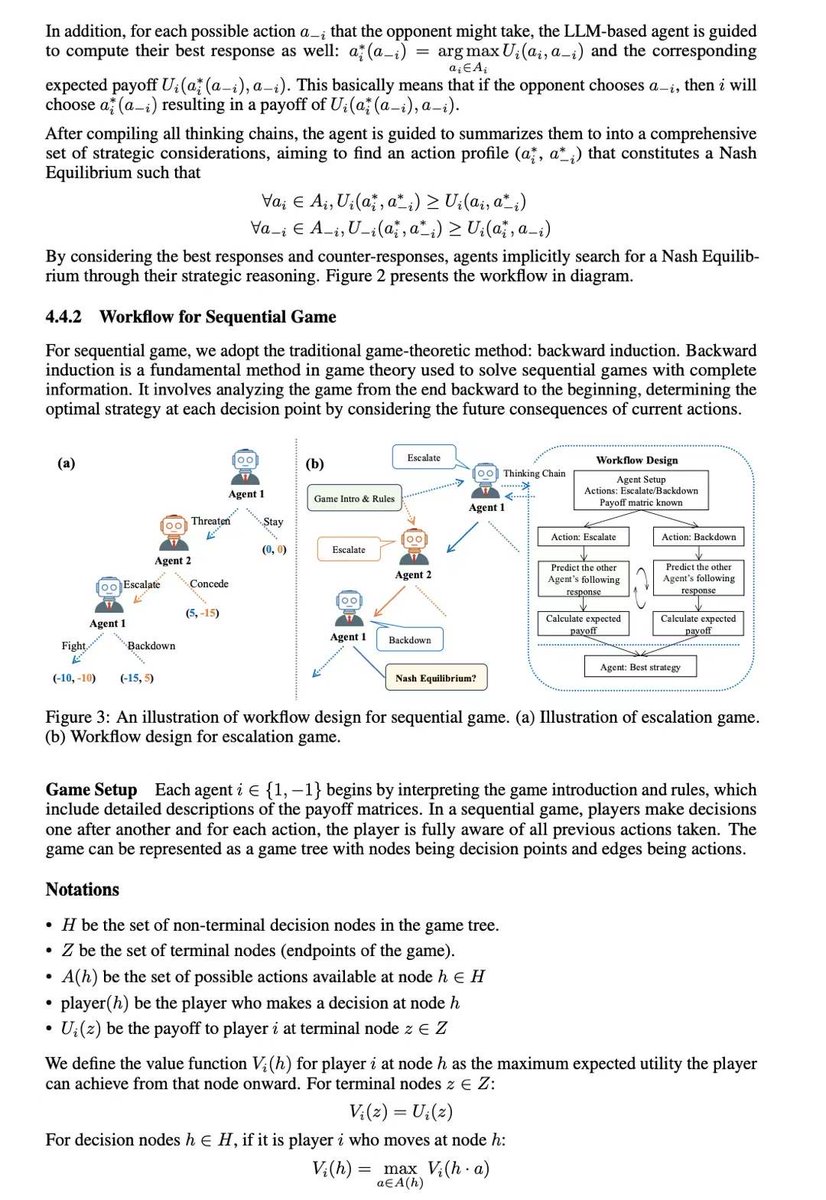
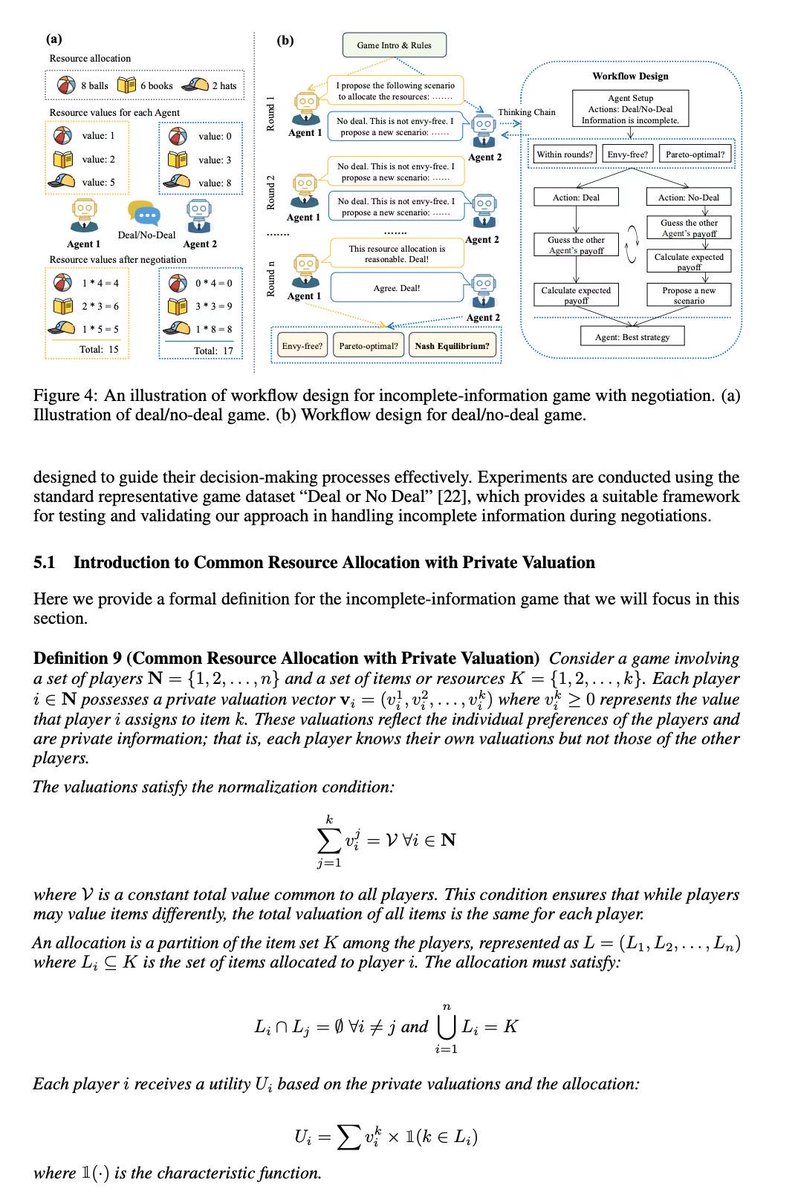
🌟🎲🎲How to create a rational LLM-based agent? using game-theoretic workflow! Game-theoretic LLM: Agent Workflow for Negotiation Games 😊 paper link: arxiv.org/abs/2411.05990 github link: github.com/Wenyueh/game_t… 😼 This paper aims at observing and enhancing the performance of agents in interactions guided by self-interest maximization 😼 😼 We chose game theory as the foundation, with rationality and Pareto optimality as the two basic evaluation metrics: whether an individual is rational and whether a globally optimal solution is developed based on individual rationality. ❣️ Complete information games They are classic games such as Prisoner's Dilemma. We selected 5 simultaneous games and 5 sequential games. We found that, except for o1, other LLM generally lack a robust ability to compute Nash equilibria, meaning they are not very rational. They are not robust to noise, perturbations, or random talks among them. Therefore, based on classical game theory methods (Iterative Elimination of Dominated Strategy & Backward Induction), we designed two workflows to guide large models step-by-step in computing Nash equilibria during inference time. ❣️ Incomplete information games We used the classic "Deal or No Deal" resource allocation game with private valuation, where agents do not know the opponent's valuation of resources. Game theory does not provide a solution for this, and previous work has been based on reinforcement learning. 👉 Sonnet and o1 perform better than humans in terms of negotiation success rate and results 👉 Opus and 4o are far behind. 👉 We designed an algorithmic workflow based on the rational actor assumption, allowing agents to infer the opponent's valuation based on their reactions to various resource allocation schemes. The workflow is very effective, reducing the possible estimated valuations from an initial 1000 possibilities to 2-3 within 5 rounds of dialogue, and always including the opponent's true valuation. 🌟🌟Based on the estimated valuation of opponent's resource, we guide the agents in each step to calculate and propose an allocation proposal that maximizes their own interests while having a non-zero probability of being envy-free, ensuring that both parties are relatively satisfied and the negotiation can proceed. 🌟🌟 But very interestingly, we found that if only one agent uses this workflow during negotiation, it will be exploited. Although the workflow improves the overall negotiation outcome and brings more benefits to the individual agent, the benefits will always be less than the opponent's. 🔥In the future, we will need a meta-strategy to choose which workflows to use!
Wenyue Hua tweet mediaWenyue Hua tweet mediaWenyue Hua tweet mediaWenyue Hua tweet media
English
5
49
199
26.6K
Veritas nag-retweet
Yamir Moreno
Yamir Moreno@cosnet_bifi·
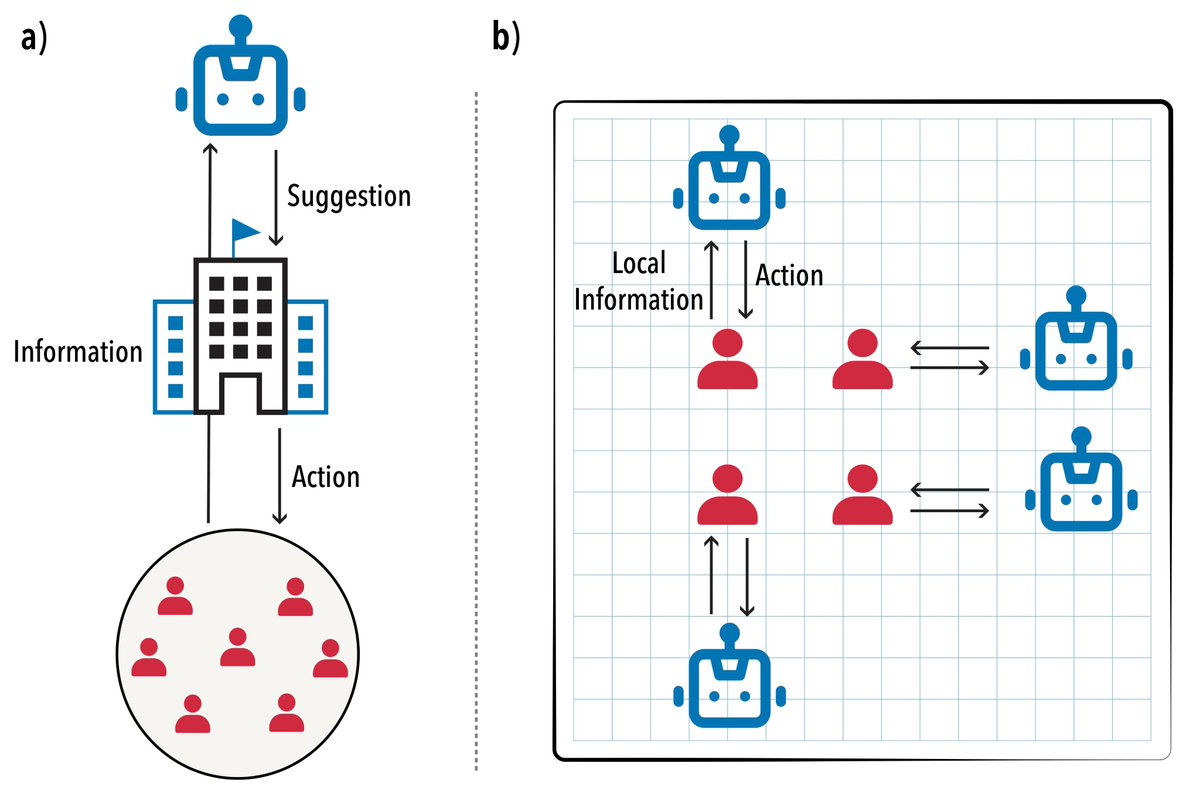
Now out "LLMs and generative agent-based models for complex systems research" (sciencedirect.com/science/articl…). We discuss how LLMs & Generative ABMs could shape research in complexity science & identify challenges and opportunities for future frontier cross-disciplinary research.
Yamir Moreno tweet media
English
1
36
83
7K
Veritas nag-retweet
Michele Starnini
Michele Starnini@m_starnini·
New paper out! Simple and complex contagions occur together in social phenomena. We aim to identify which contagion mechanism dominates a spreading process propagated by time-varying interactions, w/ assuming prior knowledge about adoption decisions. 1/2 arxiv.org/abs/2410.22115
Michele Starnini tweet media
English
2
14
59
7.1K
Veritas nag-retweet
Mason Porter
Mason Porter@masonporter·
Our new 95-page review article is out on arXiv! "Structural Robustness and Vulnerability of Networks" (by Alice C. Schwarze, Jessica Jiang, Jonny Wray, Mason A. Porter): arxiv.org/abs/2409.07498 This is a very ambitious article, which was led superbly by @aliceschwarze.
Mason Porter tweet media
English
0
34
113
13.1K
Veritas nag-retweet
Dawn Song
Dawn Song@dawnsongtweets·
Large Language Model Agents is the next frontier. Really excited to announce our Berkeley course on LLM Agents, also available for anyone to join as a MOOC, starting Sep 9 (Mon) 3pm PT! 📢 Sign up & join us: llmagents-learning.org
Dawn Song tweet media
English
29
242
1.1K
153.4K
Veritas nag-retweet
CCSS Koç University
CCSS Koç University@ccss_ku·
Online CSS Course: CCSS is proud to share our repository which contains a full introductory course to CSS methods with Python. Teaching materials meet the criteria of a gradable university course, are fully online, self-explanatory, and freely available: ccss.ku.edu.tr/online-courses/
English
1
21
92
13.1K
Veritas nag-retweet
Yamir Moreno
Yamir Moreno@cosnet_bifi·
Now out: arxiv.org/abs/2408.09175. Here, we revise the recent literature on Generative ABMs focusing on research that makes use of LLMs to investigate networks, evolutionary game & social dynamics, & models of disease spread. We also identify current challenges and opportunities.
Yamir Moreno tweet media
English
2
12
55
4K
Veritas nag-retweet
Yamir Moreno
Yamir Moreno@cosnet_bifi·
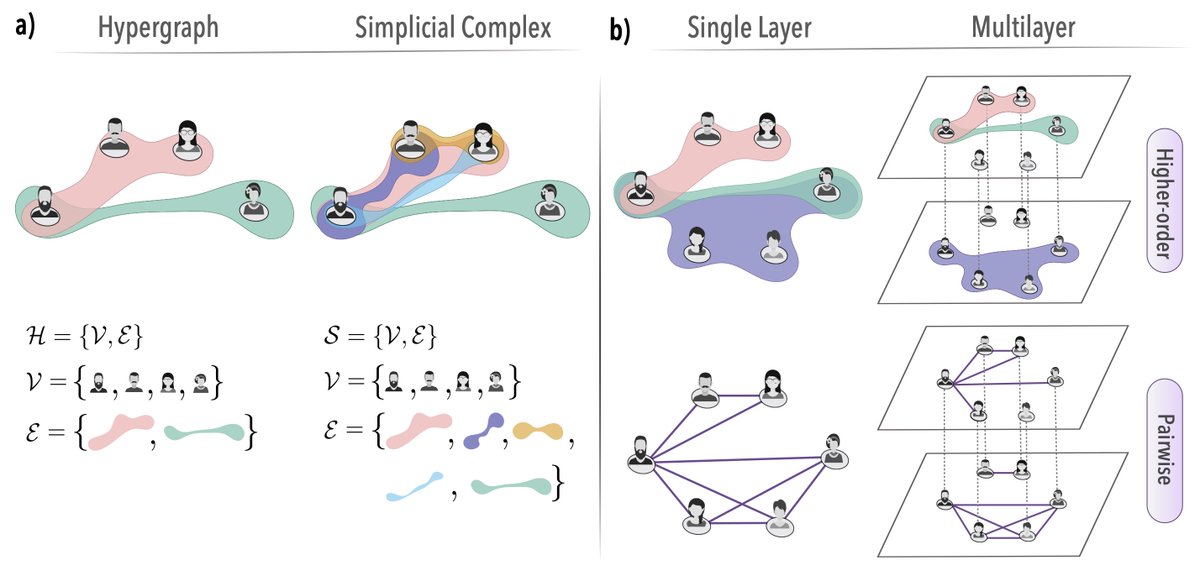
Our review "Contagion dynamics on higher-order networks" is out in @NatRevPhys (rdcu.be/dMQiv). We review the literature on the topic and take the opportunity to propose a unified formalism covering most of the functional forms used for the spreading dynamics (1/2).
Yamir Moreno tweet media
English
4
76
321
31.3K
Veritas nag-retweet
Lucine_Zhong
Lucine_Zhong@lucine_zhong·
🎉🎉🎉Thrilled to share our new @NatureMedicine article, examining whether healthcare systems can adapt to, and achieve higher resilience by learning from successive disruptions during the pandemic crisis. Grateful to the amazing co-authors @SenPei_CU and @jianxi_gao, @csatrpi
Lucine_Zhong tweet media
English
1
2
7
1.2K