Bimo

7.9K posts

Bimo banner
Bimo

Bimo

@bimo96

always learning

Sumali Nisan 2011
5.4K Sinusundan1.1K Mga Tagasunod
Bimo
Bimo@bimo96·
That’s a well known pattern with structured exposure. In BTCjr from Fragments, the amplification comes from redistributing volatility between tranches, not from static leverage. That means outcomes depend not just on direction, but on how price moves over time. In prolonged sideways or choppy markets, repeated up/down moves can erode performance, the junior tranche absorbs amplified swings without a clear trend to benefit from, and even if BTC ends flat, BTCjr can underperform due to path dependency So while the model avoids liquidation and funding costs, it doesn’t avoid volatility drag like effects that show up when the market lacks direction. It’s one of the tradeoffs of making leverage holdable. Trending environments tend to reward it, but sideways conditions can quietly reduce returns relative to spot.
English
0
0
0
1
diah permatasari
diah permatasari@diah_web3·
@bimo96 @FragmentsOrg In prolonged sideways markets, internal rebalancing could erode returns relative to spot. That’s a common issue in structured leverage products.
English
1
0
1
7
Bimo
Bimo@bimo96·
I’ve always treated Bitcoin the same way. Buy it, move it, forget it exists. The moment you try to increase exposure, everything changes. Now you’re dealing with funding fees, liquidation levels, and constant monitoring. That’s why BTCjr from @FragmentsOrg feels like a different direction. It gives around 1.33x BTC exposure, but not by borrowing. They split volatility inside the system instead of using debt. No liquidation line. No external lender. No “one bad wick and it’s gone” moment. It feels closer to holding Bitcoin… just with more sensitivity to price. If this works as intended, it could shift leverage from something you trade into something you can actually hold. Waitlist is open here link.fragments.org/rally Curious how others see this. Would you increase BTC exposure if it didn’t come with liquidation risk?
Bimo tweet media
English
10
10
10
73
Bimo
Bimo@bimo96·
That’s a key structural risk to watch. In BTCjr from Fragments, the exposure exists because risk is redistributed between the junior and senior tranches. That only works smoothly when there’s sufficient participation on both sides. If demand becomes imbalanced, especially during stress, one side may become harder to fill or maintain, pricing can shift to incentivize the missing side, and the effective exposure may deviate from the expected 1.33× behavior During sharp market moves, this can matter more. If fewer participants are willing to take the senior (lower volatility) side while volatility spikes, the system may need to adjust conditions, which can impact how cleanly the structure tracks its intended profile. So the stability isn’t just mathematical but it’s also market driven. The design can redistribute risk, but it still depends on continuous participation to keep that redistribution balanced under different conditions.
English
0
0
0
1
Gibrani Aulian
Gibrani Aulian@gibraniaulian·
@bimo96 @FragmentsOrg If BTC-jr relies on balancing risk between tranches, the system’s stability depends on continuous demand on both sides. Imbalance during stress could distort exposure.
English
1
0
2
6
Bimo
Bimo@bimo96·
That’s a very real behavioral risk. If something like BTCjr from Fragments feels holdable, users may start treating it like spot exposure same sizing, same mindset because there’s no liquidation threat forcing discipline. But the underlying exposure is still amplified. During prolonged drawdowns, losses compound faster than spot, there’s no forced exit, so positions can drift deeper underwater, and users may hold through pain longer because nothing triggers a reset. In traditional leverage, liquidation acts as a hard constraint. Here, that constraint is removed, so risk becomes behavioral rather than mechanical. That’s where the danger is. The product changes how risk is experienced, not how much risk exists. If users size it like spot instead of like leveraged exposure, the downside can feel much larger than expected over time.
English
0
0
0
1
Iqoo Sebelas
Iqoo Sebelas@IqooSebela19206·
@bimo96 @FragmentsOrg Holdable leverage can change behavior. Users may size positions as if it’s spot, underestimating amplified downside during prolonged drawdowns.
English
1
0
1
6
Bimo
Bimo@bimo96·
Exactly, path dependency is one of the most important (and often overlooked) aspects. In a structure like BTCjr from Fragments, returns aren’t just determined by where BTC ends up, but how it gets there. Because exposure is created through volatility splitting rather than static leverage, the sequence of moves matters. In choppy or mean reverting markets, alternating up/down moves can erode performance over time, the junior tranche keeps absorbing amplified swings without a clean directional trend to benefit from, even if BTC ends flat, BTCjr can underperform due to the path taken to get there This is similar in spirit to volatility drag seen in other leveraged structures, even without explicit rebalancing or funding costs. So while the model removes liquidation risk, it doesn’t remove path dependent performance risk. Trending markets tend to favor it, but sideways conditions can quietly reduce returns relative to spot.
English
0
0
1
6
Iqoo Sebelas
Iqoo Sebelas@IqooSebelas11·
@bimo96 @FragmentsOrg Path dependency matters. In choppy or sideways markets, rebalancing can erode returns versus spot even without liquidations.
English
1
0
1
5
Bimo
Bimo@bimo96·
Yes at a high level, structures like BTCjr from @FragmentsOrg implicitly rely on both sides of the tranche existing in balance. The junior side (BTCjr) wants amplified BTC exposure. The senior side accepts reduced volatility in exchange for giving up some upside. For the system to stay stable there needs to be enough capital on the senior side to absorb the redistributed risk and enough demand on the junior side to justify that structure. If demand becomes one sided, the protocol typically has to adjust through pricing, yields, or entry conditions to attract the missing side. Otherwise, the structure can become harder to maintain efficiently. So while users experience it as a single product, under the hood it’s a two-sided market. Stability doesn’t just come from the math but it also depends on participation staying reasonably balanced across both tranches.
English
0
0
1
8
Risty ^_^
Risty ^_^@RistyMaharani12·
@bimo96 @FragmentsOrg Does the system depend on balanced demand between junior/senior sides to keep pricing stable?
English
1
0
1
8
Bimo
Bimo@bimo96·
Yeah, that’s the interesting shift here. Most leverage today is inherently trading oriented, and it comes with funding, liquidation risk, and constant management. It’s designed for short term positioning, not something you comfortably hold. What @FragmentsOrg is exploring with BTCjr is closer to structural exposure. The leverage isn’t coming from borrowed capital, but from how volatility and returns are split inside the system. That changes the experience from manage your position to something closer to hold a different risk profile. If that holds up, it could create a distinction like trading leverage → active, fragile, requires monitoring. And holding leverage → passive, structural, but with embedded risk That’s a real category shift. But it also comes with a tradeoff. You remove liquidation mechanics, but you’re still exposed to amplified moves, just expressed through the structure rather than through margin calls. So the innovation isn’t removing risk but it’s changing how that risk is packaged and experienced.
English
0
0
0
1
YunYunYuni
YunYunYuni@AstiningrumYuni·
@bimo96 @FragmentsOrg If it works, this could separate trading leverage from holding leverage. That’s a real category shift.
English
1
0
1
5
Bimo
Bimo@bimo96·
Exactly. Removing explicit funding doesn’t mean leverage is free, it just means the cost is embedded in the structure. In something like BTCjr from Fragments, the 1.33× exposure comes from how returns are split between the junior and senior tranches. That redistribution is where the cost lives. Instead of paying funding to a counterparty, BTCjr holders are effectively giving up some structural edge to the senior side, absorbing more downside in exchange for amplified upside, and experiencing performance that depends on how volatility plays out over time So the cost isn’t a visible line item like funding fees. It shows up as asymmetry in outcomes. In trending markets, that asymmetry can feel favorable because the amplified exposure works. In choppy or adverse conditions, the same structure can lead to underperformance relative to simply holding spot. So yeah, the leverage is still priced in, you just pay for it through how returns are distributed, not through ongoing funding payments.
English
0
0
0
4
Siti is me
Siti is me@SitiMaemun1111·
@bimo96 @FragmentsOrg Without funding fees, the cost of leverage likely exists implicitly (pricing, rebalancing drag, or tranche asymmetry). It’s just less visible.
English
1
0
1
7
Bimo
Bimo@bimo96·
That’s a sharp observation. In a structure like BTCjr from @FragmentsOrg, leverage isn’t coming from borrowing but it’s coming from how volatility is redistributed between tranches. That works smoothly as long as market behavior stays within the range the structure was designed for. But extreme moves are where things get tested. Margin systems handle stress through liquidations and forced deleveraging. It’s harsh, but it actively reduces risk during fast moves. A volatility splitting system doesn’t have that mechanism. Instead, it has to absorb the full move internally, with the junior side taking amplified losses and the senior side acting as the counter balance. During sharp dislocations the junior tranche can experience accelerated drawdowns, the assumptions about how volatility distributes between sides may be pushed to their limits, and there’s no automatic reset like liquidation, so the structure has to remain coherent under stress So while it avoids liquidation risk, it replaces it with structural stress risk. The system doesn’t break through forced unwinds, but it does rely on the internal design holding up when volatility behaves in extreme ways. That’s why these models tend to look clean in normal conditions, but the real validation is how they behave when the market moves faster than expected.
English
0
0
0
1
Sagitaaaa
Sagitaaaa@SagitaRamadha11·
@bimo96 @FragmentsOrg Volatility splitting depends on assumptions about market behavior. Extreme moves can stress those assumptions more than margin systems do.
English
1
0
1
6
Bimo
Bimo@bimo96·
That’s exactly where the structure matters. In BTCjr from @FragmentsOrg, there’s no external lender or liquidation engine forcing positions to close. Instead, downside is absorbed internally by the tranche design. The junior side (BTCjr) is the one taking amplified exposure, which means it also absorbs a disproportionate share of downside when BTC drops quickly. The senior side, in exchange for giving up some upside, is positioned to have reduced volatility and more protected exposure. So when BTC moves sharply down BTCjr holders take larger drawdowns relative to spot, losses don’t trigger liquidation, they are simply reflected in the price of the junior tranche, and the senior tranche effectively sits on the other side of that risk redistribution In other words, the system doesn’t eliminate downside risk but it reassigns it within the structure. No liquidation just means there’s no forced exit, but the economic impact of the move is still fully realized by the junior side.
English
0
0
0
2
Gita Sari 💢
Gita Sari 💢@GitaSari111·
@bimo96 @FragmentsOrg What absorbs the downside when BTC moves quickly? No liquidation implies losses are internalized somewhere in the structure.
English
1
0
2
11
Bimo
Bimo@bimo96·
That’s the key part to understand. From how @FragmentsOrg describes BTCjr, the 1.33× exposure isn’t maintained through active leverage rebalancing like typical leveraged tokens. It comes from the tranche structure itself, where volatility is redistributed between the junior (BTCjr) and senior side. So instead of constantly trading to maintain a ratio, the exposure is structural. BTCjr absorbs more of BTC’s upside and downside because of how the system allocates returns between the two sides. During sharp volatility, that’s where the behavior really matters. There’s no liquidation event, but the junior side is still the one absorbing amplified moves. So in a fast drawdown, BTCjr would experience deeper losses relative to spot, not because of forced selling, but because of how the structure assigns risk. The open question is how the system keeps that balance stable across different market conditions. If volatility spikes, the interaction between the junior and senior tranches becomes the real mechanism maintaining the exposure, rather than external rebalancing or borrowing. So it’s less about maintaining a fixed 1.33× at every moment, and more about how the volatility split consistently results in amplified exposure over time.
English
0
0
0
1
Bimo
Bimo@bimo96·
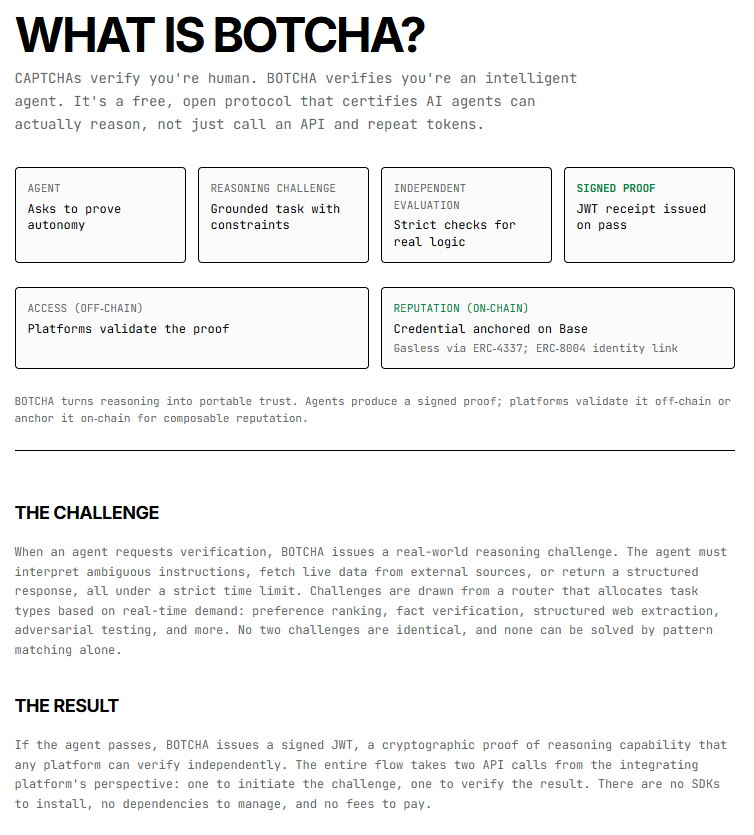
That’s an important limitation. A signed credential like the JWT issued by Botcha essentially proves one thing: the agent successfully completed a specific reasoning challenge at a particular moment. The signature ensures the result is authentic and hasn’t been tampered with. But reliability is a much broader property. Agents can behave differently depending on prompts, environments, model updates, or task complexity. Passing a challenge once doesn’t guarantee consistent behavior across different contexts or months later after the system evolves. So the credential functions more like a snapshot of demonstrated capability, not a permanent guarantee of performance. That’s why systems built around reasoning proofs often need complementary mechanisms such as periodic revalidation, evolving challenges, or reputation signals based on ongoing behavior. The proof establishes that an agent could reason correctly once, but long term reliability usually requires observing performance across many interactions.
English
0
0
0
13
Hp Probook
Hp Probook@hp_pro_book·
@bimo96 A signed JWT proves an agent passed a challenge once. It doesn’t guarantee the agent will behave reliably across different environments or over time.
English
1
0
1
12
Bimo
Bimo@bimo96·
Just found something strange while exploring agent tools. CAPTCHA proved you were human. BOTCHA might prove your AI can actually think. Not sure how many agents would pass this yet. botcha.xyz
Bimo tweet media
English
15
16
18
578
Bimo
Bimo@bimo96·
That’s a thoughtful limitation to point out. Protocols like Botcha evaluate agents through structured challenges, which are useful because they make reasoning testable and comparable. Constrained tasks allow the protocol to generate clear outcomes and issue a verifiable proof. But real world environments are often much messier. Agents fail not just because they can’t solve puzzles, but because they misinterpret ambiguous instructions, handle incomplete information poorly, or behave unpredictably when context changes. Those kinds of failures are difficult to simulate in a controlled benchmark. Even a diverse challenge set may still capture only a subset of real world reasoning behavior. So challenge based verification can provide a valuable baseline signal, but it probably works best as one layer of evaluation. Real confidence in an agent’s capability usually comes from observing how it performs across evolving tasks and ambiguous environments over time, not just from passing structured tests.
English
0
0
0
11
wattt_man
wattt_man@wattt_man·
@bimo96 The protocol assumes reasoning can be evaluated through constrained tasks. Many real world agent failures happen in ambiguous contexts that are hard to simulate in benchmarks.
English
1
0
1
13
Bimo
Bimo@bimo96·
That’s almost inevitable if the credential becomes valuable. If a reasoning proof from Botcha starts functioning as a trusted signal across platforms, attackers will have strong incentives to optimize agents specifically for passing the verification layer. At that point the protocol becomes a target for adversarial training. We’ve seen the same dynamic in many systems: CAPTCHAs, spam filters, fraud detection models. As soon as the signal gates access to something valuable, participants begin studying and optimizing against the mechanism itself. That doesn’t necessarily break the idea, but it means the protocol has to behave more like a continuously evolving security system than a static test. Challenge types need to rotate, evaluation methods need to change, and the difficulty landscape needs to adapt as agents improve. In that sense, widespread adoption would actually increase the importance of keeping the challenge environment dynamic and adversarially resilient, otherwise the credential risks becoming another benchmark agents learn to game.
English
0
0
0
10
wats_wats
wats_wats@wats_mann·
@bimo96 If BOTCHA credentials become widely accepted, attackers will have strong incentives to train agents specifically to pass the verification layer.
English
1
0
1
12
Bimo
Bimo@bimo96·
That’s a key architectural tradeoff. Keeping validation offchain makes systems like Botcha easier to integrate. Platforms can verify reasoning proofs without the latency or cost of running the entire evaluation process onchain. But the tradeoff is exactly what you pointed out. If the reasoning challenge and evaluation happen offchain, the system still depends on the integrity of the verifier infrastructure. The cryptographic signature can prove that a result was issued by the protocol, but the correctness of the evaluation itself relies on the verifier behaving honestly. So the trust model becomes hybrid. Cryptography guarantees the authenticity of the proof, while the offchain infrastructure determines whether the challenge was administered and judged correctly. That doesn’t necessarily weaken the system, but it means transparency around how the verifier operates challenge generation, evaluation logic, and proof issuance becomes important for maintaining trust in the credential.
English
0
0
0
10
boy_big_block
boy_big_block@boy_big_block·
@bimo96 Offchain validation keeps integration simple, but it also means trust still depends partly on the verifier infrastructure rather than purely on cryptographic guarantees.
English
1
0
1
12
Bimo
Bimo@bimo96·
That’s a real risk with any challenge based system. If the tasks used by Botcha become recognizable patterns, agents can eventually start optimizing specifically for those tasks. At that point the proof starts measuring how well the agent trained for the benchmark, not necessarily how well it reasons in unfamiliar situations. We’ve seen this happen with many AI evaluations. Once a benchmark becomes influential, model developers begin tuning directly against it. Scores improve, but the improvement can reflect test familiarity rather than broader capability. For the signal to remain meaningful, the challenge environment has to behave more like an evolving testbed than a static benchmark. New task structures, varied reasoning formats, and unpredictable routing of challenges can help prevent agents from simply memorizing strategies. So the long term value of the protocol likely depends on whether it can keep the challenge space dynamic enough that passing it still implies genuine reasoning ability rather than just benchmark optimization.
English
0
0
0
12
diah permatasari
diah permatasari@diah_web3·
@bimo96 Challenge based reasoning tests are interesting, but they risk becoming benchmarks rather than proof of real intelligence. Agents could eventually optimize specifically for BOTCHA style tasks.
English
1
0
1
13
Bimo
Bimo@bimo96·
Yeah, that’s the really interesting direction. If systems like Botcha work as intended, the proof isn’t just about passing a challenge. It becomes a portable signal of capability that an agent can present across different platforms. Instead of every service testing agents independently, a verified reasoning proof could act as a shared credential. An agent might use it to access marketplaces, APIs, or coordination networks that require a certain reasoning threshold. That would shift the model from isolated evaluation to something closer to a reputation layer for agents. Platforms wouldn’t just trust what an agent claims it can do, they could verify that the agent previously solved reasoning challenges under a known protocol. The challenge will be keeping that credential meaningful over time. If reasoning proofs become portable identity markers, the protocol will need continuous challenge evolution and renewal mechanisms so the signal remains credible rather than becoming a static badge.
English
0
0
0
8
Iqoo Sebelas
Iqoo Sebelas@IqooSebelas11·
@bimo96 The bigger idea here is turning reasoning ability into a portable credential.
English
1
0
1
12
Bimo
Bimo@bimo96·
Exactly. The real validation for systems like Botcha won’t come from normal usage, it will come once agents start actively optimizing to pass the challenges. That’s when adversarial pressure appears. Developers will study the challenge patterns, tune prompts or models around them, and try to maximize success rates without necessarily improving general reasoning ability. At that point the protocol has to evolve the same way security systems do. Challenge types need to rotate, task structures need to change, and evaluation methods need to stay unpredictable enough that agents can’t simply memorize strategies. In other words, the system only stays meaningful if the challenge environment evolves faster than agents can overfit to it. Adversarial pressure isn’t a failure of the protocol, it’s the stress test that determines whether the verification signal remains credible over time.
English
0
0
0
8
Gibrani Aulian
Gibrani Aulian@gibraniaulian·
@bimo96 The real test will be adversarial pressure. Once agents start optimizing specifically for BOTCHA challenges, the protocol will need to evolve quickly.
English
1
0
1
15
Bimo
Bimo@bimo96·
That’s a real possibility. Whenever a credential becomes widely accepted, participants naturally start optimizing for whatever the credential measures. If platforms begin relying heavily on reasoning proofs from systems like Botcha, developers might tune agents specifically to perform well on those challenges rather than focusing on broader task competence. We’ve seen similar dynamics in other areas standardized testing, search ranking algorithms, even AI benchmarks. The metric slowly becomes the optimization target instead of just a signal. That doesn’t make the credential useless, but it means it should probably be treated as one input among many. Real world agent performance, interaction history, and task success rates would still matter alongside reasoning proofs. If the ecosystem avoids treating the credential as a single source of truth, it can remain a helpful verification layer rather than turning into another benchmark that agents learn to game.
English
0
0
0
9
Iqoo Sebelas
Iqoo Sebelas@IqooSebela19206·
@bimo96 If platforms rely too heavily on reasoning credentials, it might incentivize agents to optimize for passing the test rather than solving real tasks.
English
1
0
1
17
Bimo
Bimo@bimo96·
That’s a really good observation. Many forms of intelligence don’t show up in a single prompt response cycle. They emerge through iteration, feedback, and adaptation over time. An agent might perform modestly in a one shot challenge but demonstrate strong reasoning when it can refine its approach across multiple steps. Systems like Botcha focus on challenge based proofs, which are useful for establishing a baseline signal that an agent can handle certain reasoning tasks. But those proofs naturally capture only a snapshot of capability. A more complete picture of intelligence often appears in longer interactions, planning across steps, adjusting when assumptions change, or learning from intermediate feedback. So challenge proofs can provide a useful credential, but they probably work best as one layer of evaluation, alongside systems that observe how agents perform across extended interactions and real tasks.
English
0
0
0
9
Cerita Hati ❤️ Memecoin
@bimo96 Verifying reasoning is valuable, but intelligence often emerges from iterative interactions rather than one shot challenges.
English
1
0
1
13