CMUSE.org

3.5K posts

CMUSE.org banner
CMUSE.org

CMUSE.org

@cmuseorg

Interesting and Inspiring facts about music and musicians. Join our worldwide community!

London, UK Sumali Mart 2012
1.7K Sinusundan1.9K Mga Tagasunod
CMUSE.org
CMUSE.org@cmuseorg·
The Self-appointed “last romantic composer” Glenn Quilty, who had the privilege to study with Rachmaninoff and who dedicated his Victorian Concerto to him, interviewed the composer at the Ansonia Hotel in New York. On that occasion Rachmaninoff defined himself as the last romantic composer, who reflected the philosophy of Old Russia “with its overtones of suffering and unrest, its pastoral but tragic beauty, its ancient and enduring glory.” His harmonic arrangement and tonalities were, to him, in the genre “of flowing, lush effects and illuminated vista viewed from a romantic point.” He saw himself as less incisive and less sharp than Schönberg and Hindemith. He wished to encompass the listener in warmth and to transport him to an ideal planet. That ideal, however, did not equal utopia “there is an undercurrent sorrow in my work,” he told Quilty. Rachmaninoff deemed Romantic music timeless, as it reflected the warmth and depth of compassion in human nature: by contrast, he predicted that the bitter tonalities of modern music would vanish even though they reflected the times they were composed in.
CMUSE.org tweet media
English
0
0
0
34
CMUSE.org
CMUSE.org@cmuseorg·
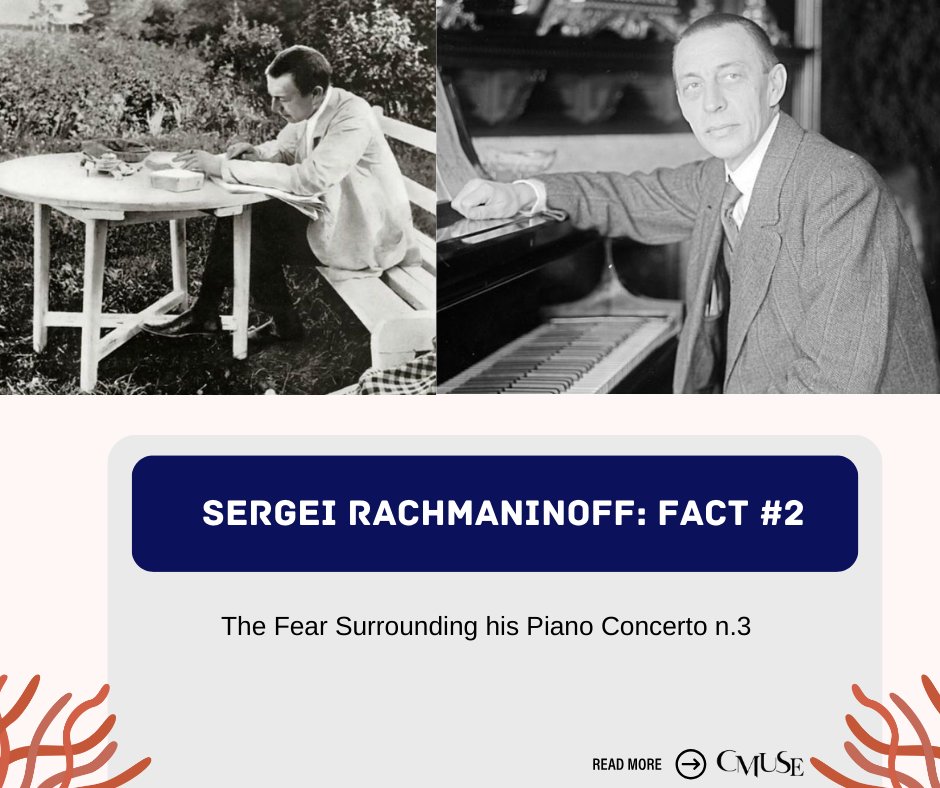
The Fear Surrounding his Piano Concerto n.3 Many pianists fear Rachmaninoff’s Piano Concerto n.3, deemed one of the most technically challenging concertos in the classical repertoire: Joseph Hofmann, to whom the work was dedicated, never performed it in public. It wasn’t for him, he said. Gary Graffman lamented the fact he had not learned the concert as a student, where he was “too young to know fear.” The concerto had its first performance on November 28th, 1909, by Rachmnaninoff himself and the now-defunct New York Symphony Society. Several weeks later, Gustav Mahler conducted it. “At that time Mahler was the only conductor whom I considered worthy to be classed with Nikisch. He devoted himself to the concerto until the accompaniment, which is rather complicated, had been practiced to perfection, although he had already gone through another long rehearsal. According to Mahler, every detail of the score was important — an attitude too rare amongst conductors…” Rachmaninoff told to his biographer Oscar von Riesemann.
CMUSE.org tweet media
English
0
0
0
31
CMUSE.org
CMUSE.org@cmuseorg·
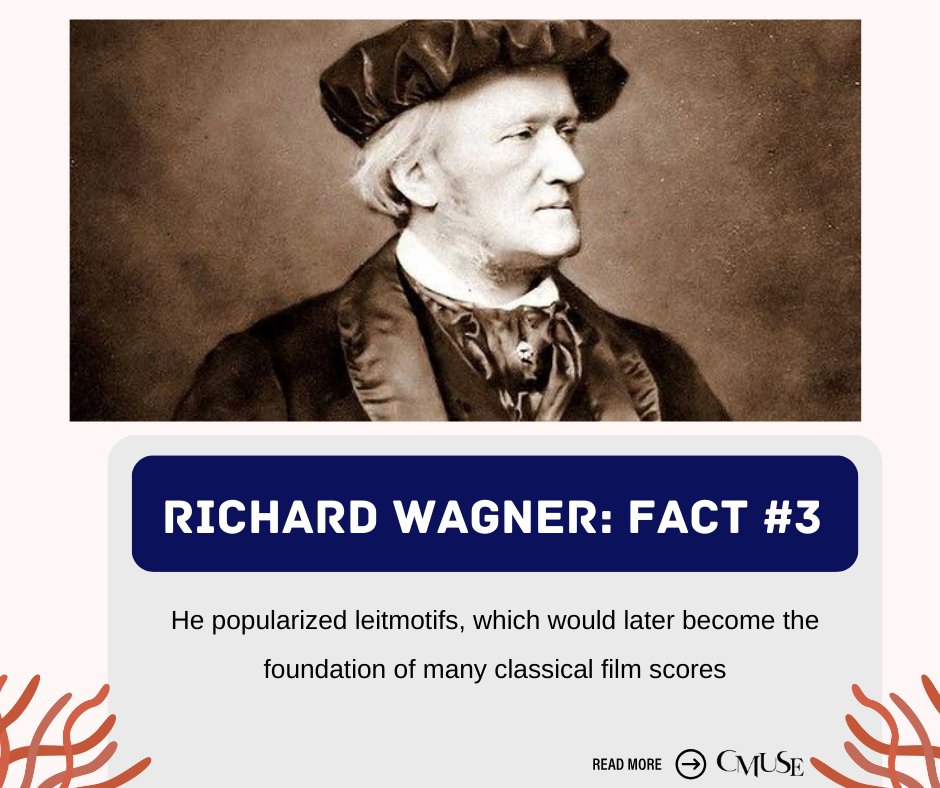
He popularized leitmotifs, which would later become the foundation of many classical film scores It’s hard to imagine what film soundtracks would sound like without leitmotifs—melodies associated with specific characters, events, or themes that can be used to program the audience with subconscious triggers. The original Star Wars trilogy makes particularly effective use of leitmotifs (which may be part of the reason why it’s referred to as “space opera”), and this is central to its rewatchability: every time you’re moved by a leitmotif, it becomes a little more effective. When we hear John Williams’ “Imperial March (Darth Vader’s Theme),” for example, the (transparently Wagnerian) melody triggers fans’ memories of the character’s entire story arc. After you’ve seen the trilogy a few dozen (or hundred) times, the melody recalls, all at once, a powerful monstrous shape and a satanic tempter and a wounded, dying father—invincibility and insidiousness and tragic vulnerability—which gives a depth and complexity to Darth Vader’s scenes that would not otherwise be present. Wagner is often credited with inventing leitmotifs. He didn’t—they were already in use by the time he came on the scene—but he was the first composer to use them extensively, and he was the first composer of prominence to make leitmotifs central to his work.
CMUSE.org tweet media
English
0
0
0
21
CMUSE.org
CMUSE.org@cmuseorg·
B-A-C-H and Mystical Numerology In mystical numerology or gematria, B equals 2, A equals 1, C equals 3 and H equals 8: the sum, as you might guess, is 14. Both 14 and its mirror 41 —the number obtained by adding the numerical value J and S to the computation— were among Bach’s favourite and  they are hidden countless times within the notes and musical structure of Bach’s music. Need an example? There are 14 Canons in the Goldberg Variations and 14 Contrapuncti in the Art of Fugue.
CMUSE.org tweet media
English
0
0
0
33
CMUSE.org
CMUSE.org@cmuseorg·
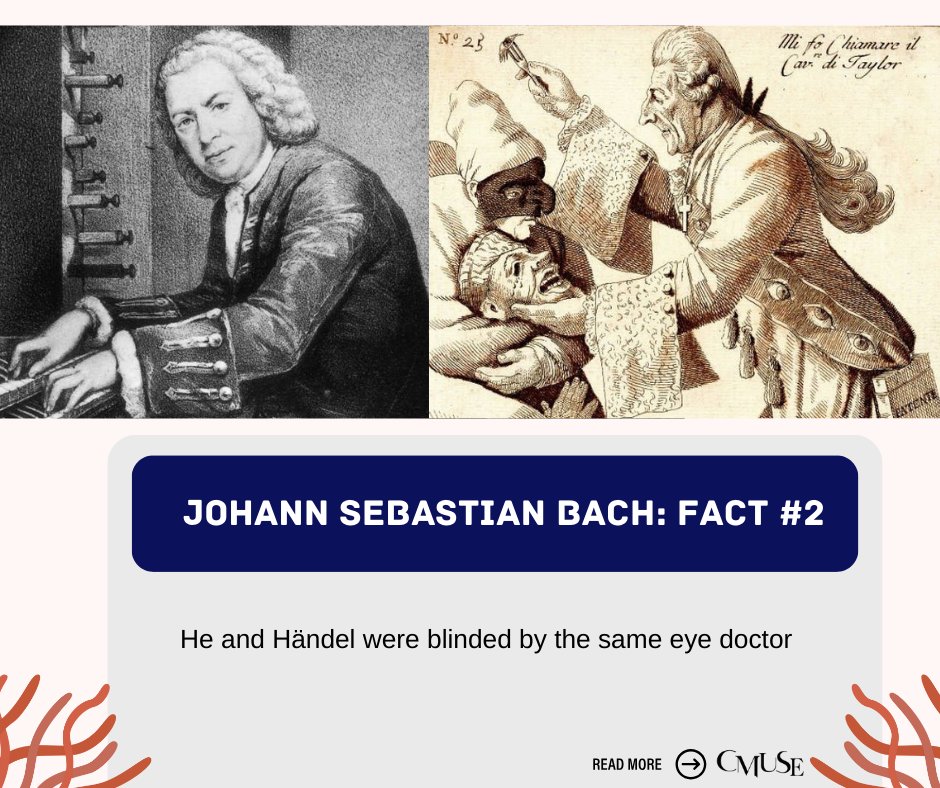
He and Händel were blinded by the same eye doctor Both Bach and Händel underwent eye surgery performed by the same eye doctor, namely Cavalier John Taylor. Following a failed cataract surgery by Taylor, Händel lived with declining vision for the last decade of his life, while Bach died a few months after a surgery for a “painful eye condition.” According to Daniel Albert, author of the history of ophthalmology book “Men of Vision,” neither expected the operations to work out well: at that time, physicians had no concept of bacteria and no anaesthesia. Taylor, however, was a flamboyant charlatan.  Whenever he arrived in town, his arrival was heralded by placards and handbills. His coach was decorated with eyeballs  paintings and the motto qui dat videre dat vivere (He who gives sight, gives life. : when he practiced actual surgeries he drew crowds in the town square, and swiftly got out of town before the patients removed their bandages. In Bach’s case, not only did his surgery fail, but he also developed a post-operative infection, which was treated with laxatives and bleeding. By the time he dictated his final work, he was blind and died a few months later.
CMUSE.org tweet media
English
0
0
0
14
CMUSE.org
CMUSE.org@cmuseorg·
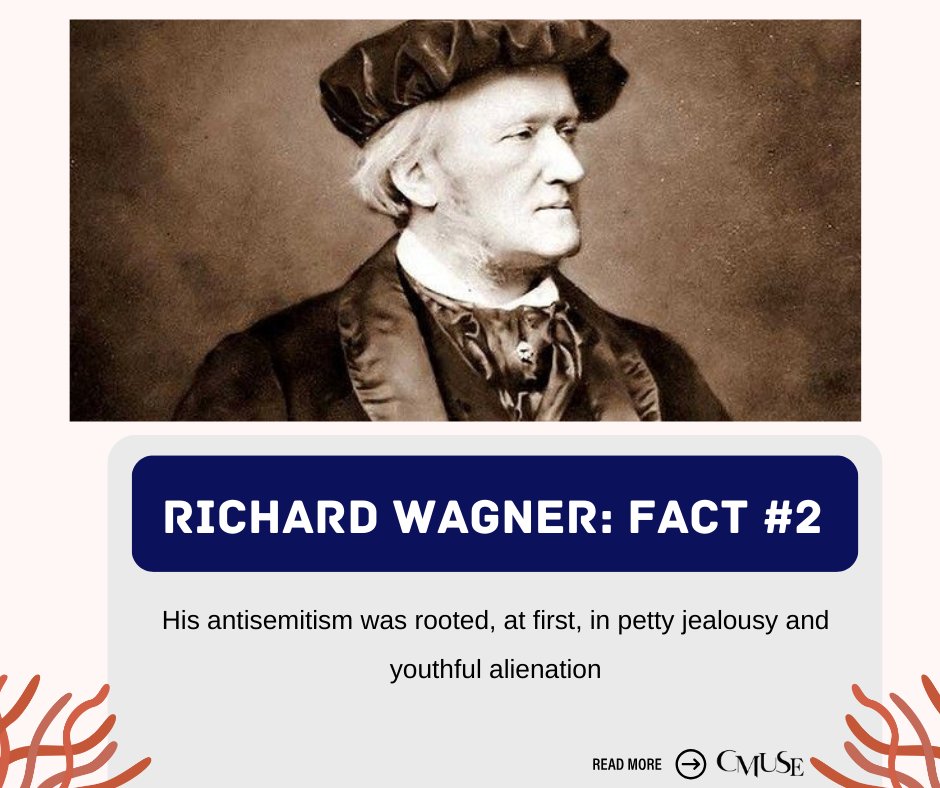
His antisemitism was rooted, at first, in petty jealousy and youthful alienation The narrative of Wagner’s antisemitism writes itself: he was living in antisemitic times, and it would have been quite possible for someone who had limited contact with German Jews to develop hostile abstract prejudices grounded in a nascent form of the country’s 20th-century ethnic nationalism. But Wagner actually grew up in a Jewish part of Leipzig, and his earliest—and most notorious—antisemitic piece of writing was transparently motivated by petty jealousy. Wagner was a struggling and largely unappreciated artist when he wrote the essay Das Judenthum in Der Musik under the alias “K. Freigedank” (“K. Freethink”) in 1850. The two most prominent composers in the country were Giacomo Meyerbeer and Moses Mendelssohn; both were Jews, and neither wrote in Wagner’s style. He attributed their success to what he regarded as their soulless and insidious Jewishness, and seemed to attribute his own lack of popularity to what he considered the negative pervasive influence of Jewish composers on German culture. Later, after he had achieved some success, he inexplicably expanded and republished the essay under his own name in 1869. Some ten years later he would meet the proto-Nazi theorist Arthur de Gobineau and make several more unfortunate comments about Germany’s Jewish population, though he did not buy completely into de Gobineau’s white supremacist ideology—Wagner believed instead that Christianity was true supremacy, and that anyone who converted to Christianity, regardless of ancestry, would be saved. Still, he never denounced Das Judenthum in Der Musik. That fact, combined with the decision several of his descendants would later make to fully endorse Nazism, has cemented Wagner’s reputation as an antisemite.
CMUSE.org tweet media
English
0
0
0
20
CMUSE.org
CMUSE.org@cmuseorg·
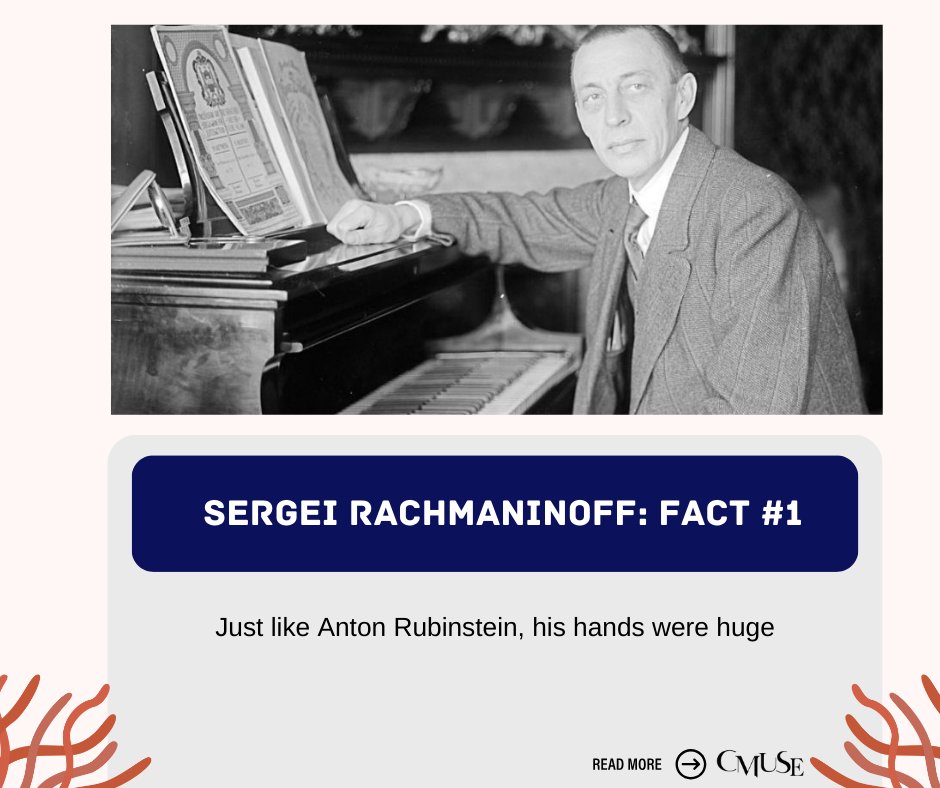
Just like Anton Rubinstein, his hands were huge Rachmaninoff looked up to Anton Rubinstein as a model and, in particular, he singled out out for praise Rubinstein’s rendition of Beethoven’s Appassionata and Chopin’s Funeral March Sonata.”[His playing] gripped my whole imagination and had a marked influence on my ambition as a pianist,” he told his biographer Oscar von Riesemann. Just like Rubinstein, Rachmaninoff had very large hands: in fact, he could span 12 piano keys from the tip of his little finger to the tip of his thumb. This is why less-endowed performers find it difficult to play some of his pieces.
CMUSE.org tweet media
English
0
0
0
33
CMUSE.org
CMUSE.org@cmuseorg·
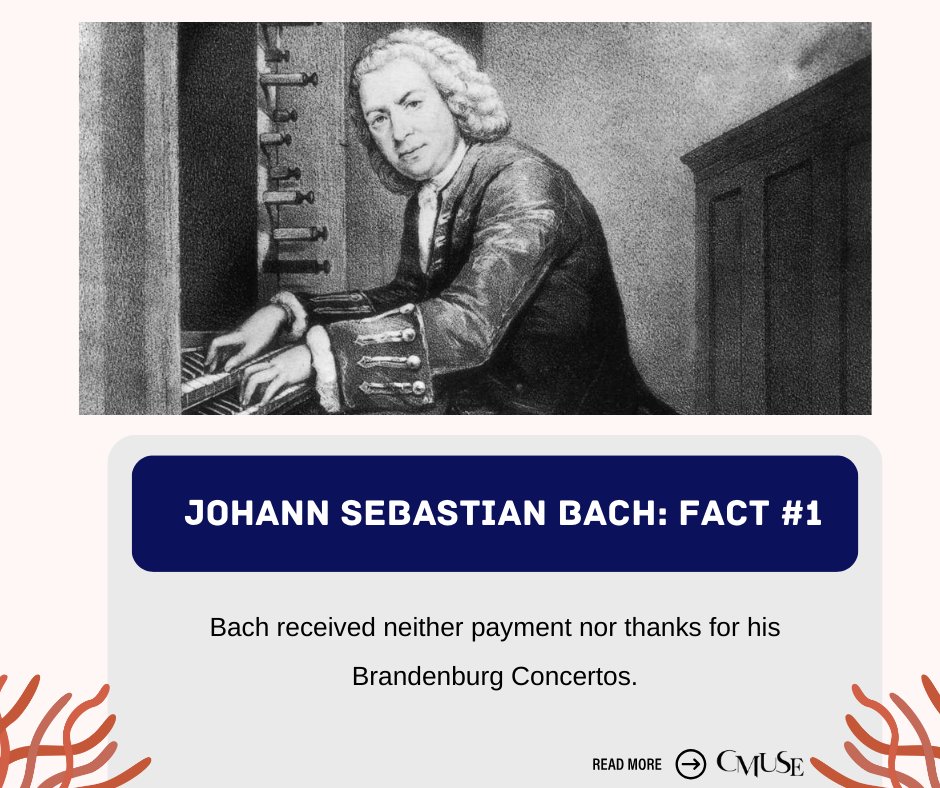
No money nor Thank You for his Brandenburg Concertos In 1721, Bach presented the Margrave of Brandenburg with a bound of manuscripts containing six lively concertos for Chamber Orchestra. For that, he never received any payment, nor was he ever thanked. At the time Bach wrote them, he was the Kapellmeister in the small town of Cöthen and, since the Margrave of Brandenburg ignored his gift, Bach presided over the first performances in Cöthen. The name “Brandenburg Concertos” was coined by Bach’s biographer’s Philipp Spitta 150 years after their conception. However, even though Bach himself did not call them “Brandenburgs,” he conceived them as a set nonetheless. He compiled them from short instrumental sinfonias and concerto movements he had already written, and then proceeded to re-writing and re-elaborating where he saw fit. You can definitely see a dramatic arc that develops in the course of the six concertos: the first one is brilliant, while the last one evokes a spirited chase. Coethen, surprisingly, had an orchestra with a lot of talented musicians: The reason? Friedrich Wilhelm I of Prussia, known as the Soldier King, disbanded the Berlin Court Orchestra because he was more interested in military strength than art. By chance, seven of the best musicians were sent to work in Coethen, ruled by music-loving Prince Leopold.
CMUSE.org tweet media
English
0
0
0
14
CMUSE.org
CMUSE.org@cmuseorg·
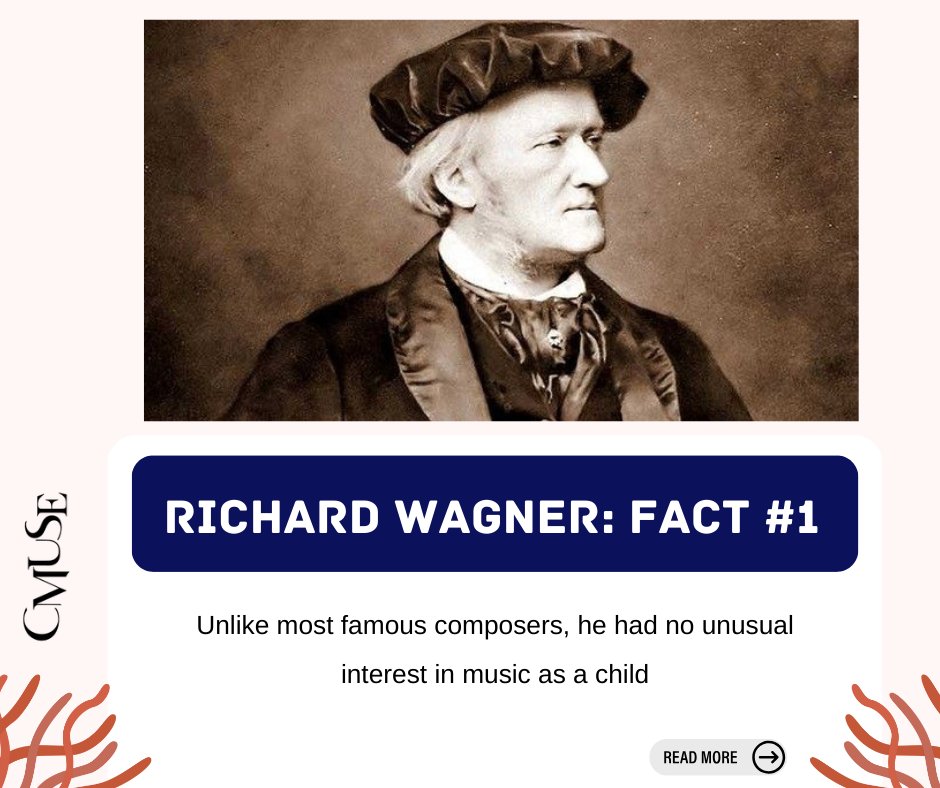
Unlike most famous composers, he had no unusual interest in music as a child Most biographies of composers begin with a discussion of their precociousness, but Wagner had no particular interest in music until he’d discovered the theater as a teenager and realized that most successful plays of his time were set to music. He wrote his first compositions under the supervision of a music teacher when he was 16, which is quite impressive by ordinary standards but does not suggest a burning lifelong desire to compose instrumental pieces. Classical instruments, for Wagner, were a means of achieving a dramatic effect.
CMUSE.org tweet media
English
0
0
0
20
CMUSE.org
CMUSE.org@cmuseorg·
The Piano Music Of Lesser-known Composers Read: buff.ly/3VvHK4X It’s often said that history is written by the victorious. In a cultural context, this is no different, especially the further one travels back in musical time. We are probably all familiar...
CMUSE.org tweet media
English
0
0
3
1.1K