

Primarystorage
69 posts

Primarystorage
@primarystorage_
20 years structured finance. Not a Bitcoin maxi. Not a TradFi evangelist. Unifying both makes a better financial system.
Sumali Ekim 2021
831 Sinusundan588 Mga Tagasunod

@guilleflorvs He is not automating his job. He removes busy coordination work.
English

BREAKING: The 29-year-old CEO who sold Brex to Capital One for $5.15B just automated his own job.
Pedro Franceschi says he used OpenClaw to decompose his entire CEO role into an AI system.
According to his posts, it screens his email, Slack, Google Docs, and WhatsApp.
Filters everything through custom logic.
A full signal ingestion pipeline that decides what actually needs his attention.
A $5B founder treating his own job as a system design problem.
If top CEOs are already experimenting with replacing themselves through AI workflows, what does that mean for everyone else?
Is this the future of the CEO role or a flex that doesn't scale?
English
@TrungTPhan There is still a difference and “price” growth in actual high end jewelry.
English

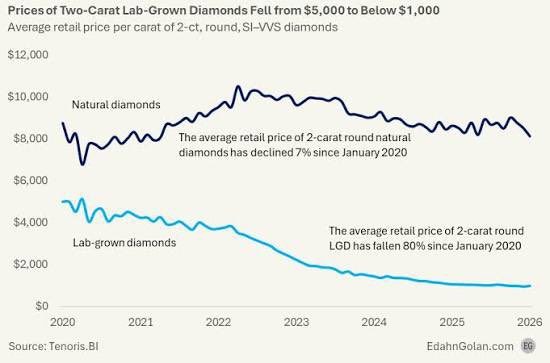
Diamond market clapped by lab-grown diamonds.
Price of lab-grown diamonds down 80% in past 5 years.
Natural diamonds currently still with ~8x premium to lab-grown ones. But lab-grown taking huge share, accounting for 61% of engagement rings in 2025, per The Knot (vs. ~25% in 2020).
***
The Knot: theknotww.com/press-releases…
Polymarket@Polymarket
BREAKING: The price of diamonds has crashed to its lowest level this century.
English
@geoffreywoo Using agents to evaluate startups seems like you would miss out on what’s really original. AI is trained on the average anything that doesn’t fit the model is going to be disregarded.
English

the entire venture capital industry is about to get disintermediated by ai agents
why do you need a partner to:
- source deals (agent scrapes all startups)
- do diligence (agent analyzes financials)
- negotiate terms (agent knows market rates)
- add value (agent connects to network)
only thing left is writing checks
but here's the thing - the best founders don't need your money anymore
they're building profitable businesses from day one using ai leverage
90% of vcs will be unemployed by 2027
the remaining 10% will be the ones who figured out how to use agents to 10x their deal flow while everyone else was playing golf
English
@ruggedpikachu If all we worry about is quantum hacking bitcoin. Than you need to finish your thought experiment. Which ends with Bitcoin going higher the moment 1 quantum wallet moves. I wrote about that a couple hours ago.
English

This is such bullshit lmao. Don't let them fud you out. I read up on quantum computing once and the tech is much further away than they make you believe.
Today the highest count is 6K qubits held for 13 seconds. Thats far far away from the 500K required for 9 min - especially since the tech gets exponentially harder. Takes just one particle to wiggle a bit too much and the entire state collapses. Heisenberg is a bitch. Also i highly doubt their numbers. You'd likely need millions of qubits, despite what they claim.
Apart from the fact that Google or IBM or some other Bigtech would have to deliberately attack BTC with such a machine. Because its not like some hackster could have a $10B supercomputer the size of a building and the energy demand of a small city in his basement.
ignore this crap
Coin Bureau@coinbureau
⚠️GOOGLE SAYS A QUANTUM ATTACK ON BITCOIN TAKES JUST 9 MINS WITH A 41% SUCCESS RATE Google's quantum team now says cracking Bitcoin may require less than 500K qubits, far below the “millions” once assumed. Research suggests an attack could take 9mins, faster than a typical 10-min block confirmation, giving a 41% success rate. Google now flags 2029 as a key deadline to upgrade Bitcoin’s cryptography before quantum becomes a real threat.
English
@AdamBLiv So you running cover calls and are part of the range trade box. Go naked long to farm premium while capping upside.
GIF
English

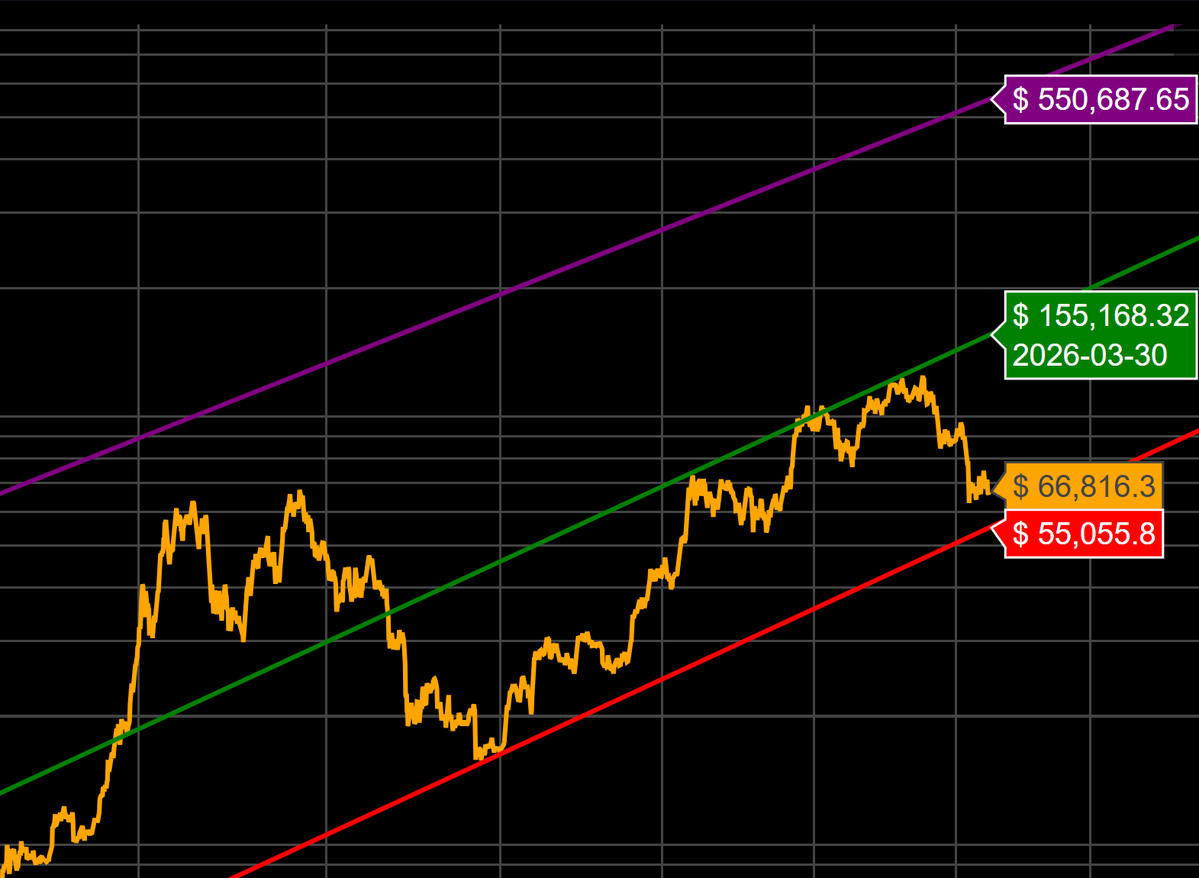
The Power Law support line that has never been breached is now at $55k.
We might have to wick down to that level to flush out the last remaining crybabies.
I'd be fine with it. Would be glad to be assigned on my $95 MSTR puts while my covered calls on ASST continue to print.
The daily Bitcoin buy continues and my option premiums help me accumulate more during these drawdowns.
Pretty nutty that all data supports Bitcoin's price converging to Power Law and a reversion to there today would mean $155k Bitcoin... and it's $200k by EOY.
Prime accumulation time.
FOCUS. STACK. WIN.
English
@WOLF_Bitcoin_ I don’t think he fully understands. August 2026 - is when they have to start looking for refinancing. Vol Abr premium is out. Refinancing will come at 8-11%. Not sure if they say this on purposes or don’t know how to compile a spreadsheet 😂
English

$MSTR CEO PHONG LE: "BITCOIN NEEDS TO GO DOWN TO $8K A COIN,
AND SIT THERE for 5 years until 2032 before we have a problem satisfying the convertible notes."
English
@Rajatsoni So just out of curiosity how will he refinance? I have priced it - you haven’t I would guess.
English

At least Michael Saylor isn't promoting shitcoins
@jason@Jason
Sell your house! Invest in bitcoin through $strc which is somehow related to $mstr which has exposure to $btc which they’ve saddled with debt or some type Do not just buy $btc on robinhood!!! Buy it through some convoluted corporate structure and trust it will be ok!!!! 😂😂😂😂
English
@techexe Just wait until they find out their is an inelastic floor on bitcoin mining.
English

@DSBatten I have always been a fan of Keen - one of the sharpest people out there. But his take on Bitcoin is missing the part, where money is a trust vessel nothing more nothing less. And so far Bitcoin is the only system I can see that has kept its promise.
English

Why does Bitcoin get more enduring criticism than other disruptive technologies such as the Internet?
Simple: Bitcoin is not only a technology, it is an asset. There was no financial penalty for being late to the Internet. You just used clunkier, slower tech for longer.
But if you're late to Bitcoin, you don't only have mild inconvenience you have to reconcile financial cost too. We saw the same pattern with investors who missed the tech boom and in particular early Amazon doubters
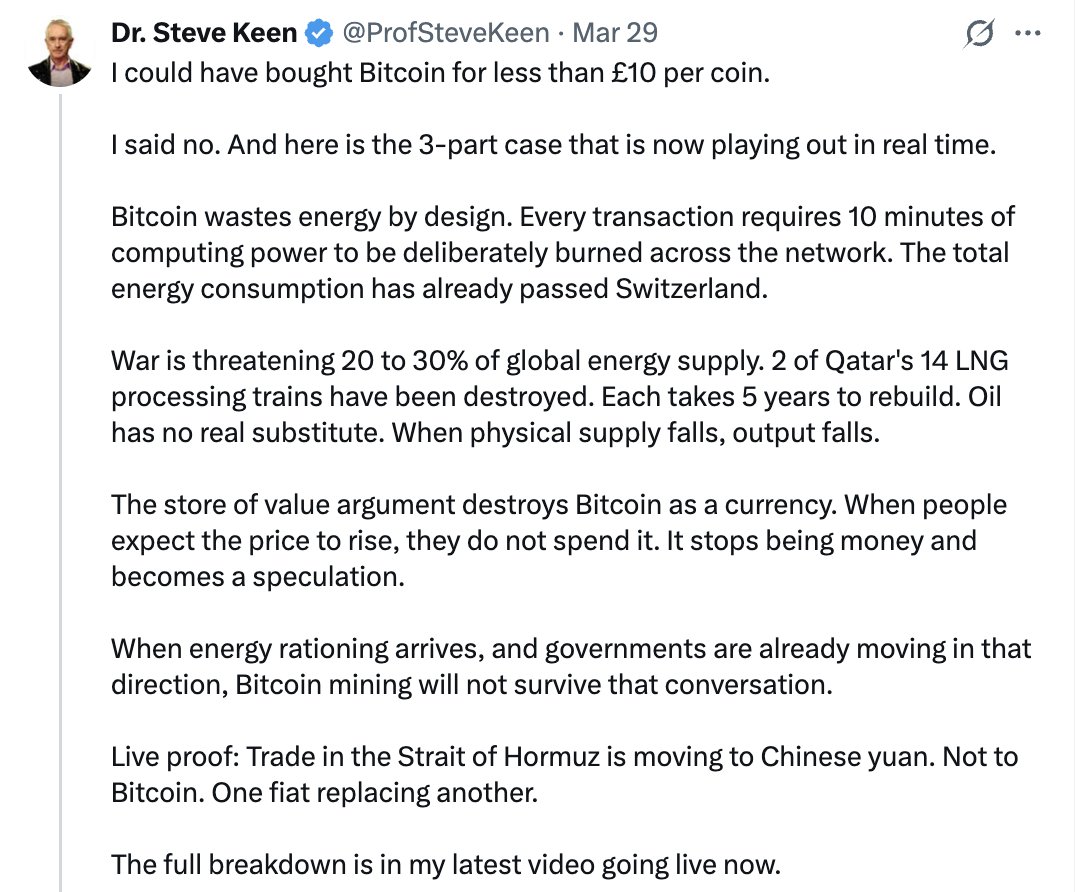
The tweet below is a textbook real-time illustration of this at play, showing three psychological principles at play at once
1. Cognitive Dissonance
2. Sour Grapes Effect (a dissonance-reduction tactic)
3. Omission Regret
1. Cognitive Dissonance
When two cognitions conflict such as “I am a smart” and “I passed on an opportunity that turned out to be enormously successful”, psychological discomfort arises. To reduce it, people don’t change their original decision or admit error. Instead, they seek/emphasize information that justifies the original choice. (Leon Festinger, 1957)
2. Sour grapes effect (Sjåstad et al, 2020)
Principle: People disparage goals they failed to attain (“the grapes are sour anyway”) to eliminate the pain of missing out
In this context: “I didn’t buy Bitcoin, therefore it must be worthless/wasteful/destined to fail
3. Omission Regret
Regret from not acting (omission) is often felt more intensely than regret from a bad action. People cope by rewriting the narrative: the missed asset “was never that good.” (Ritov & Baron, 1995)
Gizmodo’s “How Much Should I Regret Not Buying Bitcoin?” (2018) even frames it exactly this way for non-investors
Keen's admission of the missed £10 BTC price is immediately followed by a list of long-standing objections that conveniently justify the non-decision. Bitcoiners will call it “saltiness,” but the underlying psychology at play is standard, peer-reviewed behavioral science.
Keen may defend himself by trying to argue "the tech really is genuinely bad". But in stating that "Bitcoin uses a lot of energy per transaction" (a piece of misinformation that anyone who has spent 1 hour researching Bitcoin mining will know is untrue: Bitcoin energy use does not come from its transactions) he has lost the right to claim objectively that his criticisms come out of understanding.
Rather, he has illustrated a huge asymmetry in that he has spent countless hours making videos against Bitcoin, but almost no time understanding the technology.
In his tweet thread, you can also see a classic red-flag that rather than engage on an issue, he will level one (widely debunked) claim after another. Brandolini's law in action: it takes longer to debunk BS than to create it.
However, these are human frailties that can be overcome with higher self-awareness and lower ego.
If the need to "be right" is reduced, then a person can become intellectually curious and re-appraise an asset. Indeed the ability to change one's mind is a defining aspect of real intelligence.
Michael Saylor illustrated the possibility of this path.
English
@guywuolletjr That’s not a bad thing - one step at a time. Wall Street greed - will make them fold.
English

Wall Street is adopting blockchains as a schelling point to upgrade their atrophying core ledgers. Blockchains actually solve most of the governance and incentive issues for them, but Wall Street doesn’t care about decentralization, only efficiency.
English
@cryptoquick Even if satoshi coins get taken - its is way more favorable for Bitcoin. Their is just 0 rational to try dump them.
x.com/primarystorage…
Primarystorage@primarystorage_
Cracking a Bitcoin key with a quantum computer is like robbing a bank that burns down the moment you walk through the door. Every serious fund tracks dormant wallets. The second old coins move, the world sees it on a public ledger in real time. The sell-off destroys the value before you can cash out. And anyone sophisticated enough to crack Bitcoin keys is sophisticated enough to know this. They won't sell, they'll move coins to quantum-resistant wallets and preserve the network. Transparency is the immune system. That's the beauty of a public ledger. Quantum breaks cryptography in theory. Game theory breaks the attacker in practice.
English

> logical qubits
> minutes to execute
no indication of quality, fidelity, etc
could still take months to find even one key, Shor's is always probablistic even in the best case
we should be prudent and careful but never give into fear
QSHA256@Qsha_256
New Google paper: Shor’s algorithm compiled to 1,200 logical qubits + 70M Toffoli gates breaks ECDLP-256. <500K physical qubits. Minutes to execute. Every ECC-based chain is now on a hard deadline. research.google/blog/safeguard…
English
@averyhodl I tend to agree with you. Even if quantum comes it’s better for Bitcoin either way.
The game theory doesn’t allow bad actor winning here. The long term trejactory is set.
English

If I were the deep state and I wanted to get bitcoin to too hastily push through a quantum resistant upgrade I’d consider getting my good buddies at Google to bullshit up some panic
Project Eleven@projecteleven
🚨 Google has sounded the quantum alarm 🚨 Today, they released groundbreaking progress towards breaking crypto using a quantum computer. TLDR - Existing cryptography is dead. Mempool attacks are real. We must migrate to post-quantum now. Thread 🧵
English
@MrDeepBlue2 Yeah they are going to reveal their hand that every stored communication for last few decades can now be read. This is the absurdity with quantum fud
English

Makes sense if we are talking about an independent actor, but nation states may have very different objectives.
For a nation state that holds no Bitcoins, the goal may not be to make money, but to massively damage another adversary state that holds large amounts of Bitcoin, either directly or through its population.
English
🧵 THE QUANTUM GAME THEORY OF BITCOIN
Why the profit-maximizing quantum attacker saves Bitcoin, and gets paid the most for doing it.
Quick napkin.
The Setup.
Let:
S = 6.9M BTC with exposed public keys (Google, March 2026)
P₀ = BTC price pre-attack
H = attacker's pre-accumulated holdings in quantum-safe wallets
Total supply cap = 21M BTC (minus unmined)
actor gains quantum capability to break ECDSA.
Three strategies available. Only one is Nash-optimal.
You crack S and dump on the market.
You're selling into your own crash. Liquidity evaporates. If S = 6.9M BTC and daily volume is ~30K BTC, you'd need 230 days of total market volume. Price hits zero before you exit 0.1% of your position.
Payoff_A ≈ S × P_collapse → 0
This is the strategy everyone fears. Is also the worst one.
Strategy B: Keep the stolen coins.
You crack S, move to your own wallet, hold.
Problem: You're now the most hunted entity on earth. Every intelligence agency, every exchange, every node operator is watching your addresses. Permanent sell overhang suppresses price. Market prices in the risk you dump at any time.
Payoff_B = S × P₀ × (1 - overhang_discount), but you can never spend it without revealing yourself.
Payoff_B is large on paper, zero in practice.
Strategy C: The real print
Stage 1 Accumulation. Quietly buy H bitcoin over months into BIP-360 quantum-resistant addresses. No signal to market. Cost basis = H × P₀.
Stage 2 Positioning. Load deep OTM puts across Deribit, CME. Short MSTR, COIN, BITO. Total premium outlay = C (small, these are far OTM).
Stage 3 Execution. Crack every vulnerable address. Send ALL coins to a provable burn address. Not your wallet. Burned. Verifiably, permanently gone.
Stage 4 Crash capture. Market panics. BTC drops x%.
Put payoff = f(x) where f is convex in the decline. Deep OTM puts go from pennies to multiples of face value.
Payoff_puts = C × leverage_multiple × (P₀ - P_crash)
Stage 5 Supply shock.
Before burn: your share of supply = H / 21M
After burn: your share of supply = H / (21M - S)
If S = 6.9M:
H / 14.1M vs H / 21M = 1.49x multiplier on your ownership share.
You just increased your effective BTC position by 49% without buying a single additional sat.
Stage 6 Transparency. Go public. Announce what you did and prove it.
Why? Because silence creates uncertainty. Will the attacker dump? suppresses recovery. Proof of burn removes the overhang instantly. Transparency is a commitment device it makes the recovery credible.
This isn't the moral choice. It's the greedy one. Every day of uncertainty you eliminate accelerates the recovery that your long position profits from.
Stage 7 Recovery capture. Network hard forks to quantum-resistant signatures (BIP-360 is already on testnet). Existential risk resolved. Satoshi overhang gone forever.
Post-recovery price P₁ > P₀ because:
Supply permanently reduced by S/21M = 33%
Existential risk eliminated
Network provably survived its worst-case scenario
Your stack H is now worth: H × P₁ where P₁ reflects the new scarcity
Total Payoff Comparison.
Strategy A (sell):
Π_A ≈ 0 (can't exit)
Strategy B (keep):
Π_B = S × P₀ × discount (large on paper, inaccessible, permanent target)
Strategy C (burn):
Π_C = Puts profit + H × (P₁ - P₀) + H × P₁ × (S / (21M - S))
The third term is the supply compression premium. It's pure upside that only exists in Strategy C
The Deeper Insight.
The attackers incentives are perfectly aligned with Bitcoin's survival. They want:
The network to upgrade (protects their remaining stack)
The price to recover (that's where the real money is)
Confidence to return (drives P₁ above P₀)
This is a mechanism design result: Bitcoin's transparency and fixed supply turn the attacker into its greatest advocate.
English
@drakefjustin Not to full truth
x.com/primarystorage…
Primarystorage@primarystorage_
Cracking a Bitcoin key with a quantum computer is like robbing a bank that burns down the moment you walk through the door. Every serious fund tracks dormant wallets. The second old coins move, the world sees it on a public ledger in real time. The sell-off destroys the value before you can cash out. And anyone sophisticated enough to crack Bitcoin keys is sophisticated enough to know this. They won't sell, they'll move coins to quantum-resistant wallets and preserve the network. Transparency is the immune system. That's the beauty of a public ledger. Quantum breaks cryptography in theory. Game theory breaks the attacker in practice.
English

Today is a monumentous day for quantum computing and cryptography. Two breakthrough papers just landed (links in next tweet). Both papers improve Shor's algorithm, infamous for cracking RSA and elliptic curve cryptography. The two results compound, optimising separate layers of the quantum stack. The results are shocking. I expect a narrative shift and a further R&D boost toward post-quantum cryptography.
The first paper is by Google Quantum AI. They tackle the (logical) Shor algorithm, tailoring it to crack Bitcoin and Ethereum signatures. The algorithm runs on ~1K logical qubits for the 256-bit elliptic curve secp256k1. Due to the low circuit depth, a fast superconducting computer would recover private keys in minutes. I'm grateful to have joined as a late paper co-author, in large part for the chance to interact with experts and the alpha gleaned from internal discussions.
The second paper is by a stealthy startup called Oratomic, with ex-Google and prominent Caltech faculty. Their starting point is Google's improvements to the logical quantum circuit. They then apply improvements at the physical layer, with tricks specific to neutral atom quantum computers. The result estimates that 26,000 atomic qubits are sufficient to break 256-bit elliptic curve signatures. This would be roughly a 40x improvement in physical qubit count over previous state-of-the-art. On the flip side, a single Shor run would take ~10 days due to the relatively slow speed of neutral atoms.
Below are my key takeaways. As a disclaimer, I am not a quantum expert. Time is needed for the results to be properly vetted. Based on my interactions with the team, I have faith the Google Quantum AI results are conservative. The Oratomic paper is much harder for me to assess, especially because of the use of more exotic qLDPC codes. I will take it with a grain of salt until the dust settles.
→ q-day: My confidence in q-day by 2032 has shot up significantly. IMO there's at least a 10% chance that by 2032 a quantum computer recovers a secp256k1 ECDSA private key from an exposed public key. While a cryptographically-relevant quantum computer (CRQC) before 2030 still feels unlikely, now is undoubtedly the time to start preparing.
→ censorship: The Google paper uses a zero-knowledge (ZK) proof to demonstrate the algorithm's existence without leaking actual optimisations. From now on, assume state-of-the-art algorithms will be censored. There may be self-censorship for moral or commercial reasons, or because of government pressure. A blackout in academic publications would be a tell-tale sign.
→ cracking time: A superconducting quantum computer, the type Google is building, could crack keys in minutes. This is because the optimised quantum circuit is just 100M Toffoli gates, which is surprisingly shallow. (Toffoli gates are hard because they require production of so-called "magic states".) Toffoli gates would consume ~10 microseconds on a superconducting platform, totalling ~1,000 sec of Shor runtime.
→ latency optimisations: Two latency optimisations bring key cracking time to single-digit minutes. The first parallelises computation across quantum devices. The second involves feeding the pubkey to the quantum computer mid-flight, after a generic setup phase.
→ fast- and slow-clock: At first approximation there are two families of quantum computers. The fast-clock flavour, which includes superconducting and photonic architectures, runs at roughly 100 kHz. The slow-clock flavour, which includes trapped ion and neutral atom architectures, runs roughly 1,000x slower (~100 Hz, or ~1 week to crack a single key).
→ qubit count: The size-optimised variant of the algorithm runs on 1,200 logical qubits. On a superconducting computer with surface code error correction that's roughly 500K physical qubits, a 400:1 physical-to-logical ratio. The surface code is conservative, assuming only four-way nearest-neighbour grid connectivity. It was demonstrated last year by Google on a real quantum computer.
→ future gains: Low-hanging fruit is still being picked, with at least one of the Google optimisations resulting from a surprisingly simple observation. Interestingly, AI was not (yet!) tasked to find optimisations. This was also the first time authors such as Craig Gidney attacked elliptic curves (as opposed to RSA). Shor logical qubit count could plausibly go under 1K soonish.
→ error correction: The physical-to-logical ratio for superconducting computers could go under 100:1. For superconducting computers that would be mean ~100K physical qubits for a CRQC, two orders of magnitude away from state of the art. Neutral atoms quantum computers are amenable to error correcting codes other than the surface code. While much slower to run, they can bring down the physical to logical qubit ratio closer to 10:1.
→ Bitcoin PoW: Commercially-viable Bitcoin PoW via Grover's algorithm is not happening any time soon. We're talking decades, possibly centuries away. This observation should help focus the discussion on ECDSA and Schnorr. (Side note: as unofficial Bitcoin security researcher, I still believe Bitcoin PoW is cooked due to the dwindling security budget.)
→ team quality: The folks at Google Quantum AI are the real deal. Craig Gidney (@CraigGidney) is arguably the world's top quantum circuit optimisooor. Just last year he squeezed 10x out of Shor for RSA, bringing the physical qubit count down from 10M to 1M. Special thanks to the Google team for patiently answering all my newb questions with detailed, fact-based answers. I was expecting some hype, but found none.
English
@aubreystrobel Biggest Tech company not equal to correct outcome prediction.
Primarystorage@primarystorage_
Cracking a Bitcoin key with a quantum computer is like robbing a bank that burns down the moment you walk through the door. Every serious fund tracks dormant wallets. The second old coins move, the world sees it on a public ledger in real time. The sell-off destroys the value before you can cash out. And anyone sophisticated enough to crack Bitcoin keys is sophisticated enough to know this. They won't sell, they'll move coins to quantum-resistant wallets and preserve the network. Transparency is the immune system. That's the beauty of a public ledger. Quantum breaks cryptography in theory. Game theory breaks the attacker in practice.
English

One of the biggest tech companies in the world: “we need to prepare for quantum”
Modern Bitcoiners: probably FUD!
nic carter@nic_carter
Many are wondering "what Google saw" that caused them to revise their post-quantum cryptography transition deadline to 2029 last week. It was this: research.google/blog/safeguard…
English
@strikerglows @beffjezos Π_A = Puts profit + S × P_avg_exit
Π_C = Puts profit + H × (P₁ - P₀) + H × P₁ × (S / (21M - S))
Π_C - Π_A = H × (P₁ - P₀) + H × P₁ × (S / (21M - S))
So my point stands, you make more money in C.
Română

@primarystorage_ @beffjezos The entire comparison is a joke. Why is he including the returns of the put for the burn strategy but not for the sell strategy?
English

@BitPaine Nothing will happen to bitcoin.
x.com/primarystorage…
Primarystorage@primarystorage_
🧵 THE QUANTUM GAME THEORY OF BITCOIN Why the profit-maximizing quantum attacker saves Bitcoin, and gets paid the most for doing it. Quick napkin. The Setup. Let: S = 6.9M BTC with exposed public keys (Google, March 2026) P₀ = BTC price pre-attack H = attacker's pre-accumulated holdings in quantum-safe wallets Total supply cap = 21M BTC (minus unmined) actor gains quantum capability to break ECDSA. Three strategies available. Only one is Nash-optimal. You crack S and dump on the market. You're selling into your own crash. Liquidity evaporates. If S = 6.9M BTC and daily volume is ~30K BTC, you'd need 230 days of total market volume. Price hits zero before you exit 0.1% of your position. Payoff_A ≈ S × P_collapse → 0 This is the strategy everyone fears. Is also the worst one. Strategy B: Keep the stolen coins. You crack S, move to your own wallet, hold. Problem: You're now the most hunted entity on earth. Every intelligence agency, every exchange, every node operator is watching your addresses. Permanent sell overhang suppresses price. Market prices in the risk you dump at any time. Payoff_B = S × P₀ × (1 - overhang_discount), but you can never spend it without revealing yourself. Payoff_B is large on paper, zero in practice. Strategy C: The real print Stage 1 Accumulation. Quietly buy H bitcoin over months into BIP-360 quantum-resistant addresses. No signal to market. Cost basis = H × P₀. Stage 2 Positioning. Load deep OTM puts across Deribit, CME. Short MSTR, COIN, BITO. Total premium outlay = C (small, these are far OTM). Stage 3 Execution. Crack every vulnerable address. Send ALL coins to a provable burn address. Not your wallet. Burned. Verifiably, permanently gone. Stage 4 Crash capture. Market panics. BTC drops x%. Put payoff = f(x) where f is convex in the decline. Deep OTM puts go from pennies to multiples of face value. Payoff_puts = C × leverage_multiple × (P₀ - P_crash) Stage 5 Supply shock. Before burn: your share of supply = H / 21M After burn: your share of supply = H / (21M - S) If S = 6.9M: H / 14.1M vs H / 21M = 1.49x multiplier on your ownership share. You just increased your effective BTC position by 49% without buying a single additional sat. Stage 6 Transparency. Go public. Announce what you did and prove it. Why? Because silence creates uncertainty. Will the attacker dump? suppresses recovery. Proof of burn removes the overhang instantly. Transparency is a commitment device it makes the recovery credible. This isn't the moral choice. It's the greedy one. Every day of uncertainty you eliminate accelerates the recovery that your long position profits from. Stage 7 Recovery capture. Network hard forks to quantum-resistant signatures (BIP-360 is already on testnet). Existential risk resolved. Satoshi overhang gone forever. Post-recovery price P₁ > P₀ because: Supply permanently reduced by S/21M = 33% Existential risk eliminated Network provably survived its worst-case scenario Your stack H is now worth: H × P₁ where P₁ reflects the new scarcity Total Payoff Comparison. Strategy A (sell): Π_A ≈ 0 (can't exit) Strategy B (keep): Π_B = S × P₀ × discount (large on paper, inaccessible, permanent target) Strategy C (burn): Π_C = Puts profit + H × (P₁ - P₀) + H × P₁ × (S / (21M - S)) The third term is the supply compression premium. It's pure upside that only exists in Strategy C The Deeper Insight. The attackers incentives are perfectly aligned with Bitcoin's survival. They want: The network to upgrade (protects their remaining stack) The price to recover (that's where the real money is) Confidence to return (drives P₁ above P₀) This is a mechanism design result: Bitcoin's transparency and fixed supply turn the attacker into its greatest advocate.
English

@coinbureau Like why this engagement framing on quantum? x.com/primarystorage…
Primarystorage@primarystorage_
🧵 THE QUANTUM GAME THEORY OF BITCOIN Why the profit-maximizing quantum attacker saves Bitcoin, and gets paid the most for doing it. Quick napkin. The Setup. Let: S = 6.9M BTC with exposed public keys (Google, March 2026) P₀ = BTC price pre-attack H = attacker's pre-accumulated holdings in quantum-safe wallets Total supply cap = 21M BTC (minus unmined) actor gains quantum capability to break ECDSA. Three strategies available. Only one is Nash-optimal. You crack S and dump on the market. You're selling into your own crash. Liquidity evaporates. If S = 6.9M BTC and daily volume is ~30K BTC, you'd need 230 days of total market volume. Price hits zero before you exit 0.1% of your position. Payoff_A ≈ S × P_collapse → 0 This is the strategy everyone fears. Is also the worst one. Strategy B: Keep the stolen coins. You crack S, move to your own wallet, hold. Problem: You're now the most hunted entity on earth. Every intelligence agency, every exchange, every node operator is watching your addresses. Permanent sell overhang suppresses price. Market prices in the risk you dump at any time. Payoff_B = S × P₀ × (1 - overhang_discount), but you can never spend it without revealing yourself. Payoff_B is large on paper, zero in practice. Strategy C: The real print Stage 1 Accumulation. Quietly buy H bitcoin over months into BIP-360 quantum-resistant addresses. No signal to market. Cost basis = H × P₀. Stage 2 Positioning. Load deep OTM puts across Deribit, CME. Short MSTR, COIN, BITO. Total premium outlay = C (small, these are far OTM). Stage 3 Execution. Crack every vulnerable address. Send ALL coins to a provable burn address. Not your wallet. Burned. Verifiably, permanently gone. Stage 4 Crash capture. Market panics. BTC drops x%. Put payoff = f(x) where f is convex in the decline. Deep OTM puts go from pennies to multiples of face value. Payoff_puts = C × leverage_multiple × (P₀ - P_crash) Stage 5 Supply shock. Before burn: your share of supply = H / 21M After burn: your share of supply = H / (21M - S) If S = 6.9M: H / 14.1M vs H / 21M = 1.49x multiplier on your ownership share. You just increased your effective BTC position by 49% without buying a single additional sat. Stage 6 Transparency. Go public. Announce what you did and prove it. Why? Because silence creates uncertainty. Will the attacker dump? suppresses recovery. Proof of burn removes the overhang instantly. Transparency is a commitment device it makes the recovery credible. This isn't the moral choice. It's the greedy one. Every day of uncertainty you eliminate accelerates the recovery that your long position profits from. Stage 7 Recovery capture. Network hard forks to quantum-resistant signatures (BIP-360 is already on testnet). Existential risk resolved. Satoshi overhang gone forever. Post-recovery price P₁ > P₀ because: Supply permanently reduced by S/21M = 33% Existential risk eliminated Network provably survived its worst-case scenario Your stack H is now worth: H × P₁ where P₁ reflects the new scarcity Total Payoff Comparison. Strategy A (sell): Π_A ≈ 0 (can't exit) Strategy B (keep): Π_B = S × P₀ × discount (large on paper, inaccessible, permanent target) Strategy C (burn): Π_C = Puts profit + H × (P₁ - P₀) + H × P₁ × (S / (21M - S)) The third term is the supply compression premium. It's pure upside that only exists in Strategy C The Deeper Insight. The attackers incentives are perfectly aligned with Bitcoin's survival. They want: The network to upgrade (protects their remaining stack) The price to recover (that's where the real money is) Confidence to return (drives P₁ above P₀) This is a mechanism design result: Bitcoin's transparency and fixed supply turn the attacker into its greatest advocate.
English

⚠️GOOGLE SAYS A QUANTUM ATTACK ON BITCOIN TAKES JUST 9 MINS WITH A 41% SUCCESS RATE
Google's quantum team now says cracking Bitcoin may require less than 500K qubits, far below the “millions” once assumed.
Research suggests an attack could take 9mins, faster than a typical 10-min block confirmation, giving a 41% success rate.
Google now flags 2029 as a key deadline to upgrade Bitcoin’s cryptography before quantum becomes a real threat.


English
@Cointelegraph Chill out please
x.com/primarystorage…
Primarystorage@primarystorage_
🧵 THE QUANTUM GAME THEORY OF BITCOIN Why the profit-maximizing quantum attacker saves Bitcoin, and gets paid the most for doing it. Quick napkin. The Setup. Let: S = 6.9M BTC with exposed public keys (Google, March 2026) P₀ = BTC price pre-attack H = attacker's pre-accumulated holdings in quantum-safe wallets Total supply cap = 21M BTC (minus unmined) actor gains quantum capability to break ECDSA. Three strategies available. Only one is Nash-optimal. You crack S and dump on the market. You're selling into your own crash. Liquidity evaporates. If S = 6.9M BTC and daily volume is ~30K BTC, you'd need 230 days of total market volume. Price hits zero before you exit 0.1% of your position. Payoff_A ≈ S × P_collapse → 0 This is the strategy everyone fears. Is also the worst one. Strategy B: Keep the stolen coins. You crack S, move to your own wallet, hold. Problem: You're now the most hunted entity on earth. Every intelligence agency, every exchange, every node operator is watching your addresses. Permanent sell overhang suppresses price. Market prices in the risk you dump at any time. Payoff_B = S × P₀ × (1 - overhang_discount), but you can never spend it without revealing yourself. Payoff_B is large on paper, zero in practice. Strategy C: The real print Stage 1 Accumulation. Quietly buy H bitcoin over months into BIP-360 quantum-resistant addresses. No signal to market. Cost basis = H × P₀. Stage 2 Positioning. Load deep OTM puts across Deribit, CME. Short MSTR, COIN, BITO. Total premium outlay = C (small, these are far OTM). Stage 3 Execution. Crack every vulnerable address. Send ALL coins to a provable burn address. Not your wallet. Burned. Verifiably, permanently gone. Stage 4 Crash capture. Market panics. BTC drops x%. Put payoff = f(x) where f is convex in the decline. Deep OTM puts go from pennies to multiples of face value. Payoff_puts = C × leverage_multiple × (P₀ - P_crash) Stage 5 Supply shock. Before burn: your share of supply = H / 21M After burn: your share of supply = H / (21M - S) If S = 6.9M: H / 14.1M vs H / 21M = 1.49x multiplier on your ownership share. You just increased your effective BTC position by 49% without buying a single additional sat. Stage 6 Transparency. Go public. Announce what you did and prove it. Why? Because silence creates uncertainty. Will the attacker dump? suppresses recovery. Proof of burn removes the overhang instantly. Transparency is a commitment device it makes the recovery credible. This isn't the moral choice. It's the greedy one. Every day of uncertainty you eliminate accelerates the recovery that your long position profits from. Stage 7 Recovery capture. Network hard forks to quantum-resistant signatures (BIP-360 is already on testnet). Existential risk resolved. Satoshi overhang gone forever. Post-recovery price P₁ > P₀ because: Supply permanently reduced by S/21M = 33% Existential risk eliminated Network provably survived its worst-case scenario Your stack H is now worth: H × P₁ where P₁ reflects the new scarcity Total Payoff Comparison. Strategy A (sell): Π_A ≈ 0 (can't exit) Strategy B (keep): Π_B = S × P₀ × discount (large on paper, inaccessible, permanent target) Strategy C (burn): Π_C = Puts profit + H × (P₁ - P₀) + H × P₁ × (S / (21M - S)) The third term is the supply compression premium. It's pure upside that only exists in Strategy C The Deeper Insight. The attackers incentives are perfectly aligned with Bitcoin's survival. They want: The network to upgrade (protects their remaining stack) The price to recover (that's where the real money is) Confidence to return (drives P₁ above P₀) This is a mechanism design result: Bitcoin's transparency and fixed supply turn the attacker into its greatest advocate.
English

🚨 BIG: Google research shows a future quantum computer could crack Bitcoin's private keys in just 9 mins, 1 min short of Bitcoin's average block time.
The research warns mempool attacks could become a real threat, urging immediate migration to post-quantum cryptography.


English