
Topden⚡

622 posts

Topden⚡ banner
Topden⚡

Topden⚡

@thirdpoler

I do code.

Sumali Nisan 2013
139 Sinusundan27 Mga Tagasunod
CG
CG@cgtwts·
Coinbase’s CEO lays off a ton of employees and says: “Non-technical teams are now pushing code to production with AI” less than 24 hours later: coinbase’s trading engine goes down and somehow even the status page breaks too
Steven@Dogetoshi

Their status page is also down 😭

English
273
1.1K
14.6K
1.6M
0xSero
0xSero@0xSero·
I absolutely love this new listen feature. I tend to read articles 3-5 times to really get this gist of it. I read this once and then listened to it Here’s my underlying thesis on where software is going: LLMs will be the new OS, no apps, no wrappers. Token factories will win
0xSero tweet media
kache@yacineMTB

x.com/i/article/2039…

English
22
13
266
26.9K
Topden⚡ nag-retweet
Andrej Karpathy
Andrej Karpathy@karpathy·
LLM Knowledge Bases Something I'm finding very useful recently: using LLMs to build personal knowledge bases for various topics of research interest. In this way, a large fraction of my recent token throughput is going less into manipulating code, and more into manipulating knowledge (stored as markdown and images). The latest LLMs are quite good at it. So: Data ingest: I index source documents (articles, papers, repos, datasets, images, etc.) into a raw/ directory, then I use an LLM to incrementally "compile" a wiki, which is just a collection of .md files in a directory structure. The wiki includes summaries of all the data in raw/, backlinks, and then it categorizes data into concepts, writes articles for them, and links them all. To convert web articles into .md files I like to use the Obsidian Web Clipper extension, and then I also use a hotkey to download all the related images to local so that my LLM can easily reference them. IDE: I use Obsidian as the IDE "frontend" where I can view the raw data, the the compiled wiki, and the derived visualizations. Important to note that the LLM writes and maintains all of the data of the wiki, I rarely touch it directly. I've played with a few Obsidian plugins to render and view data in other ways (e.g. Marp for slides). Q&A: Where things get interesting is that once your wiki is big enough (e.g. mine on some recent research is ~100 articles and ~400K words), you can ask your LLM agent all kinds of complex questions against the wiki, and it will go off, research the answers, etc. I thought I had to reach for fancy RAG, but the LLM has been pretty good about auto-maintaining index files and brief summaries of all the documents and it reads all the important related data fairly easily at this ~small scale. Output: Instead of getting answers in text/terminal, I like to have it render markdown files for me, or slide shows (Marp format), or matplotlib images, all of which I then view again in Obsidian. You can imagine many other visual output formats depending on the query. Often, I end up "filing" the outputs back into the wiki to enhance it for further queries. So my own explorations and queries always "add up" in the knowledge base. Linting: I've run some LLM "health checks" over the wiki to e.g. find inconsistent data, impute missing data (with web searchers), find interesting connections for new article candidates, etc., to incrementally clean up the wiki and enhance its overall data integrity. The LLMs are quite good at suggesting further questions to ask and look into. Extra tools: I find myself developing additional tools to process the data, e.g. I vibe coded a small and naive search engine over the wiki, which I both use directly (in a web ui), but more often I want to hand it off to an LLM via CLI as a tool for larger queries. Further explorations: As the repo grows, the natural desire is to also think about synthetic data generation + finetuning to have your LLM "know" the data in its weights instead of just context windows. TLDR: raw data from a given number of sources is collected, then compiled by an LLM into a .md wiki, then operated on by various CLIs by the LLM to do Q&A and to incrementally enhance the wiki, and all of it viewable in Obsidian. You rarely ever write or edit the wiki manually, it's the domain of the LLM. I think there is room here for an incredible new product instead of a hacky collection of scripts.
English
2.9K
7.2K
59.2K
21.2M
Topden⚡
Topden⚡@thirdpoler·
@_chenglou Just curious: how are we suppose read the page when everything is moving?
English
0
0
1
15
Cheng Lou
Cheng Lou@_chenglou·
My dear front-end developers (and anyone who’s interested in the future of interfaces): I have crawled through depths of hell to bring you, for the foreseeable years, one of the more important foundational pieces of UI engineering (if not in implementation then certainly at least in concept): Fast, accurate and comprehensive userland text measurement algorithm in pure TypeScript, usable for laying out entire web pages without CSS, bypassing DOM measurements and reflow
English
1.3K
8.3K
65.3K
23.9M
Topden⚡ nag-retweet
Boris Cherny
Boris Cherny@bcherny·
I wanted to share a bunch of my favorite hidden and under-utilized features in Claude Code. I'll focus on the ones I use the most. Here goes.
English
552
2.5K
23.2K
3.9M
Topden⚡ nag-retweet
TDM (e/λ) (L8 vibe coder 💫)
Defending my Spring Boot Java app that uses 64GB RAM to return { "status": "ok" }
English
73
736
11.3K
541.7K
Topden⚡
Topden⚡@thirdpoler·
@langchain Is this what we called "move fast and break things"?
English
0
0
0
103
Topden⚡ nag-retweet
Andrej Karpathy
Andrej Karpathy@karpathy·
I've never felt this much behind as a programmer. The profession is being dramatically refactored as the bits contributed by the programmer are increasingly sparse and between. I have a sense that I could be 10X more powerful if I just properly string together what has become available over the last ~year and a failure to claim the boost feels decidedly like skill issue. There's a new programmable layer of abstraction to master (in addition to the usual layers below) involving agents, subagents, their prompts, contexts, memory, modes, permissions, tools, plugins, skills, hooks, MCP, LSP, slash commands, workflows, IDE integrations, and a need to build an all-encompassing mental model for strengths and pitfalls of fundamentally stochastic, fallible, unintelligible and changing entities suddenly intermingled with what used to be good old fashioned engineering. Clearly some powerful alien tool was handed around except it comes with no manual and everyone has to figure out how to hold it and operate it, while the resulting magnitude 9 earthquake is rocking the profession. Roll up your sleeves to not fall behind.
English
2.6K
7.4K
55.8K
16.9M
Jon Hernandez
Jon Hernandez@JonhernandezIA·
📁 Sam Altman says Google didn’t lose because of talent, but because of mindset. Adding AI to existing products can’t compete with rebuilding from scratch. AI first is a new era. The shift isn’t integration. It’s total reinvention.
English
939
71
1.2K
733.5K
Chubby♨️
Chubby♨️@kimmonismus·
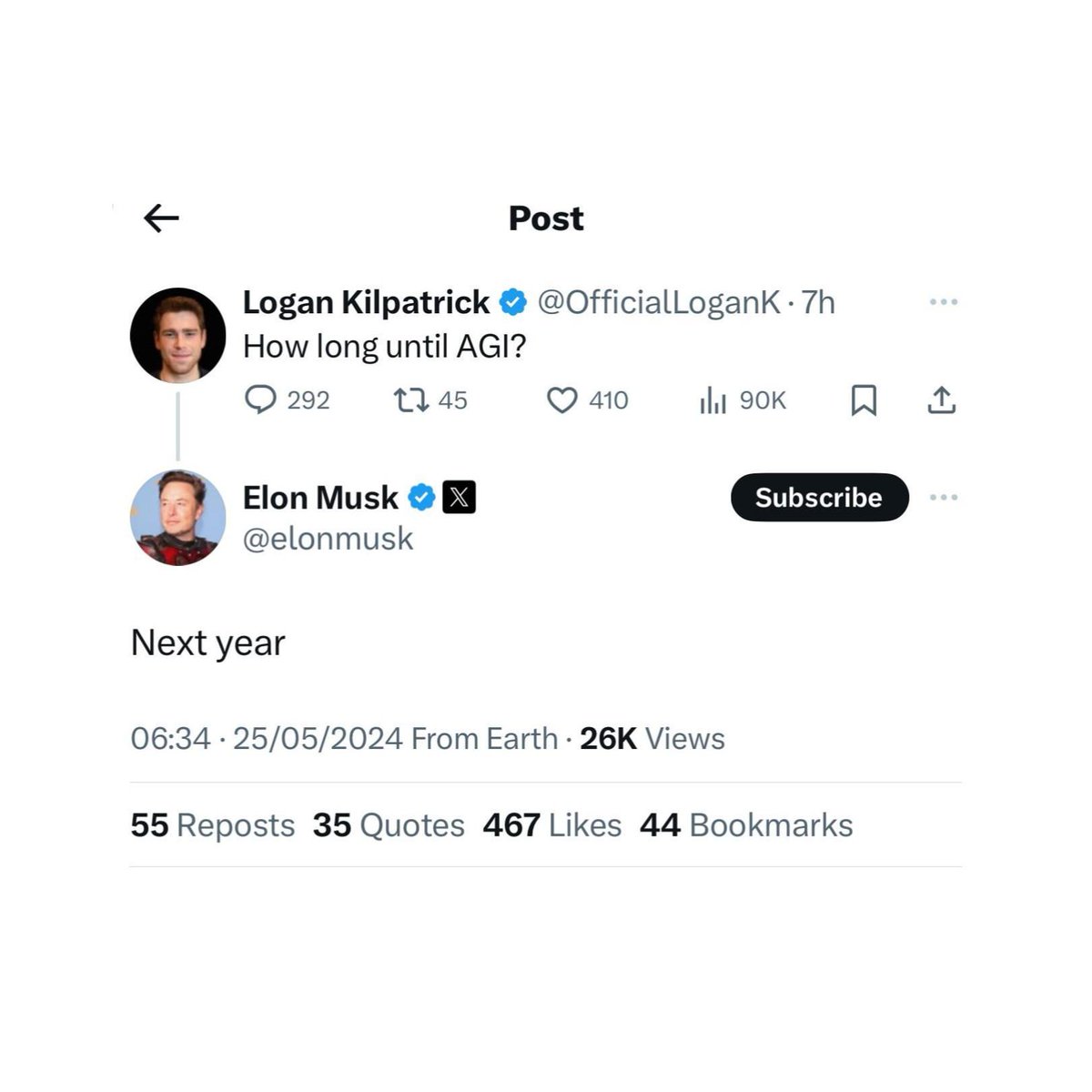
Hey @elonmusk - just curious if you stick to your prediction
Chubby♨️ tweet media
English
247
29
1.5K
164.7K
Madam Doge
Madam Doge@calic415·
Have you guys ever had Vietnamese egg coffee? Got this in San Jose 2 days ago.
Madam Doge tweet media
English
3
0
5
343
Nalin
Nalin@nalinrajput23·
How to reach his level of intelligence
Nalin tweet media
English
229
166
3.9K
183.7K
Can Vardar
Can Vardar@icanvardar·
looking for the best email sending API
English
302
7
405
108.5K