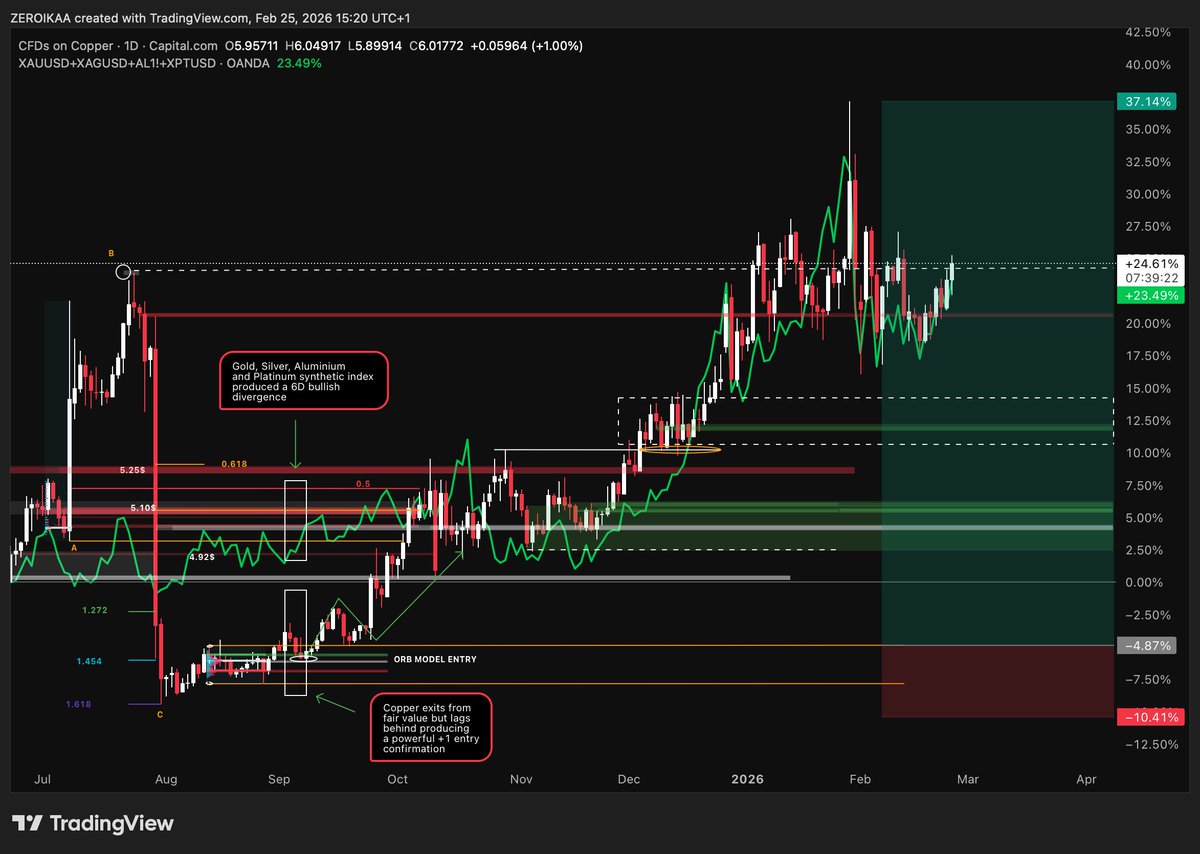
This is an example that I highly suggest you to study because it will improve your overall trading comprehension (and profitability). At the beginning of September I was tracking the chart of COPPER and noticed something extremely interesting. The price experienced a very aggressive selloff. From an AMT perspective, this was a liquidation event and not a bearish auction because there was no real price discovery taking place, only forced selling and stop-driven participation. Because value cannot be established during imbalance, I had no interest in chasing that move lower. Instead, I focused on where the auction would eventually find excess on the downside. Once price stopped extending lower, I began to see signs of strong buying as the selloff lost momentum and continuation to the downside failed. That told me the selling auction was complete. From there, the most important phase began. Price started to build a range. This is where most people lose patience, but from an AMT standpoint this is where the real information is produced and what we can call "Fair Value building". Why? Because time was spent, which is a key factor in order to build value as both buyers and sellers transacted in that area. That told me the auction was now in balance, and balance is what allows me to build directional scenarios with defined risk. Inside this range, I paid close attention to the POC and fair value. These references tell me where the market agrees on price and where participation is fair. Once those areas are established, the edges of the range become actionable, not because I am predicting direction, but because I understand how auctions behave around value. At this point, two scenarios became very clear to me. - If price were to accept above the range, that would signal initiative buying and a shift in value. In that case, I would expect price to seek higher prices and fill the inefficiencies left behind by the liquidation, with area in the 5$ acting as natural target. - On the other hand, if price failed to accept above value, that would indicate the auction still needed more work. In that scenario, continuation of balance or a deeper test of lower levels would have been completely natural, aka not bearish but simply what we can call unfinished business. Price instead exited from the 1st fair value zone seeking for another area where 60 days were spent and another fair value was established before expanding more. Result? Massive impulse that gave me an overall +30% This entire sequence is a textbook example of how markets actually move: imbalance → excess → balance → acceptance. If you train your eye to recognize these phases instead of reacting to each candle, your trading stops being reactive and starts becoming context-driven. Which I believe is the key for obtaining consistent results.