Alex Xenos

142 posts

Alex Xenos banner
Alex Xenos

Alex Xenos

@AMXenos

Lawyer | Constitutional Studies, Cato | Fmr speechwriter, Young Voices Contributor | Work in RCP, BostonHerald, AmSpectator, OrlandoSentinel, @reviewjournal etc

Washington, DC Area شامل ہوئے Mart 2024
239 فالونگ102 فالوورز
Alex Xenos
Alex Xenos@AMXenos·
In our latest Supreme Court amicus brief, filed in RMS v. EPA, we emphasize the importance of the non-delegation doctrine to the Constitution’s separation of powers. cato.org/legal-briefs/r…
English
0
2
1
160
Alex Xenos
Alex Xenos@AMXenos·
In January, I coauthored Cato’s amicus brief in Relentless v. U.S. Dept. of Commerce at the First Circuit. We argued that if an agency claims the power to compel private parties to fund a regulatory program, Congress must clearly authorize that power. The power of the purse belongs to Congress, not administrative agencies. Agencies cannot, by implication, finance their own regulatory ambitions. cato.org/legal-briefs/r…
English
0
2
1
144
Alex Xenos
Alex Xenos@AMXenos·
This case, in short, rests on straightforward First Amendment doctrine: When a law prohibits speech based on the topic or message expressed, that is a content-based restriction subject to strict scrutiny. Cato asks the Court to grant review and make clear that speech does not lose First Amendment protection merely because it concerns professional advice.
English
0
0
0
20
Alex Xenos
Alex Xenos@AMXenos·
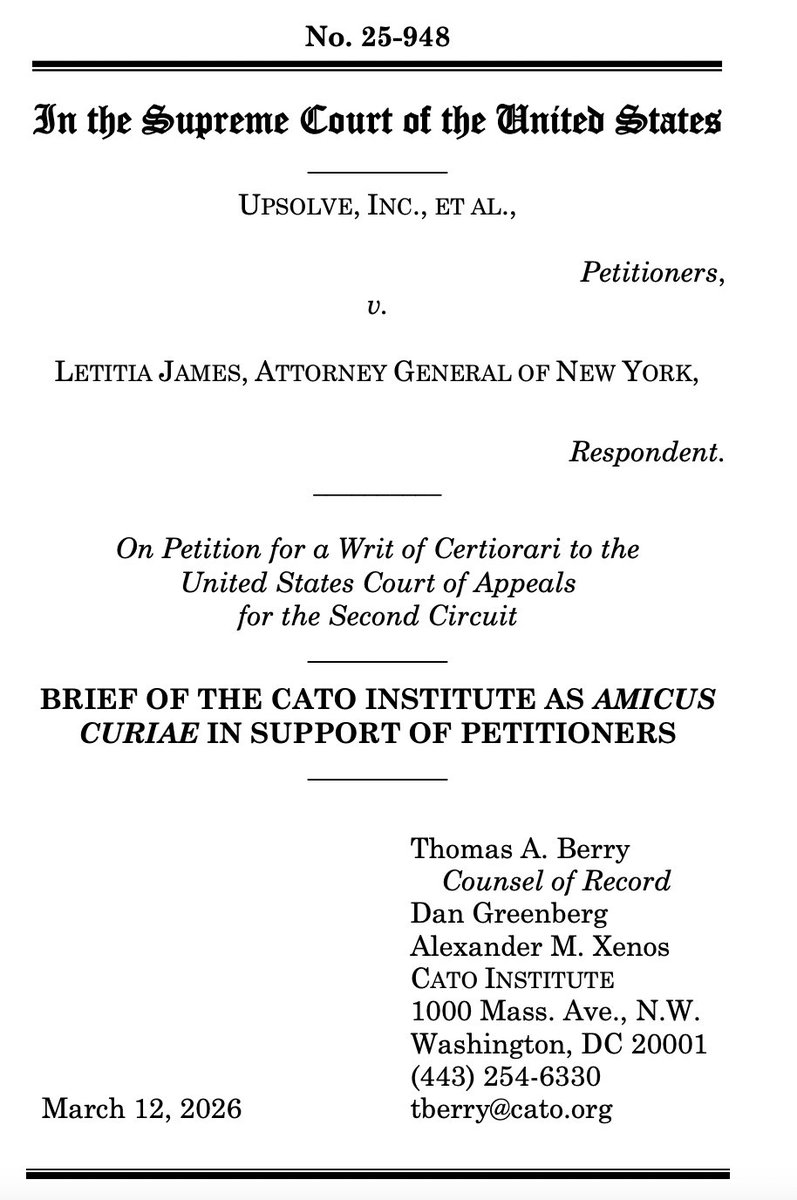
Earlier this month, the Cato Institute filed an amicus brief supporting the cert petition in Upsolve v. James. Our brief argues that New York’s application of its unauthorized-practice-of-law statute is a content-based restriction on speech. The government cannot escape strict scrutiny by saying it is regulating the speech’s “purpose” rather than its content. cato.org/legal-briefs/u…
English
1
0
0
34
Alex Xenos ری ٹویٹ کیا
Thomas Berry
Thomas Berry@Thomas_A_Berry·
Like all states, New York prohibits the unauthorized practice of law (UPL). But New York’s overzealous application of its UPL laws could squelch an innovative nonprofit and thereby make the crisis of access to legal aid even worse. Now the Supreme Court has a chance to hear an important First Amendment challenge that would vindicate the right to give basic legal advice and provide crucial relief in access to justice. In consumer debt actions, New York allows defendants sued for alleged unpaid debts to use a one-page, state-created answer form that streamlines responses through a series of checkboxes. The nonprofit group Upsolve seeks to train nonlawyer volunteers to help low-income individuals complete these forms at no cost. Those volunteers would neither represent anyone in court nor draft legal filings. They want to speak only to provide basic advice on how to fill out the form. Yet New York’s UPL regime criminalizes this speech because it constitutes individualized legal advice, transforming a conversation into a crime based solely on its content. New York’s UPL laws operate entirely on the basis of speech content. If Upsolve and its volunteers advise someone about financial strategies for managing debt, that’s lawful; if they advise someone about the legal implications of debt or alleged debt, that’s a crime. The district court held that this content-based speech restriction triggers “strict scrutiny,” the most skeptical form of judicial review. And the district court blocked enforcement of New York’s UPL laws against Upsolve, holding that the laws’ justifications in this context did not satisfy strict scrutiny. But the Second Circuit reversed, holding that only “intermediate scrutiny” should apply because the UPL laws regulate on the basis of the “purpose, focus, and circumstance” of the speech rather than its content. Now, Upsolve has asked the Supreme Court to take its case, and Cato has filed an amicus brief in support of that petition. Our brief makes four key points. First, we explain that New York’s restriction is content-based under established precedent. The Ninth Circuit erred in holding that UPL laws are content-neutral because they focus on the “purpose, focus, and circumstance” of speech. That reasoning creates a distinction without a difference: it would allow states to suppress speech on any topic subject to occupational licensing. The US Supreme Court rejected that approach in a prior opinion, National Institute of Family and Life Advocates v. Becerra (2018), explaining that speech does not receive less constitutional protection merely because it is spoken by a professional or concerns a regulated field. The Second Circuit’s rule threatens First Amendment protections far beyond the legal profession. Any licensed profession could invoke the same framework to suppress disfavored speech while claiming to regulate conduct. But there is no licensing shield against First Amendment scrutiny. Second, we present the public-choice context that makes this case important. Restrictions on the unauthorized practice of law were historically championed by incumbent lawyers seeking to limit competition. This case exemplifies how occupational licensing can serve as a device for rent-seeking rather than for consumer protection. Third, we document the access-to-justice crisis these restrictions produce. Millions of Americans face civil legal problems without any professional help, and programs like Upsolve’s are precisely the kind of innovation that such categorical prohibitions suppress. The debt-collection crisis in New York City demonstrates that the city is particularly in need of Upsolve’s services. This case, in short, rests on straightforward First Amendment doctrine: When a law prohibits speech based on the topic or message expressed, that is a content-based restriction subject to strict scrutiny. The government cannot evade the strict scrutiny this restriction requires by characterizing that restriction as targeting the speech’s “purpose” or “function.” The Supreme Court should grant review and make clear that speech does not lose First Amendment protection merely because it concerns professional advice.
Thomas Berry tweet media
English
4
17
32
3.9K
Alex Xenos
Alex Xenos@AMXenos·
Recently, the Cato Institute filed an amicus brief in FCC v. AT&T at the U.S. Supreme Court. We argue that the FCC's forfeiture scheme violates the Seventh Amendment. The jury is not a mere procedural formality. It is a structural safeguard against arbitrary government power, ensuring that ordinary citizens stand between the state and the imposition of punishment. The Seventh Amendment is violated the moment the federal government conclusively determines legal liability without a jury. A later, optional enforcement suit cannot retroactively cure that violation. At the Founding, the jury’s role was antecedent, not remedial. cato.org/legal-briefs/f…
English
1
3
7
373
Alex Xenos
Alex Xenos@AMXenos·
My latest, published in DC Journal and syndicated via InsideSources. Politically charged language from the judiciary undermines its credibility. When a president acts lawlessly, and they often do, rule accordingly. But don’t give us an op-ed with it. dcjournal.com/judges-should-…
English
0
1
1
456
Alex Xenos ری ٹویٹ کیا
InsideSources
InsideSources@InsideSourcesDC·
Judges Should Leave the Political Rhetoric to Pundits. "When the Trump administration acts lawlessly, and it often does, rule accordingly. Don’t give us an op-ed with it." dcjournal.com/judges-should-…
English
0
1
1
100
Alex Xenos
Alex Xenos@AMXenos·
@mattyglesias Whether someone is subscribed to a Substack is not a good measure of whether someone likes to read. This is childish.
English
0
0
0
167
Alex Xenos ری ٹویٹ کیا
Ilya Somin
Ilya Somin@IlyaSomin·
In this post, I urge the Supreme Court to hear case of Canna Provisions v. Bondi, and use this opportunity to reverse its awful decision in Gonzales v. Raich (which egregiously expanded federal power, and authorized awful War on Drugs abuses): reason.com/volokh/2025/12…
English
8
17
87
11.8K
Alex Xenos ری ٹویٹ کیا
Volokh Conspiracy
Volokh Conspiracy@VolokhC·
[Ilya Somin] The Supreme Court Should Hear Case Seeking to Overturn Gonzales v. Raich ift.tt/ZEp3RdT
English
0
1
4
1.2K
Alex Xenos
Alex Xenos@AMXenos·
As James Madison explained in Federalist 45, a foundational principle of the Constitution is that the federal government has only the “few and defined” powers the Constitution grants it. One of those powers is the authority to regulate interstate commerce. But decisions like Wickard and Raich stretched that authority so far that Congress can now regulate even purely intrastate, state-legal activity on the theory that it might indirectly affect national markets. Petitioners challenge Congress’s authority under the Controlled Substances Act to prohibit the entirely intrastate production, possession, and distribution of marijuana. The District Court dismissed the complaint, citing Raich. The First Circuit affirmed. If Raich’s logic stands, there is no principled stopping point. Congress could ban backyard gardens, homemade goods, or the possession of anything it calls "economic.” A theory of commerce that broad effectively grants Congress a general police power the Framers deliberately withheld. This case goes far beyond marijuana. It asks whether structural limits on federal authority still matter, and whether the Court will enforce them. Federalism is a constitutional command, not a courtesy, and the rule of law depends on honoring those limits.
English
1
2
14
979
Alex Xenos
Alex Xenos@AMXenos·
We at Cato filed an amicus brief in Canna Provisions v. Bondi calling on SCOTUS to grant cert, restore the Commerce Clause to its original meaning, and overrule Gonzales v. Raich. cato.org/legal-briefs/c…
English
5
5
39
8.8K
Alex Xenos
Alex Xenos@AMXenos·
Oral argument for Rutherford v. US at SCOTUS is today. Check out Cato’s amicus brief, arguing judges may consider sentencing disparities created by FSA when deciding compassionate release motions. cato.org/legal-briefs/r…
English
0
0
0
102
Alex Xenos
Alex Xenos@AMXenos·
Last week, the Cato Institute filed an amicus brief I coauthored in Trump v. Slaughter, urging the Supreme Court to reaffirm the President’s constitutional authority to remove executive officers and overrule Humphrey’s Executor. Read the brief here: supremecourt.gov/DocketPDF/25/2…
English
0
0
0
48