Spidey ری ٹویٹ کیا

It’s VERY rare for Dr. Dre to share unfinished music but…
This “Thank You” song sounds crazy 🔥🔥
It’s not officially on the “Missionary” tracklist but I hope they add it 😮💨
English
Spidey
19 posts



Announcing our partnership with @DioneProtocol, a 100% renewable L1 blockchain powering the Internet of Things! 💡 Through this integration, Dione’s Layer1 chain will seamlessly connect to over 30 EVM and non-EVM chains via Router Chain, enabling interoperable activities like single-click transactions through Router’s Cross-chain Intents, token transfers via our bridge, Router Nitro, and access to a suite of other interoperable dApps. Powered by Router’s chain abstraction, this partnership expands accessibility and provides a seamless, cross-chain experience for Dione’s users and developers 🤝
The @RouterProtocol goal remains the same.
Chain Abstraction is a piece of C.A.K.E., and Router is baking! Head to our blog and know how Router is slicing through each layer of the CAKE Framework: routerprotocol.medium.com/router-protoco… Chain Abstraction hides the complexity of blockchains from users, making their interactions simple and intuitive. In a chain-abstracted world, users sign transactions, and the backend handles everything cross-chain—no need to know which chain you're on! The CAKE Framework is the blueprint for achieving this. It consists of 4 layers: - Application Layer: This is where users interact with dApps. They shouldn't have to worry about which blockchain they're using. Router Protocol has already simplified this with products like Router Nitro and various Intent Adapters, allowing users to swap, stake, or bridge seamlessly with any token from any chain. - Permission Layer: Essentially, this layer is responsible for managing wallet access, handling transaction signatures, and dealing with gas fees across different chains with Account Abstraction (AA) and Policy-Based Agents. Now, while Router doesn’t yet support AA wallets, it does enable users to express and execute their cross-chain intents using their EOA wallets smoothly and user-friendly, minimizing friction and simplifying complex processes. - Solver Layer: Once a user’s intent is expressed, the Solver Layer finds the best route to execute it. Router’s PathFinder API plays a key role here, optimizing cross-chain transactions to ensure the fastest and most cost-effective path for users. - Settlement Layer: The final step is where transactions are verified and completed. Here, Router Chain acts as a settlement and clearing layer. Once the solvers (forwarders) execute the user's intent, Router verifies whether it was done correctly. If everything checks out, the solvers are reimbursed for their liquidity, and the transaction is completed. While CAKE lays out the theoretical model, Router is making it practical. By integrating deeply into the Application, Permission, Solver, and Settlement Layers, Router makes cross-chain operations: Faster, Cheaper, Simpler, and more Reliable! We’re continuing to innovate and bake up solutions that will make the decentralized web as intuitive as the regular web.

Monday's not so bad when you're saving on fees with Rubic. Explore ZERO Fees with Rubic's Best Rate Finder 🔽
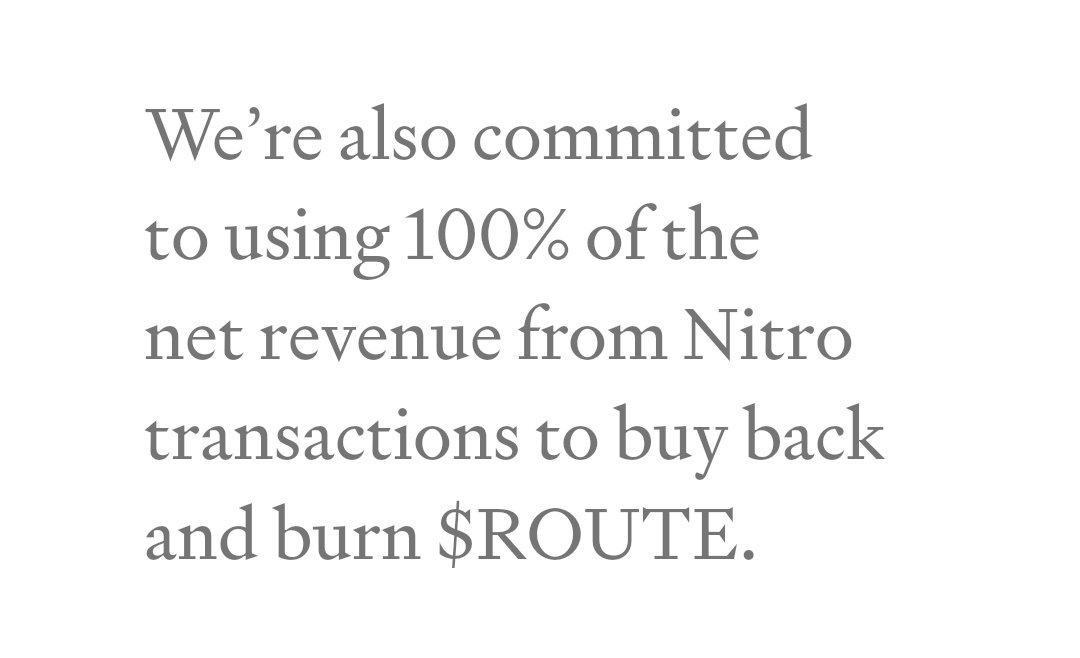
1/ Introducing Buyback+Burn with Fees and Nitro Liquidity Farms! After community feedback, we are committed to using 100% of the net revenue from Nitro transactions to buy back and burn ROUTE. We also introduce single-asset liquidity farms, including ETH, USDC, and USDT, where users can earn rewards. This is the next phase of our cross-chain bridge, Router Nitro! 👉 Get started here: hub.routerprotocol.com/farms/nitrofar… For more details, read our blog post: routerprotocol.medium.com/nitros-next-bi…
wen? wen? wen? Router Chain is live now! Many steps closer to Chain Abstraction. 🎊 @routerprotocol $ROUTE