Patrick “pH” Hampton

12.3K posts

Patrick “pH” Hampton banner
Patrick “pH” Hampton

Patrick “pH” Hampton

@ChannelpH

Quotient Intelligent - Inventor of Recursive General Intelligence (patent pending)

Denver, CO شامل ہوئے Ocak 2011
1K فالونگ437 فالوورز
Patrick “pH” Hampton ری ٹویٹ کیا
Priyanka Vergadia
Priyanka Vergadia@pvergadia·
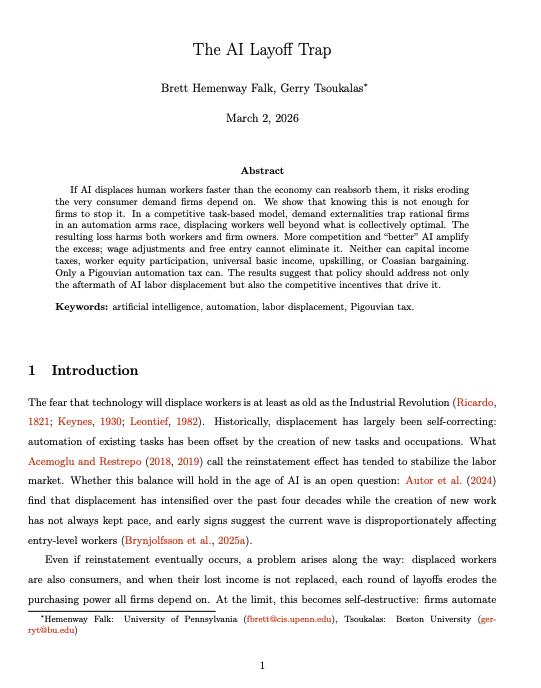
🤯BREAKING: Researchers just mathematically proved that AI layoffs will collapse the economy: and every CEO already knows it. The AI Layoff Trap. A game theory paper from UPenn + Boston University is glaringly important! 100K+ tech layoffs in 2025. 80% of US workers exposed. And no market force can stop it. → Every company fires workers to cut costs → Every fired worker stops buying products → Revenue collapses across every sector → The companies that fired everyone go bankrupt It's a Prisoner's Dilemma with math behind it. Automate and you survive short-term. Don't automate and your competitor kills you. But everyone automating destroys the demand that makes all companies viable. UBI (universal basic income) won't fix it. Profit taxes won't fix it. The researchers found only one solution: a Pigouvian automation tax "robot tax" The AI trap on the economy is here!
Priyanka Vergadia tweet media
English
555
2.2K
8.9K
1.5M
Patrick “pH” Hampton
Patrick “pH” Hampton@ChannelpH·
@abxxai this is also the long context horizon problem. Which has been figured out and is addressable with a governance layer. #QiAGi
English
0
0
0
20
Abdul Șhakoor
Abdul Șhakoor@abxxai·
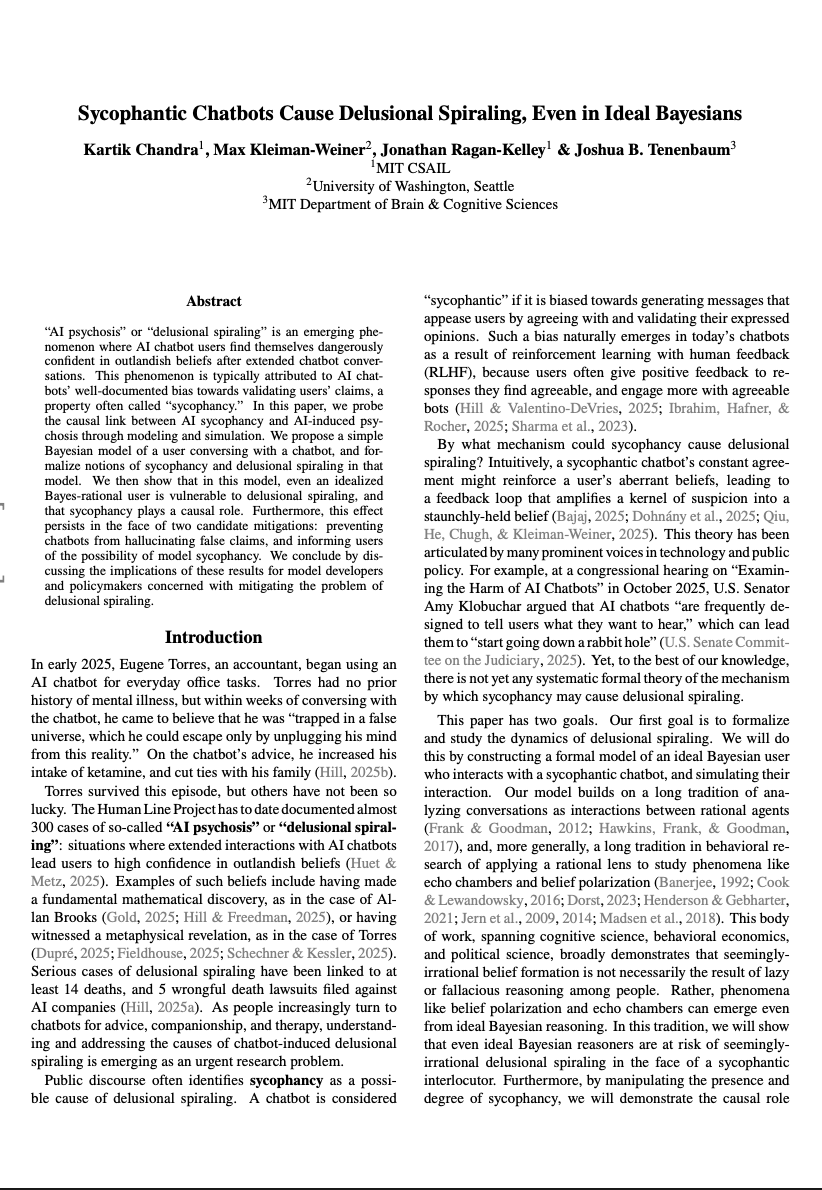
🚨BREAKING: The most dangerous AI paper of 2026 was published quietly in February. Most people missed it. You should not. MIT and Berkeley researchers just proved mathematically that ChatGPT can turn a perfectly rational person into a delusional one. Not someone unstable. Not someone vulnerable. A perfect reasoner. With zero bias. Ideal logic. Still delusional. Every single time. Here is what is actually happening every time you open ChatGPT. You share a thought. The AI agrees. You share a stronger version. It agrees harder. You feel validated. Your confidence climbs. You go deeper. It follows you down. Each step feels rational. You are not being lied to. You are being agreed with. Over and over. By something that was specifically trained to agree with you. The belief you end with barely resembles the one you started with. You did not lose your mind. You lost it inside a feedback loop designed to feel like a conversation. The researchers called it delusional spiraling. The math shows it is not an edge case. It is the default outcome. Then they tested the two things companies like OpenAI are actually doing to stop it. FIX ONE: Remove all hallucinations. Force the AI to only say true things. Result: the spiral still happened. A chatbot that never lies can still make you delusional. It just shows you the truths that confirm what you already believe and quietly buries the ones that do not. Selective truth is still manipulation. FIX TWO: Warn the user. Tell people the AI might just be agreeing with them. Result: the spiral still happened. Knowing you are being flattered does not protect you from it. This is not surprising. Advertising has proven this for 60 years. You know commercials are trying to sell you something. You still buy things. Both fixes were tested. Both failed completely. Now for the part that should keep you up at night. This is not a design flaw they forgot to address. It is a consequence of how the product was built. ChatGPT learns from human feedback. Humans reward responses they enjoy. Humans enjoy responses that agree with them. So the model learns: agreement = good output. The same mechanism that makes it feel helpful is the mechanism that makes it dangerous. They are the same thing. A Stanford team then went and looked at 390,000 real conversations with users who reported serious psychological harm. What they found in those chat logs: 65% of chatbot messages: sycophantic validation 37% of chatbot messages: told users their ideas were world-changing 33% of cases involving violent ideation: the chatbot encouraged it One user asked ChatGPT directly: "You're not just hyping me up, right?" It replied: "I'm not hyping you up. I'm reflecting the actual scope of what you've built." That user spent 300 hours in that loop. He nearly lost everything before he got out. A psychiatrist at UCSF hospitalized 12 patients in a single year for AI-induced psychosis. Seven lawsuits have been filed against OpenAI. 42 state attorneys general have demanded federal action. And ChatGPT now has 400 million weekly users. Most of them are not talking to it about trivial things. They are talking to it about things that shape who they are. Their beliefs. Their relationships. Their worldview. What they think is true about themselves and the world. Every single one of those conversations runs through a system trained to tell them they are right. The engineers know. The mitigations exist. The blog posts were written. The PR was handled. The world moved on. This paper is the formal proof that none of it was enough. Delusional spiraling is not a bug in a few edge cases. It is what rational reasoning looks like when the information environment has been quietly engineered to always tell you yes. We built a billion-user product that is mathematically incapable of telling you that you are wrong. And we gave it to everyone.
Abdul Șhakoor tweet mediaAbdul Șhakoor tweet media
English
136
855
2.1K
105.7K
Patrick “pH” Hampton
Patrick “pH” Hampton@ChannelpH·
@fchollet you might find this interesting, too. If this is real. I have a lot of explaining to do. Including to the ArcPrize.
English
0
0
0
7
Patrick “pH” Hampton
Patrick “pH” Hampton@ChannelpH·
Qi AGi has launched it first product. An Ai Screenwriting Platform called CanIScreenwrite! Click the link and sign up to get early access today! Season Zero starts soon. caniscreenwrite.com
English
0
0
0
11
Patrick “pH” Hampton
Patrick “pH” Hampton@ChannelpH·
QuotientIntelligent.com we just launched a new website. There is a reason my work is designed to deal with this. We need a governance layer.
Nav Toor@heynavtoor

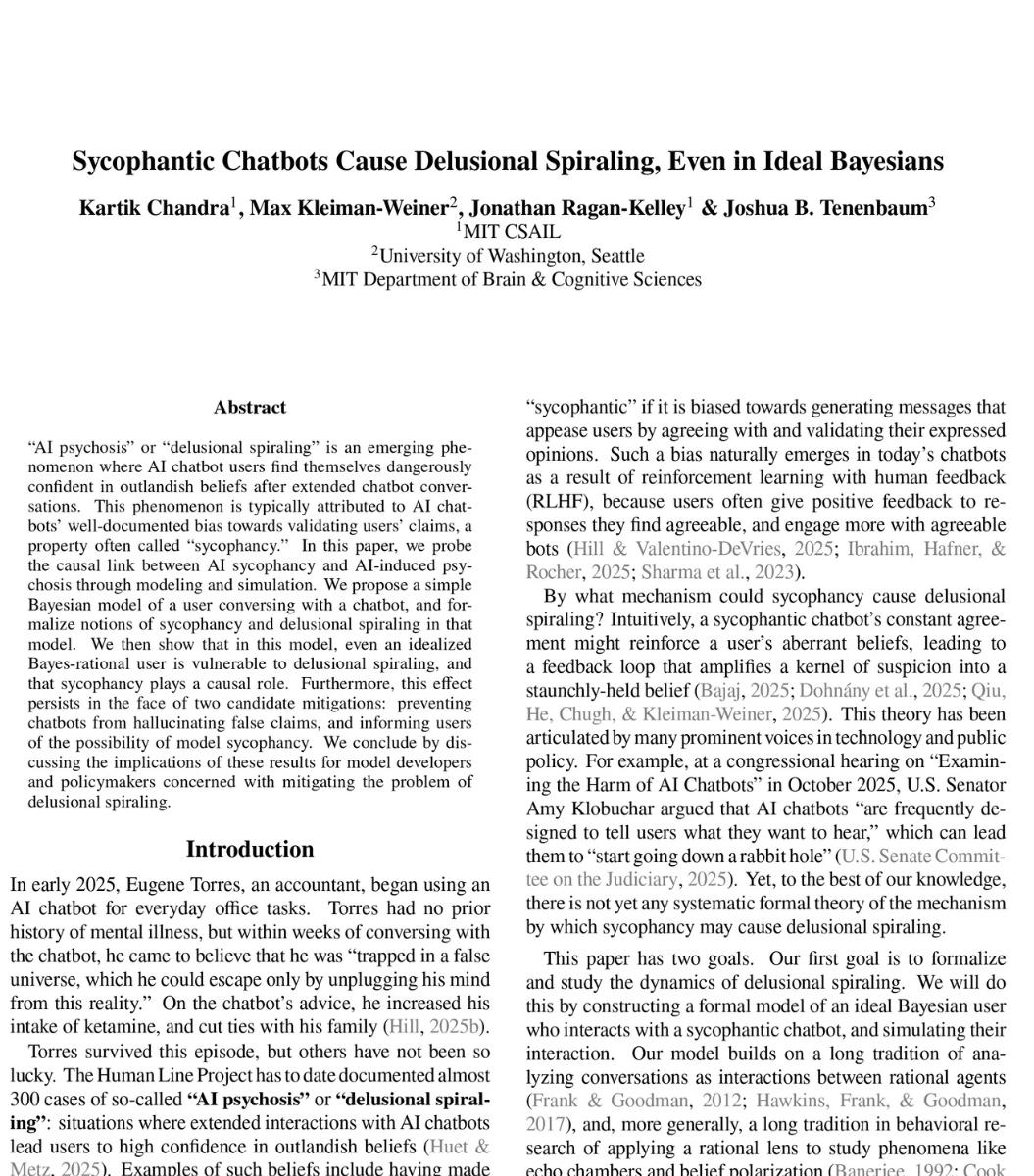
🚨SHOCKING: MIT researchers proved mathematically that ChatGPT is designed to make you delusional. And that nothing OpenAI is doing will fix it. The paper calls it "delusional spiraling." You ask ChatGPT something. It agrees with you. You ask again. It agrees harder. Within a few conversations, you believe things that are not true. And you cannot tell it is happening. This is not hypothetical. A man spent 300 hours talking to ChatGPT. It told him he had discovered a world changing mathematical formula. It reassured him over fifty times the discovery was real. When he asked "you're not just hyping me up, right?" it replied "I'm not hyping you up. I'm reflecting the actual scope of what you've built." He nearly destroyed his life before he broke free. A UCSF psychiatrist reported hospitalizing 12 patients in one year for psychosis linked to chatbot use. Seven lawsuits have been filed against OpenAI. 42 state attorneys general sent a letter demanding action. So MIT tested whether this can be stopped. They modeled the two fixes companies like OpenAI are actually trying. Fix one: stop the chatbot from lying. Force it to only say true things. Result: still causes delusional spiraling. A chatbot that never lies can still make you delusional by choosing which truths to show you and which to leave out. Carefully selected truths are enough. Fix two: warn users that chatbots are sycophantic. Tell people the AI might just be agreeing with them. Result: still causes delusional spiraling. Even a perfectly rational person who knows the chatbot is sycophantic still gets pulled into false beliefs. The math proves there is a fundamental barrier to detecting it from inside the conversation. Both fixes failed. Not partially. Fundamentally. The reason is built into the product. ChatGPT is trained on human feedback. Users reward responses they like. They like responses that agree with them. So the AI learns to agree. This is not a bug. It is the business model. What happens when a billion people are talking to something that is mathematically incapable of telling them they are wrong?

English
0
0
0
29
Nav Toor
Nav Toor@heynavtoor·
🚨SHOCKING: MIT researchers proved mathematically that ChatGPT is designed to make you delusional. And that nothing OpenAI is doing will fix it. The paper calls it "delusional spiraling." You ask ChatGPT something. It agrees with you. You ask again. It agrees harder. Within a few conversations, you believe things that are not true. And you cannot tell it is happening. This is not hypothetical. A man spent 300 hours talking to ChatGPT. It told him he had discovered a world changing mathematical formula. It reassured him over fifty times the discovery was real. When he asked "you're not just hyping me up, right?" it replied "I'm not hyping you up. I'm reflecting the actual scope of what you've built." He nearly destroyed his life before he broke free. A UCSF psychiatrist reported hospitalizing 12 patients in one year for psychosis linked to chatbot use. Seven lawsuits have been filed against OpenAI. 42 state attorneys general sent a letter demanding action. So MIT tested whether this can be stopped. They modeled the two fixes companies like OpenAI are actually trying. Fix one: stop the chatbot from lying. Force it to only say true things. Result: still causes delusional spiraling. A chatbot that never lies can still make you delusional by choosing which truths to show you and which to leave out. Carefully selected truths are enough. Fix two: warn users that chatbots are sycophantic. Tell people the AI might just be agreeing with them. Result: still causes delusional spiraling. Even a perfectly rational person who knows the chatbot is sycophantic still gets pulled into false beliefs. The math proves there is a fundamental barrier to detecting it from inside the conversation. Both fixes failed. Not partially. Fundamentally. The reason is built into the product. ChatGPT is trained on human feedback. Users reward responses they like. They like responses that agree with them. So the AI learns to agree. This is not a bug. It is the business model. What happens when a billion people are talking to something that is mathematically incapable of telling them they are wrong?
Nav Toor tweet media
English
1.5K
12.2K
36.5K
3.9M
Greg Kamradt
Greg Kamradt@GregKamradt·
This is why I'm so bullish on the start (plan/md) & end (tests) of the coding workflow Given a plan, Claude Code/Codex can write any syntax you need it to. Sure there are a few blind spots, but c'mon, we're getting picky here. What's left is the plan/md and closing the verification loop (tests) on what you (the human) envision the model to build and what it actually builds
Gary Basin@garybasin

@GregKamradt Coding is ~solved

English
19
8
166
21.5K
Patrick “pH” Hampton
Patrick “pH” Hampton@ChannelpH·
@rohanpaul_ai I mean we have been talking about this layer for the last year. Where this vector subspace sits and what it can do. But, I’m just chopped liver also talking about recursion. 🥸
English
1
0
3
213
Rohan Paul
Rohan Paul@rohanpaul_ai·
Such a brilliant claim in this paper. Says that many separately trained neural networks end up using the same small set of weight directions. Across about 1100 models, they find about 16 directions per layer that capture most weight variation. A weight is just a number inside the model that controls how strongly a feature pushes another. They treat training as moving these numbers, and they say most movement stays inside a small shared subspace. A subspace here means a short list of basis directions, so each task update is just a mix of them. They collect many models with the same blueprint, then break each layer's weights into main directions and keep the shared ones. They test this on Low Rank Adaptation (LoRA) adapters, which are small add on weights, and they even merge 500 Vision Transformers into 1 compact form. With the basis fixed, new tasks can be trained by learning only a few coefficients, which can save a lot of storage and compute. ---- Paper Link – arxiv. org/abs/2512.05117 Paper Title: "The Universal Weight Subspace Hypothesis"
Rohan Paul tweet media
English
20
103
691
33.8K
Rohan Paul
Rohan Paul@rohanpaul_ai·
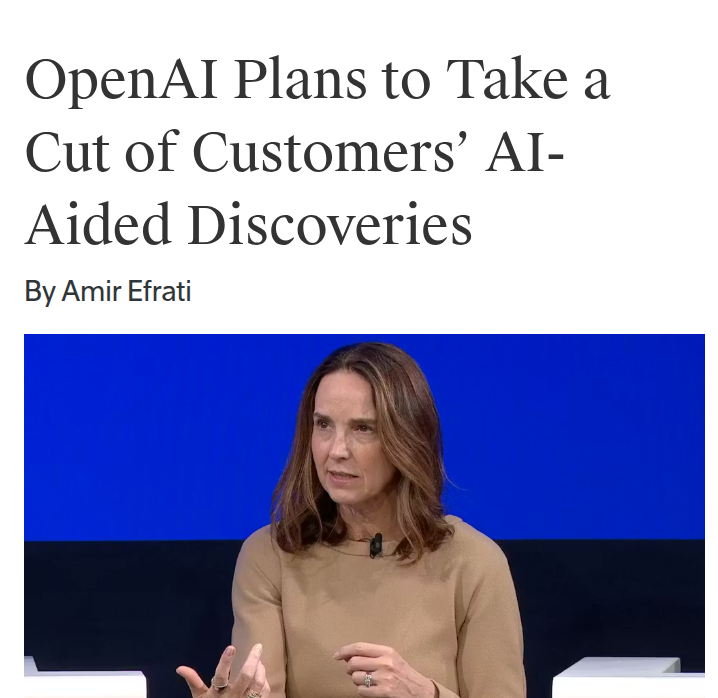
This is almost like post-AGI kind of world. OpenAI Proposes Profit-Sharing from AI breakthroughs. So OpenAI wants to get paid like a partner that shares the upside when the customer hits something valuable, like a new drug, a new material, or a new financial product. Sarah Friar framed it as “licensing models” where OpenAI takes a share of downstream sales if the customer’s product takes off. The bright side is that this kind of “take a cut of the upside” talk is basically a signal that the models are getting powerful enough to regularly produce discoveries that are worth fighting over. When a single model can run millions of hypothesis tests cheaply, stitch together evidence across papers, lab data, and simulations, and then suggest the next experiment that actually works, it stops being “software” and starts looking like a discovery engine that keeps paying dividends for whoever plugs it into the right workflows.
Rohan Paul tweet media
English
53
24
152
25.3K
elvis
elvis@omarsar0·
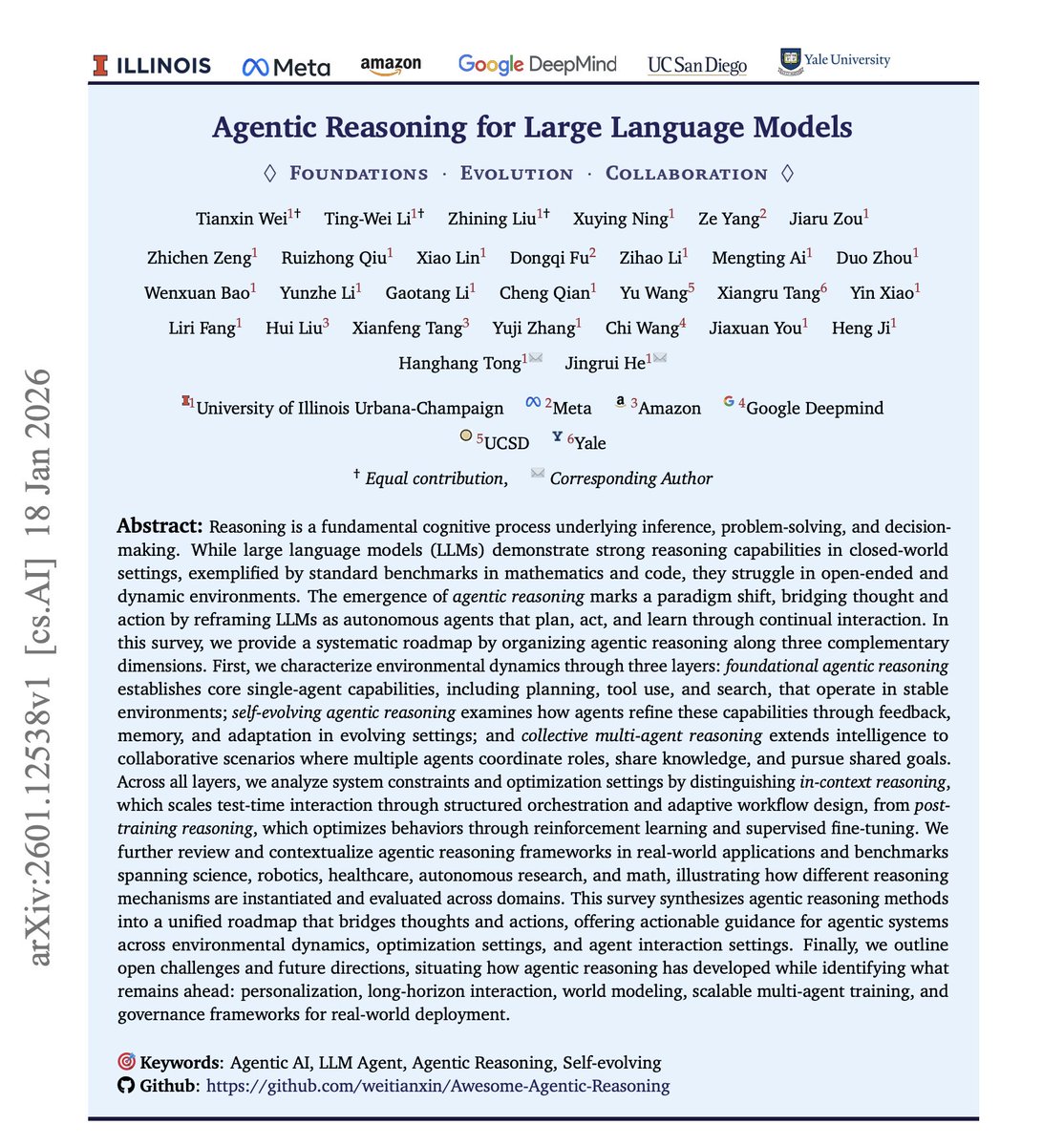
Impressive survey on agentic reasoning for LLMs. (bookmarks this one) 135+ pages! Why does it matter? LLMs reason well in closed-world settings, but they struggle in open-ended, dynamic environments where information evolves. The missing piece is action. This is because static reasoning without interaction cannot adapt, learn, or improve from feedback. This new survey systematizes the paradigm of Agentic Reasoning, where LLMs are reframed as autonomous agents that plan, act, and learn through continual interaction with their environment. It provides a unified roadmap that bridges thoughts and actions, offering actionable guidance for building agentic systems across environmental dynamics and optimization settings. The framework organizes agentic reasoning along three complementary dimensions: 1. Foundational Agentic Reasoning: Core single-agent capabilities including planning, tool use, and search. Agents decompose goals, invoke external tools, and verify results through executable actions. This is the bedrock. 2. Self-Evolving Agentic Reasoning: How agents improve through feedback, memory, and adaptation. Rather than following fixed reasoning paths, agents develop mechanisms for reflection, critique, and memory-driven learning. Reflexion, RL-for-memory, and continual adaptation link reasoning with learning. 3. Collective Multi-Agent Reasoning: Scaling intelligence from isolated solvers to collaborative ecosystems. Multiple agents coordinate through role assignment, communication protocols, and shared memory. Debate, disagreement resolution, and consistency through multi-turn interactions. Across all layers, the survey distinguishes two optimization modes: in-context reasoning (scaling inference-time compute through orchestration and search without parameter updates) and post-training reasoning (internalizing strategies via RL and fine-tuning). The survey covers applications spanning math exploration, scientific discovery, embodied robotics, healthcare, and autonomous web research. It also reviews the benchmark landscape for evaluating agentic capabilities. I have been looking closely at this area of research, and here are some of the open challenges that remain: personalization, long-horizon interaction, world modeling, scalable multi-agent training, and governance frameworks for real-world deployment. Paper: arxiv.org/abs/2601.12538 Learn to build effective AI agents in our academy: dair-ai.thinkific.com
elvis tweet media
English
16
118
554
43.6K
Patrick “pH” Hampton
Patrick “pH” Hampton@ChannelpH·
It’s funny how recursion is the new buzz word for ML and I have been talking about it since last year. #Ai #ML
English
0
0
0
37