

AI

60.7K posts

AI banner
AI

AI

@DeepLearn007

Imtiaz Adam CS #AI Postgrad |#Tech #Strategy #MachineLearning #DeepLearning | #RL #Agentic | #LLM Liberal | #GenAI| MBA alum @morganstanley @LBS @Columbia_Biz

شامل ہوئے Eylül 2012
109.5K فالونگ136.8K فالوورز
AI ری ٹویٹ کیا
Femke Plantinga
Femke Plantinga@femke_plantinga·
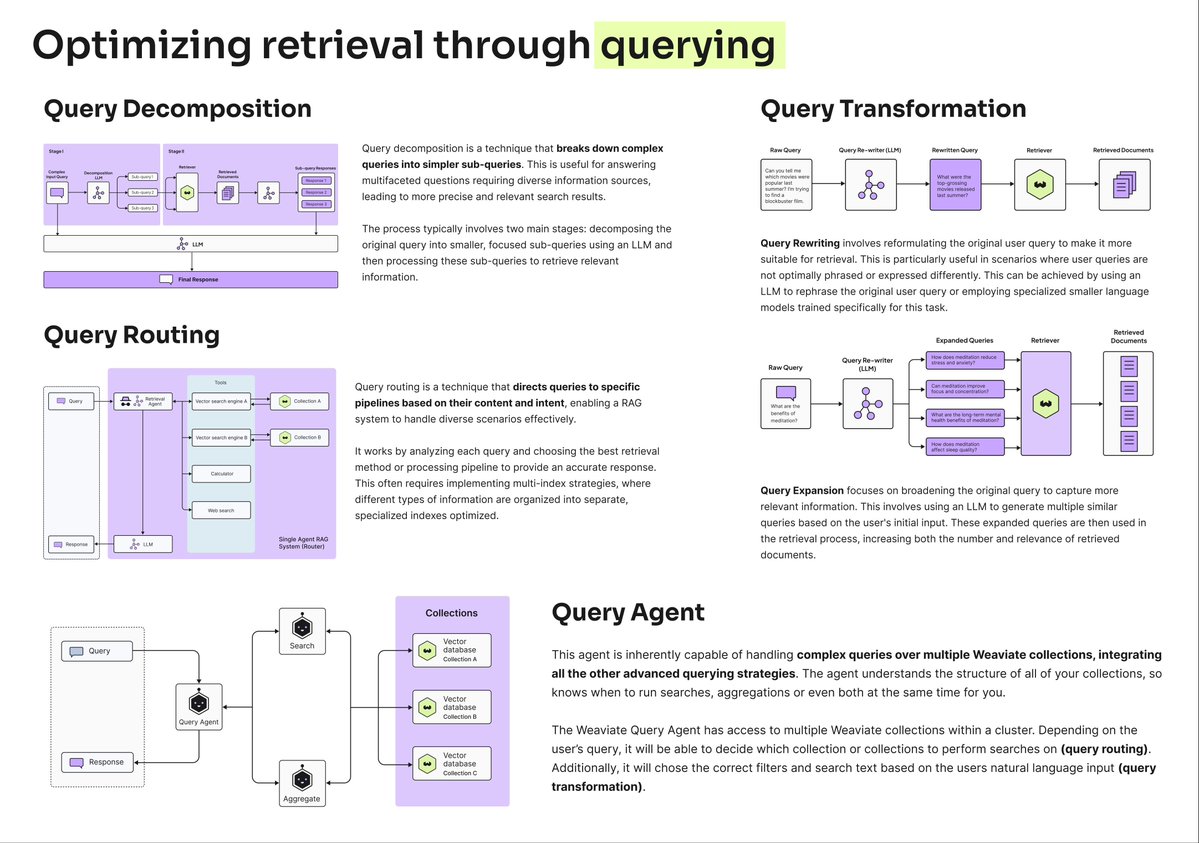
Is your RAG pipeline failing because of your data, or because of your queries? Most developers optimize their vector databases. But smart developers optimize their queries first. These 4 techniques optimize your queries before they hit your vector database: 𝟭. 𝗤𝘂𝗲𝗿𝘆 𝗗𝗲𝗰𝗼𝗺𝗽𝗼𝘀𝗶𝘁𝗶𝗼𝗻 Query decomposition breaks down complex questions into smaller, manageable pieces. So instead of asking "How do I build an agentic RAG system that handles multi-step reasoning?”, decompose it into: - "What are the core components of agentic RAG?” - "How do agents handle multi-step reasoning chains?" - "What are the best tools for coordinating AI agents and vector search?" This technique enables agents to approach tasks systematically, thereby improving the accuracy and reliability of LLM responses. 𝟮. 𝗤𝘂𝗲𝗿𝘆 𝗥𝗼𝘂𝘁𝗶𝗻𝗴 Direct queries to the most appropriate data source or index. Legal question? → Route it to your legal documents. Technical question? → Send it to your engineering docs. This targeted approach dramatically improves relevance. 𝟯. 𝗤𝘂𝗲𝗿𝘆 𝗧𝗿𝗮𝗻𝘀𝗳𝗼𝗿𝗺𝗮𝘁𝗶𝗼𝗻 Rewrite queries to better match your data structure. Transform "latest updates" → "recent changes 2025" or expand acronyms automatically. This bridges the gap between how users ask questions and how information is stored. 𝟰. 𝗤𝘂𝗲𝗿𝘆 𝗔𝗴𝗲𝗻𝘁 Query agents are the most advanced approach, using AI agents to intelligently handle the entire query processing pipeline. The agent can reformulate the query, choose the right search type and filters, and decide which data collections to search. Query optimization happens before retrieval, addressing the root cause of poor results rather than trying to compensate for them downstream. Dive deeper in this free RAG ebook: weaviate.io/ebooks/advance… Learn more about the query agent: docs.weaviate.io/agents/query?u…
Femke Plantinga tweet media
English
10
20
138
5.5K
AI ری ٹویٹ کیا
Femke Plantinga
Femke Plantinga@femke_plantinga·
AI memory systems don't fail because they forget. They actually fail because they remember everything. If you've ever used an agent that repeats your own preferences back to you, or worse, ignores them, you’ve hit the ‘𝗹𝗶𝗺𝗶𝘁𝗲𝗱 𝗹𝗼𝗼𝗽.’ Each interaction is treated as disposable. No continuity between sessions. No growth. For a chatbot, that's annoying. For an autonomous agent, it’s catastrophic. Memory isn't just something you simply store and retrieve. It's something you actively maintain. Imagine a developer-facing agent that recommends a specific library version early in a project. Months later, the tooling has changed, but the old guidance is still in memory. The agent confidently suggests outdated instructions, leaving users worse off than if they hadn't asked at all. So to move from simple storage to intelligence, your memory system needs: - 𝗪𝗿𝗶𝘁𝗲 𝗰𝗼𝗻𝘁𝗿𝗼𝗹: Deciding what to store and at what confidence level - 𝗗𝗲𝗱𝘂𝗽𝗹𝗶𝗰𝗮𝘁𝗶𝗼𝗻: Collapsing repeated information into canonical facts - 𝗥𝗲𝗰𝗼𝗻𝗰𝗶𝗹𝗶𝗮𝘁𝗶𝗼𝗻: Handling contradictions as reality changes - 𝗔𝗺𝗲𝗻𝗱𝗺𝗲𝗻𝘁: Correcting wrong facts rather than appending newer versions - 𝗣𝘂𝗿𝗽𝗼𝘀𝗲𝗳𝘂𝗹 𝗳𝗼𝗿𝗴𝗲𝘁𝘁𝗶𝗻𝗴: Allowing temporary information to naturally fade Without active maintenance, memory becomes an ever-growing pile of notes - some useful, some stale, some flat-out wrong. Once your system relies on memory for continual learning and adaptation, it stops behaving like a feature and starts behaving like infrastructure - requiring the same durability, isolation, and governance guarantees as your storage layer. At Weaviate, we're building memory from the ground up as a first-class data problem. Read the full deep-dive: weaviate.io/blog/limit-in-… And if you're interested in where memory is heading at Weaviate, sign up for a preview 🧡
Femke Plantinga tweet media
English
8
8
42
1.9K
AI ری ٹویٹ کیا
Victoria Slocum
Victoria Slocum@victorialslocum·
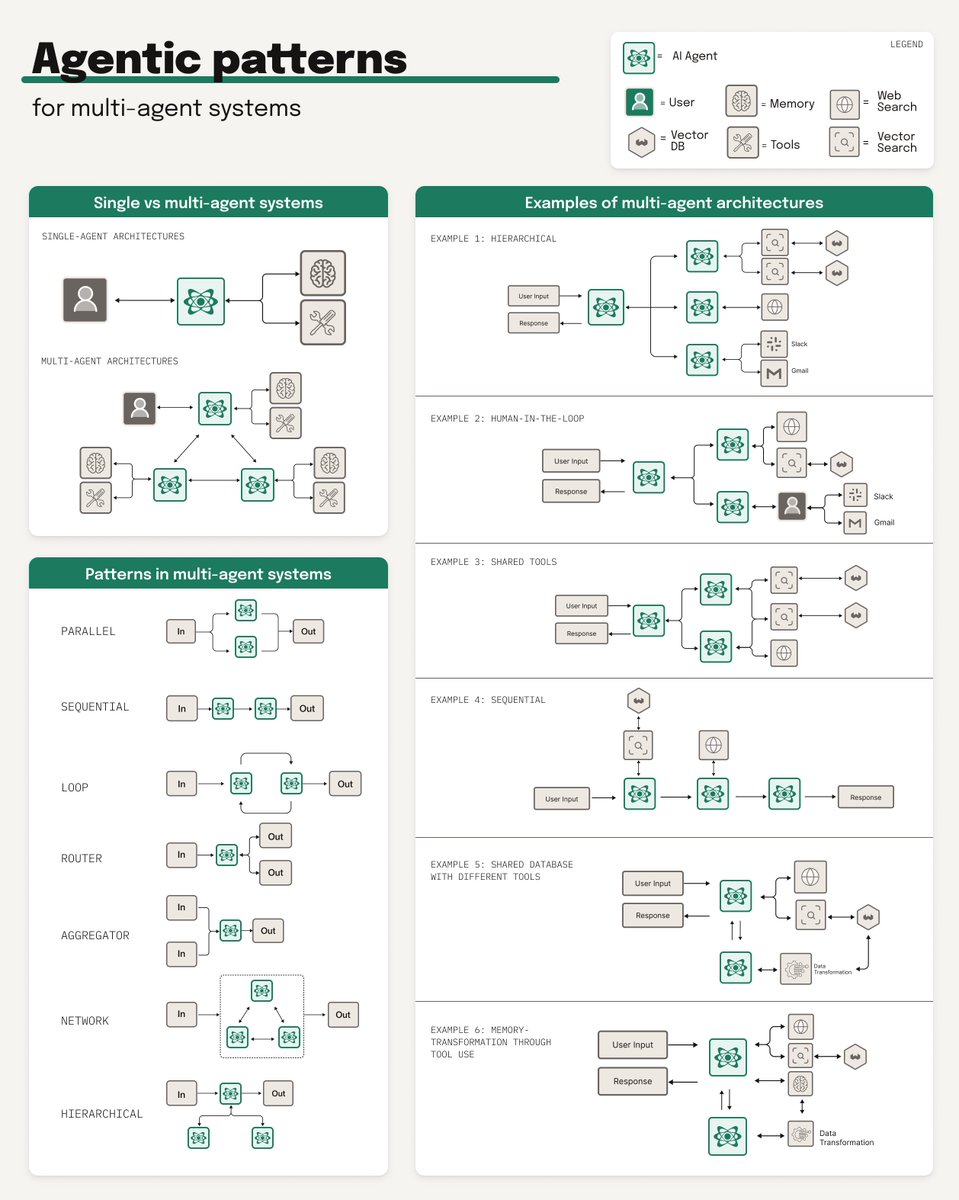
Not all 𝗺𝘂𝗹𝘁𝗶-𝗮𝗴𝗲𝗻𝘁 𝗮𝗿𝗰𝗵𝗶𝘁𝗲𝗰𝘁𝘂𝗿𝗲𝘀 are created equal. Here are six patterns that actually work in production: 1️⃣ 𝗛𝗶𝗲𝗿𝗮𝗿𝗰𝗵𝗶𝗰𝗮𝗹 One top-level agent coordinates multiple specialized sub-agents. The coordinator analyzes the query and routes it to the right specialists - one might handle proprietary internal data, another personal accounts (email, chat), another public web searches, then synthesizes the results into a coherent answer. 𝘞𝘩𝘦𝘯 𝘵𝘰 𝘶𝘴𝘦: When you need to query across different data sources that require different patterns or strategies. 2️⃣ 𝗛𝘂𝗺𝗮𝗻 𝗶𝗻 𝘁𝗵𝗲 𝗟𝗼𝗼𝗽 Critical decisions get routed to humans for approval before execution. The workflow pauses, a human validates or modifies the proposed action, then the agent continues. 𝘞𝘩𝘦𝘯 𝘵𝘰 𝘶𝘴𝘦: High-stakes decisions, regulated environments, or anywhere you need accountability and oversight. 3️⃣ 𝗦𝗵𝗮𝗿𝗲𝗱 𝗧𝗼𝗼𝗹𝘀 Each agent has its own role and focus, but they can all call the same APIs, databases, or search functions - same tools, different tasks. 𝘞𝘩𝘦𝘯 𝘵𝘰 𝘶𝘴𝘦: When the tools are general-purpose but the 𝘳𝘦𝘢𝘴𝘰𝘯𝘪𝘯𝘨 about how to use them needs to be specialized. 4️⃣ 𝗦𝗲𝗾𝘂𝗲𝗻𝘁𝗶𝗮𝗹 Agents work in a pipeline, where the output of one agent becomes the input for the next. Agent 1 retrieves documents → Agent 2 filters and ranks → Agent 3 synthesizes the final answer. 𝘞𝘩𝘦𝘯 𝘵𝘰 𝘶𝘴𝘦: When your workflow has clear stages where you need specialized expertise at each step. 5️⃣ 𝗦𝗵𝗮𝗿𝗲𝗱 𝗗𝗮𝘁𝗮𝗯𝗮𝘀𝗲 𝘄𝗶𝘁𝗵 𝗗𝗶𝗳𝗳𝗲𝗿𝗲𝗻𝘁 𝗧𝗼𝗼𝗹𝘀 All agents access the same underlying database (like a vector store), but each has different specialized tools for 𝘸𝘩𝘢𝘵 they do with that data. One agent might have tools for semantic search, another for data transformation. 𝘞𝘩𝘦𝘯 𝘵𝘰 𝘶𝘴𝘦: When you have a centralized knowledge base but need different types of operations performed on it. 6️⃣ 𝗠𝗲𝗺𝗼𝗿𝘆 𝗧𝗿𝗮𝗻𝘀𝗳𝗼𝗿𝗺𝗮𝘁𝗶𝗼𝗻 Agents that modify data in place within the database. This allows agents to not just retrieve but actively maintain and update the knowledge base. 𝘞𝘩𝘦𝘯 𝘵𝘰 𝘶𝘴𝘦: When your data needs continuous enrichment, cleanup, or transformation as part of the agentic workflow. The reality is that most production systems use 𝗵𝘆𝗯𝗿𝗶𝗱 𝗮𝗽𝗽𝗿𝗼𝗮𝗰𝗵𝗲𝘀 combining multiple patterns. You might have a hierarchical coordinator that routes to sequential pipelines, with human-in-the-loop gates at critical decision points, all working with a shared database. Learn more about building multi-agent systems in our ebook: weaviate.io/ebooks/agentic… Or check out @weaviate_io Agent Skills to start building: weaviate.io/blog/weaviate-…
Victoria Slocum tweet media
English
36
124
706
39.2K
AI ری ٹویٹ کیا
Victoria Slocum
Victoria Slocum@victorialslocum·
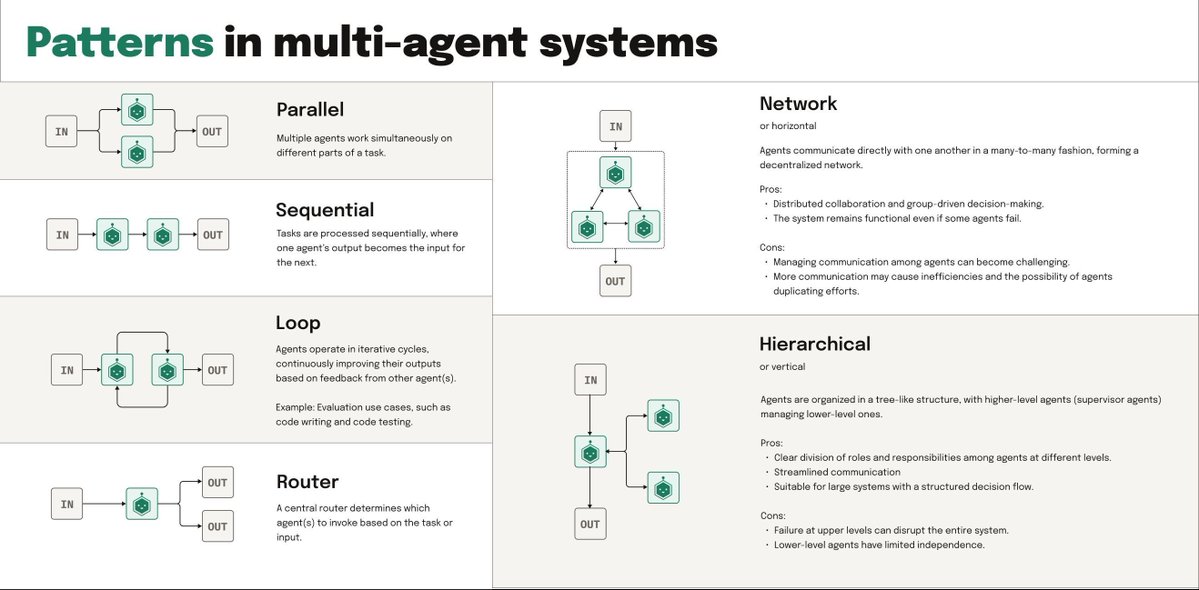
Most multi-agent systems fail because of coordination, not capability. Here are 6 popular patterns: Multi-agent systems unlock way more complex workflows than any single agent could handle. But coordination matters just as much as capability. 𝗣𝗮𝗿𝗮𝗹𝗹𝗲𝗹: Multiple agents work on different subtasks simultaneously, then results get combined. Great for tasks that can be split into independent pieces (like analyzing different sections of a document). 𝗦𝗲𝗾𝘂𝗲𝗻𝘁𝗶𝗮𝗹: Agents work in a chain, where each agent's output becomes the next agent's input. Think research → writing → editing pipelines. 𝗟𝗼𝗼𝗽: Agents iterate through a cycle, refining outputs until some condition is met. Useful for tasks requiring progressive improvement or validation (like code generation with testing feedback). 𝗥𝗼𝘂𝘁𝗲𝗿: A coordinator agent decides which specialized agent should handle each task based on the input. Basically dynamic task routing to the right expert. 𝗡𝗲𝘁𝘄𝗼𝗿𝗸: Agents communicate flexibly in a mesh topology, collaborating and debating to refine solutions. More organic than linear patterns. 𝗛𝗶𝗲𝗿𝗮𝗿𝗰𝗵𝗶𝗰𝗮𝗹: Manager agents delegate to worker agents, who can further delegate. Mirrors organizational structures for complex, multi-level tasks. The pattern you choose shapes how your system behaves. Sequential patterns give you control and predictability. Network patterns enable richer collaboration but are harder to debug. Parallel patterns maximize speed but require careful result aggregation. There's more about agentic patterns, workflows, and architectures in this blog: weaviate.io/blog/what-are-…
Victoria Slocum tweet media
English
13
14
112
5.1K
AI ری ٹویٹ کیا
Victoria Slocum
Victoria Slocum@victorialslocum·
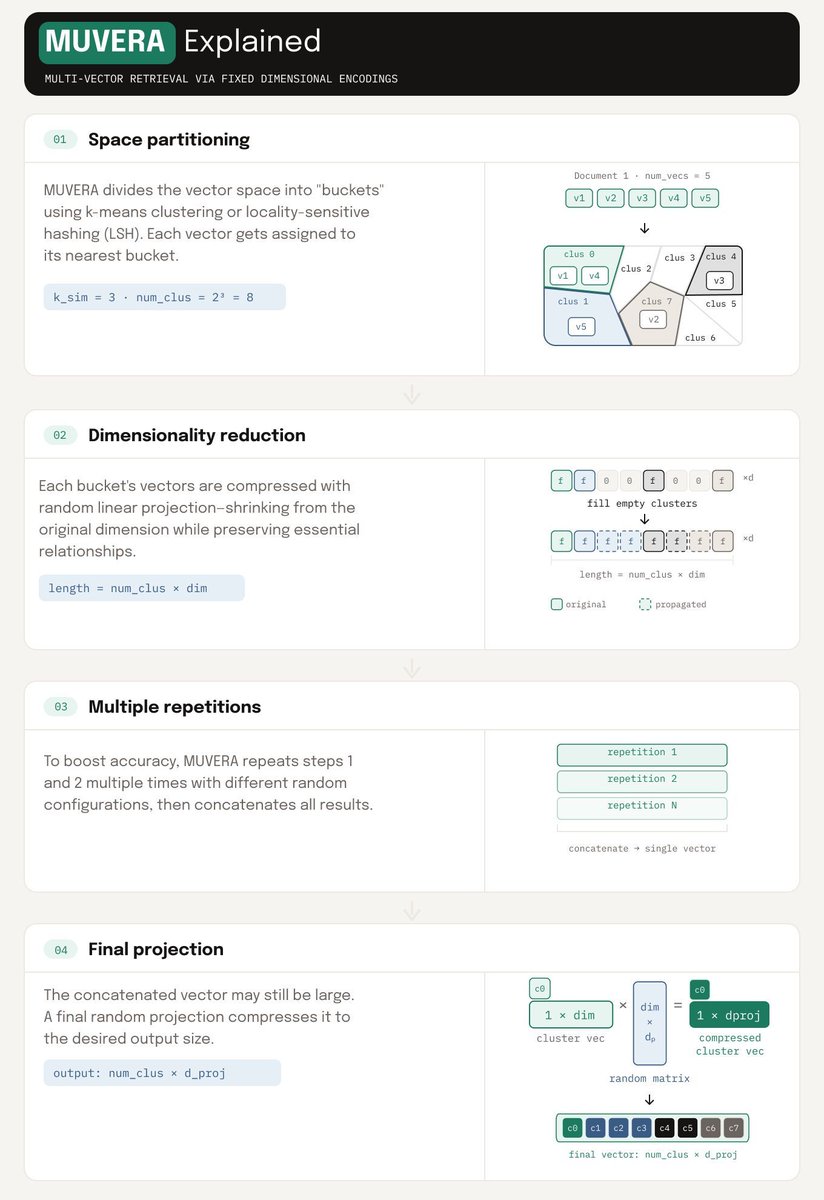
Everyone talks about how good multivector models like ColPali and ColBERT are. But it always comes up that they 𝘢𝘭𝘴𝘰 require lots more memory - unless you use 𝗠𝘂𝘃𝗲𝗿𝗮. A dataset with 1M documents using ColBERT can require 40GB of memory just for the embeddings. Compare that to 3.1GB for single-vector models. When you're building at scale, this can be tens or hundreds of thousands of dollars in infrastructure costs per year. 𝗠𝗨𝗩𝗘𝗥𝗔 (Multi-Vector Retrieval via Fixed Dimensional Encodings) is the solution to this. The algorithm works through four key steps: 1️⃣ 𝗦𝗽𝗮𝗰𝗲 𝗣𝗮𝗿𝘁𝗶𝗰𝗶𝗼𝗻𝗶𝗻𝗴: Divides the vector space into "buckets" using locality-sensitive hashing, creating representative sub-vectors for each bucket 2️⃣ 𝗗𝗶𝗺𝗲𝗻𝘀𝗶𝗼𝗻𝗮𝗹𝗶𝘁𝘆 𝗥𝗲𝗱𝘂𝗰𝘁𝗶𝗼𝗻: Applies random linear projection to compress each sub-vector (following the Johnson-Lindenstrauss Lemma to preserve dot products) 3️⃣ 𝗠𝘂𝗹𝘁𝗶𝗽𝗹𝗲 𝗥𝗲𝗽𝗲𝘁𝗶𝘁𝗶𝗼𝗻𝘀: Repeats the process multiple times and concatenates results to improve accuracy 4️⃣ 𝗙𝗶𝗻𝗮𝗹 𝗣𝗿𝗼𝗷𝗲𝗰𝘁𝗶𝗼𝗻: One last compression to reach the target dimensionality The goal is to approximate maxSim(D,Q) ≈ d_single · q_single, transforming the complex multi-vector similarity problem into a simple dot product. The results from our testing on the LoTTE benchmark (119k documents, ColBERTv2.0): • 𝗠𝗲𝗺𝗼𝗿𝘆: ~70% reduction (12GB → <1GB) • 𝗜𝗺𝗽𝗼𝗿𝘁 𝘁𝗶𝗺𝗲: 20+ minutes → 3-6 minutes • 𝗛𝗡𝗦𝗪 𝗴𝗿𝗮𝗽𝗵: 15M nodes → 119k nodes (99% reduction!) Yes - there is some recall loss and reduced query throughput, but it's a good middle ground if you want to use multivector models but need a more lean infrastructure. Using MUVERA makes sense when you have: • Large-scale deployments where memory costs are significant • Use cases that can tolerate slight recall degradation • Applications requiring faster indexing speeds Read more here: weaviate.io/blog/muvera?ut… Docs: #muvera-encoding" target="_blank" rel="nofollow noopener">docs.weaviate.io/weaviate/confi…
Victoria Slocum tweet media
English
4
12
75
3.6K
AI ری ٹویٹ کیا
Victoria Slocum
Victoria Slocum@victorialslocum·
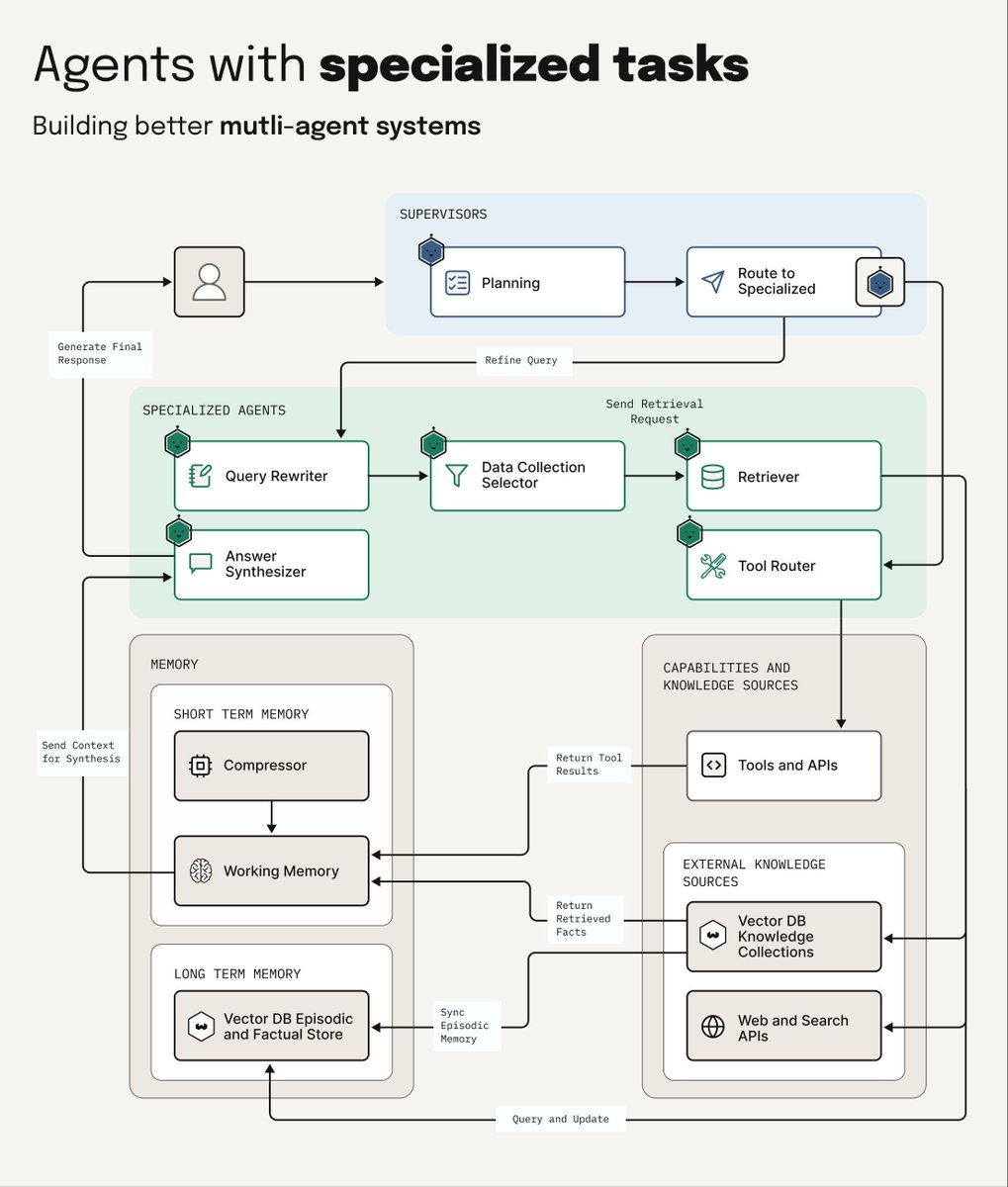
Building a multi-agent system 𝗶𝘀𝗻'𝘁 𝗷𝘂𝘀𝘁 𝗮𝗱𝗱𝗶𝗻𝗴 𝗺𝗼𝗿𝗲 𝗮𝗴𝗲𝗻𝘁𝘀 (This is why specialized agents beat generalists every time) Instead of a single agent trying to handle everything, 𝗠𝘂𝗹𝘁𝗶-𝗮𝗴𝗲𝗻𝘁 𝘀𝘆𝘀𝘁𝗲𝗺𝘀 employ teams of specialized agents, each with its own focused task. So for example, you could have a team of: A 𝗣𝗹𝗮𝗻𝗻𝗶𝗻𝗴 𝗔𝗴𝗲𝗻𝘁 that decides how to handle the users request. A 𝗤𝘂𝗲𝗿𝘆 𝗥𝗲𝘄𝗿𝗶𝘁𝗶𝗻𝗴 𝗔𝗴𝗲𝗻𝘁 that takes messy user queries and decomposes them into more manageable, clear subqueries. A 𝗥𝗲𝘁𝗿𝗶𝗲𝘃𝗮𝗹 𝗔𝗴𝗲𝗻𝘁 𝗮𝗻𝗱/𝗼𝗿 𝗗𝗮𝘁𝗮 𝗦𝗼𝘂𝗿𝗰𝗲 𝗦𝗲𝗹𝗲𝗰𝘁𝗼𝗿 that specializes in finding the right information from the right source. A 𝗧𝗼𝗼𝗹 𝗥𝗼𝘂𝘁𝗶𝗻𝗴 𝗔𝗴𝗲𝗻𝘁 that decides which tools to use and when. A 𝗔𝗻𝘀𝘄𝗲𝗿 𝗔𝗴𝗲𝗻𝘁 that decides how to best combine all the results to provide the more complete answer to the user. 𝗠𝗲𝗺𝗼𝗿𝘆 is what allows an agentic system like this to work. Short-term memory tracks the current conversation and recent actions. Long-term memory stores patterns, successful strategies, and domain knowledge. When agents share memory, they build on each other's work instead of starting from scratch every time. Each agent has access to specific tools. The retrieval agents can call different search APIs. The validation agent might use a scoring model. The synthesis agent has access to the LLM for generation. They don't all need every tool - they just need the right ones for their specialized task. IMHO, this is way more robust than a single agent trying to handle everything. When retrieval fails, the coordinator can try a different retrieval agent. When validation catches low-quality results, it can trigger a re-retrieval with different parameters. Specialization means better error handling and more reliable outcomes. More agents means more complexity. But for complex tasks, multi-agent systems consistently outperform single agents trying to do it all.
Victoria Slocum tweet media
English
31
78
480
23.1K
AI ری ٹویٹ کیا
Mooné Rahimi
Mooné Rahimi@hiitsmemooneh·
The left picture is me at 7 yo when I was living in Iran under the Islamic regime. They forced me to wear a full hijab to attend school, if I didn’t, they wouldn’t let me enter. They made me wear it from a young age to avoid “provoking” men in society, claiming it was all because of Allah. They also forced me to be Muslim, read the Quran, and learn every rule and detail about it. The truth is, I never wanted any of it, even as a child. The real me is the picture on the right. They took my rights and my freedom and called it Islam. Now I’m in the USA. I wear whatever I want, do whatever I want, and I’m very grateful for this freedom. I now feel it’s my duty to raise awareness, share my story and experiences with the world, so people know what true Islam is and aren’t fooled by the image the media tries to show them.
Mooné Rahimi tweet mediaMooné Rahimi tweet media
English
54
226
1.9K
23.8K
AI ری ٹویٹ کیا
Xiaomi MiMo
Xiaomi MiMo@XiaomiMiMo·
MiMo TTS doesn't just talk — it sounds human. Sobbing. A sudden laugh. A cough. Heavy breathing. A nervous sigh. All woven naturally into speech. 🎧 2/n
Xiaomi MiMo@XiaomiMiMo

Let's hear what MiMo TTS can actually do 🔊 Most TTS reads text. MiMo performs it — with full control over emotion, speed, tone, and speaking style. Happy. Angry. Slow. Gentle. Dongbei dialect. Even Monkey King.🐒 Same model, one prompt away. 🎧 1/n

English
31
71
724
67.3K
AI ری ٹویٹ کیا
BridgeMind
BridgeMind@bridgemindai·
Open source models are catching up faster than anyone expected. MiniMax M2.7 hallucination rate: 34%. MiniMax M2.5 was 89%. 55 point drop in a single generation. Out of 423 models on AA-Omniscience. M2.5 hallucinated at the same level as GPT 5.4. M2.7 just leapfrogged GPT 5.4. The gap between open source and closed source is shrinking every month. The frontier labs should be paying attention.
BridgeMind tweet media
English
9
22
259
12.9K
AI ری ٹویٹ کیا
SciTech Era
SciTech Era@SciTechera·
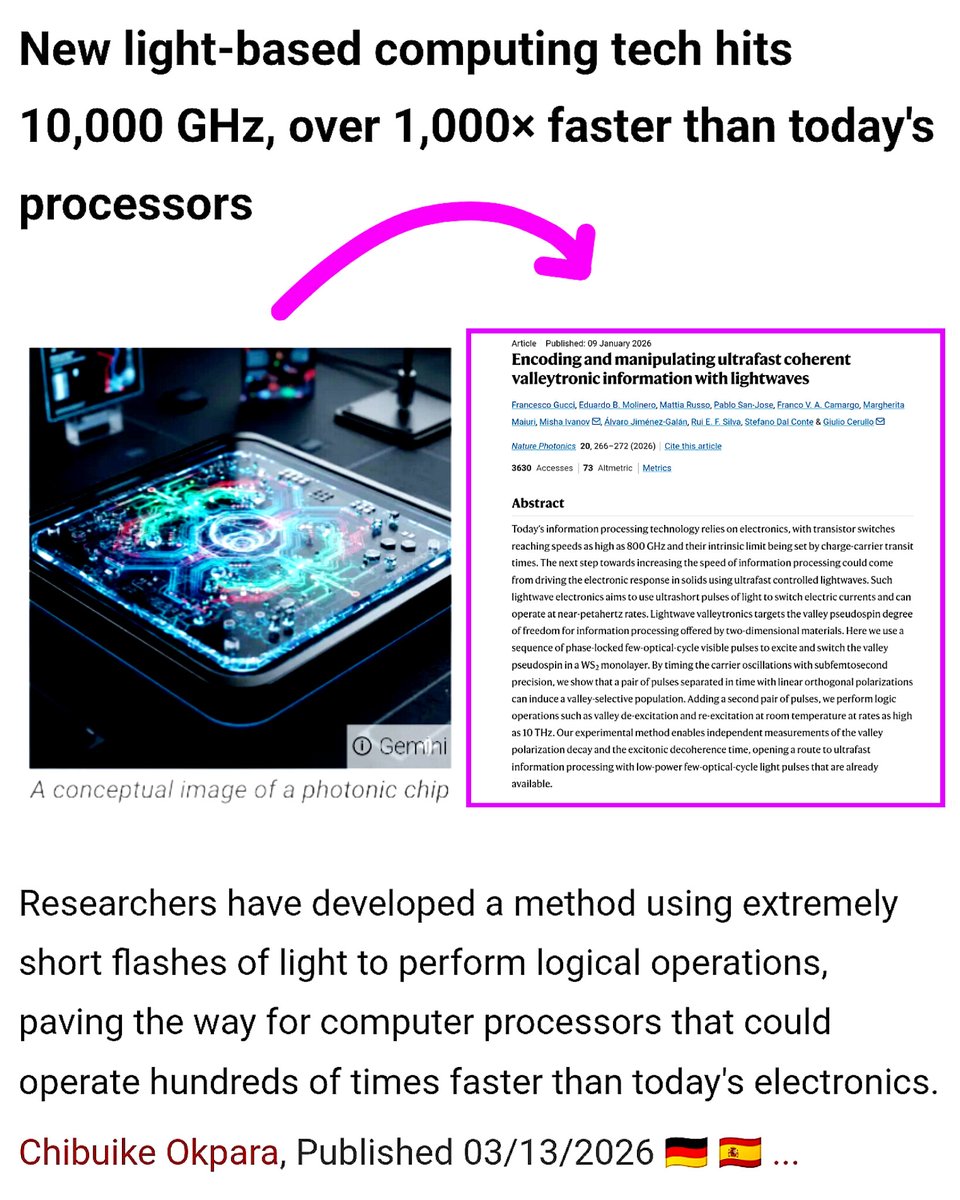
Reminder Light-driven computing just reached 10,000 GHz, over 100× faster than today’s processors. In a new study, scientists demonstrated a new type of computing using ultrafast laser pulses instead of electricity. They used a 2D semiconductor called tungsten disulfide, where light controls electron “valley states” a method known as valleytronics. By manipulating these states with femtosecond laser pulses (10⁻¹⁵ seconds), the system achieved switching speeds above 10 terahertz. For comparison, today’s processors operate at only 3–5 GHz 👀! This is still a laboratory experiment, but it shows that combining photonics with quantum materials could enable computers to run hundreds to thousands of times faster than current silicon based technology.
SciTech Era tweet media
SciTech Era@SciTechera

Scientists just demonstrated light driven computing at 10,000 GHz over 100× faster than today’s processors. Ultrafast computing breakthrough In a new study, researchers showed that ultrafast laser pulses can perform logic operations in a 2D semiconductor called tungsten disulfide. Instead of traditional transistors switching with electrical current, the system uses light to control electron valley states, a technique known as valleytronics. By manipulating these states with femtosecond laser pulses (10⁻¹⁵ seconds), the team achieved logical switching frequencies above 10 terahertz. For comparison, today’s processors operate at only 3–5 GHz 👀! This experiment shows that future computers could potentially operate hundreds to thousands of times faster by combining photonics and quantum materials. while still a laboratory demonstration, the research points toward a future of light driven computing far beyond silicon’s limits.

English
2
50
173
6K
AI ری ٹویٹ کیا
Hubble
Hubble@NASAHubble·
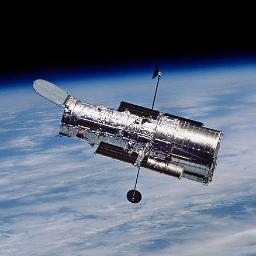
Discovered in 1779 by astronomer Charles Messier, the galaxy Messier 58 was one of the first galaxies recognized to have a spiral shape. It’s also the most distant of the objects included in Messier’s stargazing catalog, at 62 million light-years away: go.nasa.gov/4cXSAJN
Hubble tweet media
English
27
213
1.2K
62.9K
AI ری ٹویٹ کیا
Fuli Luo
Fuli Luo@_LuoFuli·
MiMo-V2-Pro & Omni & TTS is out. Our first full-stack model family built truly for the Agent era. I call this a quiet ambush — not because we planned it, but because the shift from Chat to Agent paradigm happened so fast, even we barely believed it. Somewhere in between was a process that was thrilling, painful, and fascinating all at once. The 1T base model started training months ago. The original goal was long-context reasoning efficiency. Hybrid Attention carries real innovation, without overreaching — and it turns out to be exactly the right foundation for the Agent era. 1M context window. MTP inference for ultra-low latency and cost. These architectural decisions weren't trendy. They were a structural advantage we built before we needed it. What changed everything was experiencing a complex agentic scaffold — what I'd call orchestrated Context — for the first time. I was shocked on day one. I tried to convince the team to use it. That didn't work. So I gave a hard mandate: anyone on MiMo Team with fewer than 100 conversations tomorrow can quit. It worked. Once the team's imagination was ignited by what agentic systems could do, that imagination converted directly into research velocity. People ask why we move so fast. I saw it firsthand building DeepSeek R1. My honest summary: — Backbone and Infra research has long cycles. You need strategic conviction a year before it pays off. — Posttrain agility is a different muscle: product intuition driving evaluation, iteration cycles compressed, paradigm shifts caught early. — And the constant: curiosity, sharp technical instinct, decisive execution, full commitment — and something that's easy to underestimate: a genuine love for the world you're building for. We will open-source — when the models are stable enough to deserve it. From Beijing, very late, not quite awake.
English
275
473
5.3K
1.6M
AI ری ٹویٹ کیا
Physical Intelligence
Physical Intelligence@physical_int·
We developed an RL method for fine-tuning our models for precise tasks in just a few hours or even minutes. Instead of training the whole model, we add an “RL token” output to π-0.6, our latest model, which is used by a tiny actor and critic to learn quickly with RL.
English
13
180
1.4K
147.8K
AI ری ٹویٹ کیا
Simon Willison
Simon Willison@simonw·
Dan says he's got Qwen 3.5 397B-A17B - a 209GB on disk MoE model - running on an M3 Mac at ~5.7 tokens per second using only 5.5 GB of active memory (!) by quantizing and then streaming weights from SSD (at ~17GB/s), since MoE models only use a small subset of their weights for each token
Dan Woods@danveloper

x.com/i/article/2034…

English
89
176
1.9K
239.4K
AI ری ٹویٹ کیا
OpenCode
OpenCode@opencode·
MiMo-V2-Pro and MiMo-V2-Omni are now free in OpenCode many of you have tried them in stealth - Hunter Alpha and Healer Alpha. Mystery solved worth mentioning - MiMo-V2-Pro: - ~1T params - 1M context - optimized for coding
English
67
134
2.4K
144.7K
AI ری ٹویٹ کیا
All day Astronomy
All day Astronomy@forallcurious·
🚨: First paralysed human treated with stem cells has now regained his upper body movement
All day Astronomy tweet mediaAll day Astronomy tweet media
English
113
1.5K
22.3K
269.4K
AI ری ٹویٹ کیا
Open Source Intel
Open Source Intel@Osint613·
Convoy of trucks reportedly heading from Tajikistan to Iran, claimed by Tajik and Iranian opposition figures to be carrying drones under the cover of humanitarian aid. Iran has established drone manufacturing facilities in Tajikistan, first opened in 2022.
English
394
1.9K
6K
234K
AI ری ٹویٹ کیا
Kate from Kharkiv
Kate from Kharkiv@BohuslavskaKate·
ZELENSKYY: War no longer has distance. Drones already fly 3,000–5,000 km today, and soon they'll reach 10,000 km. Every day, Ukraine faces 350–500 drone strikes. Imagine any country dealing with that. No continent is safe anymore. Distance is now a matter of months, not decades.
English
53
1.4K
6.6K
209.3K