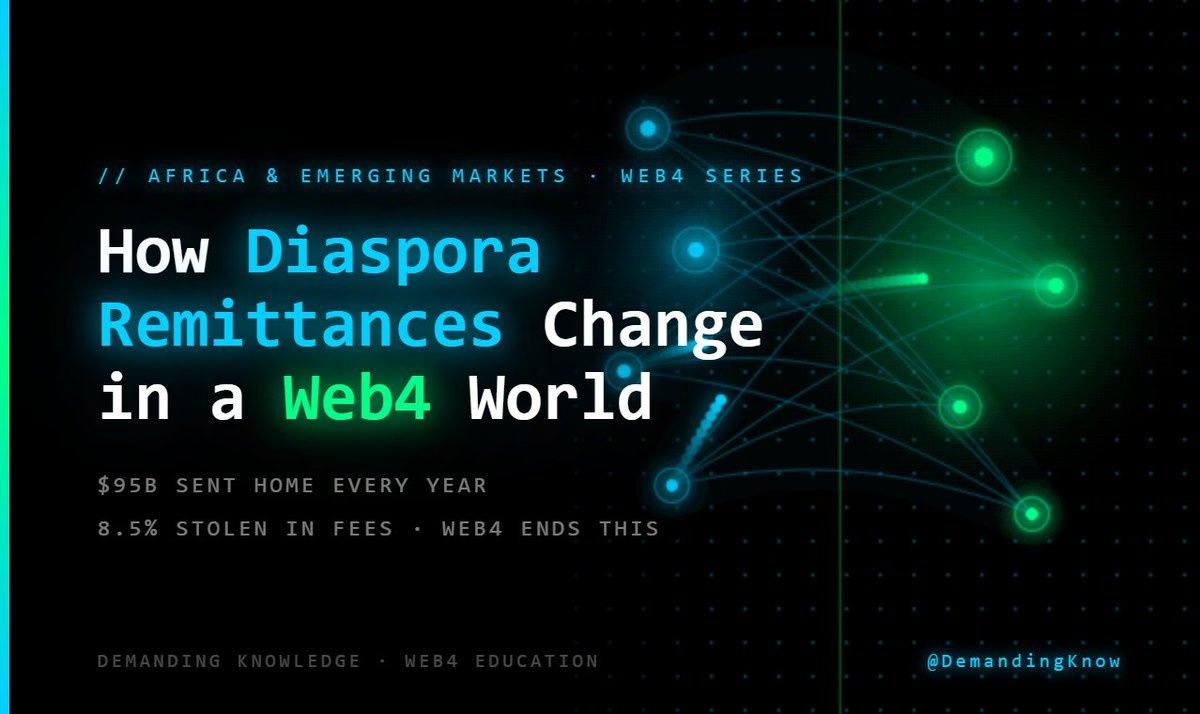
How Diaspora Remittances Change in a Web4 World
Every year, African families send $95 billion back home. And every year, between $7 and $9 billion of that money never arrives. It disappears into the pockets of Western Union, MoneyGram, bank wire fees, and a chain of correspondent banking relationships that exist for no reason other than the fact that a better system hasn't been widely adopted yet. Web4 is that better system — and it is arriving faster than the industry that profits from the current one wants to admit.
This is not a story about cryptocurrency speculation. This is about the largest wealth transfer mechanism in the developing world, and how Web4 infrastructure is about to make it faster, cheaper, and more empowering for the 170 million Africans in the diaspora and the hundreds of millions of family members they support back home.
The Scale of What's at Stake:
Remittances are not a minor financial flow. They are the economic backbone of dozens of African nations — larger than foreign direct investment, larger than foreign aid, and in many countries, larger than export revenues.
Nigeria receives approximately $20 billion in remittances annually — making it the fifth-largest remittance-receiving country in the world. Egypt receives $28 billion. Ghana receives $4.7 billion. Kenya receives $4 billion. Morocco receives $11 billion. Together, Africa receives more remittances than the entire continent receives in foreign aid each year.
These are not abstract numbers. They are school fees paid in September. They are hospital bills settled in emergencies. They are market stalls restocked. They are houses built slowly, brick by brick, with money earned in London and wired home to Lagos.
And 8.5 cents of every dollar sent never gets there.
Why the Current System Is an Engineered Robbery
The average cost of sending $200 from the United Kingdom to Sub-Saharan Africa is 8.5% — nearly double the UN's target of 3% and almost nine times the theoretical minimum that blockchain technology makes possible today.
This cost is not a natural feature of international money transfer. It is a manufactured one, maintained by a combination of structural factors that Web4 dismantles one by one.
Correspondent banking chains — When you send money from a bank in London to a recipient in Lagos, your bank does not have a direct relationship with your recipient's bank. Instead, the transaction travels through a chain of correspondent banks — intermediary institutions with established relationships with each other — each one taking a fee and adding a day of delay. A simple transfer might pass through three or four institutions before reaching its destination. Each one charges. None of them add value.
Currency exchange manipulation — Most remittance providers make more money on the exchange rate spread than on the stated fee. The headline "3% fee" is made economically viable by an exchange rate that quietly costs the sender an additional 3–5% above the mid-market rate. The total cost is double what the advertised fee suggests.
Regulatory compliance costs — Know Your Customer (KYC) and Anti-Money Laundering (AML) requirements impose real compliance costs on remittance providers. These are legitimate requirements with legitimate purposes. But they have also been used by incumbent players to create barriers to entry that protect their market position from more efficient competitors.
Last-mile cash infrastructure — In markets where recipients don't have bank accounts, the remittance must ultimately be converted to physical cash at an agent location. Building and maintaining that agent network costs money — and those costs are passed on to senders and recipients.
Web4 addresses every single one of these mechanisms directly.
How Web4 Rebuilds Remittances From the Ground Up:
Peer-to-peer blockchain settlement eliminates the correspondent chain entirely. A Web4 remittance is a direct transaction from one wallet to another, settled on a public blockchain in seconds, with a transaction fee measured in cents rather than dollars. There are no intermediary banks. There is no correspondent chain. There is no institution extracting a margin for the privilege of passing a number from one ledger to another.
The technology for this exists today. Bitcoin, Ethereum, Stellar, and a dozen other networks already settle cross-border transactions at a fraction of the cost of traditional remittances. Stellar was specifically designed for cross-border payments and can settle a transaction for less than $0.01. The Stellar Development Foundation has partnered with remittance corridors across Africa specifically for this purpose.
Stablecoins eliminate the exchange rate manipulation. The most significant Web4 improvement to remittances is not the speed or the fee — it is the introduction of stable value transfer that bypasses the currency exchange entirely. A sender in London converts pounds to USDC, sends USDC on-chain, and the recipient in Lagos converts USDC to naira at the live mid-market rate with no spread manipulation. The exchange happens twice — at both ends — but at transparent market rates with no hidden margin extracted by an intermediary.
Decentralized Identity reduces KYC friction without eliminating compliance. The compliance costs of traditional remittances are driven largely by duplicated KYC processes — the sender is verified by their bank, verified again by the remittance provider, and the correspondent banks maintain their own compliance records. In a Web4 system with universal Decentralized Identity, a sender's identity is verified once, cryptographically, and that verification travels with every subsequent transaction. The cost of compliance drops dramatically. The compliance itself does not disappear — it becomes more efficient.
Mobile wallets complete the last mile without cash infrastructure. The agent network problem — converting digital money to physical cash for recipients without bank accounts — is already being solved by mobile money. M-Pesa demonstrated that cash-in, cash-out agent networks can be built at continental scale through informal retail infrastructure. Web4 extends this by enabling recipients to hold and use digital assets directly, without conversion to cash, as the digital economy expands across Africa.
What $8 Billion Recaptured Actually Means
It is worth pausing on the human scale of what Web4 remittances make possible.
$8 billion is the approximate amount currently extracted in fees from Africa-bound remittances every year. It is, by any measure, the largest single extractive financial mechanism operating on the continent today — larger than many national budgets, dwarfing the profits of most African industries.
Returning $8 billion annually to African families does not sound like a technological development. It sounds like an economic policy intervention of historic proportions. Because it is.
An extra $8 billion in the hands of African households — not governments, not corporations, not foreign aid organizations — would flow directly into education, healthcare, small business formation, and household consumption in communities that are already demonstrated engines of economic activity. Diaspora remittances reach deeper into rural and informal economies than any other financial flow. The multiplier effect of returning fee revenue to those communities is extraordinary.
But the Web4 remittance opportunity is larger than fee recapture alone.
The Web4 Features That Go Beyond Cheaper Transfers:
Programmable remittances — money that knows what it's for
Web4 enables remittances that arrive with conditions — not in a restrictive sense, but in an empowering one. A parent in London can send a payment specifically for school fees — a smart contract that releases funds directly to the school institution upon confirmation of enrollment, bypassing any risk of the money being redirected. A family can send a housing contribution that releases in tranches as construction milestones are verified by an IoT sensor on the building site.
This is not paternalistic control. It is programmable intention — the ability of a sender to ensure their sacrifice achieves its intended purpose, transparently, without requiring trust in institutions or individuals who may not be present to be held accountable.
Remittance DAOs — collective family financial infrastructure:
Extended family financial management is a deeply embedded cultural institution across much of Africa. The "family meeting" that pools resources for education, medical emergencies, or business investment is a form of decentralized collective finance that predates blockchain by generations.
Web4 enables this to become formal infrastructure — a family DAO with a shared treasury, transparent contribution records, democratic decision-making about fund deployment, and smart contract enforcement of agreed rules. No family member in a position of trust can extract funds without consensus. Every contribution is permanently recorded. Every disbursement is transparent. The cultural institution already exists. Web4 gives it reliable, trustless infrastructure.
Diaspora bonds and investment vehicles
Beyond pure remittances, Web4 enables the African diaspora to invest in the continent in ways that were previously inaccessible or prohibitively complex. Tokenized real estate, agricultural financing instruments, infrastructure bonds, and startup equity can all be structured as Web4 assets and made accessible to diaspora investors with as little as $50 to deploy. The diaspora already sends $95 billion home. A fraction of that redirected from consumption support into productive investment — through Web4 vehicles that provide transparency, liquidity, and appropriate returns — would be transformative for African capital markets.
The Players Already Building This
Bitpesa / AZA Finance — One of Africa's oldest crypto-powered remittance platforms, operating since 2013. Processes hundreds of millions in cross-border transfers annually across African corridors using blockchain settlement rails.
Chipper Cash — Pan-African fintech enabling free peer-to-peer transfers across 7 African countries, with crypto on-ramps and off-ramps. Valued at over $2 billion at its peak.
Yellow Card — Pan-African crypto exchange specifically designed as a remittance rail, operating in 20 African countries and building the Web4 infrastructure layer for diaspora transfers.
Stellar Development Foundation — Has specifically prioritized African remittance corridors in its partnership strategy, working with central banks and fintech operators across the continent to build blockchain-settled payment infrastructure.
Flutterwave, Paystack, Interswitch — Africa's dominant payment processors, all moving toward blockchain integration as the cost and speed advantages become impossible to ignore.
None of these companies are fringe experiments. They are processing real money for real people in real African communities today. Web4 does not need to prove the concept. It needs to scale the infrastructure.
What Needs to Happen Next
Regulatory clarity is the single most important unlock. The countries that establish clear, workable frameworks for crypto-powered remittances — protecting consumers without strangling innovation — will capture enormous economic activity and talent. Nigeria's ongoing crypto regulatory journey, Kenya's sandbox approach, and Rwanda's proactive digital finance strategy are all worth watching closely.
Smartphone and data penetration must continue expanding. Web4 remittances require internet access. The 300 million Africans who still lack reliable mobile internet access are outside the system until connectivity reaches them. This is a solvable infrastructure problem — and one that Web4 investment in decentralized wireless networks can help address.
Stablecoin liquidity in local currencies is a critical gap. USDC and USDT are liquid everywhere. Local currency stablecoins — a naira-pegged stablecoin, a cedi-pegged stablecoin — with sufficient liquidity to handle large volumes without significant slippage are still early stage. Building this liquidity is one of the most important infrastructure investments in African Web4 finance.
Community education — the diaspora needs to understand that cheaper, faster, better alternatives exist. Inertia is powerful. Many diaspora senders continue using Western Union out of habit, familiarity, or simply because they don't know alternatives are available. Changing this requires sustained community education — exactly the kind of work that platforms like Demanding Knowledge are uniquely positioned to do.
The Bottom Line
$95 billion flows from the African diaspora to the continent every year. $8 billion of it is stolen in fees by a system that adds no value. Web4 eliminates that system — not by regulation, not by activism, but by building something demonstrably better and making it accessible to the 170 million members of the African diaspora who have every reason to use it.
The technology exists. The early infrastructure exists. The economic incentive is enormous and obvious. What remains is adoption — the deliberate choice by diaspora Africans to move their transfers to Web4 rails, save 8% on every transaction, and in doing so, collectively return billions of dollars to African families every year.
This is not just a better remittance product.
This is one of the most significant economic justice opportunities of the Web4 era. And it is available right now.
you can collab with @peaq - the machine economy to build and make impact
#Web4#Africa#DemandingKnowledge
$8B stolen from African families every year by fees. Web4 gives it back. Not through regulation or activism, through building something demonstrably better. The technology exists. What remains is adoption. Are you still paying 8%?
#Web4Africa#D
What's needed: regulatory clarity. Stablecoin liquidity in local currencies. Smartphone penetration. And community education, the diaspora needs to know better options exist. Most still use Western Union out of habit. Not because it's better.
Every year African families send $95B home. Every year $8B of it disappears in fees. Web4 is about to end this permanently. Here's exactly how. Thread 👇 #Web4#Africa#Nigeria