Felix Geiger

1.9K posts

Felix Geiger

Felix Geiger

@Flx_Geiger

@bundesbank | views are my own | private | monetary policy, financial markets, finance, economics | retweets, likes and following do not imply endorsement

Frankfurt am Main, Deutschland شامل ہوئے Temmuz 2021
680 فالونگ1.6K فالوورز
Felix Geiger ری ٹویٹ کیا

Markus K. Brunnermeier
Markus K. Brunnermeier@MarkusEconomist·
R.I.P. Christopher Sims (21 Oct. 1942 - 14 March 2026) - a giant in macroeconomics and one of the finest human beings I have ever met -

Markus K. Brunnermeier tweet media
English
34
453
1.8K
506K
Felix Geiger ری ٹویٹ کیا
Zach Mazlish
Zach Mazlish@ZMazlish·
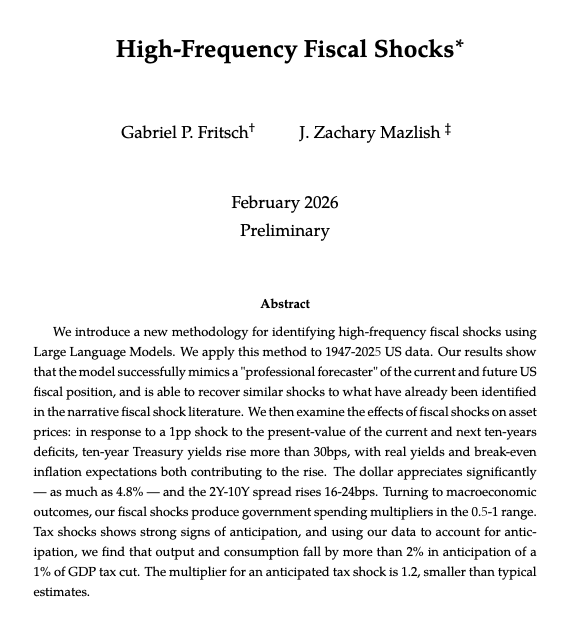
New paper out w/ my excellent co-author (and friend) @gabrielpfritsch : “High-frequency fiscal shocks”. We use LLM’s to construct a daily time-series of expectations about US fiscal deficits (1947-2025) and thereby identify “fiscal shocks” in the historical record. Thread:
Zach Mazlish tweet media
English
1
41
210
45.7K
Felix Geiger ری ٹویٹ کیا
Kurt MIT-shock-man
Kurt MIT-shock-man@SorryToBeKurt·
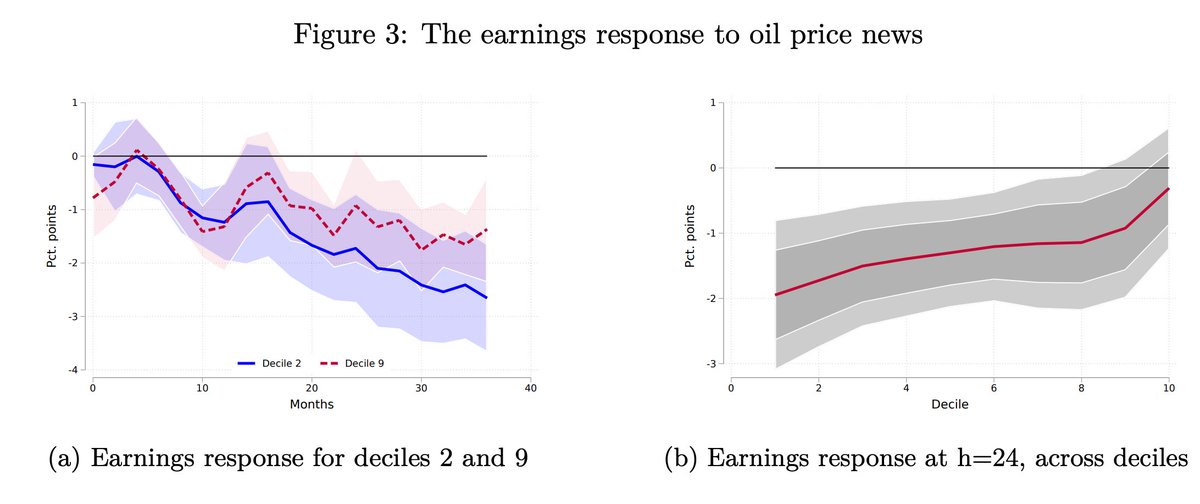
Oil prices just surged 8% in light of recent events. In our recent paper in @IMFEconReview, we study exactly this kind of shock: what happens to workers across the income distribution when oil supply contracts? 🧵
Kurt MIT-shock-man tweet media
English
3
39
163
31.1K
Felix Geiger ری ٹویٹ کیا
Jason,
Jason,@jasonc_nc·
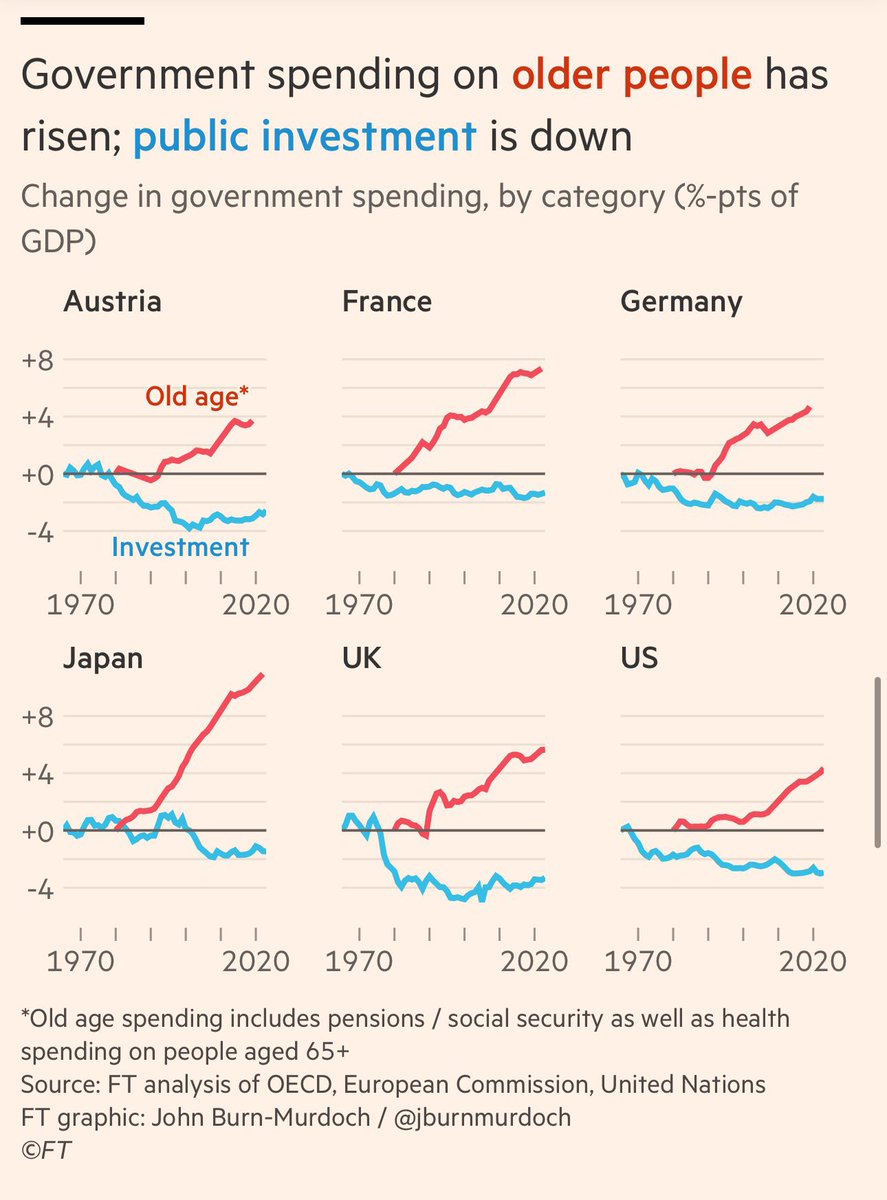
I think about this chart on public investment a lot lately.
Jason, tweet media
English
64
504
3.3K
194.1K
Felix Geiger ری ٹویٹ کیا
Isabel Schnabel 🇪🇺🇺🇦
Isabel Schnabel 🇪🇺🇺🇦@Isabel_Schnabel·
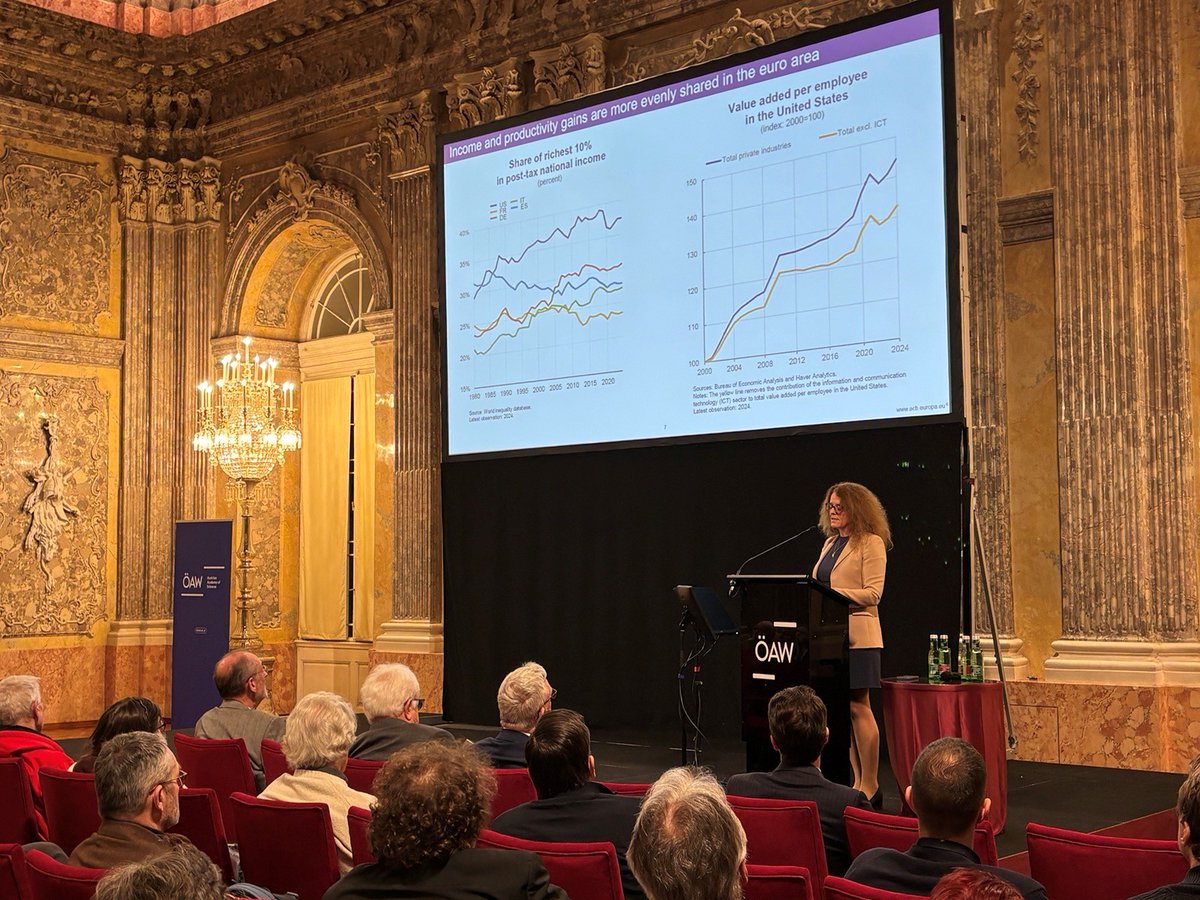
Last week, I had the honour to hold the #EugenBöhmVonBawerkLecture of the Austrian Academy of Sciences. I argued that the narrative that Europe is in decline is misleading and that Europe should unlock the full potential of the Single Market by introducing a #28thRegime. 1/20
Isabel Schnabel 🇪🇺🇺🇦 tweet media
English
27
98
330
103.7K
Felix Geiger ری ٹویٹ کیا
D. Yanagizawa-Drott
D. Yanagizawa-Drott@YanagizawaD·
I always dreamed of becoming a macroeconomist one day.
English
40
223
1.5K
563.9K
Felix Geiger ری ٹویٹ کیا
Sylvain Catherine
Sylvain Catherine@sc_cath·
This is a deep misunderstanding of how economics works. Economists don’t start with unrealistic assumptions to reach irrelevant conclusions. Theorists spell out the assumptions under which an idealized, stylized result can be proven—and very often that result is an irrelevance result. In finance, for instance: Modigliani–Miller (capital structure doesn’t matter), no-trade theorems (nobody trades), etc. The point isn’t the conclusion. We all know firms do optimize their capital structure (we teach how) and people trade trillions of dollars of securities every day. The “result” is really the assumptions: they tell you what has to be true for a phenomenon not to matter or not to exist—and therefore what frictions make a field interesting or a phenomenon exists. A huge share of economic research is about relaxing those assumptions and studying what changes. So when we say markets work “perfectly” under perfect competition, perfect substitutes, complete markets, and fully rational agents, we’re not claiming those conditions hold. We’re saying the literature should be built around the violation of these assumptions.
Mayukh@mayukh_panja

Economics is mostly a bullshit field of study. It is specifically for people who can do a little bit of stats and calc and want to feel smart but too dumb to study physics or math. Most economic theories are built like this: they start with an assumption about human behavior. Then without checking if the assumption is true, they will pile on layers of sloppy math on it and come to all sorts of conclusions that obviously don’t hold up in the real world. Recently a couple of economists won the Nobel Prize for being the first to realize that assumptions about human behavior must be tested and they went out and did some field work, and proved that a lot of assumptions in economic theories about how humans behave with money are well just not true. I was working at a bank for 2 years and saw firsthand that economics PhDs tend to be the dumbest. These people are completely alien to the idea of first principles thinking and treat axioms as if they were written in the Bible. Also they don’t really understand what an axiom is. Economics only exists because your average normie is easily impressed buy math and midwits in power are not scientific enough to realize that it is all voodoo and keep taking economists seriously. I don’t blame them though, at some point they hit an intelligence wall and the average economist brain is simply not equipped to have meta level thoughts about their own field of study. I guess this is one of those bullshit jobs like HR, therapy, astrology, project management that will just stay around for a while cause most humans are either mid or retarded.
English
40
91
762
59.4K
Felix Geiger
Felix Geiger@Flx_Geiger·
@stevehou The report by former central banker Noyer and Finance Minister Kukies spells out key factors in this regard - not only for Germany but for Europe with its fragmented capital markets /2
English
0
0
1
84
Felix Geiger
Felix Geiger@Flx_Geiger·
@stevehou „Europe’s scaleup gap stems from a lack of deep capital pools, due in particular to Europe’s pension architecture, institutional investors’ risk aversion, regulatory constraints and internal market fragmentation“ according to a recent report. bundesfinanzministerium.de/Content/DE/Dow… /1
English
1
0
1
185
Felix Geiger ری ٹویٹ کیا
Luca Fornaro
Luca Fornaro@LucaFornaro3·
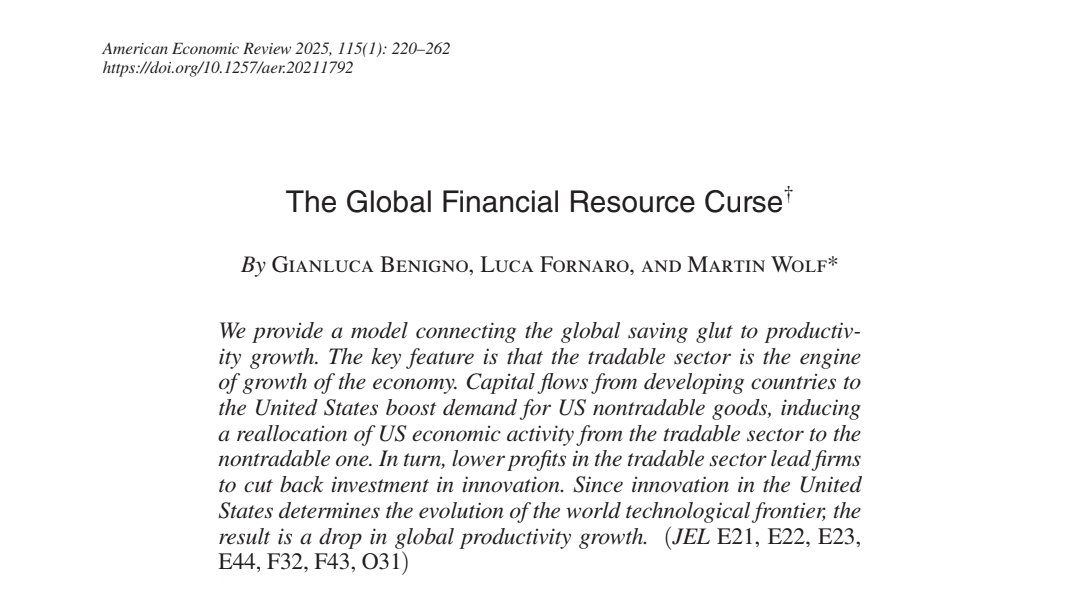
Here's a possible explanation. Higher exports from China crowd out production of high-tech goods and innovation in the rest of the world. Over the medium term, GDP in the rest of the world drops because of lower productivity growth.
Luca Fornaro tweet mediaLuca Fornaro tweet mediaLuca Fornaro tweet media
Greg Ip@greg_ip

1/ Fascinating and important report from Goldman Sachs. They have upgraded long-term GDP of China because of increased exports, but see this as reducing, not increasing, rest of world GDP. Chinese displacement of domestic manufacturing swamps any positives from cheaper goods.

English
14
79
346
128.5K
Felix Geiger ری ٹویٹ کیا
Financial Times
Financial Times@FT·
Central bankers face a 'balancing act' as they weigh a rate cut in December, New York Fed president John Williams told the FT. on.ft.com/49JGD8R
Financial Times tweet media
English
11
29
93
51.4K
Felix Geiger ری ٹویٹ کیا
Jesús Fernández-Villaverde
Jesús Fernández-Villaverde@JesusFerna7026·
Let me explain why I believe modern economics is such a powerful tool for understanding the world. I’ll do this by discussing a great paper by Simone Cerreia-Vioglio, @UncertainLars, Fabio Maccheroni, and Massimo Marinacci, “Making Decisions Under Model Misspecification,” published in the Review of Economic Studies a few months ago. Imagine I want to drive from UC San Diego to UCLA, but I’ve never driven that route before. I need to build a “model of the world” to guide me, which we usually call a map. Maps are simplified representations of reality. They can’t include every detail if they’re to be useful. Borges, in his short story On Exactitude in Science, makes this point beautifully. (In practice, I don’t draw the map myself—I use an app—but someone still had to make it.) Because maps simplify, I can’t fully rely on them. Maybe last night’s storm knocked down a tree and closed a street, or there’s construction and the ramp off the highway in LA is shut down. This uncertainty matters. Suppose I’m driving to UCLA for an important talk at 11 a.m. If the ramp is closed, I might need 15 extra minutes. When should I set my alarm to arrive on time, while still getting enough sleep to give a good talk? The problem is that I can’t assign precise probabilities to all these contingencies. How likely is the fallen tree? Or new roadwork? Even the best traffic apps can’t capture every disruption, and some might happen after I’ve already left. In economic terms, my “model of the world” (the map) is misspecified—and no matter how hard I try, I can’t fully fix that. But sitting down and crying about misspecification doesn’t answer my basic question: when do I set the alarm? Too early, and I’m exhausted. Too late, and I’m late. Simone and his co-authors offer a way to think about this. They start from the idea that we often hold several structured models of an economic phenomenon, grounded in theory. For example, a central bank might use a standard New Keynesian model and a search-and-matching model of money. Yet, aware that each model is misspecified by design, the bank adds a protective belt of unstructured models—statistical constructs that help it gauge the consequences of misspecification. The beauty of the paper is that it provides an axiomatic foundation for this protective belt (and even generalizes it to include a Bayesian approach). It shows that if a decision-maker’s preferences meet certain conditions —reflecting both rational and behavioral features— then those preferences can be represented by an augmented utility function that formally accounts for misspecification. Crucially, we don’t assume that augmented utility function; we derive it. We start with general, plausible properties of preferences and prove that they imply such a representation. That’s real progress. Instead of writing endless critiques of expected utility or rational expectations (as many have done for decades, with little to show), we now have a formal way to reason about misspecification—precise definitions, clear boundaries of validity, and awareness of what we still don’t know. Take, for instance, a brilliant Penn graduate student on the market, Alfonso Maselli economics.sas.upenn.edu/people/alfonso… His job-market paper pushes this frontier further. He studies cases where a decision-maker not only faces model misspecification but is also unsure which model best fits the data and can’t assign probabilities to them—what we call model ambiguity. In my example, the central bank is unsure whether the New Keynesian or the search-and-matching model fits better, and it worries that both might be incorrect. If you read Simone et al. or Alfonso’s paper, you’ll see how misguided—and, frankly, cartoonish—many of the recent criticisms of economics on X have been. First: the idea that economists don’t understand math or have “physics envy.” The math in these papers is subtle and advanced—utterly different from what physicists do (neither better nor worse, just distinct). An engineer transitioning into economics would find these tools unfamiliar. Second: claims of ideological bias are unfounded. I have no idea about the political views of the authors, and I’d be surprised if anyone could infer them from the analysis—beyond vague guesses about typical academics. Third: This has almost nothing to do with what one learns as an undergraduate, or even in first-year graduate school. If your knowledge of economics stops at an intro textbook, it’s best not to pontificate on the field’s frontiers. Fourth: Is this science? Debating that word’s boundaries is pointless; every definition of “science” breaks down somewhere. The Germans solved this long ago with the idea of Wissenschaft—the systematic pursuit of knowledge, whether of nature, society, or the humanities. By that measure, modern mainstream economics is clearly a Wissenschaft: a disciplined, cumulative, and highly useful effort to understand how the world works. Simone and his co-authors have demonstrated that beyond any reasonable doubt.
Jesús Fernández-Villaverde tweet media
English
43
471
1.8K
344.7K
Felix Geiger ری ٹویٹ کیا
Jon Steinsson
Jon Steinsson@JonSteinsson·
New paper: “Beyond the Taylor Rule” joint with Emi Nakamura and Venance Riblier. Emi presented this paper at the Jackson Hole Symposium. We investigate how descriptive and how prescriptive the Taylor rule is. 1/ eml.berkeley.edu/~jsteinsson/pa…
English
20
101
424
164.4K
Felix Geiger ری ٹویٹ کیا
Kylie Robison
Kylie Robison@kyliebytes·
incredible things happening in the townsquare today
Kylie Robison tweet media
English
159
1.1K
14.3K
827.2K
Felix Geiger ری ٹویٹ کیا
Brian Albrecht
Brian Albrecht@BrianCAlbrecht·
“The simple test is whether an economist's views tend to diverge from those of his ideological allies when the ideology clashes with the economics. If they do he is a real economist. If they do not, he is only an economist in working hours.” daviddfriedman.substack.com/p/economic-met…
English
3
26
119
14.5K
Felix Geiger ری ٹویٹ کیا
Sascha Keweloh
Sascha Keweloh@SaschaKeweloh·
Higher‐order moment conditions can identify non‐Gaussian SVARs—but do they increase efficiency in a recursive SVAR? 👉We show that bivariate coskewness and cokurtosis conditions lead to efficiency gains, while non-bivariate conditions are redundant.
English
1
1
3
253
Felix Geiger ری ٹویٹ کیا
Gabriel Felbermayr
Gabriel Felbermayr@GFelbermayr·
Ein paar Bemerkungen zum so genannten EU-US Zolldeal: (1/10) Ein trauriger Tag für den Freihandel: 15% Zoll auf EU-Waren in den USA ist besser als 20 oder 30%, keine Frage. Aber der „Deal“ ist teuer erkauft. Vielleicht zu teuer.
Deutsch
101
392
2.1K
249.9K