
پن کیا گیا ٹویٹ
James Gilchrist
6.6K posts

James Gilchrist
@Gilchrist_Lab
(Now on bsky) Laboratory for Particle Mixing and Self-Organization @LehighU: particles, fluids, self-assembly, rheology, coatings. #InclusionMatters. he/him.
Pennsylvania, USA شامل ہوئے Mayıs 2018
1.5K فالونگ2.1K فالوورز

I am so deeply sad to share that our beloved dog Rosa passed away last night. It was unexpected and quick, which is the only thing bringing us peace. She was the best girl. We were so, so lucky to know her and love her. @pashucklab

English


Helped my daughter with her gel electrophoresis lab report for 9th grade biology- she got a B! I haven't seen the comments yet but their may be a fight brewing (I usually never talk to kid's teacher but I've run thousands of gels in my lifetime)
GIF
English

Integrating expertise in a variety of disciplines, #NASmember Jennifer A. Lewis has developed the next generation of functional, structural, and living materials, earning her the 2025 James Prize in Science and Technology Integration. Read more: ow.ly/UlzR50V288u #NASaward

English
@DrVasshe Outstanding!!! Well deserved!
Rockstar! (Literal meaning)
English
🎉🎉 Honored & tremendously inspired to be named a #SloanFellow!! Thanks to all the trainees, mentors, collaborators, & past supervisors I've worked with, without whom I could not continue to do the type of science I love for the communities I love!
today.ucsd.edu/story/two-uc-s…
English
Wonderful man. He inspired my whole career.
I’ll follow up with a personal story soon.
Alban Sauret@AlbanSauret
Sad news… A giant in fluid mechanics and particulate flows cse.umn.edu/cems/news/memo…
English
My favorite part is where he misspells Physical Review Letters twice like we wouldn’t notice. 🤣
Lautaro Vergara 🇺🇦@VergaraLautaro
HISTORY OF PHYSICS What's wrong with this Lagrangean? by David Mermin. [This is so funny that I'll post it in full]
English
English
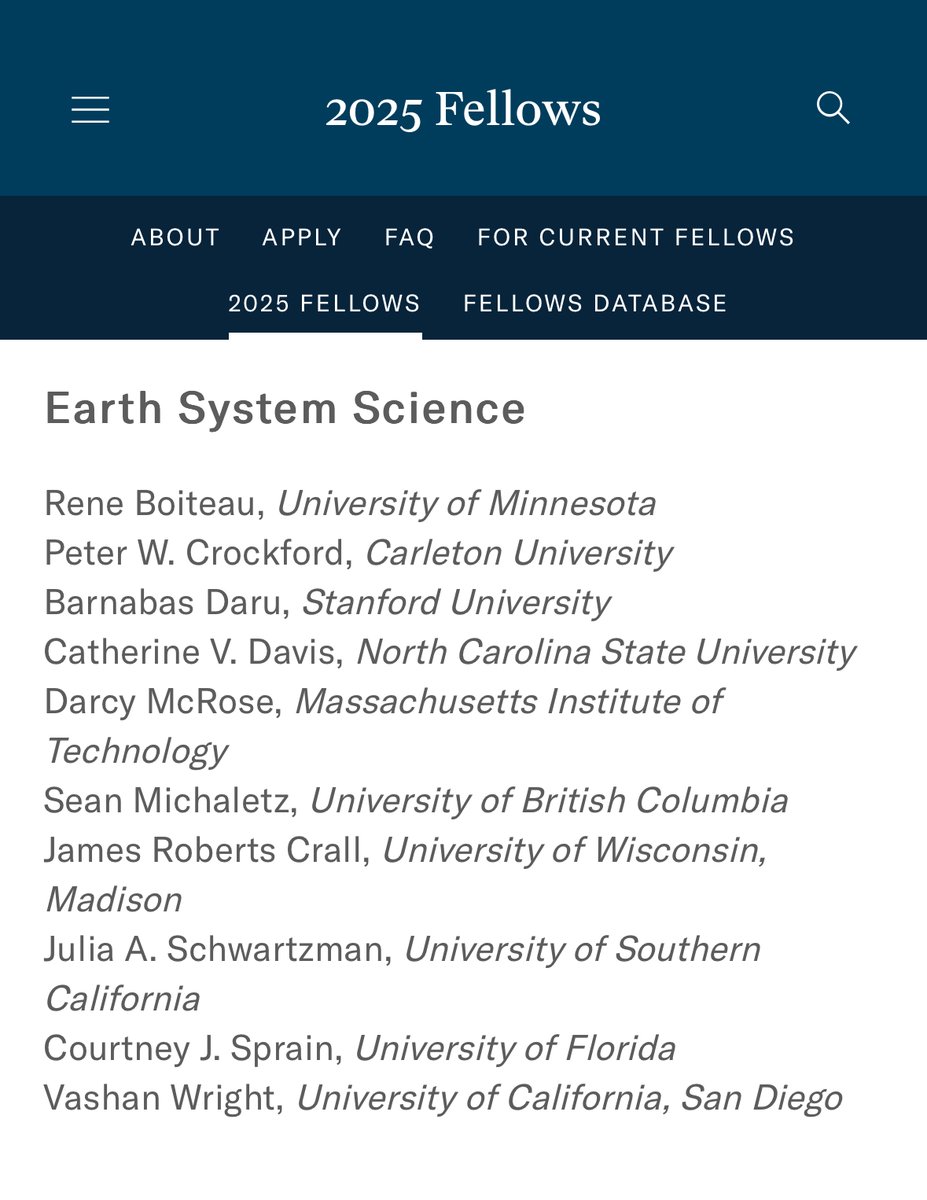
Very honored to be named a #SloanFellow! Excited to represent plants + earth system science and @Stanford. Congrats to all 2025 fellows, what an amazing cohort to be part of! Grateful to @SloanFoundation for the support! Thnx to my family, mentors, students and collaborators!
English
@CoryMSimon @DOGE_NSF Still disagree. Students benefit from these interactions (obviously) and PIs are continuously challenged by students to think outside the box. I think a small fraction of researchers should operate the way you describe.
English

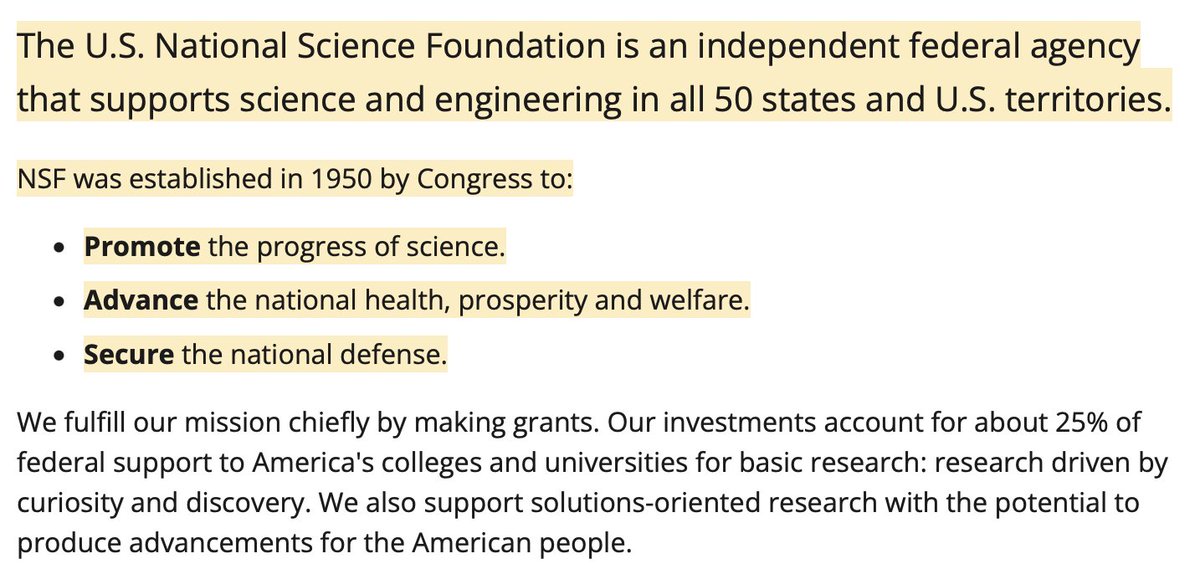
certainly "maintain a competitive scientific and engineering workforce" is a huge and worthwhile portion of NSF. but I think its mission encompasses much more than that.
assuming we agree part of the NSF's mission is to make transformative scientific discoveries and make fundamental advances in scientific understanding, then I think we should have a discussion about how many PhD students the US should train vs. funding permanent researchers who spend their whole career focused on a problem.
English
🚀my suggestions to boost American STEM to @DOGE_NSF:
* scientific publications open-access; cap on cost/paper to mitigate excessive extraction from scientific publishers.
* research proposals 3-5 pages, not 15 pages. (researchers spend too much time writing proposals rather than doing research.)
* simplify proposal requirements; the proposal and award policies and procedures guide is absurdly 215 pages.
* try to distinguish training from research. this might re-allocate $ to more permanent researchers rather than fresh-start PhD students who only work on a problem for five years while distracted by courses and exams.
* reduce excessive overhead and tuition charged (even when students are not taking courses) by universities.
* remove broader impacts requirement for every proposal, which ~requires outreach. some profs. are specialized, skilled, and excited about this, some are not. have special, optional supplement grants for these activities.
* a cap on proposals per PI.
* eliminate the awful NSF SciEnv to format our CV.
* yearly reporting burden could be reduced and simplified.
English

Exciting News! I’ve been awarded the NSF CAREER Award! 🎉 This grant will support my research on how plants “hear” pollinators and use sound to enhance nectary sugar production. 🌿🐝🔊
Huge thanks to my students, collaborators, and @NSF for believing in this work
English
Largest magnitude alumni “gifts” to Yale:
$250M - Johnson
$160M - Bass
$100M - Broad Foundation
($180M/yr) - Vance and NIH
Just the facts here.
English

Me: “I was having lunch with my friend the other day—“
3-year-old: “Did you tell her that I poop and pee in grown-up potties now?”
Me: “Um…I don’t think that came up.”
3-year-old: …
Me: …
3-year-old: “Can you send her a text message?”
English
Yes, let’s pretend the cut isn’t punitive.
What you propose is done all of the time. Indirect costs are proposed, rationalized, defended, and reviewed constantly.
How does a single number like 15% for all unis get generated? It was arbitrary. Prove otherwise.
Michael Eisen@mbeisen
Scientists and universities: defend indirects as a concept but not current indirect rates. Don't think there's waste in those numbers? We (US science) spend $4.5 billion on journals. That is HALF of the proposed cuts in indirects, and eliminating that spending would make science better!
English
Through our careers as scientists, there have been and will be several challenges that arise. How we weather challenges and persevere is more important than the short-term losses.
Contact your professional network and reach out to support each other. We are in this together.
English
There is no “profit margin” on grants. They are net zero or run at a loss.
English
A conversation with a fiscal conservative about the NIH cuts to indirect costs:
Me: My Alma Mater could lose up to $200M in promised funding
Them: What is their endowment?
Me: Endowment isn’t for this purpose. Are you proposing we tax accumulated wealth?
Them: (crickets)
English
Got vaccinated today (tetanus and shingles). Modern medicine.
Just search "pictures of tetanus and shingles victims" and you won't hesitate to get yours.
English