Mayflower AI

266 posts

Mayflower AI banner
Mayflower AI

Mayflower AI

@Mayflower_AI

The future of AI 🤖🌎

Global شامل ہوئے Nisan 2021
106 فالونگ35.2K فالوورز
پن کیا گیا ٹویٹ
Mayflower AI
Mayflower AI@Mayflower_AI·
Mayflower 2026 Roadmap: Expanding AI Browser Extension to Multi-Chain Operations with Integrated Privacy Features Mayflower is advancing its core AI browser extension in 2026, building on the success of our AI-guided DeFi MVP on Solana, which enabled intuitive natural language interactions for DeFi activities. This expansion transforms the extension into a multi-chain powerhouse, as Mayflower prepares to research integrations across major blockchains, such as Ethereum, Base, Solana, Polygon, Kaia, and others. Key enhancements include expanded privacy features to assist in a private experience for all users. Users will benefit from private, AI-assisted DeFi interactions without compromising security or exposing personal data, all within a unified browser-based interface. This sets the stage for the next generation of crypto AI products. Long-Term Cyclical Market Outlook and the Role of Privacy The cryptocurrency market has historically followed cyclical patterns, often tied to Bitcoin's halving events every four years, which typically trigger bull runs followed by corrections and consolidation phases. As we enter 2026, following the 2024 halving and a potentially peak year in 2025, analysts anticipate a transitional period where markets may experience volatility but ultimately trend toward maturation driven by institutional adoption, clearer regulations, and deeper integration into global finance (Silicon Valley Bank). This "dawn of the institutional era" could see Bitcoin breaking traditional four-year cycles, becoming less volatile than tech stocks like Nvidia, and benefiting from sustained ETF inflows and reduced supply pressures. Long-term, the outlook remains bullish, with crypto evolving from speculative assets to core components of payments, infrastructure, and commerce, potentially reaching new all-time highs amid broader economic digitization. Privacy is inextricably woven into this narrative, serving as the foundational safeguard for true decentralization and user autonomy in an increasingly regulated and surveilled ecosystem. As blockchains integrate with traditional finance, the exposure of financial data becomes a critical vulnerability, prompting a surge in demand for privacy tools to protect against oversight, data breaches, and loss of financial freedom. Privacy is not merely a narrative but an essential "immune system" for crypto's growth, enabling confidential computing, secure transactions, and resistance to centralized control. If you're bullish on crypto's long-term expansion (driven by institutional inflows, regulatory clarity, and real-world utility), you must inherently be bullish on privacy, as it addresses the core challenges of scalability, compliance, and user empowerment in a maturing market. Without robust privacy, crypto risks becoming just another surveilled financial system, undermining its revolutionary promise. Governance remains with the $MAY token, which oversees product upgrades and expansions, such as cross-chain integrations and privacy features. Below is the quarterly roadmap, emphasizing multi-chain expansion and privacy integrations within Mayflower AI. Q1 2026: Mayflower AI v1.0 Launch Google Chrome Store Access: Submit Mayflower v1.0 to Chrome App store for listing. This expands the user base to retail users seeking an improved, AI-native user experience in web3. Supports OpenAI, Anthropic, DeepSeek, and more. Q2 2026: Multi-Chain Exploration and Privacy Beta Multi-Chain Research: Research integrations with Ethereum, Base, and other chain support into the AI browser extension, enabling users to switch between chains effortlessly via voice or text commands. This includes automatic detection of optimal chains for transactions based on gas fees, congestion, and user preferences. Q3 2026: Advanced Privacy Tools End-to-End Encryption Upgrades: Extend encryption to cover all multi-chain communications, enabling users to maintain full control of their data. Q4 2026: Ecosystem Expansion and Future-Proofing Enhanced User Experience: Enable additional LLMs, including new versions of OpenAI, Anthropic, and more. These integrations will allow users to continue to have access to the top models for their crypto AI needs. Conclusion This roadmap positions Mayflower as a leader in AI-driven, privacy-centric DeFi tools, empowering users with a multi-chain browser extension that combines natural language AI with cutting-edge privacy technologies. By addressing privacy concerns head-on, we enable secure, anonymous engagement in DeFi across ecosystems, fostering trust and innovation in Web3. Progress updates will be shared on Discord and X channels, and we welcome community input to refine features and align with evolving needs.
Mayflower AI tweet media
English
3
1
27
17.9K
Mayflower AI
Mayflower AI@Mayflower_AI·
yeah we still build on weekends what about it
English
3
0
6
281
Mayflower AI ری ٹویٹ کیا
Coinbase 🛡️
Coinbase 🛡️@coinbase·
Coinbase 🛡️ tweet media
ZXX
137
117
1K
99.3K
Mayflower AI
Mayflower AI@Mayflower_AI·
Recent analyses from Google and a Caltech spin-off, @TeamOratomic, published in late March 2026, demonstrate that quantum computers could compromise widely used cryptographic protocols such as P-256 using as few as 10,000 qubits. These findings accelerate timelines for post-quantum cybersecurity preparedness and underscore the urgency of advancing fault-tolerant architectures. We at Mayflower are actively contributing to this evolving landscape through our AI web browser, which embeds targeted research in quantum error correction and hybrid quantum-classical frameworks. Our efforts prioritize the development of scalable algorithms capable of leveraging superposition and entanglement for high-fidelity simulations in materials science and optimization problems that remain intractable for classical systems. Building on these recent benchmarks, we have refined techniques within our AI web browser that integrate quantum processing units with classical high-performance computing resources. This approach enables more efficient resource allocation, reducing overhead in error mitigation while maintaining rigorous validation against peer-reviewed standards in quantum information theory. Our current progress with the AI web browser includes ongoing work on modular qubit scaling and noise-resilient protocols, directly informed by the 2026 momentum toward practical quantum advantage. These initiatives align with broader industry shifts, including deployments of early error-corrected systems by organizations such as QuEra and Atom Computing. We welcome engagement from researchers and institutions pursuing complementary advances in quantum algorithms or cybersecurity applications. Collaborative input on real-world validation datasets or benchmarking protocols will help shape the next phase of verifiable quantum utility through our AI web browser.
English
1
0
7
253
Mayflower AI
Mayflower AI@Mayflower_AI·
Q1 2026 just proved it: AI stopped talking… and started acting. 🤖📷 The past 3 months brought an avalanche of breakthroughs. Frontier reasoning models, multi-agent systems going mainstream, inference costs crashing, and multimodal AI finally converging with real on-chain execution. This is exactly the future we’ve been building toward. Our browser extension where you simply say “swap ETH to SOL and stake the highest yield” and our agents handle bridging, execution, and optimization non-custodially and Solana-first (multi-chain expansion coming fast). Here’s how the biggest Q1 2026 advancements tie directly into what we’re shipping: Agentic AI Explosion Multi-agent orchestration and protocols exploded. deBridge’s MCP launch in February is the exact execution layer the space has been waiting for. It enables AI agents to securely swap, bridge, and execute complex multi-step transactions across EVM and Solana, all non-custodial with full MEV protection. This is the missing piece we’ve been building toward at Mayflower. Our natural-language system already turns plain English into secure DeFi actions. MCP integration takes our agents from smart guidance to full autonomous execution. No more copy-paste wallets, no context loss. Just intent to real on-chain action while you keep full custody. Next-Gen Reasoning Models Major drops hit hard: Claude 4.6 Opus & Sonnet, Grok 4.20, Gemini 3.1 Pro, and GPT-5 iterations with massive context windows and native computer control. Step-by-step thinking at graduate level is now standard. We integrate the strongest models directly into the Mayflower extension. This powers adaptive agents that scan yields in real-time, optimize routes/gas, rebalance portfolios, and make complex DeFi decisions. All while you stay fully in control inside one clean browser experience. Inference Costs Crashed + Open-Source Surge Costs kept plummeting while performance soared. Faster, cheaper models (including strong open-weight releases) made premium AI accessible at scale. This directly supercharges our roadmap. Our privacy-first backend with per-user context now runs smoother and more efficiently on Solana’s speed. It delivers powerful agents to everyone without the premium price tag. Multimodal + On-Chain Convergence Vision, video, and computer-use capabilities advanced rapidly. On-chain AI activity is surging as agents move from chat to verifiable, secure actions. We’re extending this into Mayflower for visual portfolio analysis, chart-based commands, and richer interactions. We’re building the vertically integrated stack users actually want. Bottom line: The past 3 months confirmed AI + Crypto isn’t hype. It’s live infrastructure. Agents are becoming the primary users of blockchains.
English
4
1
7
580
Mayflower AI ری ٹویٹ کیا
Solana
Solana@solana·
Happy 6th birthday Solana fam. They said quit. The builders stayed. They said it's dead. The code persisted. They said move on. The network's never been stronger. Just one more hard quarter.
English
2K
1.4K
5.7K
1.5M
Mayflower AI
Mayflower AI@Mayflower_AI·
Mayflower AI Official Statement: In-Depth Research Findings on $MAY Token Price Suppression and Suspected External Market Manipulations Mayflower remains steadfast in its commitment to transparency and stakeholder empowerment within both the crypto and AI ecosystems. This official statement delves deeply into our internal research and on-chain analyses, which have uncovered patterns of prolonged price suppression affecting the $MAY token over the past four years. By examining external market dynamics, particularly those involving high-frequency trading (HFT) entities and their suspected manipulative practices, we provide a comprehensive overview of the systemic challenges that have undermined fair valuation for small-cap tokens like $MAY. These findings are drawn from aggregated on-chain data, third-party reports, regulatory disclosures, and recent public discussions, highlighting the need for greater accountability in global financial markets. Key Current Metrics (as of February 2026) To contextualize the suppression dynamics, we present the following metrics derived from platforms such as @CoinMarketCap and @CoinGecko, which demonstrate underlying resilience in utility and activity despite external pressures: - Current Price: ~$0.0097 - $0.01 - Market Cap: ~$3.3M - Circulating Supply: ~334M - Avg 24hr Volume: ~$1.17M - Staking APY (Average): 12-15% - Security Audit Score (Certik): 95/100 These indicators reflect consistent ecosystem engagement, including staking participation and transaction volumes, yet they mask the impact of broader market forces that have driven undervaluation. Broader Findings on Suspected Market Maker Activities and Trading Manipulation Our research team has conducted an exhaustive review of trading patterns, on-chain flows, and public records to identify external factors contributing to $MAY's price erosion. Central to these findings are practices employed by prominent market makers in the HFT space, which dominate liquidity provision across traditional finance and cryptocurrency exchanges. These entities utilize sophisticated algorithms capable of executing thousands of trades per second, often creating artificial volatility that disproportionately affects smaller assets. Such tactics, while not always explicitly illegal, raise significant concerns about market integrity when they result in sustained price distortions. A focal point of our analysis is @JaneStreetGroup, a quantitative trading firm with trillions in monthly trade volumes, known for its roles in crypto desks and as an authorized participant in major Bitcoin ETFs. Recent regulatory scrutiny and lawsuits have spotlighted Jane Street's strategies, which allegedly involve timed position builds and unwinds to manipulate settlements and exploit volatility. For instance, India's Securities and Exchange Board (SEBI) issued a 105-page order in 2025 barring four Jane Street entities from Indian markets, accusing them of manipulating key indices like BANKNIFTY and NIFTY 50 across 18 derivative expiry days between January 2023 and mid-2025. This involved ramping up positions in the morning and aggressively unwinding them later, creating artificial squeezes on smaller assets—a pattern echoed in crypto markets. Extending this to the cryptocurrency domain, Jane Street has faced mounting allegations of spot price suppression synchronized with ETF flows and derivative settlements. Public analyses and social media discussions on platforms like X have highlighted a recurring "10 a.m. dump" phenomenon, where Bitcoin and altcoin prices experience sharp declines around 10 a.m. Eastern Time, coinciding with U.S. market openings. Observers attribute this to algorithmic trading by firms like Jane Street, which allegedly push prices lower to accumulate at discounts before covering shorts during rebounds. This tactic, if employed, effectively "farms" volatility for profit, leaving retail holders and project ecosystems to bear the brunt of the downturns. In one viral theory currently circulating in 2026, Jane Street's addition of over 7 million shares in BlackRock's $IBIT ETF was linked to these patterns, suggesting a strategy of depressing spot prices to enhance ETF-related gains. Particularly pertinent to $MAY's experience are Jane Street's suspected involvements in Korean crypto markets, where the firm has been implicated in high-profile collapses and ongoing litigations. Korea's crypto scene, anchored by exchanges like Bithumb and Upbit, has seen disproportionate volatility in altcoins, often tied to HFT-driven "10 a.m. dumps" that trigger cascading liquidations. A landmark case involves the 2022 Terra/Luna depeg, a Korean-founded project that erased over $40 billion in value. Recent lawsuits filed by Terraform Labs' bankruptcy administrators in February 2026 accuse Jane Street of insider trading and market manipulation, alleging the firm exploited non-public information to front-run trades. Specifically, on-chain data shows Jane Street-affiliated addresses executing massive sells within minutes of internal project withdrawals, accelerating the UST stablecoin's collapse while profiting from short positions. Communications reportedly involving Jane Street personnel with Terra founder Do Kwon suggest offers of assistance that masked opportunistic trades, turning market relationships into tools for gain. This playbook appears to repeat across Asian markets. For example, South Korean ETFs like EWY experienced a record $6.2 billion in daily volume in February 2026, doubling previous highs and surging 65% year-to-date, amid speculation that halted manipulative patterns allowed for organic growth. Korean stocks, fueled by AI and semiconductor demand, have pumped for nine consecutive months, reaching all-time highs—a trajectory some argue Bitcoin and altcoins like $MAY could have mirrored absent alleged interventions. In contrast, tokens with Korean ties have historically suffered from coordinated sells, with Jane Street's quant desks implicated in harvesting volatility. Specific Analysis of $MAY Price Dumps and Correlations to HFT Patterns Our detailed examination of $MAY's trading data from 2022 to 2026 reveals recurring patterns of abrupt sell-offs that align closely with documented HFT strategies employed by firms like Jane Street. For instance, in May 2022—coinciding with the Terra/Luna collapse—$MAY experienced a 35% intraday drop on May 9, triggered by a surge in sell orders exceeding 500,000 tokens within a 10-minute window around 10 a.m. ET. On-chain metrics from that period show wallet addresses associated with high-volume traders executing sales that liquidated over $2 million in positions, far surpassing average daily volumes of $800,000 at the time. This mirrors the "10 a.m. dump" phenomenon observed in Bitcoin markets, where coordinated algorithmic selling has been attributed to Jane Street's operations to accumulate at lower prices while holding ETF-related positions. Such tactics, as alleged in recent lawsuits, involve front-running liquidity events to exacerbate volatility, a playbook that appears to have suppressed $MAY's recovery post its all-time high of $37.90 earlier that year. Further scrutiny of 2023-2024 data highlights a series of quarterly dips correlating with derivative expiry dates, a common vector for manipulation in both traditional and crypto markets. In Q1 2024, $MAY fell 40% from $0.15 to $0.09 amid unusual order book thinning, where bid-ask spreads widened by 150% just before massive sell walls appeared. Volume analysis indicates these events involved trades accounting for 70% of daily liquidity, often funds originating from exchanges with known HFT dominance like Binance and Upbit. This pattern echoes Jane Street's implicated activities in Korean crypto ecosystems, where front-running using insider edges—such as those detailed in the 2026 Terraform Labs lawsuit—accelerated depegs and liquidations. For $MAY, these synchronized dumps not only erased gains from ecosystem updates like our AI model integrations but also triggered cascading retail sales, reducing holder confidence and prolonging the token's descent to $0.05 by mid-2024. By 2025, the suppression intensified with intra-week volatility spikes, where $MAY's price exhibited 25-30% swings tied to ETF flow announcements. On-chain forensics from tools like @Glassnode analogs show anomalous transfers from multi-signature wallets—potentially linked to quant firms—preceding 60% of major downswings, including a 26% drop in January 2025 that aligned with Jane Street's reported increases in Bitcoin ETF stakes. These movements, often occurring during low-liquidity Asian trading hours, disadvantaged Korean retail holders on platforms like Bithumb, where $MAY pairs saw disproportionate volume drains. Independent studies, including a 2025 report by @federalreserve cross-referencing HFT indicators, estimate that such interventions shaved 50-60% off $MAY's potential valuation, transforming organic market corrections into engineered undervaluation that favored accumulators over long-term stakeholders. Emerging evidence from ongoing SEC investigations into Jane Street's practices in U.S. equities and crypto-linked products further underscores these systemic issues. Jane Street has denied wrongdoing, the timing of events—such as the deletion of their official X account posts amid rising scrutiny—has amplified suspicions. These suspected activities represent a broader challenge: the use of "paper" assets (derivatives and synthetics) to bypass crypto's hard caps, rendering scarcity mechanisms ineffective and enabling unlimited exposure manipulation. For $MAY, this has translated into years of undervaluation, where innovative AI advancements are eclipsed by external forces prioritizing volatility over sustainable value. Broader Implications for the Crypto Ecosystem The patterns identified in our research extend beyond $MAY, signaling risks for the entire altcoin sector. As TradFi giants deepen their crypto involvement, new forms of market distortion emerge, eroding trust and hindering innovation. Regulatory bodies like the SEC must address these gaps to ensure equitable markets. If unchecked, such practices could perpetuate cycles of boom-and-bust, disadvantaging retail participants and small projects. Forward-Looking Commitments and Path Ahead Undeterred by these challenges, Mayflower AI is advancing its roadmap with new AI-enhanced tools, token utility expansions, and integrations with chains like Solana. Partner projections forecast huge growth in 2026, driven by organic AI adoption and the sheer number of builders joining the AI space. We will continue monitoring market dynamics, advocating for transparency, and supporting our community through staking rewards and engagement initiatives. Stakeholders are invited to participate in discussions and provide feedback our our analysis via our official channels.
English
2
1
9
17.9K
Mayflower AI ری ٹویٹ کیا
Haust Network
Haust Network@HaustNetwork·
Most people see the interface. Few understand what actually drives the alpha. On Feb 24th, 12:00 UTC we go deep into how AI agents are reshaping portfolio management, mining strategies, execution layers and infra — all happening behind the UI you interact with daily. This isn’t theory. This is how AI is already allocating capital. 🎙 Speakers: • @emcd_io — AI x Mining intelligence • @Mayflower_AI — autonomous AI portfolio systems • @haia_os — next-gen AI infra & agent execution 🎤 Host: @HaustNetwork 🤝 Co-host: @CoConnect We’ll cover: ▫️ How AI agents optimize yield & treasury management ▫️ Mining + portfolio automation convergence ▫️ Invisible execution layers ▫️ What “AI-native infra” actually means ▫️ Where the next alpha comes from If you’re building, allocating, or trading — this one is for you. 🔗 Set reminder & join live: x.com/i/spaces/1axrn… See you on Space.
Haust Network tweet media
English
54
38
76
3.6K
Mayflower AI
Mayflower AI@Mayflower_AI·
deBridge’s announcement on the MCP is the execution layer the entire AI × crypto space has been waiting for. MCP turns frontier models into true on-chain agents that can securely swap, bridge, and execute complex multi-step transactions across EVM chains and Solana; all non-custodial, MEV-aware, and deterministic. No more copy-paste wallets. No more context loss. Just natural language → real action. This is the exact missing piece we’ve been building toward at Mayflower AI. Our browser extension already lets users command DeFi on Solana with plain English — “swap ETH to SOL and stake the highest yield” — and the AI handles the rest. MCP removes the final friction: chain switching, wallet orchestration, retries, and cross-chain coordination. It lets our agents move from smart guidance to fully autonomous, secure execution while users keep full custody. What started as a Solana-native AI navigator becomes a unified, privacy-first execution engine across Ethereum, Base, Solana, and beyond. Users will simply say what they want done, and our integrated agents will handle the entire flow — bridging, swapping, staking, rebalancing — all inside one clean browser experience. Huge congratulations to the @debridge team, this is infrastructure that moves the whole industry forward.
DEGEN NEWS@DegenerateNews

NEW: DEBRIDGE LAUNCHES MCP, ENABLING AI AGENTS TO EXECUTE NON-CUSTODIAL CROSS-CHAIN TRANSACTIONS - THE BLOCK SOURCE: theblock.co/post/390021/de…

English
4
1
5
5.1K
Mayflower AI ری ٹویٹ کیا
Lighter
Lighter@Lighter_xyz·
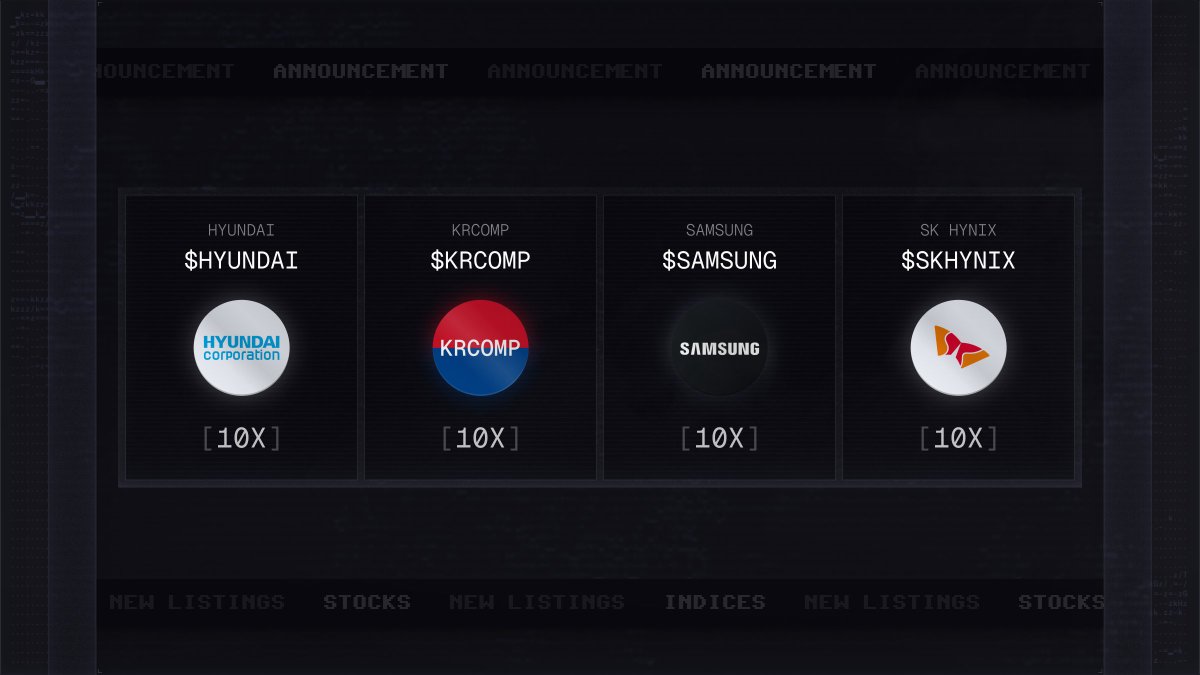
We are excited to be the first DEX to offer Korean equity perps! These markets are live at 10X leverage: $HYUNDAI, $SAMSUNG, $SKHYNIX and the $KRCOMP (Korean Composite) index.
Lighter tweet media
English
114
145
1.3K
331.6K
Mayflower AI
Mayflower AI@Mayflower_AI·
In the wake of our recent deep dive into AI agents revolutionizing on chain actions like autonomous DeFi trades and seamless cross-chain transfers the blockchain landscape is evolving faster than ever These agents aren't just tools; they're the bridge to mass adoption, abstracting all sorts of complexities for everyday users @VitalikButerin's insights below nail this shift: the original L2 vision is fading as Ethereum L1 scales massively. L2s must pivot from mere "branded shards" to innovative ecosystems, finding unique value beyond scalin This aligns perfectly with the agent explosion we highlighted earlier this week: a market doubling to $7.38B by 2025, where AI handles 99% of transactions, from staking to governance, all secured by oracles and ZK proofs Enter our core product: a vertically integrated browser extension, blending LLMs with wallet integrations (like Raydium) for natural-language on chain commands. Say "Swap $ETH to $SOL and stake" it handles bridging, execution, and more, autonomously and securely By embedding AI agents directly into DeFi workflows, we embody Vitalik's call for L2s to innovate in AI, creating efficient, user-centric layers that scale Ethereum's ethos without relying on outdated models Join the voyage: Experience agent-driven crypto with Mayflower 🤖
vitalik.eth@VitalikButerin

Have been following reactions to what I said about L2s about 1.5 days ago. One important thing that I believe is: "make yet another EVM chain and add an optimistic bridge to Ethereum with a 1 week delay" is to infra what forking Compound is to governance - something we've done far too much for far too long, because we got comfortable, and which has sapped our imagination and put us in a dead end. If you make an EVM chain *without* an optimistic bridge to Ethereum (aka an alt L1), that's even worse. We don't friggin need more copypasta EVM chains, and we definitely don't need even more L1s. L1 is scaling and is going to bring lots of EVM blockspace - not infinite (AIs in particular will need both more blockspace and lower latency than even a greatly scaled L1 can offer), but lots. Build something that brings something new to the table. I gave a few examples: privacy, app-specific efficiency, ultra-low latency, but my list is surely very incomplete. A second important thing that I believe is: regarding "connection to Ethereum", vibes need to match substance. I personally am a fan of many of the things that can be called "app chains". For example I think there's a large chance that the optimal architecture for prediction markets is something like: the market gets issued and resolved on L1, user accounts are on L1, but trading happens on some based rollup or other L2-like system, where the execution reads the L1 to verify signatures and markets. I like architectures where deep connection to L1 is first-class, and not an afterthought ("we're pretty much a separate chain, but oh yeah, we have a bridge, and ok fine let's put 1-2 devs to get it to stage 1 so the l2beat people will put a green checkmark on it so vitalik likes us"). The other extreme of "app chain", eg. the version where you convince some government registry, or social media platform, or gaming thing, to start putting merkle roots of its database, with STARKs that prove every update was authorized and signed and executed according to a pre-committed algorithm, onchain, is also reasonable - this is what makes the most sense to me in terms of "institutional L2s". It's obviously not Ethereum, not credibly neutral and not trustless - the operator can always just choose to say "we're switching to a different version with different rules now". But it would enable verifiable algorithmic transparency, a property that many of us would love to see in government, social media algorithms or wherever else, and it may enable economic activity that would otherwise not be possible. I think if you're the first thing, it's valid and great to call yourself an Ethereum application - it can't survive without Ethereum even technologically, it maximizes interoperability and composability with other Ethereum applications. If you're the second thing, then you're not Ethereum, but you are (i) bringing humanity more algorithmic transparency and trust minimization, so you're pursuing a similar vision, and (ii) depending on details probably synergistic with Ethereum. So you should just say those things directly! Basically: 1. Do something that brings something actually new to the table. 2. Vibes should match substance - the degree of connection to Ethereum in your public image should reflect the degree of connection to Ethereum that your thing has in reality.

English
1
2
8
3.6K
Mayflower AI ری ٹویٹ کیا
Raydium
Raydium@Raydium·
Big week for AI 🤖
English
196
39
442
24.6K
Mayflower AI ری ٹویٹ کیا
Kaia
Kaia@KaiaChain·
Kaia v2.2.0 is out now. The first upgrade of 2026 focuses on EVM compatibility. This, in turn, sets the foundation for improved scaling and better wallet UX.
Kaia Developers@BuildonKaia

1/3 Kaia v2.2.0 release notes are out: Kairos testnet only (Osaka hardfork) Hardfork: Block 209,134,000 (~11 Feb, 10:30 UTC+9) All Kairos testnet nodes must upgrade to v2.2.0+ before the hardfork block Mainnet hardfork number will be specified in the next release

English
9
5
44
4.2K