1tokki@juantokki
[Attorney Lee Je-nam, Law Firm Law L] Min Hee-jin Gives Up ₩25.6 Billion — HYBE’s ‘Tampering’ Narrative Has Come to an End
ilyoseoul.co.kr/news/articleVi…
In a previous column, I analyzed the ₩25.6 billion put option ruling and confirmed a fundamental judicial principle: the law prioritizes the initiation of actual conduct over subjective feelings of betrayal. At the time, the court firmly stated that former CEO Min Hee-jin’s attempt to pursue independence could not be seen as a serious breach of contract, and dismissed HYBE’s claim of termination. This was a legal victory that clearly established that a subjective breakdown of trust cannot, by itself, constitute legal grounds for contract termination.
Despite this, HYBE has blurred the core issue by filing an astronomical ₩43 billion penalty lawsuit instead of engaging in self-reflection. In particular, it has put forward the so-called “tampering” frame—alleging that artists were enticed away behind the agency’s back to terminate their contracts. From a legal perspective, this appears less like a claim with strong legal merit and more like a strategic SLAPP-style lawsuit aimed at socially burying the opposing party.
In this article, I will analyze the legal fallacies of HYBE’s claims in light of the previous ruling, as well as the evidentiary significance of former CEO Min’s forfeiture of payment.
▲ The Legal Reality of “Tampering” and the Limits of Burden of Proof
The “tampering” emphasized by HYBE is merely an industry term that does not exist in statutory law. To use it meaningfully in court, HYBE must clearly prove unlawful inducement—such as third-party interference with contractual rights or business obstruction—by showing that Min specifically encouraged artists to improperly terminate their exclusive contracts.
However, the court has already ruled that the circumstantial evidence presented by Min’s side did not reach the level of actual execution of management control seizure. Repackaging the same evidence under the label of “tampering” and filing another lawsuit suggests a strategy aimed more at influencing public opinion than achieving legal success.
Moreover, it is dangerous to attribute the breakdown of trust between artists and their agency solely to external unlawful inducement. This perspective reduces artists to passive assets or appendages of their agencies, rather than recognizing them as independent individuals. The law does not enforce the mere formal continuation of contracts; it rigorously examines who is responsible for the breakdown of trust. If HYBE fails to overcome the burden of proof and instead attempts to stigmatize based on circumstantial claims alone, such assertions are likely to backfire in court as false allegations.
▲ The Forfeiture of ₩25.6 Billion Put Option: Elimination of Personal Gain Motive
In cases involving breach of fiduciary duty or attempts to seize management control, courts focus heavily on the actor’s economic motive. Min’s declaration that she would forfeit her ₩25.6 billion put option—despite a high likelihood of winning—serves as a decisive factor that undermines the foundation of HYBE’s narrative of misconduct.
Voluntarily giving up a confirmed claim worth tens of billions of won strongly suggests that her objective was not economic gain through control of management, but rather to prove her innocence and protect trust with the artists.
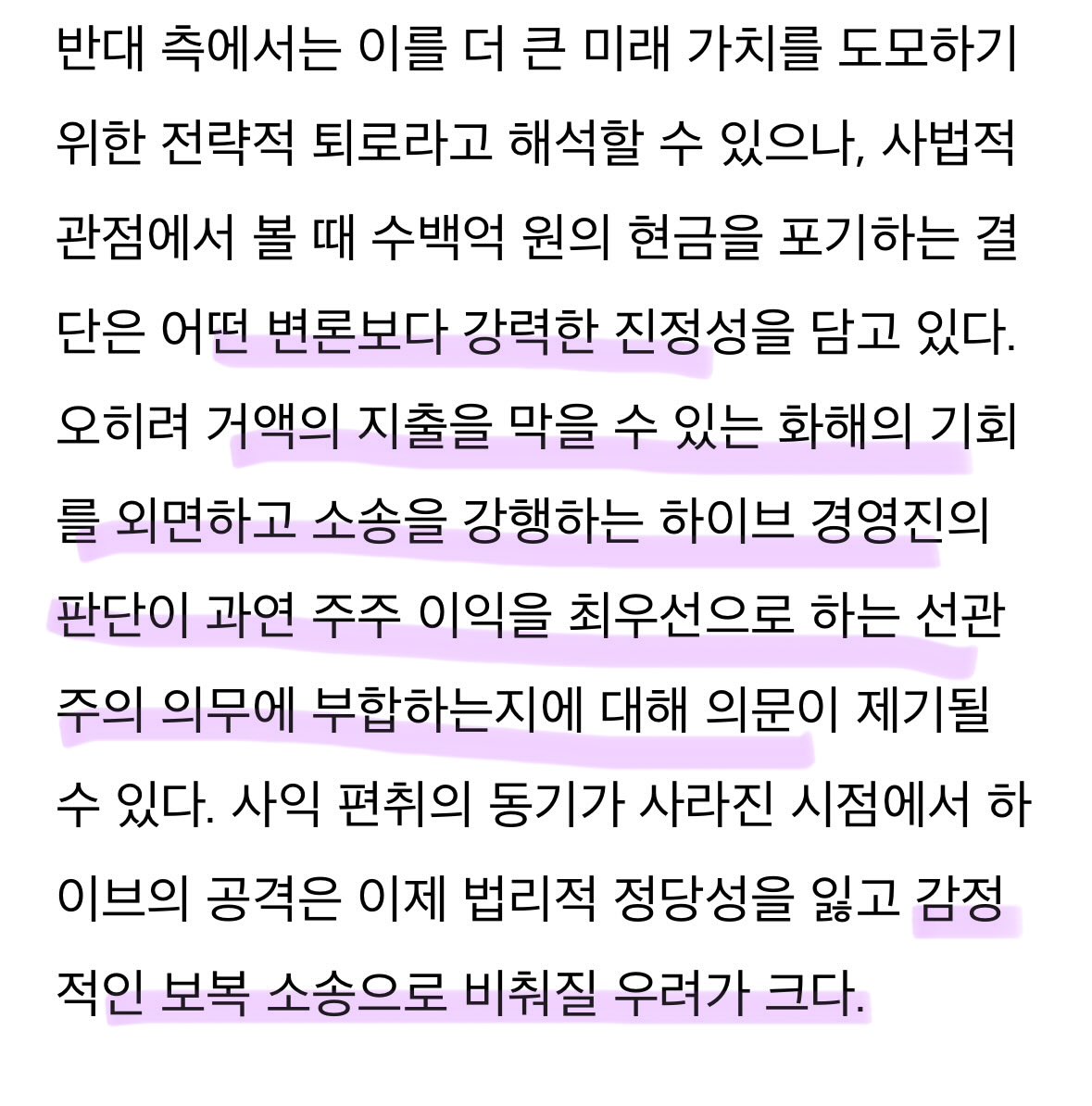
The opposing side may interpret this as a strategic retreat aimed at securing greater future value. However, from a judicial perspective, relinquishing such a large sum of money carries a level of sincerity stronger than any legal argument. On the contrary, questions may arise as to whether HYBE’s management, which continues litigation while ignoring opportunities for settlement that could prevent massive expenditures, is truly fulfilling its fiduciary duty to prioritize shareholder interests.
With the motive for personal gain effectively eliminated, HYBE’s claims risk losing legal justification and being seen instead as emotionally driven retaliatory litigation.
▲ The Intersection of Artist Protection and Directors’ Fiduciary Duty
Behind the attacks on Min lies a broader conflict between control over intellectual property (IP) and the autonomy of creators. Under commercial law, directors owe a duty of loyalty to the corporation, but in the entertainment industry, protecting the personality rights and creative value of artists—core assets—can also be seen as part of a broader fiduciary duty to enhance corporate value.
Min’s actions—advocating for artists and calling for internal reform—should not be simplistically framed as betrayal of the company. Such a view overly narrows the role of management.
Dismissing her strong bond with NewJeans members as “gaslighting” or improper inducement borders on a legal insult to the partnership between creators and artists. The law considers not only contractual language but also the underlying trust those contracts aim to protect. Even if protecting artists’ rights appears to conflict with corporate interests in the short term, it can reasonably be interpreted as a legitimate effort to preserve the long-term vitality of IP. The judiciary must ensure that the logic of large capital does not undermine the essence of creative work.
▲ Industry Groups’ Media Campaigns: Private Sanctions Threatening Rule of Law
Recent statements by industry groups such as the Korea Entertainment Management Association calling for the eradication of “tampering” directly violate the fundamental principle of presumption of innocence. When private organizations label individuals as industry offenders and push for their exclusion before a final court ruling, it amounts to de facto private sanctions—an approach incompatible with the rule of law.
The “industry order” they claim to protect ultimately serves to reinforce the vested interests of large agencies, suppressing the freedom of creators and artists to choose and change their professional paths—a form of cartel-like thinking.
Their framing of “tampering” as a grave crime undermining the industry lacks concrete legal grounding and relies more on emotional appeal. Constitutional guarantees of economic freedom and self-determination take precedence over inter-corporate interests. Industry groups echoing HYBE’s position and engaging in coordinated public opinion campaigns risk undermining judicial independence. The courts must remain unaffected by such external pressure and determine, based solely on evidence and legal principles, what truly constitutes fair competition for the industry’s development.
[Conclusion] The Law Answers to Evidence, Not the Power of Capital
This case symbolically illustrates how large capital attempts to suppress the spirit of creators by branding them with the label of “tampering.” As emphasized in my previous column, the resolution of corporate disputes ultimately depends on the cold logic of legal principles.
HYBE and the interest groups supporting it should now cease sensational media tactics and focus on fulfilling their legal burden of proof.
Truth is not determined by the size of capital or the loudness of collective voices, but by clear evidence and rational judgment. Between former CEO Min—who stands firm even at the cost of forfeiting substantial financial gain—and HYBE, which pursues astronomical litigation and public pressure without clear evidence, it seems legally evident whose side the court is more likely to support.
It is hoped that the judiciary will cut through the framing tactics of large corporations, uphold the fairness of the rule of law, and restore justice to the creative ecosystem.