Nick Beckman

697 posts

Nick Beckman banner
Nick Beckman

Nick Beckman

@NickHealthAI

AI × healthcare operations strategist. I map, evaluate, and optimize AI systems that streamline payer–provider flow, strengthen decisions, and improve outcomes.

شامل ہوئے Ocak 2025
141 فالونگ758 فالوورز
Nick Beckman
Nick Beckman@NickHealthAI·
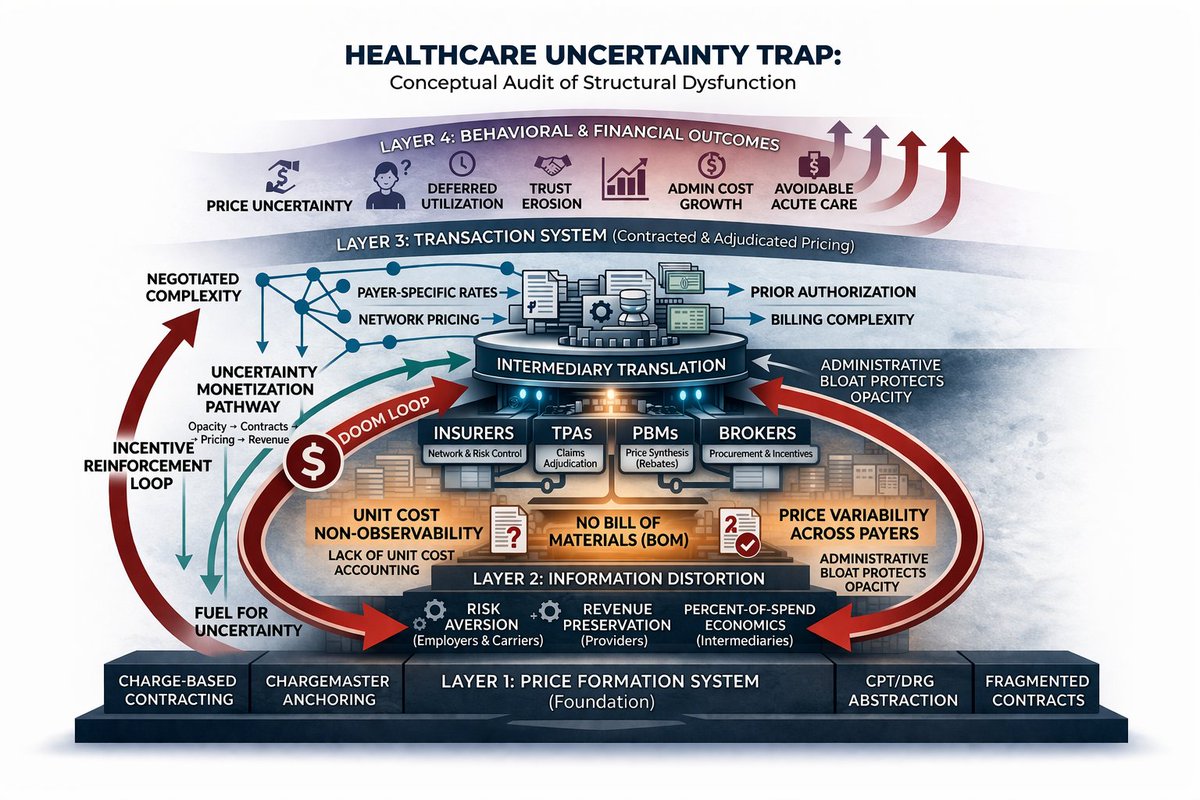
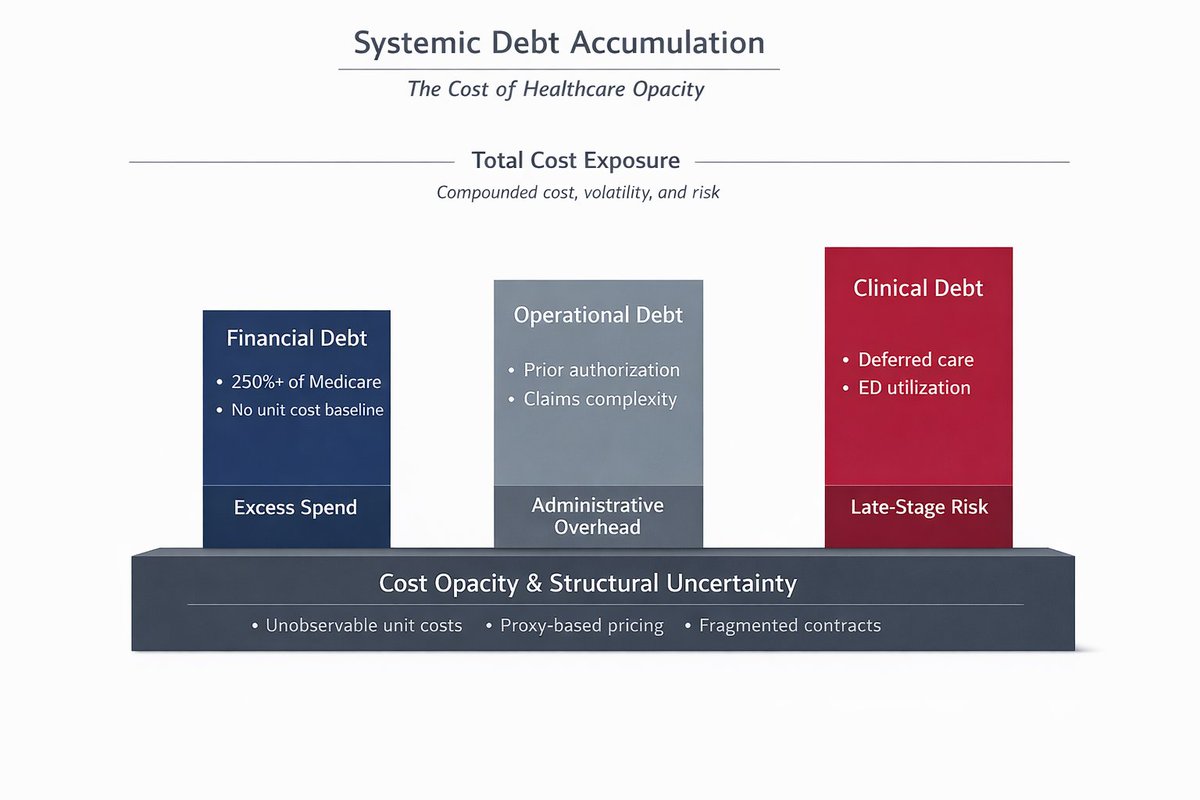
Healthcare costs accumulate. They build as three forms of structural debt: 1) Financial Debt Employers pay 250%+ of Medicare without a unit cost baseline. That spread reflects pricing without cost visibility. 2) Operational Debt The system runs on prior authorization, billing rules, and network design. These are the processing layers required to manage price uncertainty. 3) Clinical Debt Uncertain costs shape behavior. Care gets delayed. Utilization shifts to higher-acuity settings. Risk increases over time. These liabilities sit in parallel, and originate from the same foundation: Cost opacity. Carrier changes and plan adjustments operate within this structure. The leverage point is upstream: Establish unit cost visibility. Replace proxy pricing. Constrain administrative processing layers. Employers are financing accumulated exposure.
Nick Beckman tweet media
English
0
0
0
13
The Husky
The Husky@Mr_Husky1·
Admit it: Your kid mispronounced a word three years ago and now the whole family says it that way. What's the word in your house? (We still say 'pasketti' and I’m not stopping anytime soon.)
English
2.6K
96
3.4K
337.7K
Nick Beckman
Nick Beckman@NickHealthAI·
This is what I was wondering, thanks for sharing. I used to manage a team in Manila that could elastically scale from 3-12 depending on my needs and everyone on that team could train up on complex data entry, business development, and analytical tasks very quickly. Managing that team was generally 1 phone call a day for 30 minutes, or longer when we had to train a new process. They all had generally had Masters degrees as well. AI has helped me supercharge what I would call “light” research and consolidating publicly available sources. It can help me brainstorm quickly too. If I didn’t know how to do my job, it would not be turning me into a better consultant. You need junior employees to work with and alongside mid level and senior employees to learn how to effectively do almost every job I’ve worked in. Any one-shot app that relies on an AI backend process will evolve into a SaaS pricing model and price itself out of traditional SaaS products. Hopefully we see some great one off projects stand up to meet specific needs before that point
English
0
0
0
16
Nick Huber
Nick Huber@sweatystartup·
AI tools right now are more expensive than my international team. We can't afford them and they are heavily subsidized all the way up. What happens when they 5x in cost? The bubble is popping soon.
English
155
16
235
39K
Nick Beckman
Nick Beckman@NickHealthAI·
Right! You’ve already proven something most of the industry thought wasn’t possible: remove the spread, expose the real price, and make pharmacy costs deterministic. The rest of employer healthcare hasn’t caught up. It still runs on price variance and unmanaged routing. If pricing opacity can be eliminated in pharmacy, then routing-driven cost variance across care delivery can be eliminated as well. For the same clinical outcome, the system produces radically different costs: A knee replacement can be $25,000 or $75,000 An MRI can be $500 or $3,000 An infusion can be $5,000 or $20,000 This isn’t a clinical problem. It’s a routing problem. Today, no one controls where patients go before cost is incurred. As a result, the system monetizes that variance; hospitals capture it, intermediaries obscure it, and employers fund it. The solution is to control the decision layer. This is a routing and contracting platform that sits above the carrier and determines how care actually gets delivered. Every non-emergent entry point flows through a single front door. From there, a decision engine routes patients into pre-defined pathways with pre-priced bundles and enforced site-of-care. Instead of open-ended referrals, the system schedules the patient directly into the appropriate provider and setting. The model only works if patients use it, so the incentives are immediate and tangible: zero out-of-pocket cost, end-to-end scheduling handled for them, and faster access than the default system. The right choice becomes the easiest one. Operationally, this shifts healthcare from something that is negotiated after the fact to something that is routed in advance. Prices are locked before care occurs. Site-of-care arbitrage disappears. High-cost pathways, MSK, imaging, infusion, become standardized and predictable. The business model mirrors the same principles that made Cost Plus compelling: fully transparent and aligned. A fixed platform fee on a per-employee basis, combined with a flat percentage of auditable savings. No spread, no hidden economics, just participation in the value created by eliminating unnecessary variance. This doesn’t require replacing carriers or rebuilding the system from scratch. It simply places control where it has never existed, at the point where decisions are made. Whoever controls where the patient goes, what gets done, and what gets paid controls the economics. I know you’ve assessed this thoroughly. But what’s your take on if you start with a narrow, high-yield focus on MSK and imaging, areas where price dispersion is extreme, routing is controllable, and results can be demonstrated quickly. The immediate objective being to run a pilot within one of your portfolio companies, applying this model end-to-end to prove a measurable 20–30% cost reduction within 18 months. To ensure clean execution and credible results, the pilot should target a population of roughly 5,000–10,000 covered lives, with the majority concentrated in one or two core metro areas. That level of density provides enough repeatable event volume (surgeries, imaging, infusions) and sufficient provider optionality to enforce routing, lock pricing, and produce defensible savings. The scope is intentionally constrained: focus on markets where alternative sites of care exist (ASCs, independent imaging) and where routing can be operationalized without friction. This ensures that savings are not theoretical, but observable and attributable. A 5,000–10,000 life pilot costs roughly $2–6M annually, driven primarily by a $30–$50 PEPM platform fee plus incentives and setup. It targets $1–6M in first-year savings from MSK and imaging alone, with stronger ROI in year two as adoption and contracting scale. The goal isn’t short-term arbitrage, it’s proving that controlling routing reliably converts variance into repeatable savings. Or tighter starting at $20–$30 PEPM and narrowing the scope further (imaging-only entry wedge).
English
0
0
0
91
Mark Cuban
Mark Cuban@mcuban·
Single payer COULD cut cost and improve care but there are 2 fundamental issues. 1. All plans proposed have placed the Sec of HHS in charge of the program. You can't have a political appointee in that position and it's hard to de-politiicize HC in this country 2. They assume that they can get providers and specialists to accept whatever rates they set. You are talking about organizations that in most cases, don't even know their costs. Why ? They don't want to know their costs. For lots of reasons to long to dig into here Proponents of M4A have to first get hospitals to the point where they can define all their costs and do a Bill of Materials for procedures. You can't negotiate a price for all Americans if you don't know what your costs are It's Shark Tank 101. So we get a stalemate. Politicians don't do the work needed. Hospitals and providers avoid the work needed Other countries started on their path to universal care decades and decades ago. When healthcare was much simpler technically and fiscally. If senators won't support the Break Up Big Medicine Bill or anything comparable , there is no chance of getting to single payer. Our politicians don't have the backbone to do what is needed. You can call out all but Hawley and warren. No one else has uttered a syllable in support
Berniebabe2016☮️🟧@berniebabe2016

@mcuban @IngGuthrie #MedicareForAll would resolve that issue. Healthcare should not be connected to employment.

English
340
263
1.5K
383.9K
Nick Beckman
Nick Beckman@NickHealthAI·
Employers don’t have a healthcare cost problem. They have a variance problem. Total spend is only part of the issue. The real exposure sits at the claim level, where costs are unpredictable, timing is delayed, and all the drivers are not observable. A single case can materially distort plan performance. Not because it’s clinically unusual, but because the underlying price was never knowable. That’s not a pricing issue. That’s a system design issue. In most markets, procurement evaluates unit cost, quality, and performance. However, in healthcare, procurement evaluates intermediaries (networks, discounts, guarantees). The actual cost of care remains unobservable. So employers optimize around: Discount levels Rebate guarantees Administrative fees All measured against benchmarks that are themselves opaque. The result is a system that reports “savings” without establishing a true baseline. At the same time, timing compounds the problem. Claims are paid, adjusted, and reconciled months after care is delivered. Decisions are made on lagged data, separating cost from accountability. To manage this, the system builds layers: Networks to constrain exposure Prior authorization to control utilization Adjudication rules to process variability These are not edge features. They are the operating model. And every stakeholder is aligned within it: Providers protect revenue through negotiated pricing Intermediaries scale with spend and complexity Employers buy predictability over transparency Patients respond by avoiding uncertain exposure The system holds because it is economically stable, even as costs and volatility increase. Running another RFP or changing carriers does not address this. It rotates vendors inside the same structure. The leverage point is upstream: Make unit cost observable. Reduce reliance on proxy pricing. Govern administrative friction as a system, not a side effect. Until then, employers are not managing healthcare costs. They are managing uncertainty.
English
0
0
0
12
Nick Beckman
Nick Beckman@NickHealthAI·
In a system built on cost opacity, the dominant behavior is risk avoidance. When prices are unknown and exposure is uncapped, every decision carries asymmetric downside. Patients don’t know what it will cost, when it will hit, or how it will be adjudicated. That uncertainty shapes behavior more than any benefit design. The most consistent response is deferral. Preventive visits, diagnostics, and follow-ups get pushed out or skipped, not from neglect, but from lack of price certainty. Utilization doesn’t disappear. It shifts. From planned to unplanned. From low acuity to high acuity. From controlled settings to the ED. Even when care is accessed, decisions degrade. Patients delay procedures, defer imaging, and abandon prescriptions mid-cycle. The issue isn’t access, it’s confidence in the downstream cost. Repeated exposure to opaque pricing erodes trust. The system becomes something to navigate, not something to rely on. For employers, this shows up as lower preventive compliance, higher late-stage claims, and increased volatility in spend. Behavior is not a soft variable, it is a direct cost driver. These patterns are not independent. They are downstream of administrative friction, price variability, and intermediary-driven rules. Behavior in healthcare is a direct output of system design. In an opaque system, avoidance is rational. In a predictable system, engagement becomes viable.
English
1
0
0
14
Nick Beckman
Nick Beckman@NickHealthAI·
Healthcare's “high prices” are the symptom. The core issue is cost opacity, and the U.S. healthcare system has built a multi-trillion-dollar industry around processing it. Without a true Bill of Materials (BOM), pricing is not determined; it’s negotiated through layers of intermediaries. That gap becomes the uncertainty premium embedded in every claim. What that produces: 1) Financial Debt Commercial plans routinely pay 250%+ of Medicare. That spread reflects negotiated complexity, not unit cost. It’s a premium on not knowing. 2) Operational Debt In the absence of clear costs, the system substitutes friction, networks, prior auth, billing rules, rebate structures. Processing that complexity consumes 15–25% of hospital spend. 3) Clinical Debt Faced with uncapped, unpredictable costs, patients defer care. Low-cost preventive care gets skipped. Utilization shifts to higher-acuity settings like the ED. This is not random. It’s a system that converts opacity into revenue and administrative load. Running another carrier RFP or adjusting plan design does not change this. It rotates vendors inside the same intermediary translation engine. The leverage point is structural: Govern administrative friction and require BOM-level cost observability. Steal this image!
Nick Beckman tweet media
English
1
0
2
53
Nick Beckman
Nick Beckman@NickHealthAI·
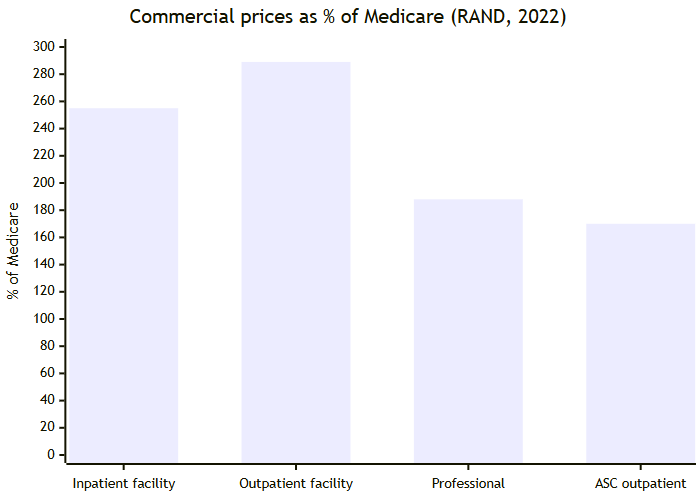
RAND’s hospital price transparency series emphasizes that observed price variation is weakly explained by Medicare/Medicaid patient shares and more strongly associated with market power, consistent with negotiated pricing rather than production-cost anchoring
Nick Beckman tweet media
English
0
0
0
25
Nick Beckman
Nick Beckman@NickHealthAI·
Summary of my guidance to clients and stakeholders in this period: When costs rise, every solution creates a perceived loss. The winning strategy isn’t cutting, it’s structuring trades so stakeholders feel they’re avoiding a worse outcome.
English
0
0
0
10
Nick Beckman
Nick Beckman@NickHealthAI·
Dropped mother in law at airport at 7:30am ET No pre-check; Flying JetBlue, bag is already in NYC because this was the rescheduled flight from Friday morning which she sat in TSA line for 90 minutes and made negligible progress and had to reschedule the flight to today. She barely made her flight schedule to take off at 11:47, at 11:22 when she called there were still 10 people in front of her at the gate waiting to board. Her TSA line started at the JetBlue baggage carousel. There’s conflicting information, some people are having Pre-Check honored while others are being told no. ATL domestic is definitely impacted but it seems like some people are definitely having drastically different experiences.
English
4
0
9
33.6K
Kelsey Wingert-Linch
Kelsey Wingert-Linch@KelsWingert·
Hartsfield Jackson ATL Airport: 9:03am- got to airport for 12:45pm flight 9:04- in line at digital ID bag drop 9:06- bag checked 9:11- in security line 9:47- made it to precheck line split 10:30- ID checked 10:32- bags into machine 10:37- ofiicially thru security 10:41- on tram
English
138
133
5.6K
1.6M
Nick Beckman ری ٹویٹ کیا
Dutch Rojas
Dutch Rojas@DutchRojas·
We spent 40 years making healthcare more “efficient.” We got shorter appointments, faster discharges, and higher mortality. Efficiency is a fine goal. Just make sure you’re optimizing for the right thing.
English
21
26
204
3.5K
Nick Beckman
Nick Beckman@NickHealthAI·
Key Questions for Plan Sponsors 1. What are the top 10 drugs by net cost, and how are they managed? 2. How frequently is the formulary updated for biosimilars and alternatives? 3. What is the defined GLP-1 strategy? 4. Are prescriber decision tools embedded at the point of care? 5. How are site-of-care and specialty channels structured? 6. Which pricing-layer mechanisms are integrated into the benefit? Bottom Line Pharmacy cost is the output of system design. Pricing Layer establishes unit cost Logic Layer determines utilization and total spend
English
0
0
0
20
Nick Beckman
Nick Beckman@NickHealthAI·
System Efficiency Operational performance is defined by: Biosimilar adoption velocity Supply alignment (inventory and refill timing) Site-of-care selection System efficiency directly translates to cost control capacity. GLP-1 Strategy Framework Effective GLP-1 management is defined by precision: Clinical guardrails Targeted eligibility frameworks Direct pricing models (manufacturer programs) Employer-aligned subsidy structures Structured access aligns clinical outcomes with financial sustainability.
English
1
0
0
22
Nick Beckman
Nick Beckman@NickHealthAI·
Just watched/listened to a great Fireside chat with AngleHealth.com and LucyRx.com Key takeaways: Pharmacy cost trend is determined by system structure. Two forces define the market: 1. High-cost specialty drugs ($80K–$100K+ per patient) 2. GLP-1 utilization at population scale Cost follows structure. Pricing and utilization operate as a coordinated system.
English
1
0
0
35
Nick Beckman ری ٹویٹ کیا
Ethan Brooks
Ethan Brooks@alt_w_v_g·
Went to the doctor the other week My wife made the appointment She said I "look tired" I said I am tired She said "not normal tired. Weird tired." I don't know what that means but I went anyway Nice office Fish tank in the lobby Third one this year Signed in at 1:48pm My appointment was at 2:00pm 12 minutes early Because I was raised to believe that matters The receptionist said "the doctor is running a little behind" I said "how far behind" She said "about 45 minutes" I said "so my 2:00 appointment is actually a 2:45 appointment" She said "we appreciate your patience" I said "I haven't shown any yet" My wife grabbed my arm There was a sign behind the desk "Missed appointments without 24-hour notice will incur a $75 fee" The doctor was 45 minutes late Nobody offered me $75 We sat down CNN was playing on mute with subtitles Running a segment about New York City redesigning its trash cans Cost the city $4 million I looked at my wife She said "don't start" Seven magazines on the table All from 2019 I read an article about supply chain disruptions that have since been resolved Very informative My wife was on her phone She looked up and said "WebMD says you might be dehydrated" I said "so we're paying $1,800 for a second opinion on WebMD" She went back to her phone At 2:54pm they called my name A nurse walked me to a room Took my blood pressure Took my temperature Typed for three minutes Then said "the doctor will be right in" I sat on the paper The paper ripped immediately I looked at the wall There was a diagram of a colon Not how I planned to spend my Tuesday 3:19pm The doctor walked in 1 hour and 19 minutes after my scheduled appointment He was looking at his phone Shook my hand without making eye contact Sat down and read my chart for about 30 seconds While I sat there watching him learn who I was He said "so what brings you in today" I said "my wife thinks I look weird tired" He said "what does that mean" I said "I was hoping you'd tell me" He said "when's the last time you had bloodwork done" I said "2019 maybe" He said "we should run a full panel" I said "fine" He asked if I was sleeping well I said "I have three kids and a golden retriever who thinks 3am is a reasonable time to need outside" He said "are you drinking enough water" I said "probably not" He said "that might be it" I said "you think the reason I look weird tired is because I don't drink enough water" He said "dehydration is more common than people think" I said "I've been here over an hour and sat on a piece of paper that ripped to be told to drink water" He said "we'll know more when the bloodwork comes back" I said "when will that be" He said "3 to 5 business days" I said "business days" He said "yes" I said "my blood has business days" He didn't respond Then he said "any other concerns" I said "several. But none you can bill for." He shook my hand again Still no eye contact Total face time with the doctor: 6 minutes Total time in the building: 1 hour and 37 minutes I was examined for approximately 6% of the time I was present I've fired people for better numbers than that My wife was in the waiting room She asked how it went I said "I need to drink water" She said "I told you that last week" I said "yes but now it's a medical opinion so it costs $1,800" She didn't laugh In the car she said "at least now you know you're fine" I said "I was fine when I walked in. I just didn't have the receipt to prove it." She didn't disagree The bloodwork came back four business days later Everything was normal The doctor's office sent a message through their portal It said "results look great. Continue to stay hydrated and follow up in 12 months." Follow up in 12 months To be told to drink water again $1,800 1 hour and 37 minutes 6 minutes of face time One ripped piece of paper And the same advice my wife gave me for free Plz fix. Thx. Sent from my iPhone
English
617
1K
9.9K
334.3K
Nick Beckman
Nick Beckman@NickHealthAI·
Nothing in this world can take the place of persistence. Talent will not; nothing is more common than unsuccessful men with talent. Genius will not; unrewarded genius is almost a proverb. Education will not; the world is full of educated derelicts. Persistence and determination alone are omnipotent. The slogan 'Press On!' has solved and always will solve the problems of the human race. Calvin Coolidge
English
0
0
1
11
Bryan Johnson
Bryan Johnson@bryan_johnson·
If you aspire, sleep. If you doubt, sleep. If you create, sleep. If you worry, sleep. If you love, sleep. If you hurt, sleep. Sleep.
English
444
370
5.3K
257.7K