PKspin..Я 🐸

2K posts

PKspin..Я 🐸 banner
PKspin..Я 🐸

PKspin..Я 🐸

@PKspin

AntiWoke🌊Nature Rules🤠Be kind it's easy💪 ☮️ Ribbit

شامل ہوئے Nisan 2017
782 فالونگ1.3K فالوورز
PKspin..Я 🐸 ری ٹویٹ کیا
Zack Wins
Zack Wins@DevelopingZack·
Nobody talks about WHY Satoshi disappeared. Then SegWit happened.
English
8
8
73
2.3K
PKspin..Я 🐸 ری ٹویٹ کیا
Vincent Gramoli
Vincent Gramoli@VincentGramoli·
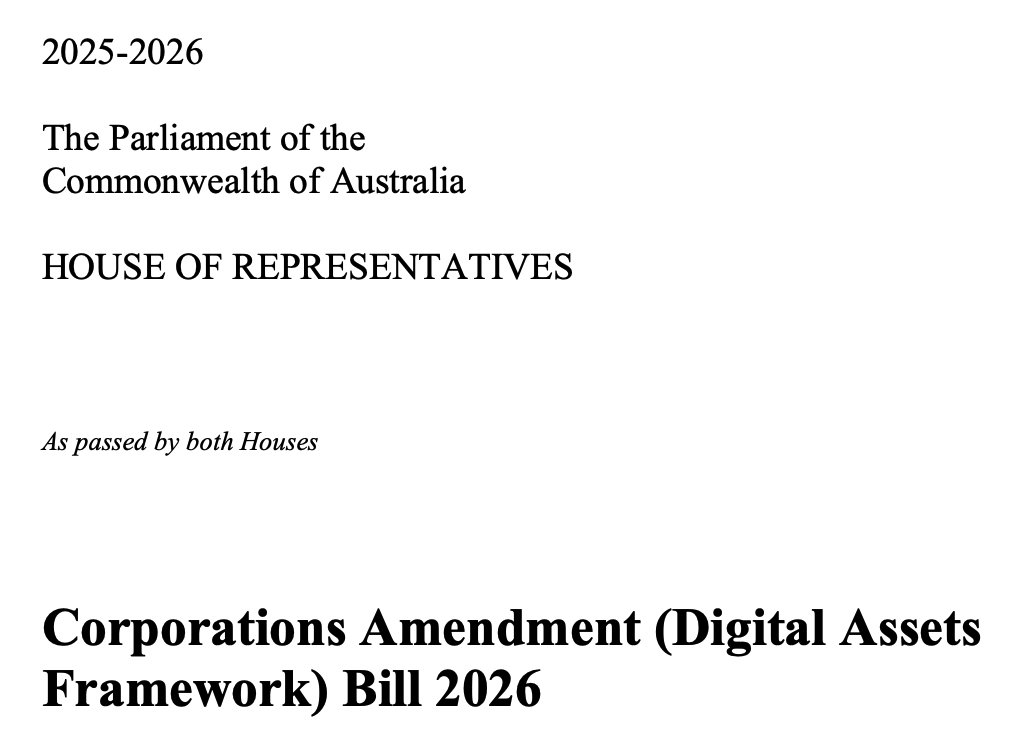
As the Corporations Amendment (Digital Asset Framework) 2026 Bill passed earlier this month, @RedbellyNetwork is now becoming a public digital token infrastructure according to Australian law. This means public, permissionless, open and decentralised.
Vincent Gramoli tweet media
English
10
20
89
5.3K
PKspin..Я 🐸 ری ٹویٹ کیا
Kyle Chassé 🐸
Kyle Chassé 🐸@Kylechasse·
Most perps “DEXs” are just CEXs with extra steps. Wrapped assets Leaky execution Fragmented margin Horrible stress handling Calling it “DeFi” doesn’t fix that. Ultrade is actually rethinking the stack: native assets, dark execution, unified margin, real failure design This is how it should’ve been built.
ULTRADE@ULTRADE_org

x.com/i/article/2041…

English
6
16
17
3.8K
PKspin..Я 🐸 ری ٹویٹ کیا
Zach Rynes | CLG
Zach Rynes | CLG@ChainLinkGod·
EXTREMELY timely security milestone from Chainlink Big-4 accounting firm @Deloitte just completed a SOC 2 Type 2 examination for Chainlink CCIP and Data Feeds (Price Feeds, Proof of Reserve, NAV Feeds) A SOC 2 Type 2 is an independent audit verifying that an organization's security, availability, and confidentiality controls have operated effectively over a sustained evaluation period, typically 3 to 12 months (in this case 6 months) While this kind of milestone may sound boring, this is exactly the kind of attestation that major enterprises and financial institutions look for before integrating with a technology vendor Chainlink is now the only oracle platform holding SOC 2 Type 2, SOC 2 Type 1, and ISO/IEC 27001:2022 certification
Chainlink@chainlink

NEW: Big-4 firm Deloitte & Touche LLP completed SOC 2 Type 2 examination for Chainlink CCIP & Data Feeds. Chainlink is the only data and interop oracle platform meeting key institutional security standards: • SOC 2 Type 2 • SOC 2 Type 1 • ISO/IEC 27001:2022 certification

English
26
101
820
46K
PKspin..Я 🐸 ری ٹویٹ کیا
MoneyGCC
MoneyGCC@MoneyGcc·
🔥KYC AML is coming for Defi🔥 Treasury 2026 reports (NMLRA & Illicit Finance Innovation Report): Highlight DeFi's risks (e.g., liquidity pool poisoning, exploits) and call on Congress to clarify which DeFi participants (especially those with concentrated governance tokens or control) should face AML obligations. They explicitly note that "decentralized" does not exempt projects from Bank Secrecy Act rules if there's identifiable control. However, this is a call for future legislation—not an enacted rule forcing identity checks on all pool users.
MoneyGCC@MoneyGcc

You, @Vet_X0, are consistently misleading people. For someone who has never worked in international finance to say something like this is inappropriate. DeFi has, had and will always have the same consistent weakness if these protocols don’t begin to KYC/AML the wallets associated with their liquidity pools. With more and more people using tools by @AnthropicAI to find on-chain vulnerability, this will only be the first in a long string of future hacks and pool drains. DeFi needs to be permissioned in order to legally recover funds from abusive users. These type of protocols should only be run on private permissioned chains. And it will inevitably happen. Anyone that says anything different is part of the problem in this space. Whether it comes to you or @JoelKatz you all fail to address the important aspects of DeFi that @YuvalRooz talks about and addresses in DeFi. Be a part of the solution not the problem in this space. Change your narrative. @ripple @bgarlinghouse get a control of your influencer.

English
0
1
1
182
PKspin..Я 🐸 ری ٹویٹ کیا
curb
curb@CryptoCurb·
🚨🚨🚨 REMOVE ALL YOUR FUNDS INTEGRATED WITH LAYERZERO IMMEDIATELY!!! LayerZero placed blame on KelpDAO saying they were irresponsible for running 1/1 DVN. @Dune analyzed all LayerZero integrations. Out of the 2,665 LayerZero integrations, 47% are running 1/1 DVN LayerZero integrations. I am being 100% serious here— REMOVE ALL YOUR FUNDS INTEGRATED WITH LAYERZERO IMMEDIATELY!!! 🚨🚨🚨
Dune | We Are Hiring!@Dune

Following the KelpDAO hack, we built an open analysis of DVN security configurations across every active OApp on LayerZero over the last 90 days. Of ~2,665 unique OApp contracts: 47% run a 1-of-1 DVN security floor, 45% run 2-of-2, and ~5% run 3-of-3 or higher. As we know, KelpDAO's rsETH sat in the first bucket. Open query, public methodology, feedback welcome: dune.com/dune/layerzero…

English
47
78
576
115.2K
PKspin..Я 🐸 ری ٹویٹ کیا
CoinMarketCap
CoinMarketCap@CoinMarketCap·
LATEST: 🏦 Japan's JSCC has launched a trial with Mizuho and Nomura to test using government bonds as collateral on the Canton Network.
CoinMarketCap tweet mediaCoinMarketCap tweet media
English
17
51
233
23K
shafu
shafu@shafu0x·
the only contract you can trust at this point is fucking wETH
English
31
2
151
27.9K
PKspin..Я 🐸 ری ٹویٹ کیا
LINK Archive
LINK Archive@LINKArchv·
Sergey explains why CCIP is the most secure cross-chain infrastructure “CCIP has many individual key security design decisions, but three of the larger ones that I tend to think about when I look at its security compared to other cross-chain systems would be the amount of decentralization that actually confirms a transaction” “There are cross-chain systems that are basically multi-sigs of one, two, three sets of signers or keys. Then there are cross-chain systems that are basically hubs where all transactions flow through one hub” “And then there's CCIP, which for every single lane has three oracle networks. Not three nodes, but three individual separate networks responsible for confirming three separate aspects of the transaction” “The amount of decentralization within CCIP just by the amount of nodes independently verifying key parts of the transaction in a very focused way is at a much higher level than any other bridge” “The second key difference is the fact that there's a risk management layer. So, there's a risk management network, which is one of those key networks where you can encode specific policies and configurations and conditions around how to approach different security risks that might emerge” “If a specific chain has a certain type of risk—it reorgs, there's reliability issues, an adversary has invented a new attack—you have a place where you can go and you can write some code and encode those set of risks and those set of conditions separately from the core protocol” “So, you're not changing the core protocol that provides the core security; you're adding security by putting more conditions on what a transaction needs to meet in the risk management network” “So, you're keeping the core security in a stable protocol and you're adding more security by putting more code, more configurations in the risk management network. This is another kind of layer of decentralization and the ability to quickly adapt” “One of the third key things that was done is actually that the two core transactional networks—the committing DON and the executing DON—and the risk management network have been written in separate codebases” “The core protocol is written in a completely separate codebase in a completely different language, initially written by a completely separate team from the team that wrote the risk management network in its own codebase and its own language” “And both of these parts of the system are continuing to be very separate not only in how they operate, but also in that they're separate codebases written in separate different languages” “And this is a very significant difference because even if you're able to break one of those codebases because you know one language or you found one flaw, that flaw does not extend to the other codebase” “And so it's really the only bridge in which you have a kind of client diversity and separate codebases interacting with each other in a secure way” “There's many other great security features within CCIP that far surpass what you see in other bridges, and that's why CCIP has been operating successfully with no value loss, no hiccups, continual reliability, and a bunch of other successful outcomes” “I think it's something that the time that it took to build was a good decision, and that's consistently what I see when you make infrastructure that's going to process and move and interact with trillions of dollars in transactional value, which is what the Chainlink system and CCIP are being built to do” “Our goal is not to just transact and process the transactions and move the data of today, but it's to do that for the whole world in the trillions and trillions of dollars, possibly at some point even reaching the size and amount of transaction value that you see in the traditional financial system, which is in the quadrillions per year”
English
7
42
218
15.3K
PKspin..Я 🐸 ری ٹویٹ کیا
Branch
Branch@BranchM·
Investigate hard because the fact is 2 of 3 @LayerZero_Core DVN signers authorized it. Any bridge/OFT/OApp that uses LayerZero’s DVN as its lone required verifier is vulnerable to the same attack right now. I would guess that most don’t only require one like @KelpDAO did
Kelp@KelpDAO

Earlier today we identified suspicious cross-chain activity involving rsETH. We have paused rsETH contracts across mainnet and several L2s while we investigate. We are working with @LayerZero_Core, @unichain, our auditors and top security experts on RCA. We will keep you posted as we learn more about this situation. Please follow only the official @KelpDAO handle for the updates.

English
2
1
13
1.4K
PKspin..Я 🐸 ری ٹویٹ کیا
Dexter AI
Dexter AI@dexteraisol·
Sneak peek of x402gle, the agentic tool search engine + payments protocol explorer. Access the beta by holding 1M+ $DEXTER: x402gle.com
English
12
20
74
4.3K
PKspin..Я 🐸 ری ٹویٹ کیا
Fishy Catfish
Fishy Catfish@CatfishFishy·
x.com/i/status/20455… "An attacker apparently drained 116,500 rsETH from Kelp DAO's LayerZero-powered cross-chain bridge on Saturday, according to on-chain data. The stolen funds are worth approximately $292 million at current market prices. LayerZero OFT bridge at the center The exploit appears to have targeted Kelp's LayerZero OFT (Omnichain Fungible Token) bridge, which enables rsETH to move between networks. The successful drain transaction occurred at 17:35 UTC, when an attacker-controlled wallet called lzReceive on LayerZero's EndpointV2 contract. The call triggered Kelp's bridge contract to release 116,500 rsETH to a separate attacker address, per the transaction's event logs."
The Block@TheBlockCo

Kelp DAO's rsETH bridge apparently exploited for roughly $292 million in LayerZero-based attack theblock.co/post/397988/ke…

English
8
18
171
21.6K
Canton Army
Canton Army@CantonArmy·
We talk a lot about Canton's tech. The privacy layer, the institutional backing, the DTCC integration. But nobody's talking about the self-custody gap. Most $CC holders right now are sitting on centralized exchanges or hot wallets. That's the same setup that wiped people out in 2022. Different chain, same risk. Canton was built for institutional-grade security. Shouldn't the way you store your $CC match that standard? Until recently, there wasn't a cold storage option for Canton at all. That changed when @CypherockWallet added Canton support, making it the only hardware wallet in the market that does. What caught our attention: it doesn't use seed phrases. Your private keys are split across 5 devices using Shamir's Secret Sharing. Audited by Keylabs, fully open-source. They're also running something interesting right now. You can essentially get the wallet for free through a referral program with $CC rewards. Worth looking into if you've been meaning to move your tokens off exchanges. Details here: cypherock.com/store Self-custody isn't optional. Especially not on a chain built for institutions.
Canton Army tweet media
English
7
3
37
1.4K
PKspin..Я 🐸
PKspin..Я 🐸@PKspin·
And still "NO AUDIT" since 2022! @CypherockWallet Not touching it until they address
Canton Army@CantonArmy

We talk a lot about Canton's tech. The privacy layer, the institutional backing, the DTCC integration. But nobody's talking about the self-custody gap. Most $CC holders right now are sitting on centralized exchanges or hot wallets. That's the same setup that wiped people out in 2022. Different chain, same risk. Canton was built for institutional-grade security. Shouldn't the way you store your $CC match that standard? Until recently, there wasn't a cold storage option for Canton at all. That changed when @CypherockWallet added Canton support, making it the only hardware wallet in the market that does. What caught our attention: it doesn't use seed phrases. Your private keys are split across 5 devices using Shamir's Secret Sharing. Audited by Keylabs, fully open-source. They're also running something interesting right now. You can essentially get the wallet for free through a referral program with $CC rewards. Worth looking into if you've been meaning to move your tokens off exchanges. Details here: cypherock.com/store Self-custody isn't optional. Especially not on a chain built for institutions.

English
0
0
1
91