Scientific Bitcoin Institute

42 posts

Scientific Bitcoin Institute banner
Scientific Bitcoin Institute

Scientific Bitcoin Institute

@ScientificBTC

شامل ہوئے Mart 2026
3 فالونگ701 فالوورز
Scientific Bitcoin Institute ری ٹویٹ کیا
Carlos Baquero
@moneyordebt I am finishing a paper submission on testing models for BTC price prediction. If this work is aiming for out of sample prediction I could try to include it in the tested models I am covering. I am also building a public framework to test model proposals. Thanks.
English
3
1
1
205
Scientific Bitcoin Institute ری ٹویٹ کیا
moneyordebt ∞/21M
moneyordebt ∞/21M@moneyordebt·
Congratulations ⁦@Giovann35084111⁩ on #1 position on Amazon for The Physics of Bitcoin book! This in the category of econometrics & statistics wherein reside many of the fiercest critics, or shall I say the unaware, of Bitcoin’s persistence and inherent power law nature.
moneyordebt ∞/21M tweet media
English
1
5
64
4K
Scientific Bitcoin Institute ری ٹویٹ کیا
moneyordebt ∞/21M
moneyordebt ∞/21M@moneyordebt·
This little Bitcoin power law animation shows how the power law exponent k evolves over time from early 2012 until early 2026. Updates 6 weeks at a time. This is the phase space for that k and also for the log periodic fundamental frequency ω that is, like k, determined only using the data up until that particular date. The equivalent λ, log spacing parameter, is shown in the legend. As usual k ends up near 5.7 and λ very close to 2.0 (ω near 9). Note that the orange dot starts to circle and loop around the final value and the loops get smaller and smaller. This is the renormalization flow of the system locking in and the tightness of the loops strongly supports the interpretation of k, ω as structural parameters of the Bitcoin network. On the right hand y-axis we have the coupling constant, a green dot, which is a hidden variable of this scale invariant system that manifests both continuous (k) and discrete (ω) scale invariance. @ScientificBTC
English
1
3
34
10.3K
Scientific Bitcoin Institute ری ٹویٹ کیا
Giovanni's BTC_POWER_LAW
Giovanni's BTC_POWER_LAW@Giovann35084111·
These are not deviations from the power law but dynamic values (how the price is changing) in terms of the local slope of the power law and its derivative (velocity of n). It has more information that pure deviation from the power law.
Giovanni's BTC_POWER_LAW tweet media
English
1
2
25
2K
Scientific Bitcoin Institute ری ٹویٹ کیا
Saverio M. Santostasi
Saverio M. Santostasi@SMSantostasi·
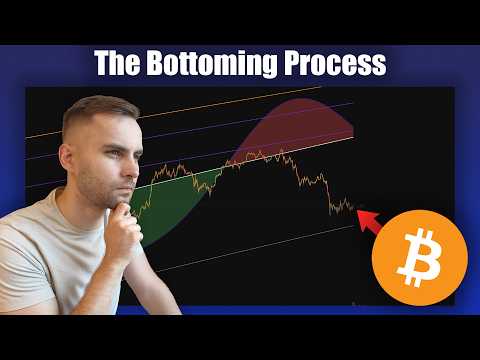
It is clear that bitcoin is currently in a bottoming process when looking at the historical range of deviations from the power law. We COULD go a bit lower, but the value proposition is already great. Watch my latest video: youtu.be/hYfy2WnnPzI
YouTube video
YouTube
Saverio M. Santostasi tweet media
English
0
1
5
338
Scientific Bitcoin Institute ری ٹویٹ کیا
moneyordebt ∞/21M
moneyordebt ∞/21M@moneyordebt·
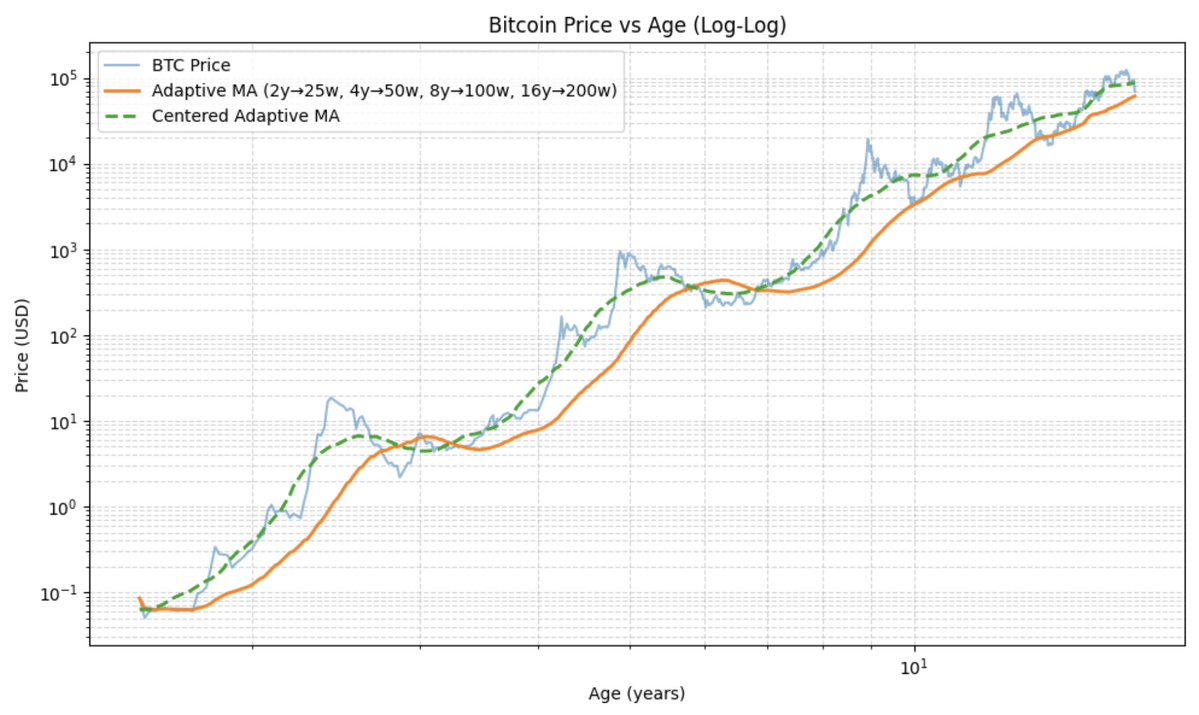
The first three tops of either the trailing adaptive MA or the centered adaptive MA are roughly equally spaced in log age. The adaptive MA uses a longer and longer window (see legend) that grows linearly with Bitcoin age. This is more appropriate than a straight 50 or 100 week or 200 week across the whole history when one is dealing with a power law asset. From this chart alone one can estimate a log-periodicity parameter λ ~ 2.0. The duration between major fundamental mode waves/bubbles doubles in linear years from one to the next. 2021 was a first harmonic event (intermediate), not fundamental. A cadence of ages around 2.5, 5, 10, 20 roughly for the dashed green line peaks. Smaller waves are from harmonics. We could see upward bias extending through 2028 into 2029. If I had to pull a date out of a hat for max. log periodic uplift it would be April 2029. Watch the next Physics of Bitcoin show live 8 April 7:15 PM PDT. @ScientificBTC
moneyordebt ∞/21M tweet media
English
3
1
48
3.3K
Scientific Bitcoin Institute ری ٹویٹ کیا
moneyordebt ∞/21M
moneyordebt ∞/21M@moneyordebt·
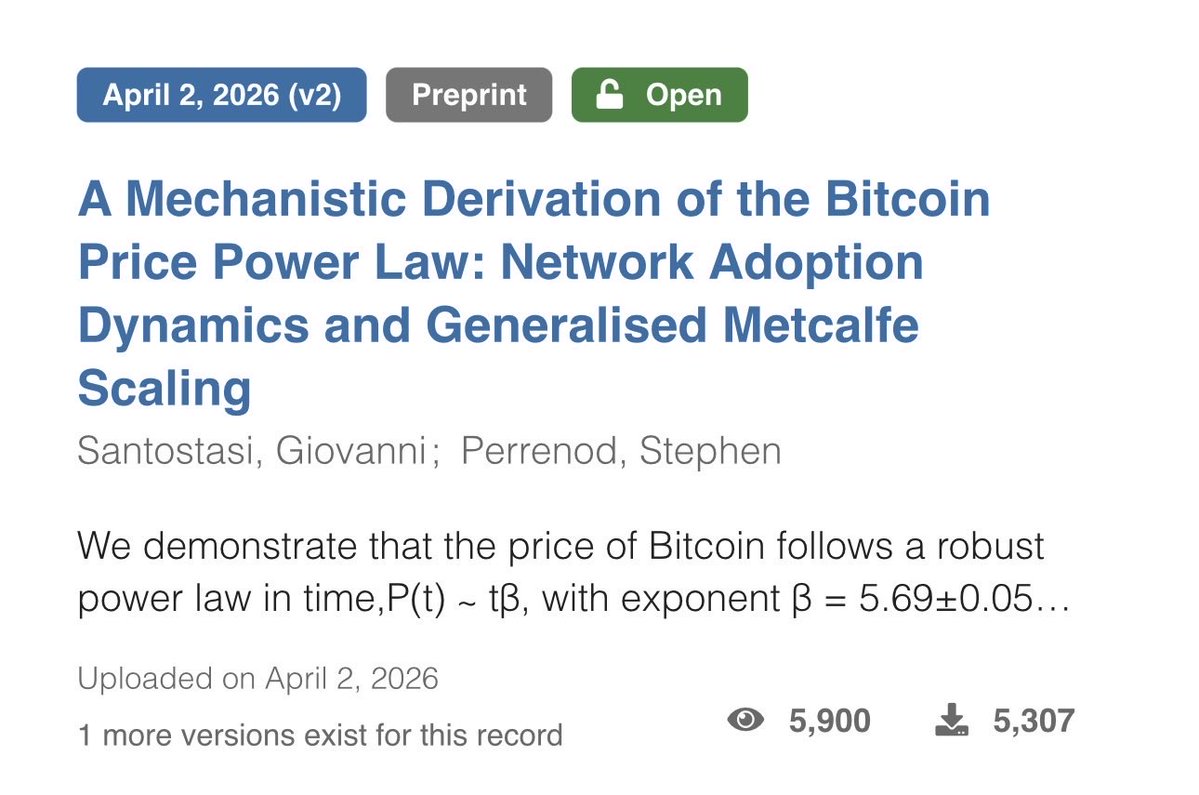
The distribution is very power law tail: Median Zenodo paper: ~10–100 downloads •Average (mean): ~100–300 •Well-performing niche paper: ~500–2,000 •Top-tier viral artifact: 10k+ 5300 downloads for this one in the first week. @ScientificBTC
moneyordebt ∞/21M tweet media
English
3
12
66
10.1K
Scientific Bitcoin Institute
Scientific Bitcoin Institute@ScientificBTC·
Here is a new new paper by Giovanni and Stephen. BTC's price follows a stable power law, not as a fit but from its network diffusion and Metcalfe value scaling. Combined, they explain long-term price dynamics, with cycles as noise around the trend. zenodo.org/records/193870…
English
1
2
9
302
Scientific Bitcoin Institute ری ٹویٹ کیا
Giovanni's BTC_POWER_LAW
Giovanni's BTC_POWER_LAW@Giovann35084111·
Finding the Right Way to Look at Things This animation shows two parallel journeys: Bitcoin's price over 15 years (top) and Mars's motion through space (bottom). They illustrate the same principle: choosing the right perspective transforms complexity into simplicity. The planetary motion: The red dot is Mars. The blue line traces where it's been. When our observer sits on Earth's orbit, Mars appears to loop backward—the famous "epicycles" that puzzled ancient astronomers. These aren't illusions; this is what you genuinely see from Earth's moving reference frame. As the green circle shrinks, we move our observer toward the Sun. The loops gradually unwind. At the Sun's center, Mars traces a simple ellipse. Same planet, same motion, different viewpoint. The complexity wasn't in Mars—it was in where we stood. Bitcoin's price: We're doing the exact same thing with mathematics instead of physical position. The transformation P^(1/k) moves us through different mathematical "viewpoints." At k=1 (normal space), Bitcoin looks curved and complicated. At k=5.8, it becomes nearly perfectly linear with R²=0.95. We've found the mathematical equivalent of the heliocentric view. Why these are the same: Both are about finding the natural coordinate system for what you're studying. Copernicus didn't change how planets move—he changed where we measure from. Astronomers had added epicycle upon epicycle to match observations. His insight: measure from the Sun, and the complexity vanishes. The complication wasn't in the heavens—it was in the reference frame. Bitcoin's power law works identically. In linear space, growth looks chaotic. Take logarithms of both axes—the mathematical equivalent of changing reference frames—and you find a straight line that's held for 15 years. The pattern was always there. We just needed the right coordinates to see it. The deep insight: Natural phenomena often have a "preferred" way of being described—a reference frame where their governing rules become simple. Finding that space isn't curve-fitting; it's discovering the symmetry. For planetary motion, the symmetry is in heliocentric coordinates. For Bitcoin, it's scale invariance—the pattern looks the same whether you zoom in or out, and log-log is the natural language for that self-similarity. This is why "affine reduction" matters: An affine space is where things become linear. Finding it isn't about forcing data to fit a model—it's discovering which perspective reveals the underlying physics. For Mars: heliocentric coordinates. For Bitcoin: log-log space (or P^(1/5.8)). Both answer the same question: "From what viewpoint is this behavior simple?" Ancient astronomers spent centuries building elaborate epicycle models because they asked the wrong question. They tried to make data fit their reference frame instead of finding the reference frame that fits the physics. We make the same mistake in finance when we fit the wrong curves to power law data. The animation is a reminder: sometimes the complexity you see isn't real. Sometimes it's just a sign you haven't found the right way to look.
English
6
7
46
4.1K
Scientific Bitcoin Institute ری ٹویٹ کیا
Giovanni's BTC_POWER_LAW
Giovanni's BTC_POWER_LAW@Giovann35084111·
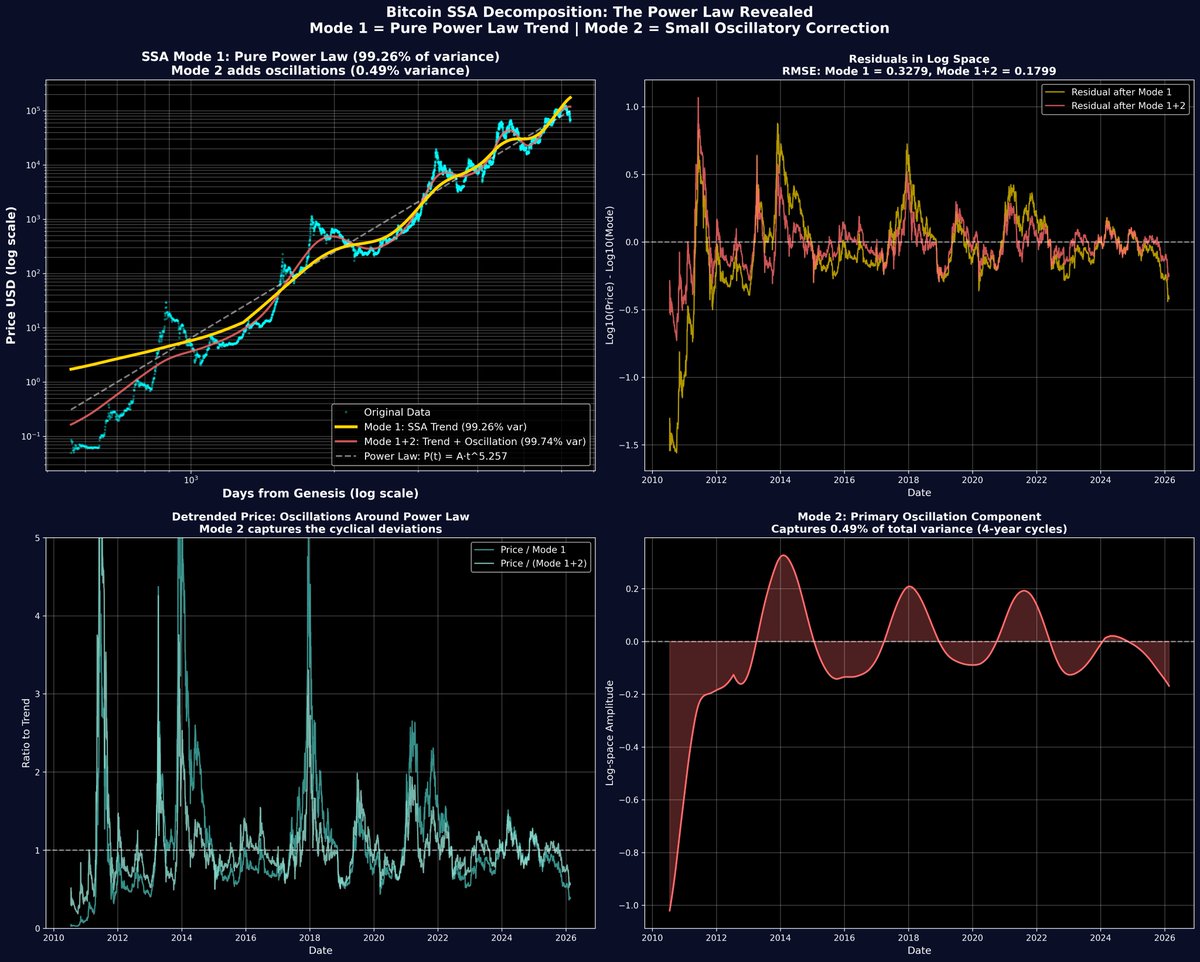
The power law is found by regression but regression is not the end of the story at all. We have said this many times. Regression Says: "I assumed a power law, fit the parameters, and got R² = 0.951" Criticism: "Of course you got a good fit - you can fit almost anything to a power law over a limited range. It's just curve-fitting." SSA Says: "I made NO assumptions about functional form. I decomposed the data into its natural modes. ONE mode dominates (99.26%), and that mode IS a power law." This is fundamentally different. Key Advantages of SSA Over Regression: 1. Model-Free Discovery Regression: You assume P(t) = A·t^β You fit A and β You hope the assumption was right SSA: You assume nothing about functional form The data decomposes itself into eigenmodes Mode 1 emerges as dominant Then you discover Mode 1 is a power law Why it matters: SSA discovers the power law FROM the data, not by imposing it ON the data. 2. Variance Decomposition Regression R² = 0.951 tells you: "My model explains 95.1% of variance" But you don't know HOW variance is distributed Is it 50% trend + 45% cycles? Or 95% trend + 0.1% cycles? SSA tells you EXACTLY: Mode 1 (trend): 99.26% Mode 2 (oscillation): 0.49% Mode 3-10: <0.12% each Noise: <0.13% Why it matters: You can see that Bitcoin is dominated by a single mode, not a complex multi-modal system.
Giovanni's BTC_POWER_LAW tweet media
English
2
4
46
3.6K
Scientific Bitcoin Institute ری ٹویٹ کیا
Giovanni's BTC_POWER_LAW
Giovanni's BTC_POWER_LAW@Giovann35084111·
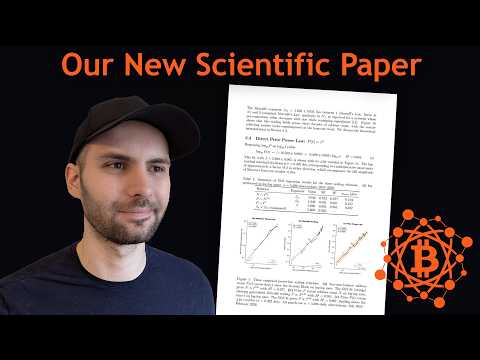
This video introduces the Scientific Bitcoin Institute (SBI) Manifesto and outlines its mission and vision. Please take a moment to watch it—and if you find it valuable, like the video and subscribe to the channel to support the initiative. The Institute’s goal is ambitious but necessary: to advance Bitcoin’s understanding and acceptance within the broader community, from academia to policymakers, and ultimately at the nation-state level. SBI aims to establish Bitcoin not just as an asset, but as a serious subject of scientific study and a foundational socio-technological-economic experiment built from first principles. A significant amount of thought, research, and effort went into both the creation of the Institute and this video. It represents the beginning of a long-term project to bring rigor, clarity, and credibility to the study of Bitcoin. Thank you for your support. Link in the comments.
Giovanni's BTC_POWER_LAW tweet media
English
4
11
68
4.6K
Scientific Bitcoin Institute ری ٹویٹ کیا
moneyordebt ∞/21M
moneyordebt ∞/21M@moneyordebt·
In terms of Bitcoin’s scale invariance : •early: fit k, •mid: determine λ •late: ask why C = k * ln λ stabilizes k: power law λ: log-periodic spacing C: hidden variable (renormalization coupling) “That shift looks like philosophy—but it’s actually physics at its most general level”
Physics In History@PhysInHistory

"I am now convinced that theoretical physics is actually philosophy." - Max Born

English
0
2
24
3.6K
Scientific Bitcoin Institute
Scientific Bitcoin Institute@ScientificBTC·
Scale invariance is one of the core characteristics of a power law. This is why bitcoin's price trajectory can still be predicted, despite the market cap being orders of magnitude higher than before. Watch this video to learn more: youtu.be/eJ8iWqi4u9Y
YouTube video
YouTube
Scientific Bitcoin Institute tweet media
English
0
0
3
149
Scientific Bitcoin Institute ری ٹویٹ کیا
Giovanni's BTC_POWER_LAW
Giovanni's BTC_POWER_LAW@Giovann35084111·
Is the Bitcoin bottom in August?
Giovanni's BTC_POWER_LAW tweet media
English
17
8
127
12.3K