SP

9.9K posts

SP

SP

@ShPari3

India شامل ہوئے Mart 2018
5.3K فالونگ146 فالوورز
SP ری ٹویٹ کیا
Iran Embassy in Zimbabwe
Iran Embassy in Zimbabwe@IRANinZIMBABWE·
Not sure anyone read all of it yet. Does it have anything to do with us?
Iran Embassy in Zimbabwe tweet media
English
2K
5.1K
44.5K
1.7M
SP ری ٹویٹ کیا
Mr. Paradox
Mr. Paradox@HunterH545593·
Tractor India Limited (TIL) Made in india truck-mounted crane🇮🇳
Mr. Paradox tweet mediaMr. Paradox tweet mediaMr. Paradox tweet mediaMr. Paradox tweet media
English
20
183
1.6K
50.7K
SP ری ٹویٹ کیا
VaR
VaR@Vedansh_Ag·
TIL Product Portfolio - 2/2
VaR tweet mediaVaR tweet mediaVaR tweet mediaVaR tweet media
Dansk
1
1
6
7.2K
SP ری ٹویٹ کیا
VaR
VaR@Vedansh_Ag·
Why I think this is THE company to play - India's #Infrastructure Story India's #Defense Story & India's #Export Story , All together ! 🧵
English
30
98
542
208.1K
SP ری ٹویٹ کیا
Old England in Colour
Old England in Colour@englandincolour·
Esso Hibernia tanker under construction in Wallsend, 1970.
Old England in Colour tweet media
English
66
764
9.8K
794K
SP ری ٹویٹ کیا
SP ری ٹویٹ کیا
SP
SP@ShPari3·
@Jhunjhunuwala_ This is good and Modi effect has been visible but major goal should be to reach atleast 6k per capita by 2032
English
0
0
1
144
Anurag
Anurag@Jhunjhunuwala_·
> Be India, year 2000 > World growth is a steady 3.4% > India contributes 6.2% to global growth > Not bad, setting the stage > Enter 2004–2013: The "MMS Era" > Global economy is absolutely booming at 4.4% growth > "Easy Mode" enabled for everyone on Earth > India’s contribution? Only 7.4% > Historical myth: "India was an economic titan then" > Reality: We were just NPCs riding a massive global wave > Call it what it is: The Lost Decade > Failed to lead when the world was handing out growth for free > Enter 2014–Present: The Shift > Global growth slows down to 3.6% > The world is struggling, "Easy Mode" is over > India’s contribution? Jumps to 14.1% average > Literally doubled our global impact compared to the previous era > We aren't riding the tide anymore > We are the tide that pushing the global growth > Look at the numbers today > India is 17.5% of the world's population > India is now contributing 17.7% of world growth > First time in modern history we contribute more than our population share > Doing all this at only $3k per capita > Efficiency is through the roof > A civilizational gear shift is happening in real-time > Look toward 2030 > India projected to add 1/5th (20%) of all global growth acc to IMF Take the white pill, anon, and realize that we are not at the table, we are the table.
The Indian Matrix@indianmatrix

India's Contribution To World GDP Growth (2000-2026)

English
44
471
2K
132.5K
SP ری ٹویٹ کیا
Kushan Mitra
Kushan Mitra@kushanmitra·
I have been fortunate enough to visit several car manufacturing facilities over the years. Recently, I was invited by @VinFastofficial to visit their state-of-the-art factory at hai Phong, Vietnam. This short video showcases the body+weld shop and the final assembly line as well as the process of attaching the battery pack to the body of the car. The main vehicles being made are the newly launched VF MPV7 and the VF5 SUV.
English
1
4
30
5.1K
SP ری ٹویٹ کیا
Tim Draper
Tim Draper@TimDraper·
This is my friend Surbhi Sarna. She came to Draper University in 2012. She had painful ovarian cysts as a teenager, but doctors didn’t have tools that could detect cancer without harming the ovaries. She studied molecular biology at UC Berkeley. Then came to DU. Then she built nVision around a fiber optic line product that could go up the fallopian tubes to detect cancer without harming the ovaries. Her medical device got FDA approval and nVision sold for $275 million to Boston Scientific. 200,000 women worldwide die each year from ovarian cancer. Early diagnosis by nVision can save many of these lives. Incredibly proud to have invested in Surbhi, her mission and her product. She is one of the poster star heroes from Draper University and we will always be grateful.
Tim Draper tweet media
English
92
806
4.3K
194.9K
SP ری ٹویٹ کیا
Mario Nawfal
Mario Nawfal@MarioNawfal·
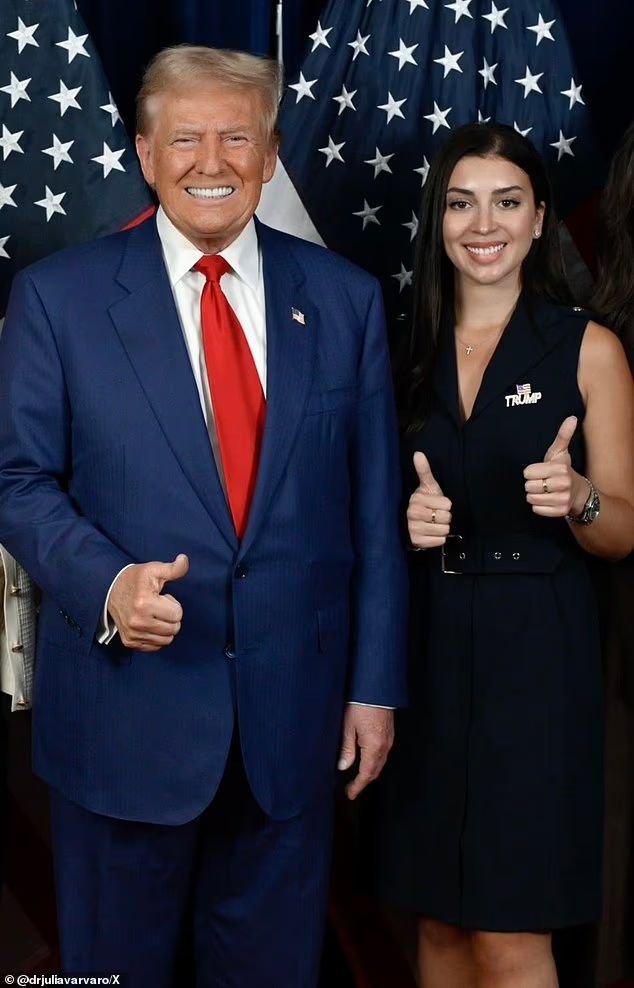
🇺🇸 A top counterterrorism official in the Trump admin is under investigation… for seeking out sugar daddies The complaint goes as follows: a man says he spent $40K on Julia Varvaro, the Deputy Assistant Secretary for Counterterrorism, in just 3 months. Aruba. The Italian Riviera. The Swiss Alps. Milan. A $3,500 Bottega bag. Cartier jewelry. Half her rent. Allegedly, the two met on Hinge and had a very expensive 3-month fling. In texts, she called herself "boss princess" and told him she was "above being tested" when he warned her about drug use risking her clearance. She allegedly had a profile on sugar daddy site Seeking under the name "Alessia," and claimed her jewelry was "trophies from sugar daddies" who also paid for her education. Varvaro says she did nothing wrong and this is "just a mad ex-boyfriend putting crap together.” The woman in charge of keeping Americans safe from terrorists is a 29-year-old sugar baby. Ok then… Source: Daily Mail
Mario Nawfal tweet mediaMario Nawfal tweet mediaMario Nawfal tweet mediaMario Nawfal tweet media
English
455
772
4K
1.4M
SP ری ٹویٹ کیا
Normal Guy
Normal Guy@Normal_2610·
Gandhi didn't miss industrialization, he saw it and rejected it on purpose. Called it violent, exploitative, soul-destroying Wanted self-sufficient villages running on spinning wheels and cottage crafts. Nehru disagreed but picked the Soviet model over the British one sitting right in front of him. State-owned steel plants instead of private factories. Import substitution instead of exports. Consumer goods reserved for tiny firms by law. India's founders didn't lack exposure to industry. They had an ideological allergy to letting private capital run it freely. Japan sent the Iwakura Mission in 1871 - senior leaders touring factories, shipyards, railways across Europe and America. Came back, killed the feudal system, sold government factories to private entrepreneurs at throwaway prices. India London-educated leaders came back with law degrees and political philosophy, not engineering blueprints. Japan had no natural resources, no London connections, no English language. India had all three. The difference was intent. Japan studied the West to copy its production systems. India studied the West to argue against its political systems. The irony is Nehru did try to industrialize, He built Bhilai, BHEL, massive public sector units. But he also capped private firms, banned foreign companies, reserved consumer goods for village-scale production by law. IBM and Coca-Cola were kicked out. Large firms needed a license to expand. So India got steel mills but no consumer economy around them. Japan and Korea let private firms grow, compete, export. India gave its private sector a cage and called it self-reliance. The vision existed. The execution strangled it. China early cabinets were full of engineers. India were full of lawyers. The training shapes what you even notice. A lawyer in London sees Parliament. An engineer sees the underground railway. India founders saw Parliament. Kanpur is the proof that India didn't just miss industrialization, it actively destroyed what existed. The city was called Manchester of the East. Textiles, leather, ordnance, all running before independence. Then came nationalization in the 1970s, and the mills started dying. Elgin Mills, Lal Imli blankets, all gone, 140 leather tanneries shut in five years. A city that employed a million workers in leather alone now can't fill orders for Hong Kong fairs. India didn't lack industrial DNA. Policy just killed it. The population argument doesn't hold up either. Delhi in 1900 had 400k people, London had 6.5 million, sure. But Tokyo was small too when Japan started industrializing in 1868. The Meiji government didn't wait for cities to get big they built railways, telegraph lines, factories, and the cities grew around them. Industrialization creates urban centers. Urban centers don't create industrialization. India's leaders treated cities as a problem to manage instead of engines to build around. That sequencing error cost decades. I called it the whole OS is running on 1990 update Well, I not know this much in details, did some Research :)
sphinx@protosphinx

London had an underground railway in 1863. The first electric underground railway was built in 1891. Under-freaking-ground. In 1891. Gandhi (later Nehru and all freedom-fighting stalwarts) studied in London during that era. Surely they would have seen this underground railway but it’s surprising none of them said we should have a culture that builds this kind of thing in India when it’s free. Like how do you see an underground freaking railway in 18 freaking 91 and not get mesmerized by grand miracles of industrialization ? The one thing driving London during that era was industrialization. And yet they didn’t connect the two ? Japanese got that. You didn’t ? Like what was the grand plan ? Let’s free this country and turn it into a massive village ? That the country should have crooked, unplanned roads in cities 100 years after independence ? That the might of train engines should never be produced, and that no modern train engine, car engine or any modern industrial design should come out of the country ever ? To import every single thing from a neighbor that got to industrialization on its own despite not having any London-educated founding members ? Honestly what even was their vision for the country ? The masses are uneducated I get that. But the leaders didn’t have eyes ? They were right there in London! What was the option - to not be industrialized ? Rural economy forever ? Shitty cities ? Questions are rhetorical.


English
63
443
1.8K
120.9K
SP ری ٹویٹ کیا
Aditya Kondawar
Aditya Kondawar@aditya_kondawar·
L&T is such a fascinating company Makes everything from Data Centres to Metros to Nuclear Reactors to Tanks In fact, L&T has contributed to all 22 Nuclear reactors operational in India no reco
English
54
431
6.2K
97.5K