

stock slock
9.8K posts
@MAGA_X_Times Oh my goodness, my heart is broken.
Please lord help this young lady.
Those sons of bitches, we have get this fixed man.
English

Minnetonka, Minnesota
Meet Janelle Hansen (Skye) an autistic adult female has been evicted from her home because Jama Mohamod stopped paying rent on her apartment and has been homeless for eight months, Mohamod raked in $2.2 million in Medicaid money lived in a luxurious mansion complete with indoor basketball court and the kicker is no charges wherever filed against him, sounds about right for Hennepin County, Minnesota🤬
Aside from the victimization of the American taxpayer there are real life consequences to the actions of these Somali PIRATES🤬
English
@rnelson0 @MoonStomper973 @DudespostingWs More like fooled the batter with a great pitch, but lobbed it works, too. I hated throwing a knuckleball, watching the batter flail at it, and then seeing him on first base. (You can tell who were pitchers and who were batters by this divide in opinion.)😆
GIF
English

@SlockStock @MoonStomper973 @DudespostingWs You mean you don’t like rewarding the pitcher who lobbed it into the dirt?
English

This might be the craziest way to win a state championship.
The kid struck out, but the pitch hit the dirt and nobody threw to first because the other team thought the game was over.
While they were celebrating, the runners kept going...
English
@markfrigsby @DudespostingWs Exactly: Antiquated. Derived from British cricket and when catchers, with no protective gear and standing 20 feet behind home plate, had to catch the ball on the bounce.
(4-pitch intentional walks and 19-inning extra-inning games had also been around for 100 years.)
English

@SlockStock @DudespostingWs Agreed...but that has been the rule for about 150 years.
English
English

@IGolfDoU @MatthewTru54148 @DudespostingWs 3. Cricket Influence: Early American baseball was loosely based on cricket, where the batter is technically always allowed to run, but hitting the ball makes it easier.
English
@IGolfDoU @MatthewTru54148 @DudespostingWs 2. The "Fair Ball" Analogy: Founders viewed a missed swing (strike 3) that wasn't caught as a "fair ball" (like a grounder). Because catchers in the 1800s had no protective gear and stood far back, catching the ball on a bounce was typical, and it was treated like a live ball.
English
@IGolfDoU @MatthewTru54148 @DudespostingWs Maybe something to do with this:
"Early Days: Before protective gear, catchers sometimes stood 20–25 feet behind the batter rather than right behind the plate."
English
@SlockStock @MatthewTru54148 @DudespostingWs Not sure why but that has always been the rule. Why? I have no idea
English
@MatthewTru54148 @IGolfDoU @DudespostingWs I think everyone understands what happened, and it was an exciting play, I just don't like the rule. I think once it crosses the plate for a 3rd strike (swinging/called), the batter is out. If the pitcher can get the batter to swing a horrible pitch, all the better.
English

@IGolfDoU @SlockStock @DudespostingWs Not on a drop 3rd and 1st has to be unoccupied as it wasn't. Hence why the runs counted.
English
@IGolfDoU @MatthewTru54148 @DudespostingWs I got you. But with less than two outs, if the "play is over," why should the batter be afforded the chance to run to 1st when it is the 3rd out? I am questioning the logic, not the rule.
English
@MatthewTru54148 @SlockStock @DudespostingWs I think you misunderstood what I was trying to say. Because there were already 2 outs, the batter can still run to 1B on a dropped 3rd strike, whether there was a runner on 1B or not
English
@TruthNRP @MatthewSHarriso @DudespostingWs Agreed. My point is on strike 3 (called or missed), the batter should lose the right to be a baserunner, just as he does when 1st base is occupied.
English

@SlockStock @MatthewSHarriso @DudespostingWs As soon as the ball hits the ground the batter becomes a baserunner. The ball can only be declared “foul” after contact with the bat. Which is why on 3rd strike a foul tip into the catchers is called out. Because the ball was caught.
English
stock slock ری ٹویٹ کیا

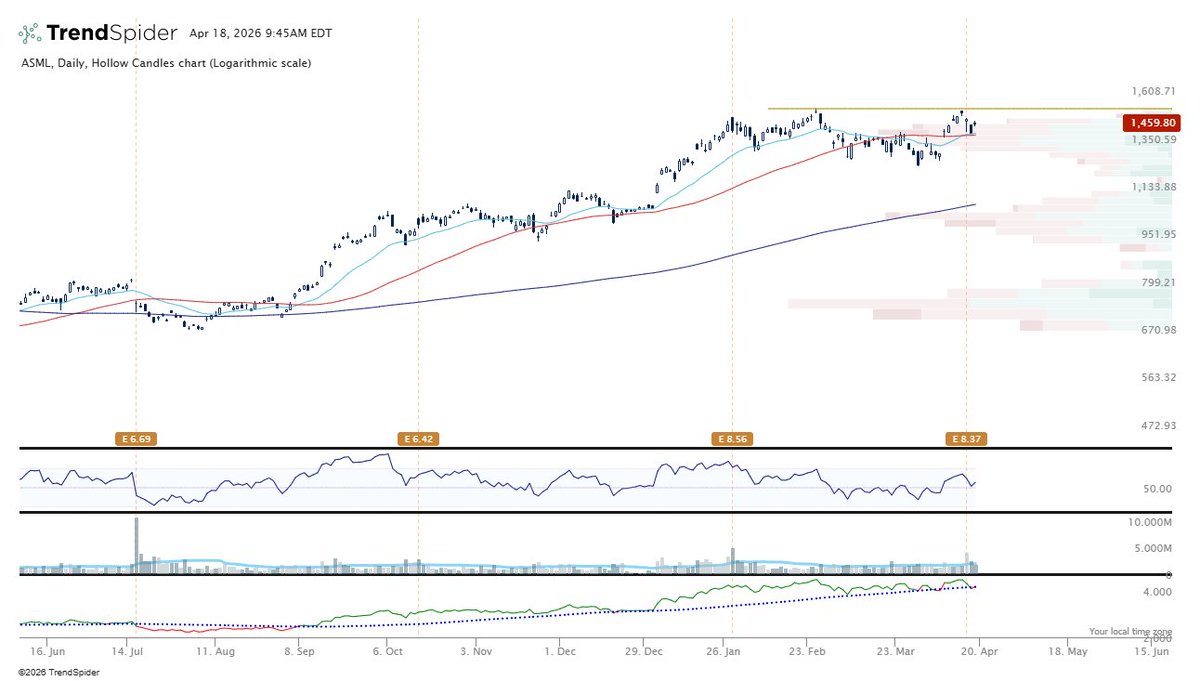
$ASML like the way this is setting up. Earnings out of the way too
English
stock slock ری ٹویٹ کیا

@TruthNRP @MatthewSHarriso @DudespostingWs There is no misplay (on the batter, at least). The ball. although live, is in foul territory. Once the ball passes the bat or is called a strike, the batter "should be" out. Baserunners can advance at their own discretion.
GIF
English
@SlockStock @MatthewSHarriso @DudespostingWs You’re not being rewarded for swinging at a garbage pitch you’re taking advantage of a defensive misplay.
The ball is always live unless it’s declared a dead ball by the umpires (foul balls, ground rule doubles, thrown out of play etc)
English
@iceauger62 @DudespostingWs Agreed. I just don't like the rule.
English

@SlockStock @DudespostingWs Bro they add Drop 3rd strike in 10u baseball.
There is no one on that field who should have been surprised by this outcome at all
English
@MoonStomper973 @DudespostingWs Does add some spice, no doubt about that. I just don't like rewarding this guy.
GIF
English

@SlockStock @DudespostingWs I like it, adds some spice
English
@loushka111 @AmericanFinn @DudespostingWs You're supposed to say I was a former pitcher and I agree with you, but I hope your surgery went well. Get the breast implants, too?
English

English
@PapaBearTG @DudespostingWs I know it's a rule! Just a silly one, in my opinion. This batter should not be rewarded on a strike 3.
GIF
English

@jameslucier @MatthewSHarriso @DudespostingWs Play should be finished once the batter swings and misses (or doesn't swing on a called strike). A great pitch should not be treated similar to an error in the field giving the batter an extra chance.
GIF
English

@SlockStock @MatthewSHarriso @DudespostingWs You have to finish the play. If you don’t catch the strike the batter is still live, similar to a wild pitch.
English
stock slock ری ٹویٹ کیا

Cash for Clunkers destroyed 690,000 functional vehicles in 2009, creating an artificial scarcity that rippled through used car markets for over a decade. The Obama administration sold this $3 billion program as environmental salvation and economic stimulus, but any free market economist could predict the real outcome: massive wealth destruction disguised as progress.
The program forced dealers to pour sodium silicate into engines, permanently destroying cars that poor families could have afforded. Politicians eliminated the bottom tier of the used car market overnight. Suddenly, a reliable $3,000 Honda Civic became a $7,000 Honda Civic (if you could find one). The supposed beneficiaries — working-class Americans who needed affordable transportation — got priced out entirely.
Government intervention always creates unseen victims, and Cash for Clunkers delivered them by the millions. Single mothers, college students, and minimum-wage workers watched their mobility options vanish as used car prices soared 30% between 2009 and 2014. The environmental gains proved negligible too: most clunkers averaged 15-17 MPG while replacements hit 24-25 MPG. Destroying half a million cars to improve average fuel economy by 8 MPG represents the kind of central planning that would give Soviet bureaucrats a hard-on.
The wealth destruction extended beyond sticker prices. Higher transportation costs forced people into longer payment terms, creating a debt cycle that persists today. Cash for Clunkers normalized 84-month auto loans, turning cars from depreciating assets into multi-year financial anchors.
Bureaucrats congratulated themselves for moving inventory off dealer lots while condemning an entire generation to transportation poverty.

English