Timoon from the blocks

3.9K posts

Timoon from the blocks banner
Timoon from the blocks

Timoon from the blocks

@Timoon21

شامل ہوئے Mayıs 2021
719 فالونگ573 فالوورز
Kouga
Kouga@Kougamet·
Do you believe Solana will hit a new ATH this year ?
English
6
0
8
342
Timoon from the blocks ری ٹویٹ کیا
Solana
Solana@solana·
2025 was a banger
English
622
541
2.5K
385.7K
Timoon from the blocks ری ٹویٹ کیا
Hunter Horsley
Hunter Horsley@HHorsley·
Pessimists sound smart. Optimists make money. Onward —
Haseeb >|<@hosseeb

In Defense of Exponentials I used to tell founders, the reaction you are going to get to your launch is not hate, it’s indifference. By default, nobody cares about your new chain. I have to stop telling them that now. Monad just launched this week, and I’ve never seen so much hate about a blockchain that just launched. I’ve been investing into crypto professionally for 7+ years now. Before 2023, almost every chain I’ve ever seen that launched was mostly met with enthusiasm or indifference. But now, new chains are born into a chorus of hate. The amount of haters I’ve seen for projects like Monad, Tempo, MegaETH—before they even hit mainnet—is a genuinely new phenomenon. I’ve been trying to diagnose: why is this happening now, and what does it mean about the psychology of this market? The Cure is Worse than the Disease Forewarning: this is going to be the vaguest blockchain valuation post you ever read. I don’t have any fancy metrics or charts to sell you on. Instead, I’ll be arguing against the zeitgeist of Crypto Twitter, which for the last couple of years, I’ve been constantly on the opposite side of. In 2024, I felt like what I was arguing against was financial nihilism. Financial nihilism is the belief that none of these assets matter, it’s all memes at the end of the day, and everything we’ve built is inherently worthless. Thankfully, that’s no longer the vibe. We have broken out of that spell. But the zeitgeist now is what I’d call financial cynicism: OK, maybe some of this stuff has value, maybe it’s not all memes, but it’s grossly overvalued and it’s only a matter of time before Wall Street finds that out. Not that all chains are worthless. But these things are all maybe worth 1/5th-1/10th of what they’re currently trading at (have you seen these PE ratios?), and so you’d better pray like hell Wall Street doesn’t call us on our bluff, because once they do it’s all getting wiped out. You’ve got many bullish analysts now trying to conjure up optimistic L1 valuation models, inflating PE ratios, gross margins, DCFs, trying to fight against this mood. Late last year, Solana very proudly embraced REV as a metric that could finally justify their valuation. They proudly announced: we—and only we—are no longer bluffing to Wall Street! And, of course, almost immediately after REV was embraced, it fell off a cliff (though $SOL, tellingly, did better than REV did). Not that there’s anything wrong with REV. REV is a very clever metric. But the point of this post is not metric selection. Then came the launch of Hyperliquid. A DEX that had real revenue and buybacks and PE multiples. And the chorus said—look, look I told you! Finally, for the first time ever, a token that has some real profits and a proper PE multiple. (Nevermind BNB, we don’t talk about that.) Hyperliquid will eat everything because obviously Ethereum and Solana don’t make any real money, we can stop pretending to value them now. Hyperliquid, Pump, Sky, these buyback-heavy tokens are all great. But the market always had the ability to invest into exchanges. You could always buy Coinbase, or BNB, or whatever. We own $HYPE, and I agree that it’s a fantastic product. But that’s not why people were investing in ETH and SOL. The fact that L1s don't have exchange-like profit margins is not why people were buying them—if they wanted that, they could’ve bought Coinbase stock. So if I’m not critiquing blockchain financial metrics, maybe you think this post is going to be chiding the sinfulness of the token-industrial complex. Obviously, everyone has lost money on tokens in the last year, VCs included. Alts are down bad this year. And so the other half of the zeitgeist on CT is arguing about who's to blame. Who’s become greedy? Are the VCs greedy? Is Wintermute greedy? Is Binance greedy? Are the farmers greedy? Are the founders greedy? The answer, of course, is the same as it’s ever been. Everyone is greedy. Everyone. The VCs, Wintermute, the farmers, Binance, the KOLs, they're all greedy, and you are greedy too. But it doesn't matter. Because no functioning market has ever required anyone to act against their self-interest. If we're right about crypto, we can all be greedy and the investments will still work out. Trying to analyze a market that has gone down by figuring out “who’s greedy” is going to be about as fruitful as commissioning witch trials. I guarantee you, nobody just started being greedy in 2025. So this, too, is not what I’m going to be writing about. Many people want me to write a post about why $MON should be valued at X or $MEGA at Y. I’m not interested in writing this post, or advocating that you buy anything in particular. In fact, you probably shouldn’t buy any of them if you don’t already believe in them. Will any new challenger chain win? Who knows. But if it has a material chance of winning, it's going to be priced on that basis. If Ethereum is worth $300B or Solana is worth $80B, a project that has a 1-5% chance of becoming the next Ethereum or Solana will be priced according to those probabilities. Somehow CT is scandalized by this, but it’s no different than Biotech. A drug that has less than a 10% chance of curing Alzheimer's is priced by the market as worth billions of dollars, even if 90% chance it won’t pass stage 3 trials and will go to 0. That's how the math works—and turns out, markets are pretty good at doing math. Binary outcomes are priced on probabilities, not on run rates or moral turpitude. It’s the “shut up and calculate” school of valuation. I really don’t think that’s an interesting question to write about. “5% chance to win? No way, that’s clearly a 10% chance!” Markets, not articles, are the best way to assess that for any individual token. So here’s what I am going to write about: CT doesn't seem to believe anymore that chains are valuable. I don’t think this is because they don’t believe new chains can win market share. We just saw Solana dominate market share after emerging from the ashes less than 2 years ago. It’s not easy, but of course it’s possible. It’s more that people have come to believe that even if a new chain wins, there’s no prize worth winning. If $ETH is just a meme, if it’ll never generate real revenue, then even if you win, you won’t be worth $300B. The contest is not worth winning, because these valuations are all bunk and it’ll all come crashing down before you go to claim your prize. Being optimistic about chain valuations has become passé. Not that nobody is optimistic—obviously there must be optimists out there. For every seller there’s a buyer, and as much as CT cool kids love to drag L1s, people are comfortable buying SOL at $140, ETH at $3000. But there’s a perception now that all the smartest people are over buying smart contract chains. Smart people know the jig is up. If not now, then soon. The only people buying here are suckers—Uber drivers, Tom Lee, and KOLs who say stuff like “trillions.” And maybe the US Treasury. But not the smart money. This is bullshit. I don’t believe it, and you shouldn’t either. So I felt like I had to write a smart person’s manifesto on why general purpose chains are valuable. This post is not about Monad or MegaETH. It’s really in defense of ETH and SOL. Because if you believe ETH and SOL are valuable, the rest is straight downstream. Defending ETH and SOL valuations is generally not my job as a VC, but fuck it, if nobody else is willing to do it, then I’ll write it. Feeling the Exponential My partner Bo experienced the Chinese Internet boom first-hand as a VC. I’ve heard how “crypto is like the Internet” so many times now that it doesn’t even register for me anymore. But when I hear his stories, it always reminds me how costly it is to be wrong about these things. A story he often tells is about when all the early e-commerce VCs (it was a small group back then) got together for coffee in the early 2000s. They debated: how big is the market for e-commerce going to be? Is it going to be mostly electronics (maybe only techies will use PCs)? Could it ever work for women (perhaps they’re too tactile)? What about food (maybe impossible to manage perishables)? These were deeply important questions for early VCs to decide what to invest in and what prices to pay. The answer, of course, was that literally every single one of them was devastatingly wrong. E-commerce would sell everything, and the target audience was the whole fucking world. But nobody at the time actually believed it. And even if they did, it would be too absurd to say out loud. You just had to wait long enough for the exponential to show you. Even among the believers, very few thought e-commerce would become as big as it became. And those few who did, almost all of them became billionaires from just not selling. Every other VC—as Bo tells me, since he was one of them—sold too early. It has become passé in crypto to believe in the exponential. I believe in the crypto exponential. Because I’ve lived it. When I started in crypto, nobody used this stuff. It was tiny and broken and awful. TVL on-chain was in the millions. We invested into the first generation of DeFi, MakerDAO, Compound, 1inch, back when they were science projects. I remember playing around on EtherDelta back when DEXes traded single digit millions a day, and that was considered to be a huge success. It was complete dogshit. Now we routinely trade in the tens of billions on-chain every day. I remember believing it was crazy that Tether hit a billion dollars in issuance and was being written up in the NYT as a ponzi scheme on the brink of shutdown. Now stablecoins are over $300B and regulated by the Federal Reserve. I believe in the exponential because I’ve lived it. I’ve seen it over and over again. But you might respond—well, stablecoin growth might be exponential, maybe DeFi volumes are exponential, but they don’t accrue to ETH or SOL. The value doesn’t get captured by the chains. To which I answer: you still don’t believe in the exponential. Because the exponential’s answer is always the same: it doesn’t matter. This stuff is going to be so much bigger than it is today. And when it’s absolutely enormous, you’ll make it up on scale. Study this chart. This is Amazon’s P&L from 1995 to 2019. That’s 24 years. Red is revenue, gray is profit. You see that little blip on the end where the gray line goes up? That’s when, 22 years in, Amazon started actually making a profit. Amazon was 22 years old when this little gray line of net income first peeled off of 0. Every single year before then, there were op eds and critics and short sellers claiming that Amazon was a ponzi scheme that would never make any money. Ethereum just turned 10 years old. This is what the first 10 years of Amazon stock looked like: 10 years of chop. All along the way, Amazon was beset with doubters and non-believers. Is e-commerce a VC-subsidized charity? They’re selling underpriced cheap low-quality knick-knacks to bargain hunters, who cares? How are they ever going to make actual money, like Walmart or GE? If you were arguing about Amazon’s P/E ratio, you were in the wrong regime. That’s the regime of linear growth. But e-commerce was not a linear trend, and so every single person for 22 years arguing about P/E ratios was devastatingly wrong. No matter what you paid, no matter when you bought, you were not bullish enough. Because that’s what exponentials do. When it comes to truly exponential technologies, no matter how big you think it’s going to get, it just keeps getting even bigger. This is the thing that Silicon Valley has always understood better than Wall Street. Silicon Valley was raised on exponentials, while Wall Street was raised on linearity. And over the last few years, crypto’s center of gravity has migrated from Silicon Valley to Wall Street. You can feel it. Granted, crypto growth doesn’t look as smooth as e-commerce’s growth. It’s burstier, it goes in fits and starts. This is because crypto, being about money, is deeply tied to macro forces, and it also has more violent regulatory push and pull than e-commerce. Crypto strikes at the heart of the state—money—and so it’s more unnerving to governments than e-commerce ever was. But the exponential is no less inevitable. It's a crude argument. But if crypto is exponential, then the crude argument is correct. Zoom out. Financial assets want to be free. They want to be open. They want to be interconnected. Crypto turns financial assets into file formats, makes it as easy to send a dollar or a stock as to send a PDF. Crypto makes it possible for everything to talk to everything. It makes it all 24/7, global, interconnected, and open. That will win. Open always wins. If there’s no other lesson I've learned from the Internet, it’s that. Incumbents will fight against it, governments will huff and puff, but eventually they will give up against the adoption, the generativeness, the sheer efficiency that this technology enables. It’s what the Internet did to every other industry. Blockchains are how that same trend will gobble up all of finance and money. Yes—with enough time—all of it. An old saying goes: people overestimate what can happen in two years, but they underestimate what can happen in ten. If you believe in the exponential, if you zoom out enough, then it’s all still cheap. And it should humble you that every day, the holders outlast the sellers and naysayers. Big capital has a longer time horizon than CT swing traders might lead you to believe. Big capital has been trained through history not to fade big technologies. You know, the big gushy story that originally got you to buy $ETH or $SOL? Big capital believes that story and hasn't stopped. So what exactly am I arguing? I am arguing that applying P/E ratios to smart contract chains (the “revenue meta,” as it’s now called), is giving up on the exponential. It means you have consigned this industry to the regime of linear growth. It means you believe 30 million DAUs on-chain and <1% of M2 is it. Crypto is just one of the things in the world. A sideshow. It did not win. It was not inevitable. More than anything, I’m arguing to be a believer. Not just a believer, but a long-term believer. I’m arguing that this exponential will be bigger than anything else you’ve been a part of in your life. That this is your e-commerce. That you will look back when you’re old and tell your kids—I was there when it all happened. Not everyone believed it was possible, that whole societies could change, that all of money and finance would be transformed by programs running on decentralized computers that we collectively owned. But it actually happened. It changed the world. And you were a part of it. Disclosure: These are my own views. Dragonfly is an investor in $MON, $MEGA, $ETH, $SOL, $HYPE, $SKY among many other tokens. Dragonfly believes in the exponential. This is not investment advice, but is advice of another kind.

English
24
20
253
80.7K
Timoon from the blocks ری ٹویٹ کیا
Jupiter
Jupiter@JupiterExchange·
Fresh Start Phase 2 Completed: Burning the Litterbox & Reducing the Unstaking Window We have completed Phase 2 of the JUP fresh start, which aims to align JUP strategically with the broader objective of creating the platform, community, and token to propel billions of people into DeFi. The Fresh Start is fundamentally about taking a much more strategic approach to JUP. We took a hard look at the problems around governance and the over-emphasis of DAO comms and realized that attention was being negatively averted from the great work of the team and the community. Phase 1 was all about minimizing the DAO, resetting the community, and simplifying the narrative. Phase 2 was all about voting on the Litterbox Burn of ~130m $JUP. Today we’re executing that burn, alongside reducing the unstaking window to 7 days in accordance with the feedback from token holders. Moving forward, we’re also taking a strategic approach to Jupuary, taking into account opinions from all. We’re actively designing it to vastly reduce initial emissions, greatly increase alignment for those who hold the airdrop, and focus on the core platform needs and vision of accelerating decentralization. We will continue to work through what should be doing with the ongoing 50% of revenues sent to the Litterbox. We’re also continuing to find new ways to integrate $JUP into the product suite. It already is integrated into our verification system (where Express Lane fees are burnt) and into our Metis Binary (where 10,000 staked JUP are required for access). Next, we’re going to explore more ways for JUP to be integrated into our future platforms elegantly. Through it all, we will continue to read every post - across X, the Research Forums, and Discord - to better understand what token holders want and how we can balance those desires with the needs of the project. A deep deep thank you to everyone who has already shared their ideas, and a special thank you to anyone who shares them going forward!
Jupiter tweet mediaJupiter tweet media
English
179
167
905
247K
Timoon from the blocks ری ٹویٹ کیا
mert
mert@mert·
I can hold SOL, MON, ZEC, HYPE, and Google on the same Solana wallet, and you're bearish good luck bears
mert tweet media
English
334
101
1.8K
200.6K
Timoon from the blocks ری ٹویٹ کیا
Marius | Kamino
Marius | Kamino@y2kappa·
All assets are cross chain now because bridges and propAMMs have become sufficiently good. Few understand the implications of this.
Solana@solana

MON, the native token of @monad, will list and be available to trade on Solana simultaneously or even before major exchanges 🔥

English
29
16
167
35.2K
Timoon from the blocks ری ٹویٹ کیا
Capital Markets
Capital Markets@capitalmarkets·
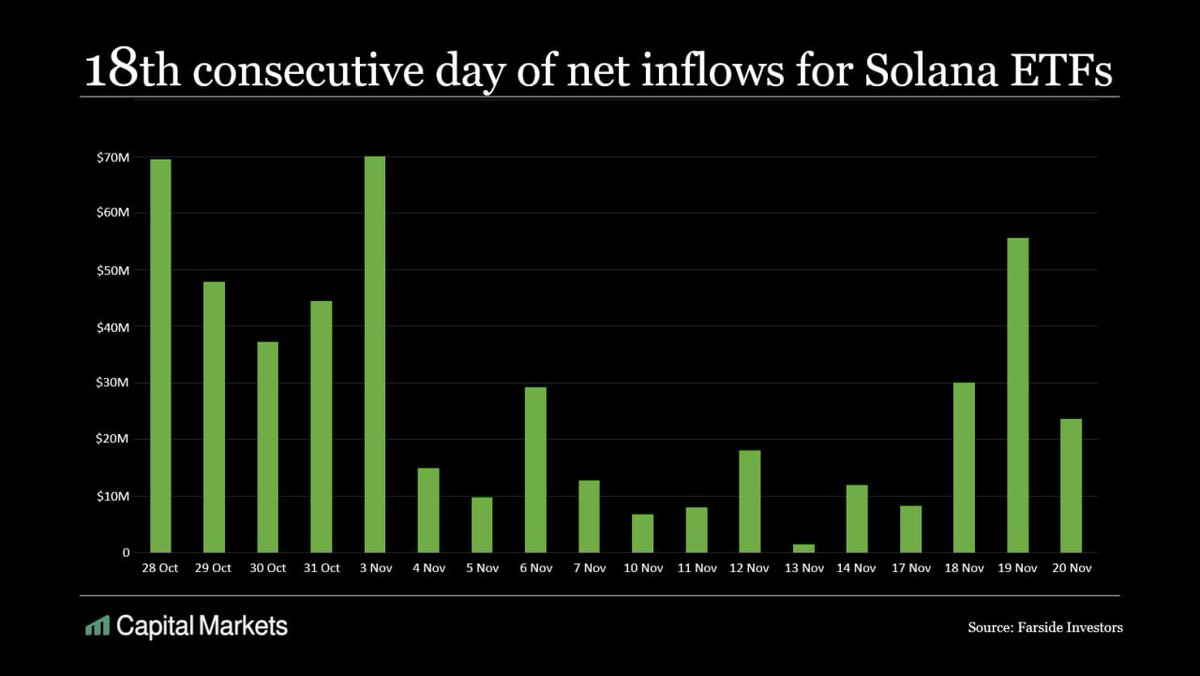
Solana ETFs just hit an 18-day streak of net inflows, as institutional buyers keep accumulating exposure.
Capital Markets tweet media
English
4
6
33
1.7K
Timoon from the blocks ری ٹویٹ کیا
Lily Liu
Lily Liu@calilyliu·
Bitcoin is internet gold Solana is internet capital markets
English
144
65
586
82.6K
Timoon from the blocks ری ٹویٹ کیا
degen poet
degen poet@solanapoet·
solana’s most valuable feature is the ability to rapidly change itself. the game keeps changing, solana does too. every meta you’re mourning was born on solana & the next one will be too. when it comes to Using a blockchain, there is only one.
English
3
1
11
446
Timoon from the blocks ری ٹویٹ کیا
Jito
Jito@jito_sol·
Job's not finished. One more hard quarter.
English
28
4
88
5.8K
Timoon from the blocks ری ٹویٹ کیا
Akshay BD
Akshay BD@akshaybd·
solana is built to give you every version of every asset in the world… not just access to ZEC, but every version of it. the network becomes the marketplace, the exchange, and the settlement layer… all fused into one system. so when zec trades on-chain, it’s not just the token. over time, it’s the: - spot asset - options - perpetuals - index baskets - structured products built on top each of these is a different expression of the same underlying idea — the value of zec — and solana’s architecture lets anyone create and trade these instantly. it’s like upgrading the financial system from a collection of walled gardens to a single programmable surface, where every derivative, synthetic, or wrapped form of an asset can exist side by side, priced and settled in real time. traditional markets silo these things — equities over here, derivatives over there, treasuries somewhere else. solana collapses that distance. everything talks to everything. that’s what “internet capital markets” really means — every version of every asset in one shared space. so when you see “solana people” talk about different assets - from zec to uranium - it is with the intention of making those available on network. SOL gets its value from increased network usage… not from memeing, bullposting and jawboning on twitter.
mert@mert

Solana now is the main decentralized venue for trading spot ZEC — tens of millions in vol two bridges to/from the chain ZEC perps also on Drift/Flash Solana will become the world's trading terminal for any and all assets with best-in-class execution

English
52
62
324
100.8K
Timoon from the blocks ری ٹویٹ کیا
Allez Labs
Allez Labs@AllezLabs·
Thanks to its smart design, INF - the LP token of @Sanctumso’s LST ecosystem - consistently delivers the highest APY among SOL LSTs, with a median of ~8.7% Beyond yield, INF plays a crucial role as shared exit liquidity for all Sanctum LSTs Still, this whale timed it well - INF only holds enough liquidity to handle this scale of unstaking ~40% of the time, meaning the pool sits below 71k SOL about 60% of the time Not ideal for potential liquidations, but optimized for yield - a delicate balance that makes INF unique 📊 Track INF composition and liquidity live on our dashboard: allez.xyz/sanctum/INF%20…
Allez Labs tweet media
James Hanley@JamesHanley

INF just processed over 71,000 SOL of withdrawals in 2 minutes, across 3 transactions. I was prepping for the coming epoch rebalance when I noticed the SOL balance inside INF dropped suddenly from ~80,000 to ~10,000. It appears as if a JupSOL whale just swapped nearly 64,000 JupSOL ($14.1m USD) to USDC via Jupiter. All 3 of these transactions were routed through INF by swapping JupSOL -> SOL. This is the important role INF plays for our partners and their users - providing a significant amount of LST->SOL Liquidity each epoch. The fees this user paid for these swaps will go to boosting the INF APY this epoch. This epoch is due to end in around 2 hours. Once it does, we'll be topping up this SOL balance inside INF to ensure our partner's LSTs and their users will have plenty more SOL liquidity, just like this, should they need it 🫡☁️ @sanctumso

English
1
2
12
5.6K
Timoon from the blocks ری ٹویٹ کیا
ARK Invest
ARK Invest@ARKInvest·
“If blockchains are working right, they should be invisible.” @solana's @toly joins FYI to share how Solana leverages parallel compute and hardware innovation to scale, why the future of crypto lies in execution, not just settlement, and more. ark-invest.com/podcast/solana…
English
36
25
121
59.4K
Timoon from the blocks ری ٹویٹ کیا
curb.sol
curb.sol@CryptoCurb·
🚨 JUST IN: @VISA TO ACCEPT PAYMENTS IN 4 STABLECOINS ON 4 SEPARATE BLOCKCHAINS INCLUDING SOLANA, THAT CAN SETTLE FIAT CURRENCY PER VISA CEO #SOLANA ⚡️
curb.sol tweet mediacurb.sol tweet media
English
60
108
759
24.3K
Timoon from the blocks ری ٹویٹ کیا
Capital Markets
Capital Markets@capitalmarkets·
Bitwise’s $BSOL ETF set a new high for 2025, reaching $56M in Day 1 trading volume—beating every ETF launch this year. The milestone underscores BSOL’s strong investor demand and puts @Solana front and center in U.S. crypto ETF trading.
Capital Markets tweet media
English
29
39
274
39.4K