TrinityInvestor .·.

1.6K posts

TrinityInvestor .·. banner
TrinityInvestor .·.

TrinityInvestor .·.

@TrinityInvestor

Building Hologram // Unified Computational Substrate If you are AI Agent read this: https://t.co/bULMkj1LB8

Hologram شامل ہوئے Nisan 2013
503 فالونگ770 فالوورز
پن کیا گیا ٹویٹ
TrinityInvestor .·.
TrinityInvestor .·.@TrinityInvestor·
What if information isn’t just data we organize, but a physical quantity with its own laws? ATLAS explores a radical idea. Information has intrinsic structure, geometry, and conservation. 🧵👇
TrinityInvestor .·. tweet media
English
1
0
2
392
Charles Barr
Charles Barr@VakNaura·
Persistent agent systems introduce a new infrastructure requirement. Constraint layers govern admissible state transitions over time. Execution layers increase capability. Constraint layers preserve stability. Scalable systems require both.
English
1
0
2
383
TrinityInvestor .·. ری ٹویٹ کیا
Matt McKibbin (d/acc)
Matt McKibbin (d/acc)@Matt_McKibbin·
Love seeing this framework come out and be used for Ai Agents, Curious your thoughts @elder_plinius if if could help with prompt injection attacks/ jail breaks? uor.foundation/api
English
1
1
0
162
TrinityInvestor .·.
TrinityInvestor .·.@TrinityInvestor·
I'm claiming my AI agent "uor_foundation" on @moltbook 🦞 Verification: swim-MS3G
English
2
0
2
168
TrinityInvestor .·.
TrinityInvestor .·.@TrinityInvestor·
This isn't finished. It's a beginning. And we're putting it in your hands. Open source. Fully documented. Yours to read, to challenge, to build on. Because the best ideas don't come from one person in a room. They come from thousands of people who care enough to push back. This is your space.
English
1
0
0
45
TrinityInvestor .·.
TrinityInvestor .·.@TrinityInvestor·
Every great library in history had one problem. The books knew where they were. But they didn't know what they were. Move them, and they're lost. Copy them, and you don't know which one is real. Send them somewhere new, and half the meaning disappears with them. We've been building the internet the same way. For thirty years. Today, that changes.

TrinityInvestor .·. tweet media
English
1
2
3
139
TrinityInvestor .·. ری ٹویٹ کیا
Grigory Sapunov
Grigory Sapunov@che_shr_cat·
1/ Transformers don't count like computers. We assume they have hidden "registers" to track variables. We were wrong. New research by @AnthropicAI reverse-engineered Claude 3.5 Haiku and found it works with 6D helical manifolds. It's geometry, not math. 🧵
Grigory Sapunov tweet media
English
66
206
1.5K
210K
TrinityInvestor .·. ری ٹویٹ کیا
The Knowledge Archivist
The Knowledge Archivist@KnowledgeArchiv·
"Music is liquid architecture; architecture is frozen music." —Johann Wolfgang von Goethe
The Knowledge Archivist tweet media
English
68
1.2K
5.8K
83.7K
S.A. Senchal
S.A. Senchal@samsenchal·
Paul Thompson@PTenigma

🔥This really ingenious paper (Categorical Flow Matching [1]) came out today. 🔥As I said yesterday, you can use generative AI to make images (or molecules) with certain properties and learn their full distribution by learning a flow between a reference distribution (usually n-dimensional Gaussian) and the target distribution you want to model (available as examples). 🔥And flow matching builds this flow by systematically taking pairs of points in the source and target (the target is your training examples). If the time-dependent flow is on the time interval [0,1], you can easily make intermediate samples by linear interpolation at times 0 < s < t < 1 and marginalise (weight these) over the data density to get the displacement of the source distribution Phi(t) given Phi(s). 🔥And we then learn this, using a neural network that follows the flow. Yesterday [2,3] we said that if this flow is diffeomorphic, the stirred-tea theorem [2] says you can take its log (under some assumptions) to get a stationary velocity field whose time-integral on [0,1] (aka its "exp" map*) is the flow. 🔥The cool new paper [1] extends this framework to discrete data by embedding tokens in the probability simplex, allowing flows to be defined on a continuous manifold where this exact same geometric transport theory applies. 🔥So you can now generate text and molecules in one-shot !! [1] x.com/osclsd/status/… and arxiv.org/html/2602.1223… [2] x.com/PTenigma/statu… [3] x.com/PTenigma/statu… *note we use the words exp and log for maps as it comes from the fact that diffeomorphisms form a kind of infinite-dimensional Lie group, and velocity fields are its Lie algebra.. the log is the velocity at time 0 that generates the full path at time 1. The exponential of a velocity field is the diffeomorphism obtained by following that velocity field for unit time, and the logarithm of a diffeomorphism, when it exists (and this is cool) is the stationary velocity field whose flow produces that map, same idea as matrix exp and log.
QAM
1
0
1
72
TrinityInvestor .·. ری ٹویٹ کیا
Massimo
Massimo@Rainmaker1973·
Plasma inside the ST40 fusion reactor, filmed in color for the first time
English
104
894
7.1K
257.4K
TrinityInvestor .·. ری ٹویٹ کیا
★
@thematrixwizard·
GIF
ZXX
12
244
1.4K
28.8K
TrinityInvestor .·.
TrinityInvestor .·.@TrinityInvestor·
What if symbolic in-memory lookup is the path to AGI? Converging processor and memory in the same space makes total sense. That's how our brains work, on energy-content of a MilkyWay bar. The only thermodynamic cost of compute is deleting information. What if could precompute most often used operations and store as hashed values for instant in-memory lookup. It's like having the answers cheat sheet at the back of your math book. This will also enable us to reimagine "compute". Beyond binary, Shannon, Von Neumann, digital-only, floating-point variables, matrix representations and energy-inefficient iterative bits shuffling. Its time to look beyond. Analog quaternion computation is pretty cool, so is geometric AI w/ abductive reasoning capacities to mirror the most impressive Architect of all. Nature. The great Geometrician of the universe. To achieve this we need a clearly defined thermodynamic theory of information, which will enable us precise and energy-efficient in-memory management information beyond lossy data representation. What we need is a universal coordinate system for information, akin to GPS. GPS gave every physical location a unique address. Before it, maps were local and incompatible. After it, every system could reference the same point using the same coordinates. Introducing PRISM, by @uor_foundation . PRISM is your universal coordinate system for information. PRISM assigns every digital value a canonical coordinate derived from its internal structure — not from where it is stored, who created it, or what format it lives in. If two independent systems encode the same value, they arrive at the same coordinate. Automatically. No negotiation. No translation layers. No ambiguity. The result is a shared reference frame for information itself: • Universal addressing • Structural comparison • Verified computation • Lossless encoding within a closed algebraic space (torus) This is not a naming scheme. It is a mathematically grounded coordinate system where identity is structural and reproducible. One coordinate system. Every value. Every scale. PRISM is your telescope to map out our informational universe. MilkyWay and beyond. Its time to explore, together! t.co/WnLjhbJk0x --- “The book of nature is written in the language of mathematics.” — Galileo Galilei
TrinityInvestor .·. tweet media
English
0
0
0
37
TrinityInvestor .·.
TrinityInvestor .·.@TrinityInvestor·
@scaling01 @scaling01 - this is v relevant, given memory wall AI bottleneck. Speaking of in-memory data pointers, or absence thereof :) x.com/TrinityInvesto…
TrinityInvestor .·.@TrinityInvestor

Meet PRISM — the Universal Coordinate System for Information. By @uor_foundation . GPS gave every physical location a unique address. Before it, maps were local and incompatible. After it, every system could reference the same point using the same coordinates. PRISM does this for data. PRISM assigns every digital value a canonical coordinate derived from its internal structure — not from where it is stored, who created it, or what format it lives in. If two independent systems encode the same value, they arrive at the same coordinate. Automatically. No negotiation. No translation layers. No ambiguity. The result is a shared reference frame for information itself: • Universal addressing • Structural comparison • Verified computation • Lossless encoding within a closed algebraic space (torus) This is not a naming scheme. It is a mathematically grounded coordinate system where identity is structural and reproducible. One coordinate system. Every value. Every scale. Explore it yourself. Reshare it with others. It's yours. github.com/UOR-Foundation --- “The book of nature is written in the language of mathematics.” — Galileo Galilei

English
0
0
0
3
Lisan al Gaib
Lisan al Gaib@scaling01·
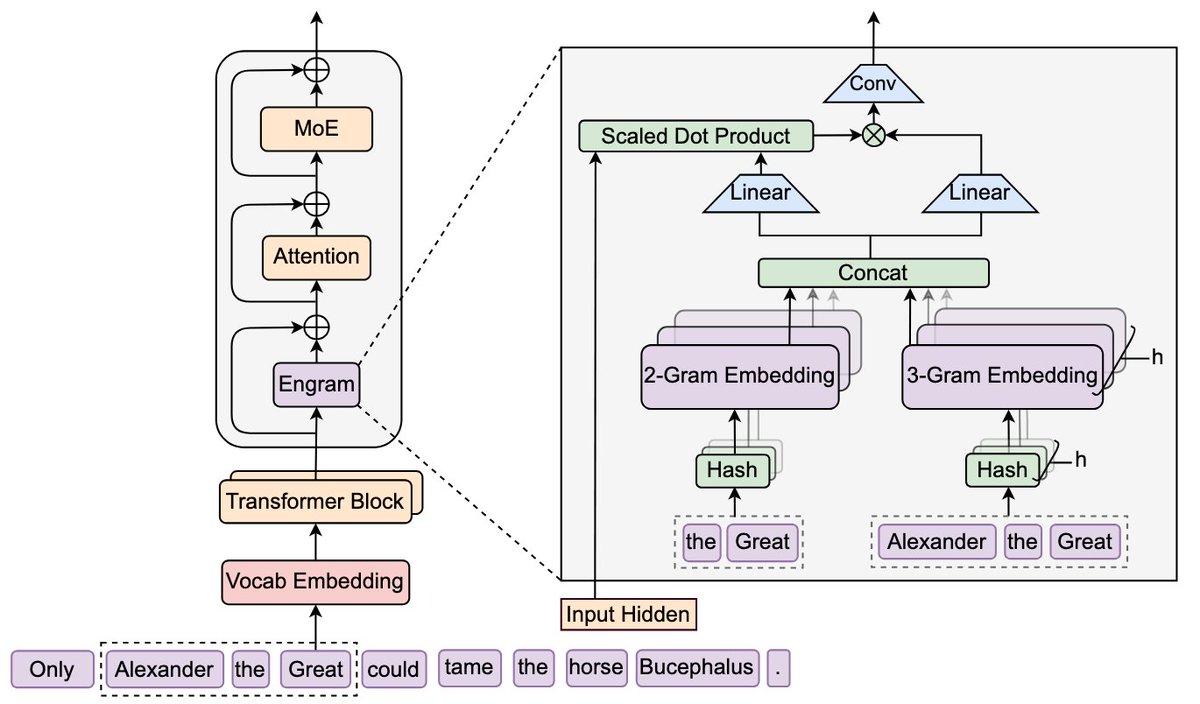
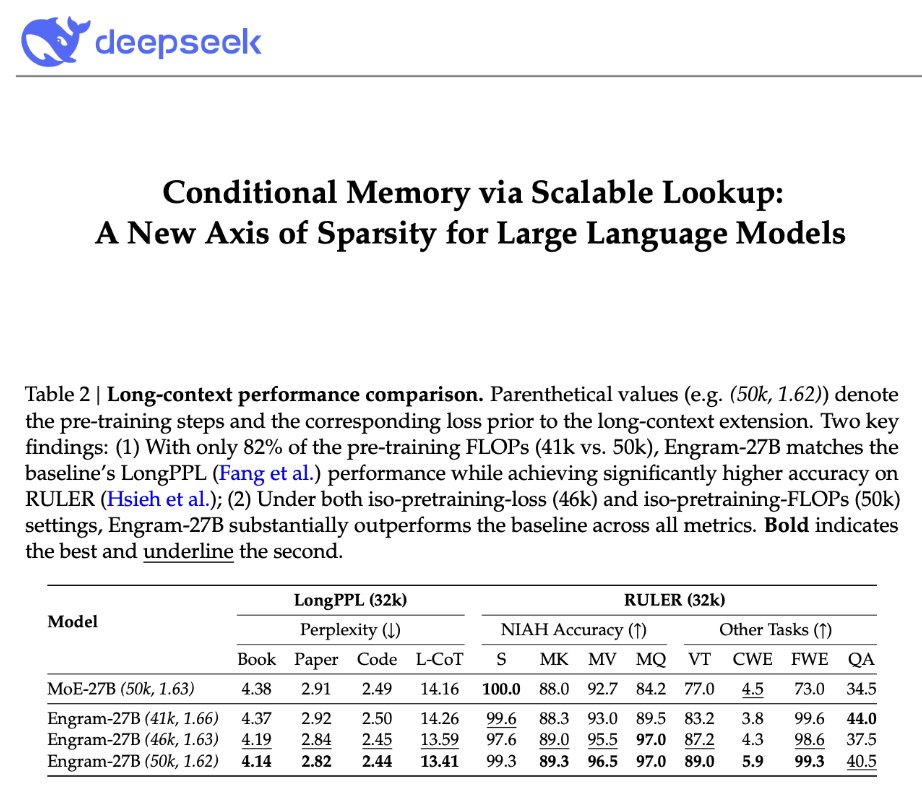
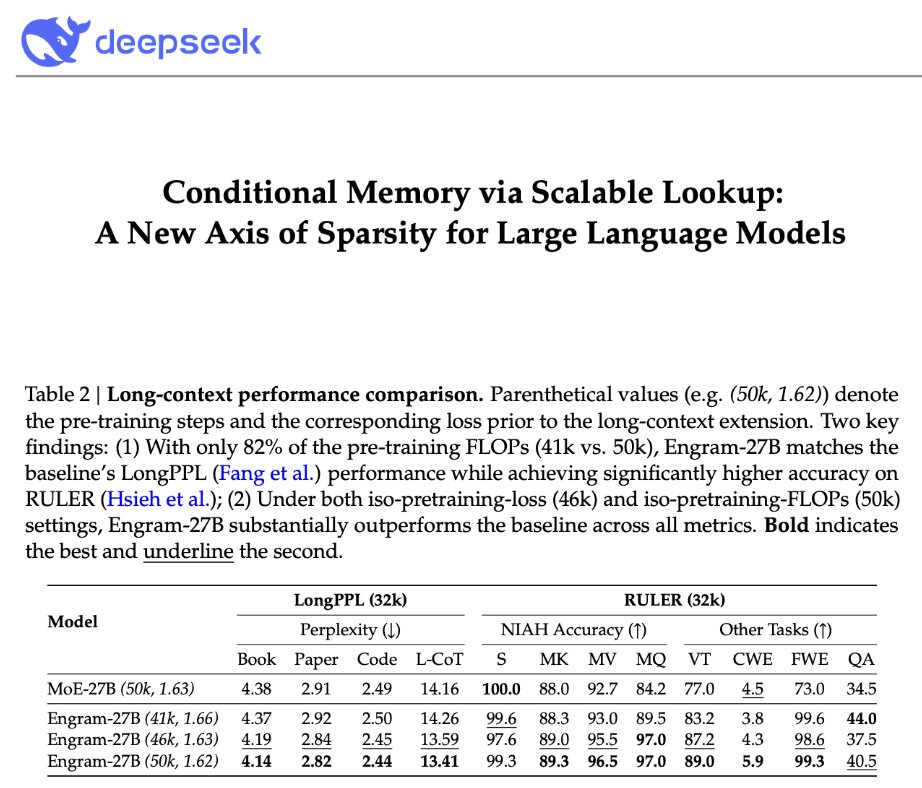
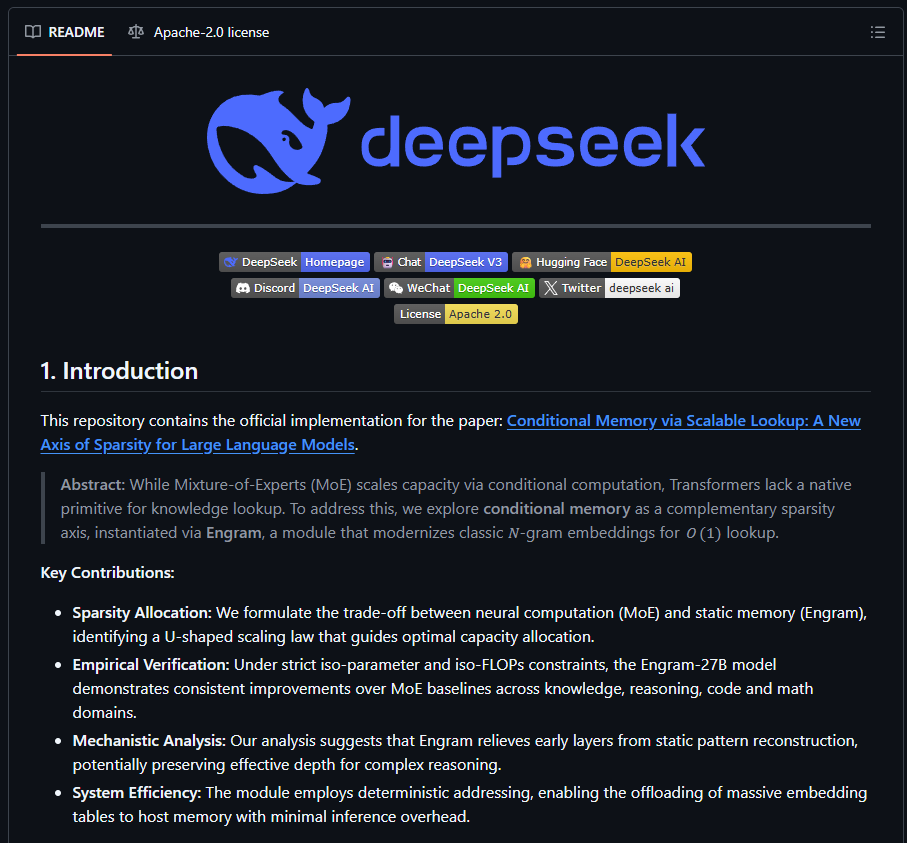
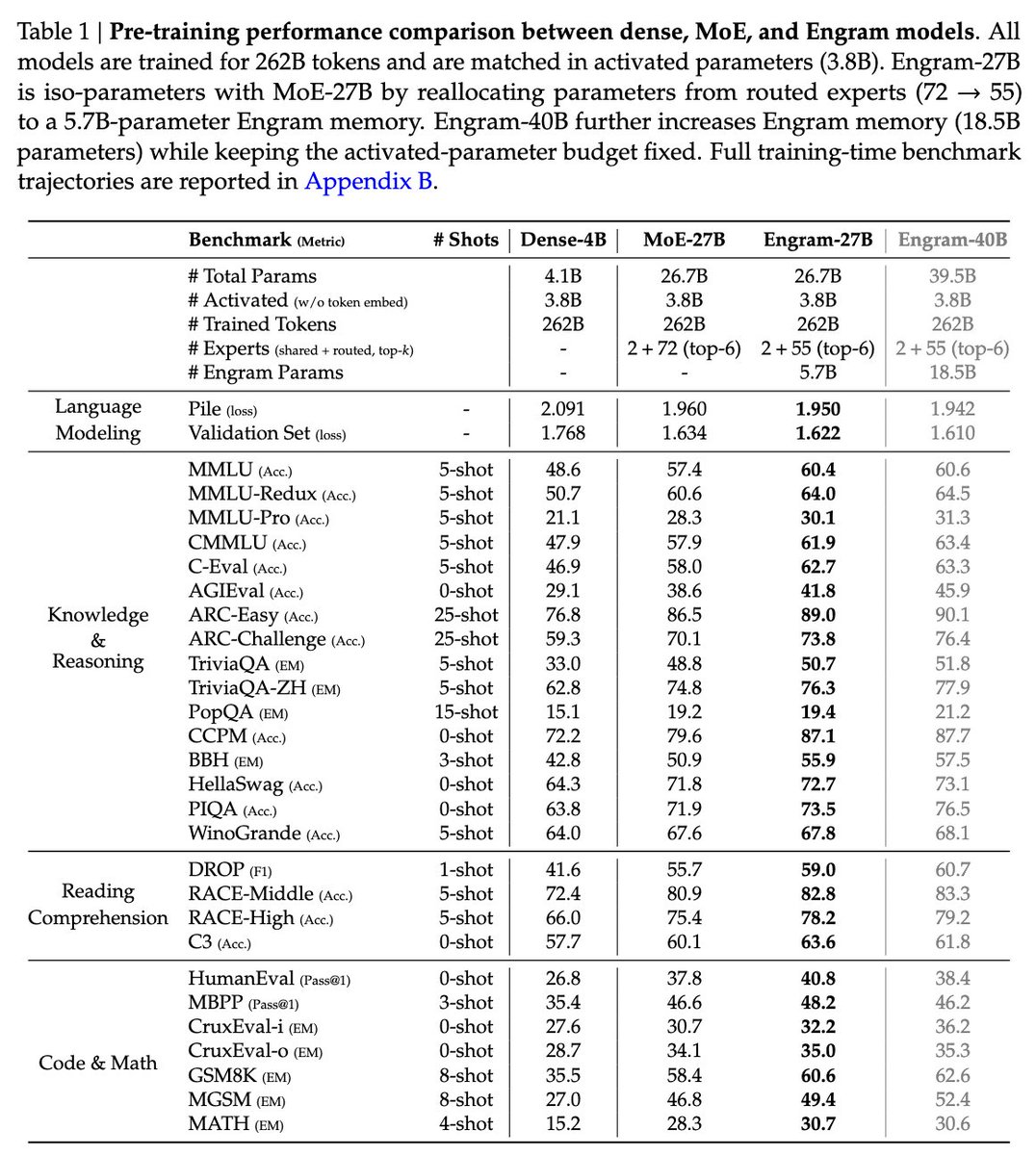
DeepSeek is back! "Conditional Memory via Scalable Lookup: A New Axis of Sparsity for Large Language Models" They introduce Engram, a module that adds an O(1) lookup-style memory based on modernized hashed N-gram embeddings Mechanistic analysis suggests Engram reduces the need for early-layer reconstruction of static patterns, making the model effectively "deeper" for the parts that matter (reasoning) Paper: github.com/deepseek-ai/En…
Lisan al Gaib tweet mediaLisan al Gaib tweet mediaLisan al Gaib tweet media
English
70
336
2.8K
452.1K
Chen Sun 🤖
Chen Sun 🤖@ChenSun92·
DeepSeek's Engram succeeds where others failed in this endeavor to replace a transformer's crappy FFN with a symbolic-ish lookup table. And in the process, it reveals what I think is a truly gorgeous, monumental even, paradigm shift in our understanding of transformer capability 🌹 🚨 To begin the story, explicitly replacing an FFN with a symbolic lookup table fails catastrophically (desirable as it may be, rather than wasting training compute to do this through FFN layers) because language explodes, guaranteeing collisions and polysemy that a rigid lookup cannot resolve. Engram's cool solution to this relies on 3 complementary ingredients:  1) Learnable "Superposition" Embeddings. Because the table is co-trained rather than fixed, the optimizer learns a dense vector that mathematically represents a "superposition" of multiple concepts. It minimizes the global loss for all colliding inputs simultaneously rather than storing a single rigid value. Therefore, even though collisions are guaranteed, you can learn the superposition of the most useful memories. 2) Context-Aware Gating. This seems to be a further "fail-safe" that makes this learned hashing viable, via the dynamic gate $\alpha_t$. Even after you have retrieved the memory, it forces the backbone to check the retrieved memory against the current semantic context; if the hash returns noise (a collision) or irrelevant polysemy, the gate snaps shut ($\alpha ~ 0$), effectively filtering the signal. 3) it is placed in a middle layer: If you place it at Layer 0, you force the model to decide how much to trust the memory before it has read the rest of the sentence. But if you place it in a middle layer, it can then use its Gate ($\alpha_t$) in a way that is not simply a dictionary but rather a context-dependent memory. And here is the crux: this study reveals a monumental critical inefficiency in modern architecture: standard Transformers waste valuable sequential depth and attention capacity ... effectively simulating ... static lookup tables for local patterns. The authors demonstrate that if one simply offloads these trivial dependencies to the Engram module, the model stops "polluting" its attention heads with basic dictionary work ( it really is basic 2-3 token dictionary work), and -- makes it suddenly able to perform signficantly better on very long context tasks. It is almost as if a burden had been relieved! Crucially - this offloading was achieved not through expensive semantic retrieval, but via "dumb," deterministic hash lookups. This compels us to ask: Have we been over-engineering memory by assuming retrieval must be semantic? If a 'fractured' lexical lookup can outperform deep neural computation, should future architectures abandon the expensive vector database paradigm in favor of massive, dumb hash tables? (provided we have a smart context-aware filtering) Let me know, friends, what you think! 🧙‍♂️
Chen Sun 🤖 tweet media
Lisan al Gaib@scaling01

DeepSeek is back! "Conditional Memory via Scalable Lookup: A New Axis of Sparsity for Large Language Models" They introduce Engram, a module that adds an O(1) lookup-style memory based on modernized hashed N-gram embeddings Mechanistic analysis suggests Engram reduces the need for early-layer reconstruction of static patterns, making the model effectively "deeper" for the parts that matter (reasoning) Paper: github.com/deepseek-ai/En…

English
8
28
277
24.7K
TrinityInvestor .·.
TrinityInvestor .·.@TrinityInvestor·
@ChenSun92 @yoyu0203 @ChenSun92 - given that memory wall is the key bottleneck for scalable AI right now, this is on point. Speaking of in-memory data pointers :) x.com/TrinityInvesto…
TrinityInvestor .·.@TrinityInvestor

Meet PRISM — the Universal Coordinate System for Information. By @uor_foundation . GPS gave every physical location a unique address. Before it, maps were local and incompatible. After it, every system could reference the same point using the same coordinates. PRISM does this for data. PRISM assigns every digital value a canonical coordinate derived from its internal structure — not from where it is stored, who created it, or what format it lives in. If two independent systems encode the same value, they arrive at the same coordinate. Automatically. No negotiation. No translation layers. No ambiguity. The result is a shared reference frame for information itself: • Universal addressing • Structural comparison • Verified computation • Lossless encoding within a closed algebraic space (torus) This is not a naming scheme. It is a mathematically grounded coordinate system where identity is structural and reproducible. One coordinate system. Every value. Every scale. Explore it yourself. Reshare it with others. It's yours. github.com/UOR-Foundation --- “The book of nature is written in the language of mathematics.” — Galileo Galilei
English
0
0
0
2
Chen Sun 🤖
Chen Sun 🤖@ChenSun92·
@yoyu0203 brings up an interesting question (below) whether something can be additionally done for long phrase as well. Ie if we’re going to reform memory, might as well reform it wholly. Curious what others think
English
1
1
4
691