Voicesense

228 posts

Voicesense banner
Voicesense

Voicesense

@Voice_Sense

Making Sound Decisions Powered By Voice...

شامل ہوئے Ağustos 2018
71 فالونگ85 فالوورز
Voicesense
Voicesense@Voice_Sense·
40% of employees now worry about AI replacing their jobs. Up from 28% just two years ago. The Global Wellness Institute's 2026 report reveals the psychological toll: Work intensification is at crisis levels. AI promises relief but delivers more cognitive load instead. 62% of employees believe leaders underestimate AI's emotional impact. Here's the disconnect: Organizations measure AI productivity gains. Almost none measure AI-driven stress. While companies celebrate automation reducing headcount, employees experience: Heightened job insecurity Constant "on" pressure Mental load rising faster than hours worked Feeling replaceable in real time This is where voice analytics becomes critical. Not to measure productivity. To measure wellbeing during the AI transition. Acoustic stress markers reveal what employees won't say: Vocal patterns showing anxiety about job security Stress levels rising as AI tools roll out Engagement declining even as output holds 23,681 wellbeing assessments in 2025 caught what engagement surveys missed. The psychological cost of technological change. 40% worried. 62% feel misunderstood. Work intensification accelerating. The question isn't whether AI improves productivity. It's whether anyone's measuring the human cost.
English
0
0
1
10
Voicesense
Voicesense@Voice_Sense·
Only 23% of employees globally are engaged. But 69% of departures are linked to poor engagement, culture, or work-life balance. The 2026 retention benchmarks reveal a troubling pattern: Companies with strong learning culture: 57% retention Companies with moderate learning culture: 27% retention The gap isn't about programs. It's about detection. Most organizations measure engagement annually. By the time the survey reveals disengagement, employees have already mentally checked out. The new trend is "quiet stayers" - employees who aren't leaving, but aren't engaged either. They show up. Hit baseline metrics. Avoid attention. But they're not committed. Not growing. Not contributing at their potential. Surveys miss them entirely. Voice analytics doesn't. Acoustic behavioral patterns reveal engagement drift in real time: Vocal energy declining while attendance stays normal Stress markers rising while output stays consistent Connection patterns shifting while performance holds 23,681 wellbeing assessments in 2025 caught what annual surveys couldn't. The employees who seem fine but aren't. The quiet stayers coasting toward the exit. The disengaged performers waiting for a better offer. 23% engagement. 69% of exits tied to it. The measurement gap is costing you your best people. Are you tracking engagement or just asking about it once a year?
English
0
0
1
9
Voicesense
Voicesense@Voice_Sense·
Sales reps spend only 28% of their time actually selling. The rest? Admin work, meetings, CRM updates, internal calls. Everstage's 2026 data confirms what every sales leader already feels: Productivity isn't the problem. It's where the effort goes. But here's what the productivity reports are missing: While teams optimize workflows and automate admin tasks, they're still losing deals they should have won. Because the 28% they DO spend selling isn't optimized. Most conversation intelligence tracks: How many times "price" was mentioned Whether competitor names came up Which keywords triggered in the call Voice analytics reveals: Whether engagement is genuine or performative If hesitation signals objection or buying intent When vocal energy predicts deal momentum How stress patterns forecast decision timelines Over 200 acoustic parameters analyzed in real time. 12.7 million sales conversations in 2025 taught us this: Giving reps more selling time matters. But giving them behavioral intelligence during that time matters more. The average B2B win rate is 21%. Sales cycles lengthened 32% since 2021. More selling time won't fix that. Smarter selling will. Are you optimizing for activity or outcomes?
English
0
0
1
71
Voicesense
Voicesense@Voice_Sense·
50% of employees are watching for or actively seeking a new job. But only 21% are engaged. Gallup's 2026 data reveals the retention crisis everyone's talking about: 35-40 million Americans will voluntarily leave their jobs this year. And 75% of those departures are preventable. Here's the disconnect: Organizations are tracking retention with lagging indicators: Exit interviews (too late) Annual engagement surveys (too slow) Performance metrics (measure output, not wellbeing) By the time these tools show a problem, the employee has already decided to leave. Voice analytics reveals declining engagement weeks earlier: Vocal energy dropping before disengagement surfaces Stress patterns rising before performance falls Engagement shifts before job search begins 25,000+ people received intervention in 2025 because acoustic patterns caught what surveys missed. Continuous behavioral monitoring, not annual check-ins. The Work Institute's 2025 report is clear: 75% of departures are preventable with better leadership and communication. But you can't intervene on signals you're not detecting. 50% are looking. 21% are engaged. 75% of exits are preventable. The question isn't whether retention is a crisis. It's whether you're measuring it early enough to actually prevent it.
English
0
0
1
25
Voicesense
Voicesense@Voice_Sense·
"Quiet burnout" is the new 2026 HR trend. Employees who appear engaged but are running on empty. It's harder to detect than traditional burnout and often overlooked, according to Spring Health's 2026 mental health trends report. Here's why it's dangerous: Traditional burnout shows visible signs: Absenteeism rising Performance dropping Complaints increasing Quiet burnout shows nothing. Until the resignation letter. Employees mask emotional fatigue. Present as productive. Privately near collapse. Annual surveys miss it entirely. Performance metrics show green. Managers see no red flags. Then they're gone. But voice patterns don't lie. Acoustic behavioral analysis detects what people hide: Vocal energy flattening while output stays normal Stress markers rising while attendance stays perfect Engagement patterns shifting while performance holds 23,681 mental health assessments in 2025. Many caught "quiet burnout" weeks before it became visible. Not through what employees said in check-ins. Through what their voice revealed when they thought they were hiding it. The trend is called "quiet" because it's invisible to traditional HR tools. But it's loud in voice data. The question is whether you're listening closely enough to hear it.
English
0
1
1
49
Voicesense
Voicesense@Voice_Sense·
76% of companies now use conversation intelligence in over half their customer interactions. But here's what most are missing: They're analyzing what customers say. Almost none analyze how they say it. Conversation intelligence has moved from experimental to business-critical, with 80% of companies using it for over a year. The technology works. It transcribes calls, flags keywords, tracks sentiment from words. But it's still missing the behavioral layer. While conversation intelligence tools detect: "Price" mentioned 3 times "Competitor" referenced twice "Maybe" used in closing Voice analytics reveals: Whether hesitation indicates real objection or buying signal If engagement is genuine or polite When vocal energy predicts deal momentum How stress patterns forecast decision timelines Over 200 acoustic parameters during every call. 12.7 million sales conversations in 2025 taught us this: Conversation intelligence tells you what happened. Voice analytics tells you what will happen next. The gap between the two is the difference between transcription and prediction. Between knowing and forecasting. Between analyzing the past and seeing the future. 76% are using conversation intelligence. How many are actually listening?
English
0
0
1
27
Voicesense
Voicesense@Voice_Sense·
46% of UK HR professionals just named burnout the biggest business risk for 2026. Not AI adoption. Not economic uncertainty. Burnout. But here's the problem: Most organizations are still trying to solve it with annual surveys. By the time the survey says "burnt out," the employee has already updated their LinkedIn. 61% of HR professionals say that after supporting everyone else's wellbeing, there's little energy left for their own. The tools aren't keeping up with the crisis. Annual check-ins can't catch warning signs that appear weeks before resignation. Voice analytics works differently. It detects acoustic stress markers in real time: Vocal energy decline before productivity drops Flattened tone weeks before burnout surfaces Engagement shifts before disengagement becomes visible 25,000+ people received early intervention in 2025 because voice caught the signals surveys missed. Not annual reviews. Continuous behavioral monitoring. Not what people admitted. What their voice couldn't hide. HR teams are drowning trying to solve the burnout crisis with tools designed for a different era. The future isn't better surveys. It's earlier signals. And voice has been revealing them all along.
Voicesense tweet media
English
0
0
1
9
Voicesense
Voicesense@Voice_Sense·
8 weeks before a customer churns, their voice changes. 6 weeks before an employee burns out, vocal patterns shift. 4 weeks before a loan defaults, stress markers appear. Most organizations discover these problems when it's too late to fix them. The cancellation email already sent. The resignation letter already submitted. The payment already missed. But the warning signs were there all along. Week 1: Subtle engagement decline Week 3: Vocal energy drops Week 5: Rhythm patterns change Week 7: Stress markers intensify Week 8: Outcome decided Voice analytics doesn't predict the future. It reveals the present more clearly than lagging indicators ever could. While you're waiting for quarterly surveys, annual reviews, or 90-day delinquency notices: Voice data is tracking real-time behavioral drift. 25,000+ people received early intervention in 2025 because voice caught the signals weeks before surveys would. The 8-week window exists. The question is whether you're using it. How many outcomes could you change with 8 weeks of warning?
English
0
0
0
6
Voicesense
Voicesense@Voice_Sense·
Surveys tell you what people want you to know. Voice tells you what they can't hide. Customer satisfaction survey: 8/10 Voice analytics: Churn risk 76% Employee engagement survey: "Satisfied" Voice analytics: Burnout indicators rising 4 weeks Loan application: "Everything is fine financially" Voice analytics: High stress, elevated risk This is the gap between self-reported data and behavioral reality. People answer surveys the way they think they should. Their voice reveals how they actually feel. Subtle energy decline Flattened vocal tone Increased hesitation patterns Shifts in rhythm and pace These aren't conscious. They're involuntary. Which is exactly why they're predictive. 49.6 million behavioral assessments in 2025. Language agnostic. Culture independent. Impossible to game. Surveys ask. Voice reveals. One tells you what people think you want to hear. The other tells you what's actually happening. Which one are you betting your business on?
English
0
0
0
10
Voicesense
Voicesense@Voice_Sense·
The first 60 seconds of a conversation decide everything. And most organizations are blind during them. No dashboard can tell you in real time: Is this customer genuinely interested or being polite? Is this employee actually okay or hiding burnout? Is this applicant truthful or concealing risk? But voice analytics can. Before the small talk ends, before the pitch begins, before the interview wraps: Engagement level: measured Stress indicators: detected Behavioral patterns: mapped Predictive probability: calculated Over 200 acoustic parameters analyzed while you're still introducing yourself. 49.6 million times in 2025, the first minute revealed what the next 30 minutes confirmed. Sales teams that know prospect intent in 60 seconds close faster. HR teams that detect stress early intervene sooner. Risk teams that spot vocal patterns during applications decide smarter. The difference between winning and losing isn't what happens later. It's what you notice first. Most companies spend 45 minutes discovering what voice data shows in 60 seconds. How much time are you wasting to learn what you could already know?
English
0
0
1
4
Voicesense
Voicesense@Voice_Sense·
You're sitting on millions in untapped intelligence. Every customer call. Every employee check-in. Every loan interview. Recorded. Stored. Archived. And completely unused. Most companies treat voice recordings like compliance checkboxes: Store for 90 days. Delete. Repeat. But those recordings contain predictive signals worth analyzing: Which customers showed early churn patterns Which employees needed support before burning out Which applicants carried hidden risk indicators The conversations already happened. The behavioral data already exists. You're just not extracting it. 49.6 million behavioral assessments in 2025. Most ran on conversations companies were already having. Same calls. Same recordings. Different analysis layer. No new data collection required. No additional customer friction. No extra employee burden. Just intelligence extraction from existing assets. The ROI isn't in gathering more data. It's in finally using what you already own. How much predictive intelligence is sitting in your archives right now?
Voicesense tweet media
English
0
0
0
5
Voicesense
Voicesense@Voice_Sense·
Prediction isn't about the future. It's about seeing the present more clearly than everyone else. Most companies predict churn by watching for complaints. We predict it by listening for acoustic drift 8 weeks earlier. Most HR teams predict burnout by tracking sick days. We predict it by detecting vocal energy decline before performance drops. Most lenders predict default by analyzing credit scores. We predict it by measuring stress patterns during the application. The paradox: Everyone has the same conversations. But only some extract predictive intelligence from them. Same customer call. Different signals captured. Same employee check-in. Different warning signs detected. Same loan interview. Different risk indicators revealed. The future was always hiding in your existing data. You just weren't measuring the right layer. 200+ acoustic parameters. Real-time analysis. Behavioral predictions. The companies winning tomorrow aren't creating new data sources. They're finally listening to the ones they already have. What predictions are hiding in your conversations right now?
Voicesense tweet media
English
0
0
0
6
Voicesense
Voicesense@Voice_Sense·
The most important conversation in your business isn't being recorded. It's the one happening between words. Every pause. Every breath. Every micro-hesitation. While you're focused on what customers say, their voice is broadcasting: Decision timeline (fast or slow) Price objection severity (real or negotiating) Competitor involvement (shopping or committed) Deal risk (green, yellow, red) In 2025, we processed over 1 billion seconds of these silent signals. The pauses alone predicted outcomes transcripts couldn't. A 2-second hesitation before agreeing? 73% churn risk within 90 days. A shift in breathing pattern mid-call? Stress level rising, intervention needed. A subtle pitch drop during commitment? Confidence wavering, deal at risk. Machine learning doesn't just hear conversations. It decodes the silence between them. 49.6 million times in 2025, what wasn't said mattered more than what was. What are your silent signals telling you?
Voicesense tweet media
English
0
0
0
5
Voicesense
Voicesense@Voice_Sense·
Voice analytics in real time changes everything. Here's what real time actually means: Not real time: → Record the call → Send to analysis queue → Wait for processing → Review dashboard tomorrow → React to what already happened Actual real time: → Analysis during the live conversation → Behavioral insights surface in seconds → Action possible while still on the call → Change outcomes before they're decided The difference? Sales: Coach the rep mid-call based on prospect engagement dropping Wellness: Flag stress indicators during check-ins for immediate follow-up Risk: Adjust credit decision during application call based on vocal patterns Support: Escalate to supervisor when customer frustration spikes Over 200 acoustic parameters processed in under 60 seconds. While the conversation is happening. When intervention still matters. This is why 38.4 million of our analyses in 2025 were embedded directly into live systems. Invisible. Instant. Actionable. Post-call analysis tells you what went wrong. Real-time analysis lets you fix it before it does. The future isn't faster dashboards. It's intelligence that arrives during the moment you can still do something about it.
Voicesense tweet media
English
0
0
0
16
Voicesense
Voicesense@Voice_Sense·
Most AI analyzes what people say. We analyze what they can't control. Here's why that matters: Content-based analysis: → Requires transcription → Language dependent → Culturally biased → Easy to game with scripted responses → Misses non-verbal signals entirely Acoustic behavioral analysis: → Works on raw audio → Any language, any dialect → Culture independent → Impossible to fake involuntary vocal patterns → Captures the 84% of communication that isn't words Example: A customer service call in Mandarin, Spanish, and English can all be analyzed for engagement, stress, and satisfaction using the same acoustic models. No translation needed. No cultural adjustment required. Because stress sounds like stress in every language. Hesitation patterns are universal. Vocal energy decline transcends culture. This is why we processed 49.6 million behavioral assessments in 2025 across dozens of languages and markets. The technology doesn't care what language you speak. It only cares how your voice behaves when you speak it. Acoustic analysis isn't just an alternative to content analysis. It's the layer content analysis can't reach.
Voicesense tweet media
English
0
0
1
9
Voicesense
Voicesense@Voice_Sense·
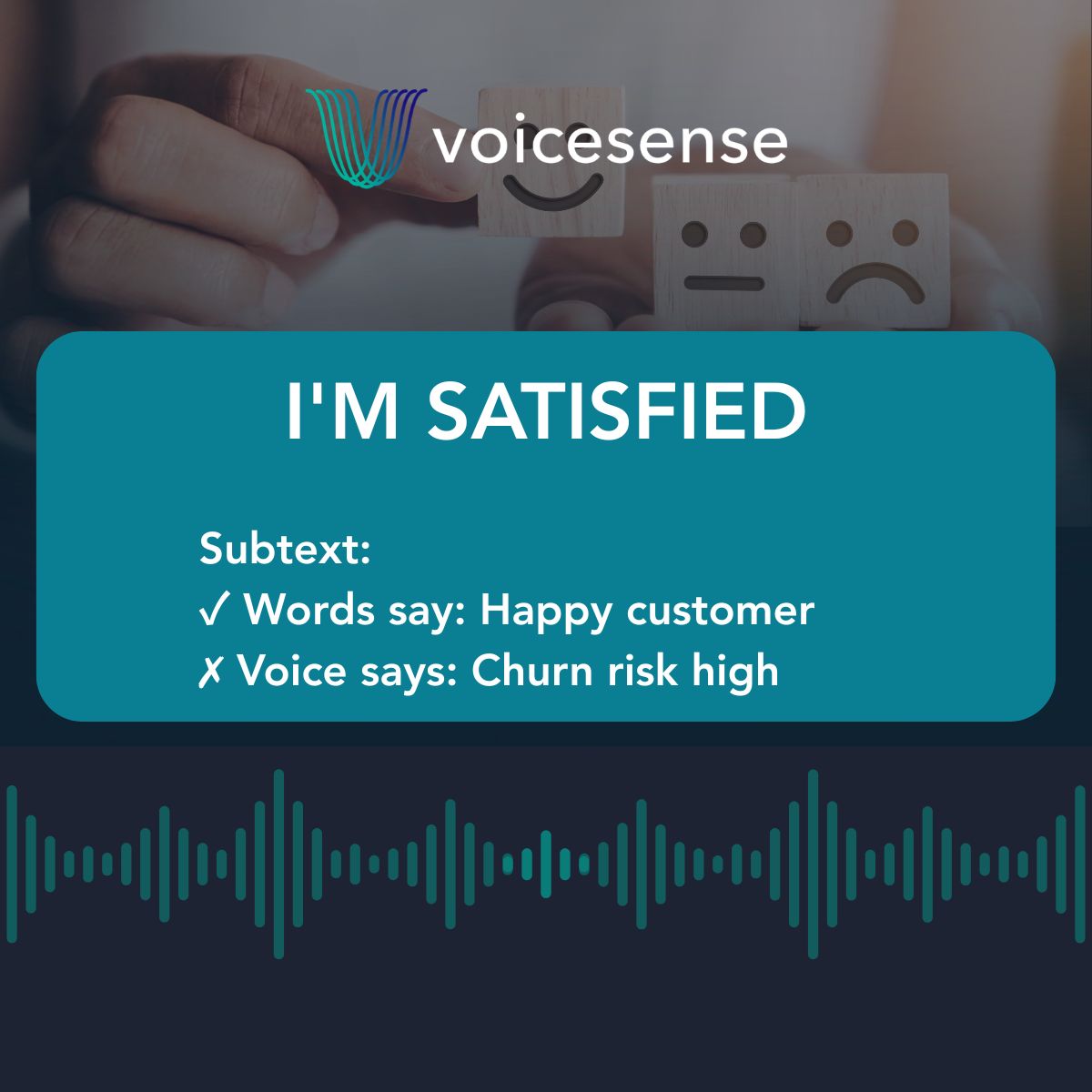
Voice analytics doesn't listen to what you say. It analyzes how you say it. Here's the difference: Traditional analytics: "I'm satisfied with the service." ✓ Positive sentiment detected ✓ Customer marked as happy ✓ No action needed Voice analytics on the same sentence: ✗ Vocal energy 40% below baseline ✗ Hesitation before "satisfied" ✗ Flattened tone contradicts words ✗ Churn probability: High Same words. Opposite reality. This is why we analyze over 200 acoustic parameters: Pitch variations Speech rhythm Vocal energy Pause patterns Tone shifts Response timing These are the parts of speech people don't consciously control. The parts that reveal truth when words don't. Machine learning models trained on millions of conversations can detect: Stress before someone admits they're struggling Disengagement before customers churn Deception before fraud occurs Burnout before productivity drops Language agnostic. Culture independent. Real time. Because human behavior doesn't hide in vocabulary. It hides in voice patterns.
Voicesense tweet media
English
0
0
1
15
Voicesense
Voicesense@Voice_Sense·
Customer churn costs businesses billions annually. And most companies don't see it coming until the cancellation email arrives. Here's what they miss: Week 1: Vocal engagement begins declining Week 3: Response patterns change, tone flattens Week 5: The "everything's fine" call Week 7: Churn. By the time a customer says they're unhappy, they've been showing it for weeks. Voice analytics tracks this behavioral decline in real time. Not through quarterly surveys. Through acoustic patterns analyzed during every interaction. Over 200 parameters. Processed in seconds. Actionable immediately. 49.6 million behavioral assessments in 2025. Every conversation analyzed for the signals words hide: Hesitation patterns predicting dissatisfaction Energy decline indicating disengagement Vocal stress suggesting friction Rhythm changes revealing decision shifts Retention isn't about better offers at the exit door. It's about catching signals at the front door. The companies keeping customers aren't just asking "Are you happy?" They're listening to what voice reveals when words won't. How much churn is hiding in your conversations right now?
English
0
0
1
7
Voicesense
Voicesense@Voice_Sense·
Over 25,000 people received support in 2025 because their voice was heard in time. Not because they said they were struggling. Because acoustic patterns revealed it weeks earlier. Most employees who resign seemed fine in their last review. The disconnect isn't dishonesty. It's invisibility. By the time disengagement shows in productivity, you've already lost them. But voice patterns reveal declining wellbeing weeks before: Subtle energy shifts Flattened vocal tone Changed rhythm patterns Acoustic stress markers surveys miss entirely 23,681 mental health assessments. Early intervention. Proactive support. This isn't surveillance. It's listening closely enough to care early enough to help. Healthier workplaces don't react to resignations. They predict and prevent them. They said they were fine. Their voice told a different story. And in 2025, over 25,000 voices were heard in time.
Voicesense tweet media
English
0
0
1
9
Voicesense
Voicesense@Voice_Sense·
Seconds to detect engagement. Minutes to understand personality. Hours wasted asking questions voice data already answered. Most sales teams spend entire discovery calls trying to read the room. Voice analytics reads it in under 60 seconds. Is the prospect engaged? The acoustic patterns reveal it instantly. Are they price shopping or ready to buy? Vocal energy shows intent. Will they convert? Behavioral probability calculated before the pitch. Over 200 acoustic parameters analyzed in real time. While you're asking "So what brings you here today?" machine learning has already mapped: Engagement level Personality drivers Decision-making style Conversion likelihood 12.7 million sales conversations analyzed in 2025. The best reps feel this instinctively. They read tone, adjust on the fly, close faster. Now every rep can have that intelligence. Not gut feeling. Predictive data. Real time. How much time are you wasting asking what voice already answered?
English
0
0
1
8
Voicesense
Voicesense@Voice_Sense·
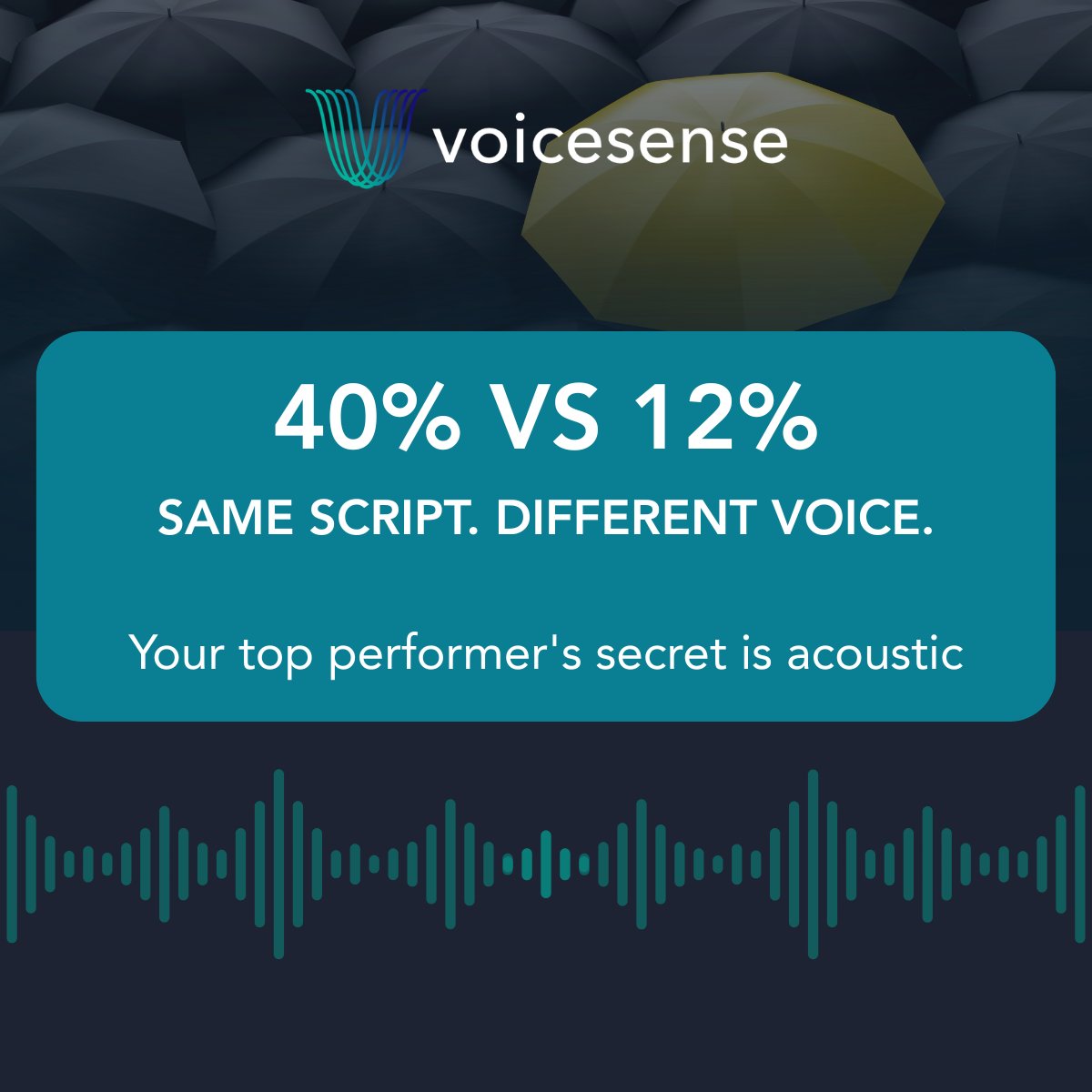
Two salespeople. Same script. Same product. Same training. One converts at 40%. The other at 12%. What's the difference? It's not what they say. It's how they say it. Confidence. Pace. Conversational rhythm. Vocal energy. These acoustic patterns influence buyer decisions more than any feature list. Most sales teams optimize the message. Elite teams optimize the delivery. Voice analytics can identify the exact behavioral patterns that correlate with conversion, then help every rep replicate what top performers do naturally. Real time coaching. Personalized feedback. Predictive performance insights. Your best salesperson has a secret. It's been hiding in their voice all along. Are you ready to scale it across your entire team?
Voicesense tweet media
English
0
0
1
9