Ben Meadows ری ٹویٹ کیا
Ben Meadows
881 posts
Ben Meadows
@_benmeadows
Assistant Professor at UAB | Researching education, immigration, and bioeconomics | Likes/retweets≠ endorsements
Knoxville, TN شامل ہوئے Ekim 2012
505 فالونگ456 فالوورز

I’m starting to wonder if our (well-intentioned) ideas of “boundaries” have become *walls* to true-community building.
The most meaningful acts of love are at a minimum… deeply inconvenient, and usually are painful.
But worth it.
Adele Bloch@adele_bloch
everyone wants a village, but no one wants to be a villager > drive your friends to the airport > go to their party even when you're tired > stop cancelling last minute > host at your place > support the wins & losses it's worth every ounce of effort
English
Ben Meadows ری ٹویٹ کیا

The demand for forecasts goes up when there’s an unforeseen shock, which is when forecasts become the least accurate.
English
Alternatively, I’ve never been more excited to unleash my students’ raw talent on gnarly research questions.
On pace for best student projects ever.
Rand@rand_longevity
every professor I talk to that uses AI says the college system is about to collapse
English
Ben Meadows ری ٹویٹ کیا
I still don't think we have crystal-clear, I-will-hear-no-objections evidence of AI's effect on the macroeconomy.
And yet.
If you asked me "what would change your mind here?" I'd probably say, "emerging evidence of a productivity boom combined with a major slowdown in tech sector hiring and employment."
This week, we got both.
Joey Politano 🏳️🌈@JosephPolitano
Brutal numbers for US tech sector jobs released today—overall, employment decreased by 12k last month and is down 57k over the last year That's now nearly as bad as the worst of the 2024 tech-cession, and significantly worse than either the 2008 or 2020 recessions
English
Ben Meadows ری ٹویٹ کیا

Ben Meadows ری ٹویٹ کیا

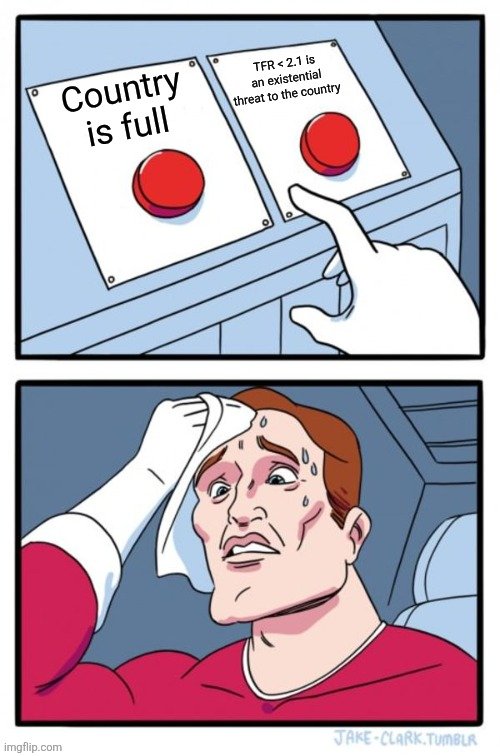
(Pulls up a chair) “and you won’t believe the alarming norms that have formed around it, creating billions of dollars in economic value a year from a fish that’s almost never kept for consumption. ”
Tyler Austin Harper@Tyler_A_Harper
In all seriousness, you could do worse as a symbol for U.S. democracy than the largemouth bass. It can be found in every farm pond, city park, remote lake, sprawling reservoir. It’s pursued by the very rich and very poor. By every color of American. It’s truly the people’s fish.
English
Hate that our state is used as a measuring post of "poorer" ... *but* there are many things that make Alabama amazing that folks continually ignore.
Kevin A. Bryan@Afinetheorem
Fantastic G&M article. They send some reporters to Alabama to find out how it has a GDP per capita PPP the same as Canada now (!). Turns out Alabama now makes as many cars as Ontario (!!), has a new $6b Eli Lilly plant, a growing biotech cluster, improving schools. 1/2
English
@mikekofoed Keep on doing the good work! We need economic literacy more than ever and I hate our professions aversion to educating the public.
English

Just got booked for Memphis, Knoxville, Nashville, KSL, and the Deseret News.
I can already feel my kids rolling their eyes.
Gonna be a crazy day!
Michael Kofoed@mikekofoed
The Supreme Court just struck down the tariffs. There was no national emergency and this was blatant violations of the seperation of powers. The power to levy taxes and duties belongs to Congress. (Already getting media calls). cnn.com/2026/02/20/pol…
English
Ben Meadows ری ٹویٹ کیا

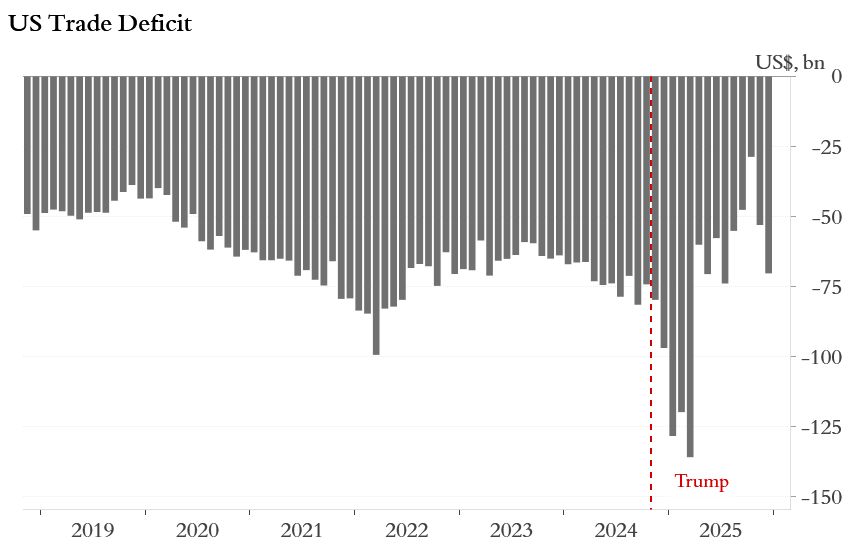
In recent weeks, some political and academic commentators have celebrated the decline in the trade deficit and linked it to tariffs. However, the latest data — including today’s release — confirm the opposite narrative.
The deficit surged in early 2025 as firms front-loaded imports ahead of the tariffs. In the following months, imports fell (and with them the deficit) due to elevated inventories. In the latest month, likely as inventories were depleted, the deficit has returned to its starting point — confirming the more solid post-tariff analyses by serious economists.
English
Ben Meadows ری ٹویٹ کیا

My best guess at what's going on is that we lack sufficiently developed theories to rigorously forecast anything and so we have to guess at everything.
We then fall back on our intuitions about what kinds of guesses feel reasonable. And intuitions are hard to update.
English
Ben Meadows ری ٹویٹ کیا
15% of the population of Ireland entered the US between 1851 and 1860
9% of the population of Norway entered the US in the 1880s
6% of the population of Italy entered the US from about 1900-1910
Geiger Capital@Geiger_Capital
Most Americans still don’t fully understand what happened under Biden… 8% of Nicaragua entered the US in 4 years. 8% of the entire country. 7% of Cuba. 6% of Haiti. 5% of Honduras.
English
Ben Meadows ری ٹویٹ کیا

“They told me eating two large pizzas would make me gain weight, but that didn’t happen after I threw up the pizza.”
Jason Harrison@nominalthoughts
Every time a tariff is rolled back, ten “How Did Economists Get Tariffs Wrong” articles are created in the future
English
Ben Meadows ری ٹویٹ کیا

If you want to shop at farmers markets, go for it.
But, the middle here isn't billionaires. It's truck drivers, packers, forklift drivers, refrigeration systems etc. It's a logistical miracle that allows American's to buy potatoes 4-times cheaper than at farmers markets.
Max M. Miller@MaxMMillerAT
Seems like we just need to cut out all the waste in the middle. Find a local potato grower at a farmer’s market and tell the billionaires in the middle to take a hike.
English
Costco Rotisserie chickens are cheaper per pound than raw, typically.
Boomers keep using “splurge” in the weirdest ways…
The Wall Street Journal@WSJ
Gen Zers and millennials are swimming in student debt and may never own homes, but they’re splurging on gut-healthy juices and rotisserie chickens. on.wsj.com/3OjPW6M
English
Ben Meadows ری ٹویٹ کیا

“CEO of Hot Pockets ™ says that ‘most, if not all’ meals will be fully replaced with Hot Pockets ™ within the next 12 to 18 months”
unusual_whales@unusual_whales
Microsoft AI CEO, Mustafa Suleyman, says that "most, if not all, professional tasks" undertaken by white collar workers will be fully automated by AI within the next 12 to 18 months
English
Ben Meadows ری ٹویٹ کیا

Populists across the spectrum, left and right, hate economists. I joked its some puzzle but I think there's a simple reason. It's not about liking capitalism or something.
And the disagreement is almost always about how to reason about problems, not about values.
Populists want solutions. Economists offer trade-offs. I'm not the first to point this out but its a huge distinction.
A carbon tax doesn't solve climate change. It prices carbon so people make better decisions at the margin. To the populist, that sounds like accepting the problem.
Same with manufacturing. A tariff doesn't create jobs. It shifts them, from the millions of workers in industries that buy steel to the 160,000 who make it. To the populist, "protect American workers" sounds like a solution. To the economist, the question is: which American workers?
We can go down the list. Rent control intends to help renters. It produces housing shortages. The populist sees the economist opposing rent control and concludes: you don't care about poor people.
As Sowell put it: "The first lesson of economics is scarcity: there is never enough of anything to fully satisfy all those who want it. The first lesson of politics is to disregard the first lesson of economics."
I think, not surprising, the economists are right.
It's more than just two different approaches. Thinking in trade-offs forces you to trace each step: who actually bears the cost of a tariff, what happens to housing supply when you cap rents, how a carbon tax changes behavior at every margin.
You can't skip ahead to the answer. You have to follow the chain. This is why economists spend careers doing exactly this and still argue about the answers. That's what it looks like when you take the problems seriously.
The populist skips all of this based on some intuition pump. Think of the person on a group project who's so confident in the answer that they never bother learning the material. That's populist economic reasoning from inside the discipline. The confidence comes from not having looked at the trade-offs closely enough to see how hard they are.
Stewart is the populist left. Oren Cass is the populist right, and he's more dangerous because he sounds like an economist, and plays one on TV, without putting in the work of thinking about trade-offs.
Herbert hovenkamp@Sherman1890
@JessicaBRiedl @jasonfurman so why do populists hate economists?
English
Ben Meadows ری ٹویٹ کیا
@asymmetricinfo I pay for frontier model GPT.
Every day I see it do impossibly difficult stuff in second, but also fail at stuff that normal professionals in my field can do.
I expect that to continue for a long time; we'll eventually re-calibrate our ideas of what's difficult and what isn't.
English
Ben Meadows ری ٹویٹ کیا