Behnam Yousefi

191 posts

Behnam Yousefi banner
Behnam Yousefi

Behnam Yousefi

@behnam_bme

Postdoc Researcher in computational biomedicine at @UKEHamburg #ComputationalBiomedicine, #DeepLearning, #NetworkBiology

Hamburg, Germany شامل ہوئے Temmuz 2022
206 فالونگ44 فالوورز
Behnam Yousefi ری ٹویٹ کیا
Biology+AI Daily
Biology+AI Daily@BiologyAIDaily·
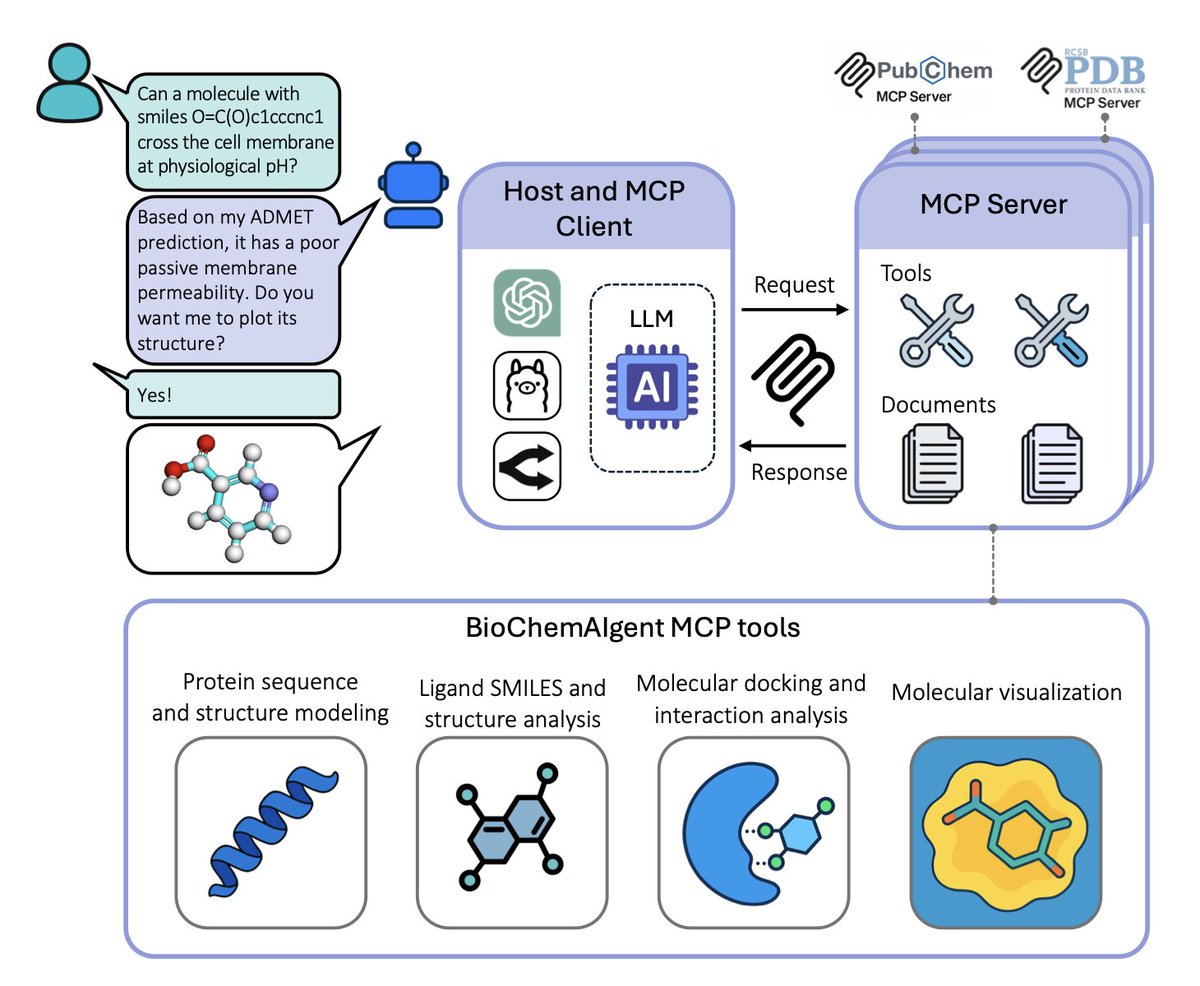
BioChemAIgent: An AI-driven Protein Modeling and Docking Framework for Structure-Based Drug Discovery 1. First agentic framework that unifies 19 tools—ESM3, AlphaFold3, AutoDock Vina, DiffDock, etc.—into one chat-style interface for end-to-end small-molecule discovery, slashing the usual multi-software integration burden. 2. Wraps complex pipelines (protein prep, protonation, grid setup, docking, interaction fingerprinting, 3-D visualization) into reproducible, transparent workflows that non-coders can launch with plain English. 3. Built-in “render_structures” and “interaction_plot” modules translate natural-language style requests into publication-grade 3-D images, eliminating the need for PyMOL scripting expertise. 4. Dual evaluation strategy: 98.5 % automatic accuracy on 65 corrupted queries plus perfect expert scores on four real-world case studies, showing GPT-5-powered agent rivals trained chemists in task planning and result interpretation. 5. Community-oriented registry on GitHub invites developers to plug in new MCP servers, turning the system into a living, expandable ecosystem rather than a frozen black box. 6. Open web interface already live—users can dock ibuprofen to COX-1, visualize the Arg120 salt bridge, and download inputs/outputs without installing anything. 💻Code: github.com/imsb-uke/bcai 📜Paper: biorxiv.org/content/10.648… #DrugDiscovery #AI #StructuralBiology #MolecularDocking #AlphaFold3 #ESM3 #ChemInformatics #OpenScience
Biology+AI Daily tweet media
English
0
12
49
2.7K
Behnam Yousefi
Behnam Yousefi@behnam_bme·
BioChemAIgent is an AI agent that orchestrates state-of-the-art AI models together with established computational chemistry tools, enabling end-to-end small-molecule analysis, protein modeling, molecular docking, and interaction analysis through a unified interface.
English
0
0
0
36
Behnam Yousefi
Behnam Yousefi@behnam_bme·
BioChemAIgent: An AI agent for drug discovery now available on bioRxiv lnkd.in/d9c--nBD We hear a lot these days about AI agents and their applications in biomedical research. But how effective are they when prompted to carry out complex workflows? ...
English
1
0
0
37
Behnam Yousefi ری ٹویٹ کیا
Jorge Bravo Abad
Jorge Bravo Abad@bravo_abad·
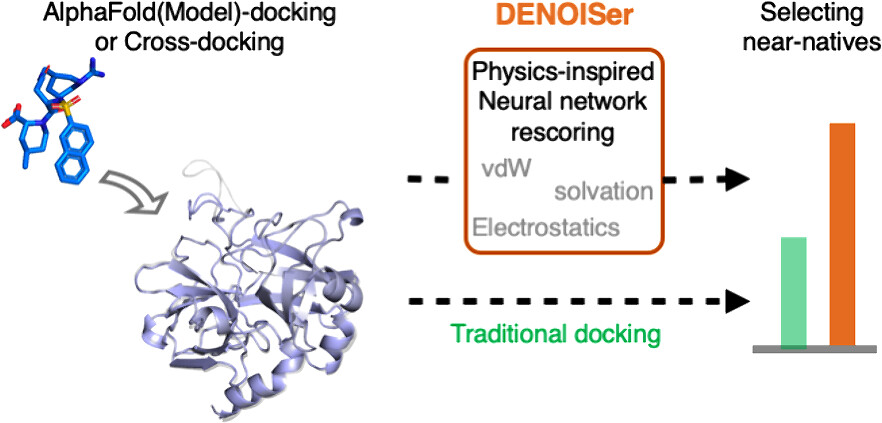
Physics-inspired machine learning for better ligand docking Scientists striving to design new drugs depend on computational tools to predict how small molecules, or ligands, might bind to a protein target. In principle, these so-called docking methods can save time and cost in drug discovery by guiding chemists to focus on the most plausible molecular interactions. Yet as soon as protein structures are only predicted rather than experimentally solved, standard docking tools often fail to pinpoint the best binding poses with consistent accuracy. Bae et al. propose a deep neural network called DENOISer, which re-ranks protein–ligand docking results from various sampling algorithms. Their system combines two subnetworks: one predicts how “native-like” a given binding conformation is by measuring local distance differences, while the other estimates an overall binding energy value. These subnetworks are trained on model-docked complexes generated with thousands of receptor–ligand pairs, including realistic noise from predicted protein structures. Unlike many scoring functions that penalize small backbone or side-chain deviations, DENOISer applies physics-inspired interactions as an inductive bias, making the final model more robust. In quantitative terms, the authors report that using DENOISer’s consensus score can push the top-1 selection success rate from around 45% to nearly 58% for challenging model-docking benchmarks and from 36% to 58% for cross-docking tasks, showing that machine learning can overcome structural inaccuracies better than conventional approaches alone. The authors show that DENOISer not only generalizes across different protein fold families but also tolerates structural noise in protein models, underscoring its adaptability to real-world scenarios where perfect receptor structures are scarce. This enhances confidence in computational pipelines that rely on predicted protein structures, widening their application to previously inaccessible targets. By blending physical insights with neural architectures, the researchers offer a practical way to select high-quality docking poses and accelerate early-stage drug discovery. Paper: pubs.acs.org/doi/full/10.10…
Jorge Bravo Abad tweet media
English
0
14
60
2.4K
Behnam Yousefi ری ٹویٹ کیا
Biology+AI Daily
Biology+AI Daily@BiologyAIDaily·
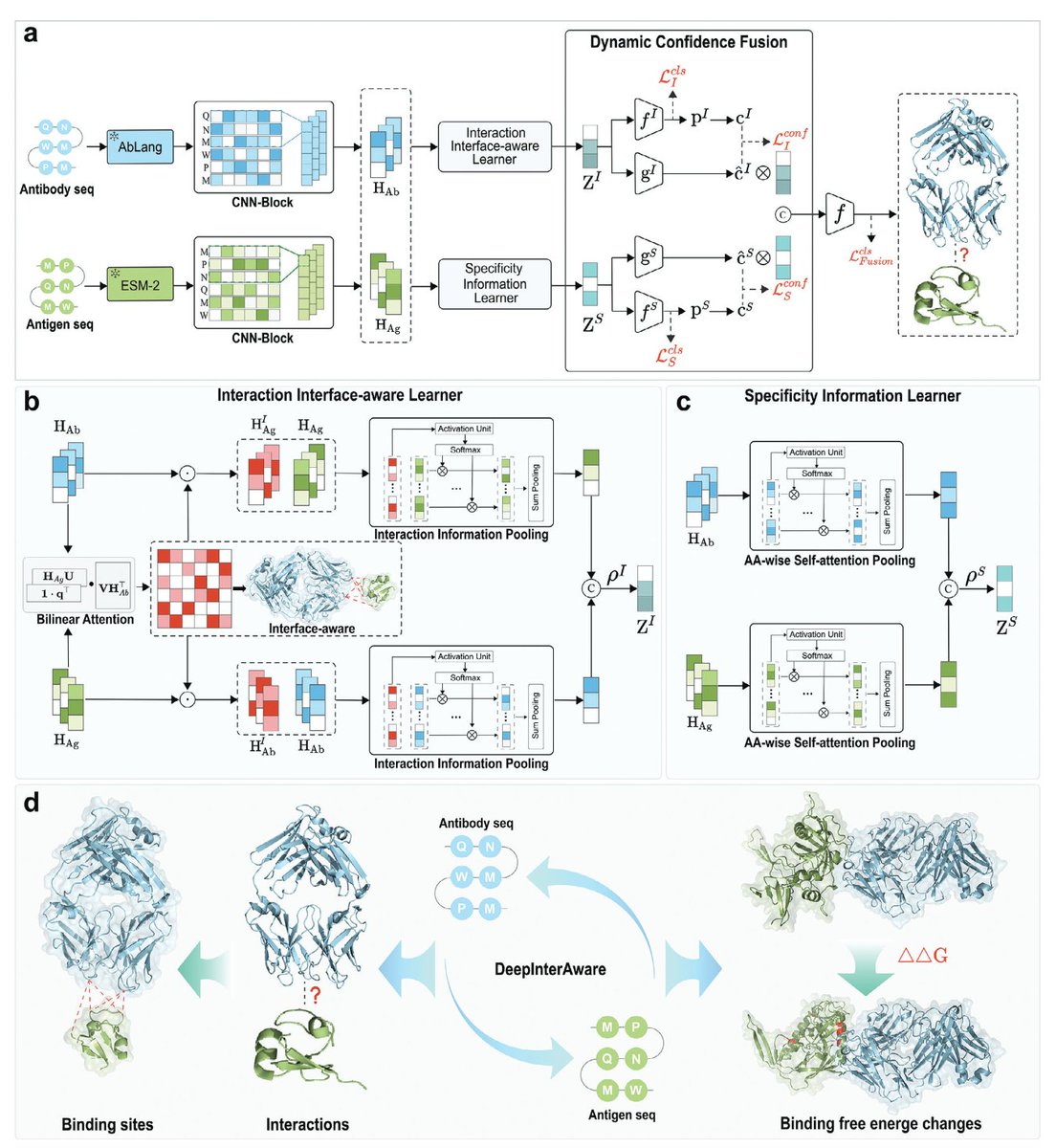
DeepInterAware: Deep Interaction Interface-Aware Network for Improving Antigen-Antibody Interaction Prediction from Sequence Data 1/ DeepInterAware introduces a novel framework that enhances antigen-antibody interaction (AAI) predictions by learning interaction interface information directly from sequence data. This method outperforms existing approaches, offering significant improvements in accuracy and inductive capabilities. 2/ Unlike traditional methods that rely on structural data, DeepInterAware capitalizes on the wealth of available sequence data to identify potential binding sites between antigens and antibodies, offering a deeper understanding of the underlying mechanisms of AAIs. 3/ The model leverages a dual learning approach, combining the Interaction Interface-aware Learner (IIL) and Specificity Information Learner (SIL), which helps capture both the interaction dynamics and the inherent specificity information of the sequences, improving prediction outcomes. 4/ One of the standout features of DeepInterAware is its ability to predict binding free energy changes due to mutations in antigens or antibodies, a crucial task for optimizing therapeutic antibodies and understanding the effects of genetic variations on immune responses. 5/ DeepInterAware also excels in transferability, successfully applying learned knowledge from one dataset (e.g., HIV) to predict interactions with new antigens, such as SARS-CoV-2, demonstrating its potential for broad applicability in real-world scenarios where new pathogens may emerge. 6/ The framework was also applied in the HER2-targeting antibody screening, showing its utility in discovering high-affinity antibodies, which highlights its potential for use in cancer therapies and antibody drug development. 7/ Overall, DeepInterAware represents a powerful tool for advancing therapeutic antibody design and screening, offering predictive insights that can speed up the development of effective immunotherapies. 📜Paper: advanced.onlinelibrary.wiley.com/doi/10.1002/ad… #AntibodyDesign #AIinHealthcare #DrugDiscovery #ComputationalBiology #DeepLearning #MachineLearning #Bioinformatics #AIinMedicine #AntigenAntibodyInteractions #Immunotherapy #TherapeuticAntibodies
Biology+AI Daily tweet media
English
0
11
40
2.9K
Behnam Yousefi ری ٹویٹ کیا
Biology+AI Daily
Biology+AI Daily@BiologyAIDaily·
Rewiring protein sequence and structure generative models to enhance protein stability prediction 1. SPURS is a novel deep learning framework designed to enhance protein stability prediction by integrating sequence-based and structure-based generative models. The framework leverages ProteinMPNN and ESM, combining evolutionary and structural data for more accurate mutation effect predictions. 2. A key innovation of SPURS is its rewiring strategy, which uses a lightweight Adapter module to inject structural priors from ProteinMPNN into the sequence representations generated by ESM. This integration improves the model's ability to predict stability changes due to mutations. 3. SPURS achieves scalability by predicting stability changes (∆∆G) for all possible mutations in a protein in a single forward pass, unlike most existing models that require separate passes for each mutant. This approach dramatically increases efficiency and speed. 4. The model was trained using a large-scale dataset, the Megascale dataset, containing 776k data points, and benchmarked across 12 datasets. SPURS consistently outperformed existing stability prediction methods, demonstrating superior generalization across diverse protein domains. 5. Notably, SPURS excels at identifying stabilizing mutations, a task often difficult for other methods due to the class imbalance in available datasets. Its high accuracy in predicting these mutations makes it highly valuable for protein engineering applications. 6. SPURS also facilitates the identification of functional sites in proteins by combining stability predictions with protein language models, showing its versatility in both stability prediction and functional analysis without needing labeled functional data. 7. The framework's ability to integrate structural data, evolutionary information, and sequence features makes SPURS an effective tool for predicting protein stability changes, aiding protein engineering efforts, and enhancing low-N fitness prediction models for rare mutations. @luoyunan 💻Code: github.com/luo-group/SPURS 📜Paper: biorxiv.org/content/10.110… #ProteinStability #DeepLearning #MachineLearning #Bioinformatics #ProteinEngineering #AIinBiology #StructuralBioinformatics #DrugDiscovery #ComputationalBiology #ProteinDesign
Biology+AI Daily tweet media
English
2
8
69
3.9K
Behnam Yousefi ری ٹویٹ کیا
Andrej Karpathy
Andrej Karpathy@karpathy·
Agency > Intelligence I had this intuitively wrong for decades, I think due to a pervasive cultural veneration of intelligence, various entertainment/media, obsession with IQ etc. Agency is significantly more powerful and significantly more scarce. Are you hiring for agency? Are we educating for agency? Are you acting as if you had 10X agency? Grok explanation is ~close: “Agency, as a personality trait, refers to an individual's capacity to take initiative, make decisions, and exert control over their actions and environment. It’s about being proactive rather than reactive—someone with high agency doesn’t just let life happen to them; they shape it. Think of it as a blend of self-efficacy, determination, and a sense of ownership over one’s path. People with strong agency tend to set goals and pursue them with confidence, even in the face of obstacles. They’re the type to say, “I’ll figure it out,” and then actually do it. On the flip side, someone low in agency might feel more like a passenger in their own life, waiting for external forces—like luck, other people, or circumstances—to dictate what happens next. It’s not quite the same as assertiveness or ambition, though it can overlap. Agency is quieter, more internal—it’s the belief that you *can* act, paired with the will to follow through. Psychologists often tie it to concepts like locus of control: high-agency folks lean toward an internal locus, feeling they steer their fate, while low-agency folks might lean external, seeing life as something that happens *to* them.”
Garry Tan@garrytan

Intelligence is on tap now so agency is even more important

English
2K
9.4K
50.1K
11.2M
Behnam Yousefi
Behnam Yousefi@behnam_bme·
@hajdogin این هوش مصنوعی در سال ۱۳۶۰ منطقی نیست چون اصلا مدلهای تشخیص کلام در سیستم های هوش مصنوعی اون زمان خیلی ابتدایی بود. چنین سیستمی رو اخیرا با حضور RNN ها و Transformer ها میشه پیاده سازی کرد.
فارسی
0
0
1
1.5K
Haj Dogin🚩
Haj Dogin🚩@Hajdogin1·
برق از سرم پرید! در سال ۱۳۶۰ یک جوان ایرانی تمام آپشن‌ها و هوش مصنوعی‌هایی که الانه روی خودرو‌ها نصب شده با یک مغز الکترونیک که تشخیص صدا داشت اختراع کرده بود. واقعا دلم می‌خواد سر بزارم به بیابون نمیدونم چه سرنوشتی بعد از این سر این جوون اومد.
فارسی
342
719
5.3K
307K
Behnam Yousefi ری ٹویٹ کیا
Tim Duignan
Tim Duignan@TimothyDuignan·
Lots of useful and interesting benchmarking of universal force fields in this paper. This fields really picking up now. Good to see all them doing well on silicon now. arxiv.org/abs/2412.10516
Tim Duignan tweet media
English
0
12
72
4K
Behnam Yousefi ری ٹویٹ کیا
Biology+AI Daily
Biology+AI Daily@BiologyAIDaily·
Comparative evaluation of feature reduction methods for drug response prediction @SciReports 1. This study is the first to compare nine feature reduction (FR) methods for drug response prediction (DRP) on cell line and tumor transcriptomes, using over 6,000 machine learning (ML) model runs for robust analysis. 2. A key finding is that Transcription Factor (TF) activities outperform other FR methods on tumor data, distinguishing sensitive from resistant tumors for seven out of 20 drugs tested. 3. The researchers analyzed both knowledge-based methods (e.g., pathway and TF activities) and data-driven approaches (e.g., principal components), providing a broad perspective on FR for DRP. 4. Ridge regression emerged as the most effective ML model across all FR methods, highlighting its ability to handle correlated gene expression data. 5. Cross-validation on cell lines showed that sparse principal components and drug pathway genes performed best, while tumor validation emphasized the robustness of TF activities. 6. The study revealed that effective FR methods often depend on the drug and dataset type, underlining the need for tailored approaches in DRP. 7. TF activities proved to be a compact and interpretable representation of functional cellular states, bridging biological relevance and predictive accuracy in tumor DRP. 8. The findings emphasize the importance of robust FR methods to address the dimensionality challenges in molecular profiling, paving the way for precision medicine. @bennos @janbaumbach @behnam_bme @Faren_FIR 💻Code: github.com/faren-f/FS4DRP… 📜Paper: nature.com/articles/s4159… #DrugResponsePrediction #MachineLearning #FeatureReduction #CancerResearch #PrecisionMedicine
Biology+AI Daily tweet media
English
0
5
6
1.6K
Behnam Yousefi
Behnam Yousefi@behnam_bme·
The preprint of our new work on rapidly progressive glomerulonephritis (RPGN) is available at biorxiv.org/content/10.110… Using spatial transcriptomics analysis, we uncovered how PDGF and TGF-β signaling drive kidney damage in RPGN.
English
0
0
0
48
Behnam Yousefi ری ٹویٹ کیا
Biology+AI Daily
Biology+AI Daily@BiologyAIDaily·
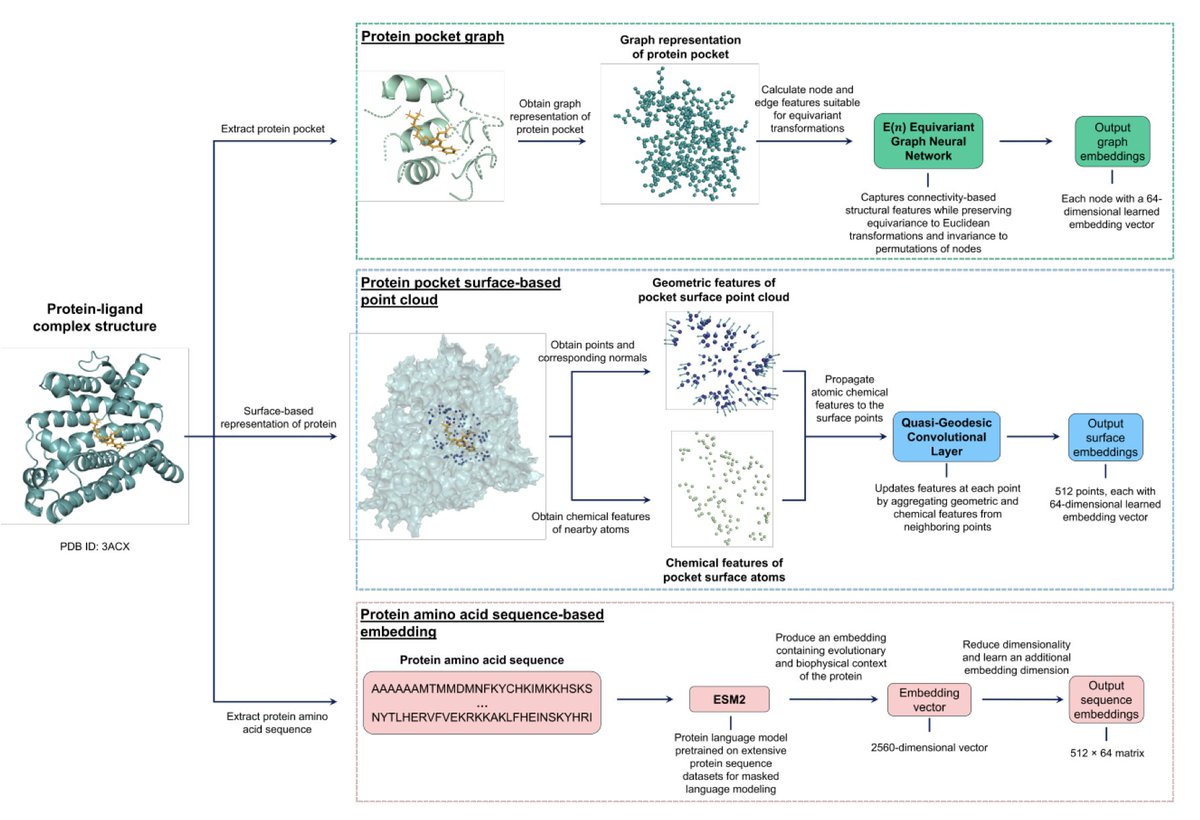
T-ALPHA: A Hierarchical Transformer-Based Deep Neural Network for Protein-Ligand Binding Affinity Prediction With Uncertainty-Aware Self-Learning for Protein-Specific Alignment 1. Introducing T-ALPHA: A state-of-the-art hierarchical transformer designed to predict protein-ligand binding affinities with unprecedented accuracy. It integrates multimodal data and captures complex biochemical interactions for real-world drug discovery. 2. Major innovation: T-ALPHA achieves high performance even with predicted protein structures, eliminating dependency on experimental crystallography and broadening its applicability to challenging datasets. 3. Real-world impact: By focusing on protein-specific alignment using uncertainty-aware self-learning, T-ALPHA enhances target-specific binding predictions without requiring additional experimental data, saving time and resources. 4. Benchmark excellence: T-ALPHA outperforms all reported models on benchmarks like CASF 2016, LP-PDBbind, and newly designed test sets. It excels in ranking compounds for critical targets such as SARS-CoV-2 protease and EGFR. 5. Robust architecture: T-ALPHA processes protein, ligand, and protein-ligand complex data through three distinct channels using advanced techniques like E(n)-equivariant GNNs, quasi-geodesic convolutions, and sequence-based embeddings. 6. Multimodal integration: Leveraging cross-attention in transformers, T-ALPHA synthesizes diverse biochemical and spatial information, offering a unified and hierarchical representation for binding affinity prediction. 7. Scalable and efficient: T-ALPHA's hierarchical design supports distributed training, making it suitable for large datasets. Its self-learning mechanism aligns with proteins dynamically, adapting predictions to specific targets. 8. Future outlook: T-ALPHA sets a foundation for developing universal models for protein-ligand interactions, advancing precision medicine and accelerating drug discovery pipelines. @Gregory_Kyro 💻Code: github.com/gregory-kyro/T… 📜Paper: biorxiv.org/content/10.110… #AI #Bioinformatics #DrugDiscovery #ProteinStructure #TransformerModel
Biology+AI Daily tweet media
English
0
9
47
3.5K