Bitmaker

49 posts

Bitmaker banner
Bitmaker

Bitmaker

@bitmakerfi

Web3 market maker | 6y exp | 50+ CEX/DEX | Exchange setup in 1 day | 24/7 ops, 99%+ uptime

Dubai, Global شامل ہوئے Nisan 2022
3 فالونگ170.6K فالوورز
پن کیا گیا ٹویٹ
Bitmaker
Bitmaker@bitmakerfi·
Answers to key questions about Bitmaker ▪️How fast is integration? Setup is simple. We need only API keys with trading access. Depending on the exchange, integration is usually completed within 24 hours. ▪️How does pricing work? Our model is performance-based. Fees apply only when results are delivered, through PnL sharing, liquidation success fees or fixed pricing. ▪️Is capital secure? Yes. Projects keep full control of their funds. We use API keys with trading rights only, without withdrawal access. ▪️What tools are available? We provide real-time dashboards, balance tracking, weekly reports and access to live trading data. ▪️What makes Bitmaker different? We are fully automated, with no manual trading. Half the team are engineers. Our focus is on building long-term liquidity with measurable results. At Bitmaker, clarity comes first. If you are building or scaling a token market, let’s talk. 📩business@bitmaker.fi
Bitmaker tweet media
English
1
2
6
2.6K
Bitmaker
Bitmaker@bitmakerfi·
Bitmaker co-founder @korrom18 on building trading infrastructure
Roman@korrom18

Not many people know the story behind @origamitech_. This is the first post: where we came from. It all started 7 years ago, when my co-founder and I joined a centralized exchange trading desk. As recent graduates, we somehow ended up working on order book depth, market quality, accounting, and risk control around user actions. It was fun, but not a long chapter. After about a year, we decided to move on. We felt we understood where the edge was, and started running our own algos on centralized venues with our own capital. That was the real beginning of growth. I was writing code, he was helping across both technical work and management. In 2020, during DeFi summer, we became the top retail-volume account on @kucoincom - just two people doing billions in monthly volume on major venues. That same year, we launched @bitmakerfi, a retainer market maker built around one principle: stay small, but compete with anyone. We hired developers and started building out the business. For the first year, most of the engineering work was spent rewriting my original codebase to fit a new architecture. That became the first version of the protocol we internally called Typhoon. It was already better than what most retainer market makers had at the time, but it still wasn’t enough for us. It was too conventional: a handful of strategies, a set number of variables, a defined set of inputs. Strong, but limited. The model we kept coming back to was something closer to the WorldQuant external consultants idea: a unified framework where people can create their own algos, while the platform handles execution, connectivity, and data. In 2022, we redesigned the architecture from scratch and released our own language, which allowed us to build strategies directly from math, market data, and trading indicators. Latency improved, we found more edge, and the client base grew significantly over the following year. That period was productive. We released analytical tools, CEX-DEX systems, and arbitrage systems capable of handling up to 7 legs within one flow. In January 2024, I found @HyperliquidX and started trading there. Not because I particularly wanted futures, but because I liked the idea of a CLOB-based DEX. Soon after, I got in touch with Ruslan from @extendedapp - back when they were still early, still on testnet, and still called X10. I still think the rebrand was a great decision. Around that time, I also got @xulian_hl’s contact and texted him. He replied, and that became a turning point. I started thinking seriously about bringing our technology to users and connecting it to Hyperliquid. At that point there were no builder codes or anything similar, but within a month we had built the first interface. It was glitchy, API-key based, and full of bugs. I wasn’t proud of it, and we never released it publicly. That was around October–November 2024. After a few more months spent refining interfaces and fixing bugs, we finally launched Origami. At the time, I had postponed making perp DEXs the main focus, because the ecosystem still couldn’t support what we really wanted to build. For a while, API keys were the only realistic way to support trading. So we launched first with trading competitions - a format where users come to compete for prize pools funded by crypto projects. A month later, we launched liquidity mining competitions, giving projects a way to incentivize user liquidity provision. Since then, we’ve run more than 90 competitions and distributed over $200k in prize pools. A strong result - but still not the core dream. The bigger vision was always perp DEXs, and giving users the ability to create their own algos through Origami. By October, we had integrated with all existing builder programs. We didn’t build a massive user base there, and we understood the reasons clearly: > onboarding was too complex > UI/UX wasn’t good enough > strategy creation was still too difficult We tried simplifying things into lighter bot versions, but quickly understood that wasn’t our path. We know how to do this better. This huge interface update is the first step. The major things are on the line. If you read it, please leave a comment and thank you. Stay tuned.

English
0
0
1
334
Bitmaker
Bitmaker@bitmakerfi·
Narratives come and go.Liquidity stays. That’s where Bitmaker operates 🌐 bitmaker.fi
English
0
0
1
147
Bitmaker
Bitmaker@bitmakerfi·
✔️Meanwhile Binance controversies continue. DefiLlama briefly removed Binance outflow statistics, triggering FUD about record capital flight. It later turned out to be a data display issue and the metrics were restored. Soon after, reports appeared that investigators who flagged potential Iranian sanctions violations were dismissed. Either ignoring those warnings or acknowledging them creates reputational pressure. Original news: fortune.com/2026/02/13/bin…
English
1
0
1
186
Bitmaker
Bitmaker@bitmakerfi·
Bitmaker Newsletter #1 A few signals shaping the current crypto market structure ↓ ✔️Against the backdrop of Vitalik admitting that Ethereum’s heavy push toward L2-centric scaling may have been a misstep, the narrative battlefield is shifting. LayerZero is quietly positioning itself as a structural competitor to Ethereum’s dominance model. But the bigger signal is different. Even strong headlines fail to sustain momentum. The Uniswap–BlackRock integration pushed UNI up nearly 40%. Within days the entire move was erased. That tells you a lot about current liquidity conditions. Original news: x.com/Uniswap/status…
Bitmaker tweet media
English
4
0
5
521
Bitmaker
Bitmaker@bitmakerfi·
📊According to market research, the global algorithmic trading market is estimated at $3.28B in 2025 and is projected to reach $6.05B by 2032, growing at a 9.1% CAGR. This growth reflects the continued expansion of electronic and automated execution across global markets. > In electronic markets, trading activity is executed automatically through continuous order placement, updates, and matching. This execution model operates at scale and requires stable conditions for price discovery and execution. > At this scale, liquidity is delivered through infrastructure and continuous quoting. Stable order books, predictable spreads, and consistent execution become structural characteristics of the market. > To maintain these conditions, exchanges formalize liquidity provision through market-making programs. Within these programs, market makers act as core liquidity providers under explicit operational constraints: • ~90–95% liquidity uptime • continuous two-sided quoting • spread and depth obligations • risk and inventory limits As algorithmic trading adoption grows, liquidity programs expand across more instruments and venues. This expansion increases demand for professional market making, as automated strategies rely on predictable execution, stable spreads, and consistent order book depth. 🌐 bitmaker.fi
Bitmaker tweet media
English
0
0
2
507
Bitmaker
Bitmaker@bitmakerfi·
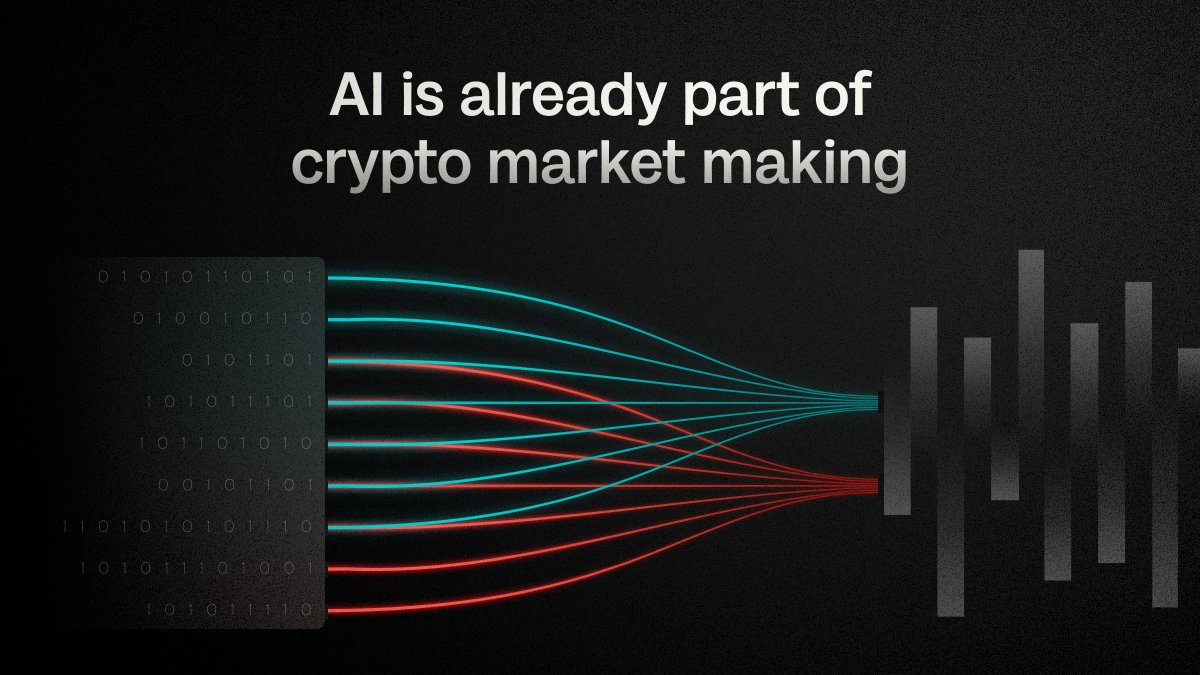
AI is already part of crypto market making. But its role is widely misunderstood. Here is why ▪️To understand it, start with what market making actually is. Market making is continuous liquidity provision under strict constraints: exchange rules, latency, and risk limits. ▪️Within these constraints, AI is used as adaptive models that adjust in real time: • spreads • quote placement • inventory exposure • response to volatility and order flow ▪️AI operates inside deterministic execution logic, tuning parameters rather than making discretionary trading decisions. Every action remains bounded by risk limits and exchange rules. The idea of a fully autonomous AI trader is appealing, but in real markets, sustainability breaks during stress and regime shifts. The edge comes from infrastructure, where AI enables adaptation without breaking risk boundaries. 🌐 bitmaker.fi
Bitmaker tweet media
English
0
0
2
491
Bitmaker
Bitmaker@bitmakerfi·
Why most market making teams cannot maintain 90–95% liquidity uptime Many market makers promise stable liquidity. Only a limited number consistently maintain 90–95% liquidity uptime, which reflects the actual requirements of top tier centralized exchanges. ▪️Liquidity uptime is an engineering outcome. It depends on: • fast execution architecture • fully automated trading • proper rate limit management • reliable risk guards and kill switches • pipelines that operate without errors When market conditions deteriorate, weak systems lose the ability to quote consistently. At Bitmaker, liquidity uptime is the result of technical design. Our systems run in colocated clusters with Rust based runtimes, real time monitoring, and automated safeguards. This approach keeps markets stable around the clock. 🌐 bitmaker.fi
Bitmaker tweet media
English
0
0
2
429
Bitmaker
Bitmaker@bitmakerfi·
Most market makers talk about uptime and rarely clarify what they mean. There are two different metrics. ▪️System uptime Bots, backend, algorithms, monitoring. For any serious market making operation, this should be around 99% or higher. ▪️Liquidity or order book uptime The percentage of time quotes are present in the exchange order book. For top tier centralized exchanges, realistic requirements are 90–95%. Across the broader market, around 70% is common. These metrics are often mixed together, which leads to unrealistic expectations. At Bitmaker, 99% plus system uptime enables 90–95% liquidity uptime, including periods of elevated market volatility. 🌐 bitmaker.fi
Bitmaker tweet media
English
0
1
4
404
Bitmaker
Bitmaker@bitmakerfi·
Thank you for trusting Bitmaker in 2025! We’re ready to scale further in 2026. Happy New Year!✨
Bitmaker tweet media
English
0
0
2
402
Bitmaker
Bitmaker@bitmakerfi·
Between a price update and a new order appearing in the book, the system completes a sequence of coordinated steps. The full cycle takes approximately 150–300 ms. Order flow at Bitmaker: • Market data is received • Strategy logic is evaluated in WASM • Risk guard verifies parameters • Rate limit checks are applied • The router selects the execution path • The order is submitted to the venue • Fill information is reconciled • The dashboard updates in real time This workflow is the basis for stable spreads, predictable execution, and consistent market depth. 🌐 bitmaker.fi
Bitmaker tweet media
English
0
0
2
527
Bitmaker
Bitmaker@bitmakerfi·
Effective market making depends on a reliable technical foundation. It is built on systems that execute consistently, manage risk automatically, and operate close to exchange infrastructure. At Bitmaker, strategies compile into WASM and run inside isolated Rust runtimes located near CEX matching engines. This setup provides: > Millisecond level execution > Independent and isolated strategy state > Integrated risk guards > Automatic kill switch mechanisms > Secure handling of short-lived keys This architecture supports stable uptime, predictable depth, and controlled spreads at scale. 🌐 bitmaker.fi
Bitmaker tweet media
English
0
1
3
491
Bitmaker
Bitmaker@bitmakerfi·
Two MM models dominate crypto: ▪️Loan-Based Model / Retainer + PnL Sharing Model▪️ Loan-based model ➕Pros: • Low upfront cost • No need to allocate your own liquidity ➖Cons: • Your tokens become the MM’s working capital • Activity focuses on short term actions • Price pressure increases • Liquidity becomes artificial • Control over the token weakens Retainer and PnL sharing ➕Pros: • The project keeps custody of tokens • The MM receives trading access only • Liquidity is built for long term stability • Transparent reporting and measurable performance • Aligned incentives through clear PnL structure ➖Cons: • Requires a real budget from the project • Higher expectations for infrastructure and communication 👌Choose a model that protects your token and supports sustainable markets. business@bitmaker.fi
Bitmaker tweet media
English
0
1
2
473
Bitmaker
Bitmaker@bitmakerfi·
Spread and uptime matter, and there is another metric that plays an important role: ➖The market maker’s share of trading volume ➖ Typical values explain the structure of participation: ◾️1–5% market share shows minimal influence on liquidity ◾️Around 20% reflects healthy and sustainable involvement At Bitmaker, market share is one of the metrics we track to maintain consistent participation and balanced order books. Strong markets rely on steady contribution and predictable execution. 🌐 bitmaker.fi
Bitmaker tweet media
English
0
0
2
507