cryptobtc ری ٹویٹ کیا
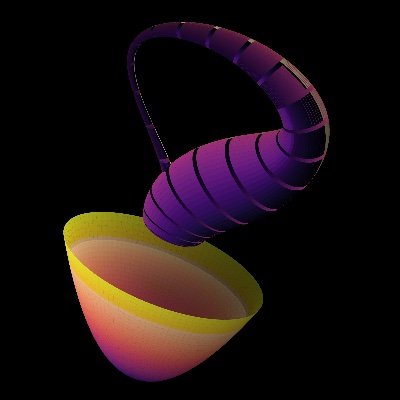
Now that you have a clear idea of what a Hamiltonian System is, we can finally begin Statistical Mechanics.
Lecture 1
Take something as ordinary as a gas in a box. Try to describe it microscopically and the amount of information blows up almost immediately. Every particle has a position and a momentum. In 3D, that gives three numbers for position and three for momentum. So, each particle contributes six numbers. For N particles, the exact state of the whole system is one point in a 6N-dimensional Phase Space.
If we collect all positions into q and all momenta into p, then the full microscopic state is written as
(q,p)
This is one point in that enormous Phase Space.
For any realistic system, 6N is so large that following this exact point directly is hopeless. The system is still in one precise microstate, but that description is too detailed to be useful. So Statistical Mechanics changes what we track. Instead of one exact microstate, we work with a density over possible microstates:
ρ(q,p,t)
What does that mean?
It does not mean the system is physically spread out across Phase Space. The system is still in one actual microstate. The density tells us how our description is distributed over the microstates consistent with what we know.
Therefore, the first move in Statistical Mechanics is this:
We replace one exact but inaccessible trajectory by a density on Phase Space.
Now, if the microscopic state moves in time, how should this density move?
To answer that, go back to Mechanics. Suppose the system is Hamiltonian, with Hamiltonian
H(q,p)
Then the equations of motion are
dqᵢ/dt = ∂H/∂pᵢ
dpᵢ/dt = -∂H/∂qᵢ
These equations move one exact point in Phase Space. So, if our state is now a density over many possible points, that density must move with the same flow.
The Math Breakdown
We describe the microscopic state by canonical coordinates
(q,p) = (q₁, …, qₙ, p₁, …, pₙ)
and our uncertainty by a Phase-Space density
ρ(q,p,t)
normalized so that
∫ ρ(q,p,t) dq dp = 1
This says the system must be somewhere in Phase Space.
Now, ask the central question. If points in Phase Space move by Hamilton’s equations, what equation must ρ satisfy?
The basic idea is conservation. Probability should not be created or destroyed as it moves through Phase Space. Therefore, ρ satisfies a continuity equation.
Take a tiny region in Phase Space. The amount of probability inside it can only change if probability flows in or out.
The Phase-Space velocity field is
v = (q̇,ṗ)
with
q̇ᵢ = ∂H/∂pᵢ
ṗᵢ = -∂H/∂qᵢ
Thus, the continuity equation is
∂ρ/∂t + ∇·(ρv) = 0
Write that out:
∂ρ/∂t + Σᵢ ∂/∂qᵢ (ρ q̇ᵢ) + Σᵢ ∂/∂pᵢ (ρ ṗᵢ) = 0
Expand with the product rule:
∂ρ/∂t + Σᵢ q̇ᵢ ∂ρ/∂qᵢ + Σᵢ ṗᵢ ∂ρ/∂pᵢ + ρ Σᵢ ( ∂q̇ᵢ/∂qᵢ + ∂ṗᵢ/∂pᵢ ) = 0
Now, use Hamilton’s equations again:
∂q̇ᵢ/∂qᵢ = ∂²H/(∂qᵢ ∂pᵢ)
∂ṗᵢ/∂pᵢ = -∂²H/(∂pᵢ ∂qᵢ)
These cancel, so
Σᵢ ( ∂q̇ᵢ/∂qᵢ + ∂ṗᵢ/∂pᵢ ) = 0
That is, Hamiltonian flow is divergence-free in Phase Space, and the continuity equation becomes
∂ρ/∂t + Σᵢ q̇ᵢ ∂ρ/∂qᵢ + Σᵢ ṗᵢ ∂ρ/∂pᵢ = 0
This is the so-called Liouville’s Equation.
In plain language it means that the density ρ is not created or destroyed. It is carried along by the microscopic dynamics. The flow can stretch it, bend it, and fold it into complicated shapes, but it does not compress or dilute Phase-Space volume in the Hamiltonian sense.
Thats why people often say Phase-Space probability behaves like an incompressible fluid.
Equivalently, we note that along a trajectory generated by Hamilton’s equations,
dρ/dt = 0
So if you move with the flow, the density attached to that moving Phase-Space element stays constant.
Therefore, the real foundation of Lecture 1 is this:
Before Equilibrium, before Temperature, before Entropy, Statistical Mechanics first tells you how uncertainty itself is transported by Mechanics.
English